BIO 152 Module 1 Section 5
 Call Kai
 Learn
Learn Practice Test
 Spaced Repetition
 Match
Match Flashcards
 Knowt Play
1/39

There's no tags or description
Looks like no tags are added yet.
Name | Mastery | Learn | Test | Matching | Spaced | Call with Kai | Chat |
|---|
No analytics yet
Send a link to your students to track their progress
40 Terms
Eukaryotic cell
A cell with a membrane-bound nucleus andd other membrane-bond compartments
Organelle
A specialized cellular structure that performes a particular function
Cytoplasm
The contents inside the plasma membrane but outside the nucleus including cytosol and organelles
Cytosol
The fluid portion of the cytoplasm
Cytoskeleton
A network of protein filaments that supports cell structure and helps organize and move cellular components
Endomembrane system
A group of membranes and compartments that work together to make, modify, sort, and transport proteins and lipids
Vesicle
A small membrane-bound compoartent used for transport or storage
Endocytosis
Uptake of material when the plasmamembrane folds inward and forms a vesicle
Exocytosis
Release of material when an internal vesicle fuses with the plasma membrane
Genome
The complete collection of an organism’s genetic material
Nucleus
Houses most of the cell’s dna; site of transcription
Large compartment with a double membrane
Nuclear envelope
Separates the nucleus from the cytoplasm; pores regulate exchange
two membranes surrounding the nucleus
Nucleolus
Produces rRNA and assembles ribosomal subunits
Dense region inside nucleus
Ribosomes
Build proteins by translating mRNA
Tiny dots, free in teh cytosol and attached to rough ER
Rough ER, Endoplasmic Reticulum
Helps produce, fold, and process proteins entering the secetory pathway
Membrane network covered with ribosomes
Smooth ER
Lipid synthesis; also detoxification and calcium storage in appropriate cells
Membrane network without ribosomes
Golgi apparatus
Modifies, sorts, and packages proteins and lipids
Stack of flattened membrane sacs
Lysosome
Digests and recycles macromolecules and cellular material
Small membrane-bound comportment
Peroxisome
Performs oxidation reactions including some fatty acid breakdown
Small membrane bound compartment
Mitochondrion
Produces much of a cell’s ATP through Cellular respiration
Double membrane with a highly folded inner membrane
Chloroplast
Photosynthesis in photosynthetic plant cells
Double membrane with internal stacks of membrane discs
Central vacuole
Storage breakdown of materials and support through turgor pressure
Large compartment occupying much of a plant cell
Plasma membrane
Selectively regulated movement between cell and surroundings
Thin boundary around the cell
Cell Wall
Support and resistance to excessive swelling
Rigid layer outside the plant plasma membrane
Plasmodesmata
Chanells connecting plant cells, Connections passing through cell walls
Differences between plant and animal cells
Animal cells have no cell wall, hcloroplast, large central vacuole, or plasmaodesmata
The endomembrane system
conecects the production, processing, and delivery of cellular materials
Main components: Nuclear envelope, ER’s, Golgi apparatus, Transport vesicles, Endosomes and lysosomes, Vacuoles, and plasma membrane
Route for protein from production to secretion
Nucleus to nuclear pore to ribosome to rough ER, to Transport vesicle, to golgi apparatus, to secetory vesicle, to exocytocies
Endocytosis
Folds inward and pinces off. Brings extracellular material into a vesicle
Exocytosis
Fuses with an internal vesicle
Releases cargo outside and adds vesicle membrane to plasma membrane
Three types of cytoskeleton
Microfilaments
Microtubiles
Intermideate filaments
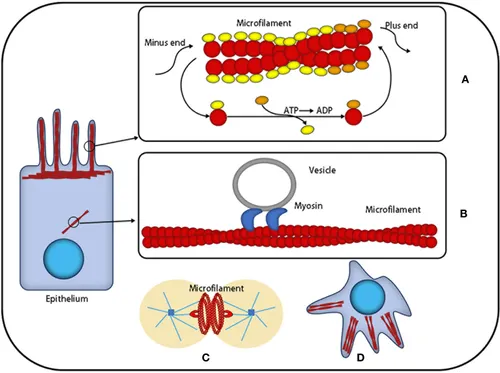
Microfilaments
Made of actin they are thin filiments composed of two strands intertwined, they support cell shape, help change cell shape, and assist endo/excoytocis
Microtubules
Made of tublin they are hollow cylinders.
They are tracks for transport, chromosome movement, and are support in cilian and flagella
Intermediate Filaments
Made from various proteins
Tough rope like fibers
Their main function is mechanical strenght, stabilize cell structure, and help anchor organells
G actin
Individual globular actin subunits
F actin
Filiments assembles from those subunits
Motor protein associate with actin
myosin
Microtubule motor protein
Kinesin and dynein
How do the endomembrane system and cytoskeleton work together to secrete proteins?
The rough ER and Golgi process and package proteins into vesicles. Motor proteins move vesicles along microtubules, while actin helps with events near the cell surface. Vesicles fuse with the plasma membrane, releasing proteins by exocytosis.
Why have membrane bound compartments useful
to maintain different ph vals, ion concentrations, conentrate enzyems and their substrates, seperate processes that would interfere with each other, isolate potentially damaging reactinons, maintian gradients