Lab Animal Health Exam 2
 Call Kai
 Learn
Learn Practice Test
 Spaced Repetition
 Match
Match Flashcards
 Knowt Play
1/107

There's no tags or description
Looks like no tags are added yet.
Name | Mastery | Learn | Test | Matching | Spaced | Call with Kai | Chat |
|---|
No analytics yet
Send a link to your students to track their progress
108 Terms
Which animal source provides animals with a verifiable health status from birth?
Class A
Class B dealers
-Purchase and may condition random-source animals for resale
• Incomplete health status; verifiable only since the time the animal was acquired
• Possible unwanted research variable
Wild Caught
• Unknown health status which is not verifiable
• Quarantined for assessment prior to sale
• $$$ - very expensive!
• Wildlife laws and regulations apply
Bred at the research institution
• Provides availability of strains not commercially available
• Health status is verifiable from birth
• Cost-effective option
• Stress of transport to the facility is eliminated because they are bred on-site
Conventional Microbiological status
animals that carry an unknown and uncontrolled variety and number of organisms
Axenic Microbiological status
germ free; absolutely no detectable bacteria, viruses, or other microorganisms
Gnotobiotic Microbiological status
define flora; very small numbers of KNOWN microorganisms are present
SPF Microbiological status
only specific microorganisms are absent
Why is the health status of the animal at the time of purchase important?
You minimize the introduction of unknown or unwanted variables when you know the health status at the time of purchase.
An animal with an unknown, uncontrolled variety and number of microorganisms is called:
conventional
Axenic is a term for an animal which has a microbiological status which is:
germ-free
What does 'SPF' stand for?
specific pathogen free
Which of the following outlines the regulations for transport of animals used in research?
AWA (Animal welfare act)
Which of the following is NOT required to be written on the cage card for the animal?
age and weight
What is the purpose of quarantine?
apply permanent ID (if applicable), acclimation period, and verify the health status
Quarantine rooms should be maintained under which of the following conditions?
Negative pressure, biocontainment barriers
What is the acclimation period?
stress recovery and adjustment to husbandry and environment
During which of the following periods will conditioning occur?
quarantine
The typical quarantine period for the average healthy animal is:
72 hrs
The IP route means that you are injecting in which of the following locations?
intraperitoneal
T/F: All animals must enter quarantine upon arrival to a new facility or before moving to a new study at the same facility.
True
AWR
specifies characteristics of shipping containers, temperature ranges, ventilation, and space
Before bringing any containers into the facility, ________________ of all containers according to receiving SOPs
disinfect the outside
Enteral (orally or rectally)
via the GI tract
Parenteral
via other routes that are NOT the GI tract!
(IV, IP, IM, SQ, IC, ID, Epidural, Inhalation, Topical)
Which of the following signs would indicate that barbering of mice is occurring?
alopecia with healthy skin
Porphyrin staining is an indication of which of the following in rodents?
stress, disease, or injury
The direct sentinel program places sentinel animals in which location?
A shared microenvironment with each individual animal on the study.
An acceptable method of euthanasia is one in which:
The method consistently causes rapid death.
Hypoxia causes euthanasia by which of the following methods?
Inadequate supply of oxygen to tissues and cells.
Hypoxia is NOT an appropriate method of euthanasia for which of the following?
Reptiles
Amphibians
Diving ducks and diving mammals.
Which of the following methods of euthanasia would be BEST for a group of animals?
gaseous agents
Adjunctive methods are those which can only be used when:
Animals are unconscious, anesthetized, or insentient.
Which route is considered adjunctive for administration of chemical agents for euthanasia?
IC
Sodium pentobarbital is the most common agent for which category of euthanasia?
chemical agents
What is MS - 222?
A topical chemical agent used for euthanasia.
MS - 222 is commonly used for euthanasia in which species?
amphibians and fish
Which of the following compressed gases is most commonly used for euthanasia?
carbon dioxide
Adjunctive agents are most commonly used for which of the following purposes?
To confirm death in animals which are difficult to assess.
What is a sentinel?
Animals used to detect foreign agents in animals on a study.
T/F: Isolation is for animals that become sick while on a study.
True
T/F: It is less stressful to euthanize animals in a foreign cage that is unknown to them.
False
T/F: Filling the chamber with the gaseous agent before introducing the animal reduces stress.
False
T/F: The euthanasia procedure is NOT complete until you have verified death.
True
Barbering in mice is a sign of what?
dominance
Malocclusion signs in lab animals
smaller than cage/litter mates; underweight; lethargic; abnormally shaped nose/face; hunched posture; abnormal gait
degloving injuries and loss of the tail tip is a sign of what?
improper handling
Direct sentinel program
placed into the same microenvironment as members of the colony
Indirect sentinel program
placed into a separate yet identical microenvironment designed to simulate the exact conditions of the colony's microenvironment
Euthanasia methods result in death via one of these three ways:
• Loss of brain function that sustains basic life processes
• Hypoxia, which is the inadequate supply of oxygen to cells and tissues of the body
• Physical disruption and destruction of brain activity
the most frequently used chemical injectable agent for euthanasia are???
barbiturates
What is the most common barbiturate agent used for euthanasia?
Sodium pentobarbital
Animals must remain submerged in the bath containing MS-222 for __________________ opercular movement stops
10 min AFTER
Clove oil in fish is acceptable???
NO
Gaseous agents that are inhaled are considered _____________________ as a method of euthanasia for small mammals that weigh less than 7 kgs.
acceptable with conditions
Cervical dislocation is only appropriate for the following species when specific conditions are met:
• Mice and rats weighing less than 200 grams
• Rabbits
• Poultry
• Small birds
Decapitation may only be used in _____________________ animals with justification and approval from IACUC!
unanesthetized
What is the purpose of performing a dilution?
Measure, administer, and absorb correctly for the patient.
How do you convert Fahrenheit to Celsius?
(F-32)/1.8 = Celsius
How should you move the decimal to convert liters to milliliters?
3 places to the right
Unwanted variables are problematic if they occur during the study because:
Data analysis may be compromised and results altered.
During which step in experimental design will you state your hypothesis?
Step 2: Design the experiment.
Your study is not complete until you perform which of the following?
report your findings
t/F: Changes or differences in husbandry or macroenvironment for animals in the same study can introduce unwanted variables.
true
What is favoritism?
Bias in a study caused by handling and interacting differently with animals on the same study.
If you have a rat weighing 550 grams, how many kilograms does this same rat weigh?
550/1000= 0.55kg
How do you convert Celsius to Fahrenheit?
(C x 1.8) + 32
To determine the volume (mls) of sterile water or saline needed, you need to........
subtract
22 mls new stock solution - 1 ml (xylazine) =
21 mls of sterile water/saline required to dilute
What is the scientific name for the laboratory rat?
Rattus norvegicus
Which rat stock is known as the 'hooded rat'?
Long-Evans
The front teeth of rats grow continuously throughout their lives and are called:
incisors
Rat pups are weaned at how many days of age?
20-21
What is NOT usually considered a sign of illness or distress in a rat?
sleeping during the day
Which of the following methods of euthanasia would not be acceptable in an adult rat weighing over 200 grams?
cervical dislocation
Which two mating systems are commonly used in rats?
Monogamous, polygamous
Ring tail is a condition of rats that can occur when the humidity is:
less than 20%
What is the scientific name for the Syrian hamster?
Mesocricetus auratus
What wood is toxic to rats?
cedar and pine
What is NOT an appropriate method for handling hamsters?
picking them up by the tail
Which antibiotic should never be used in hamsters?
penicillin
What is a characteristic of hamsters?
They hibernate when the temperature drops.
What is an anatomical feature of hamsters?
Expandable cheek pouches
Rat diets
20-25% protein and 4% fat
Rat water intake
15 ml water/100g BW per day
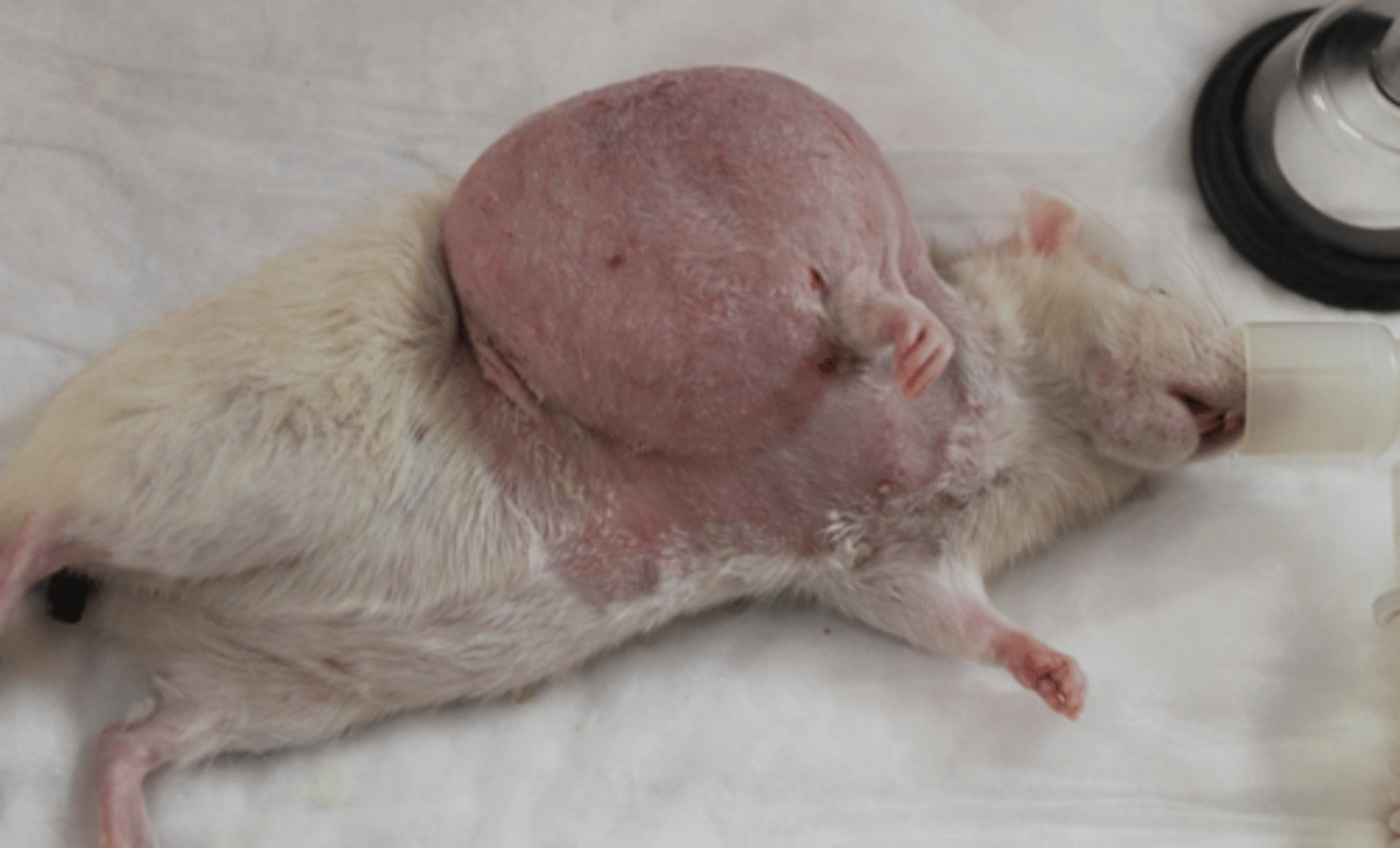
mammary fibroadenoma
common subcutaneous tumor of rats; not cancerous and does not spread; can be on back or flank away from nipples in either sex; surgical removal is usually curative
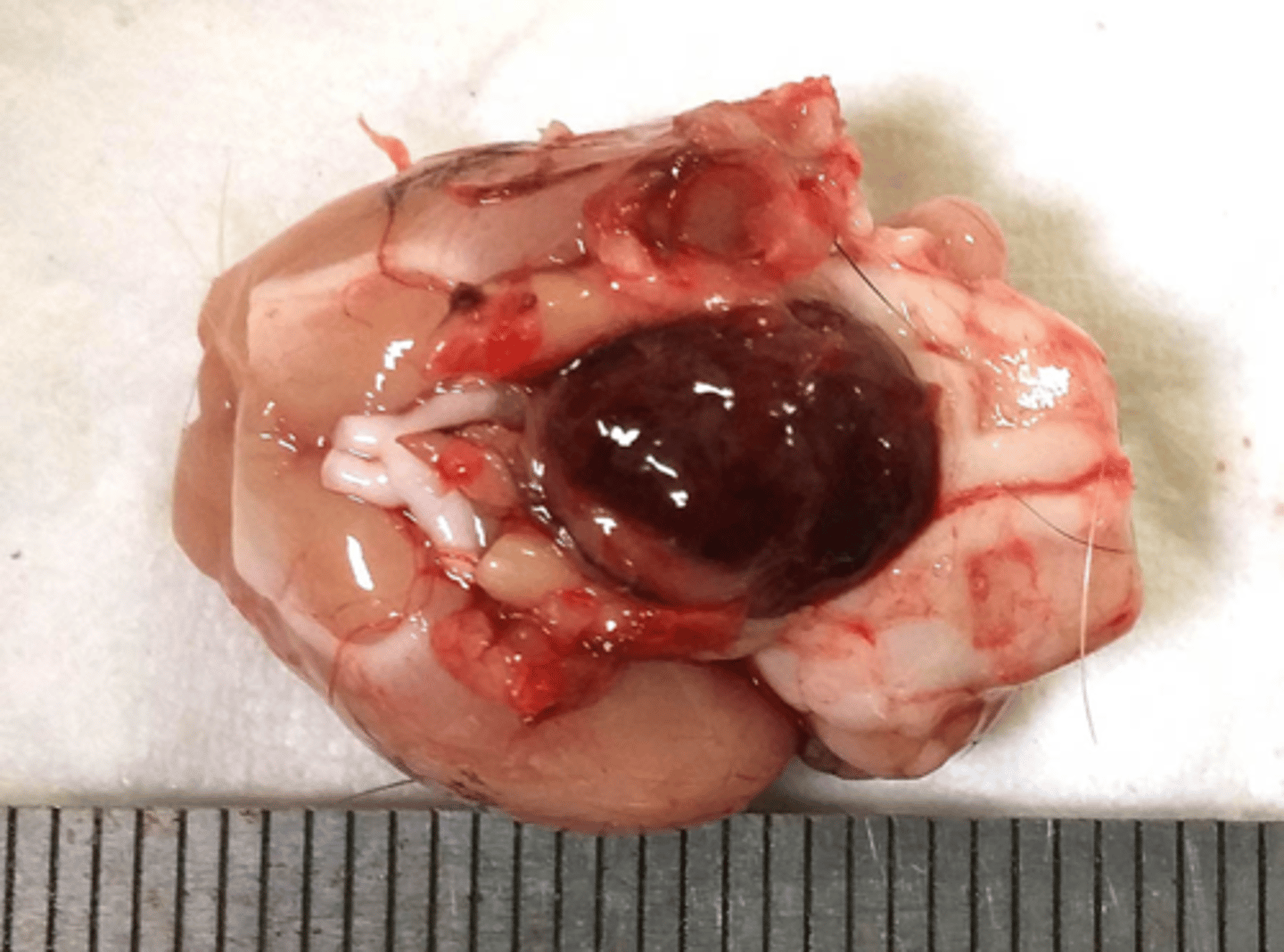
Pituitary chromophobe adenoma
An extremely common tumor of rats that is more common in female rats; benign and slow growing; factors include age, genetic factors, diet, breeding history, infections, injury
Acariasis
-Transmitted by direct contact with an infested animal or the environment of that animal
- Mites commonly found on dorsum of affected animals
- Clinical signs may range from asymptomatic to mild alopecia to severe pruritus and ulcerative dermatitis
What are hamsters used for in research?
diabetes research, cancer research and genetic studies, and dental research
What anatomy do hamsters lack?
lymphatic vessels
Do hamsters vomit?
NO
What are the 4 different mating systems in hamsters?
Hand, Harem, Intermittent, Monogamous pair mating
What zoonotic virus do hamsters carry?
Lymphocytic choriomeningitis virus (LCM)
(Presents as flu-like symptoms but may develop into meningitis)
What parasite is spread through hamster urine?
Leptospira spp.
What are genes made from?
DNA
What is the term for a fertilized ovum?
zygote
Which of the following cells do NOT have paired chromosomes?
ovocytes
How long after mating can mucous plugs remain in the rodent's vagina?
24 hrs
What is the scientific name for the common laboratory mouse?
Mus musculus
What is the term used when a mouse chews the hair off its cage mates?
barbering