Unit 2: Tissues
 Call Kai
 Learn
Learn Practice Test
 Spaced Repetition
 Match
Match Flashcards
 Knowt Play
1/32

There's no tags or description
Looks like no tags are added yet.
Name | Mastery | Learn | Test | Matching | Spaced | Call with Kai | Chat |
|---|
No analytics yet
Send a link to your students to track their progress
33 Terms
What is a tissue?
A group or mass of similar cells working together to perform common functions
What are the four major types of tissues?
Epithelial
Connective
Muscle
Nervous
Epithelial Tissue
Covers all body surfaces both inside and out
Main glandular tissue
Attached to underlying connective tissue at the basement membrane
Usually has no vascular tissue - no blood supply
Cells reproduce rapidly, resulting in rapid healing and scarring'
Cells tightly pack together
Function
Protection, secretion, absorption, excretion, senses
Simple Squamos
Form
Flat and thin, single layer
Function
Secretion, diffusion, and filtration
Location
Found in air sacs of the lungs, and in capillaries

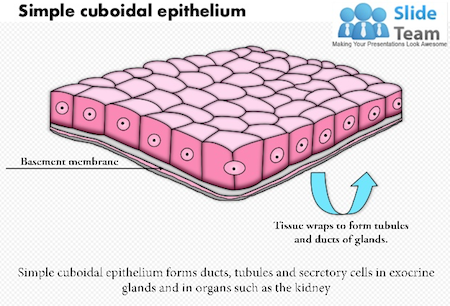
Simple Cuboidal
Form
Single-layer, cube-shaped cells
Function
Secretion and absorption
Location
Lining of kidney tubules, covering the surface of ovaries
Simple Columnar
Form
Single Layer, long cells
Function
Secretion and absorption
Location
Digestive tract and uterus

Stratified Squamos
Form
Flat and thin, multiple layers
Function
Protection
Location
Around body cavities, skin, and mouth

Stratified Cuboidal
Form
Multiple layers, cube-shaped cells
Function
Provides protection and aids secretion
Location
Glandular regions and male urethra

Stratified Columnar
Form
Multiple layers, long cells
Function
Protection and secretion
Location
Eye, male urethra, anus, pharynx

Pseudostratified Columnar
Form
Single layer with nuclei at various levels giving the appearance of layered cells
Can have cilia and goblet cells
Function
Secretion, and cilia-aided movement
Location
Lining air passages like the trachea, tubes of the reproductive system

Transitional Epithelium
Form
Thick, layered cuboidal cells (stretchable)
Function
Forms a barrier to block diffusion
Location
Urinary bladder

Glandular Epithelium
Cells specialized to secrete substances. They make up the body’s glands
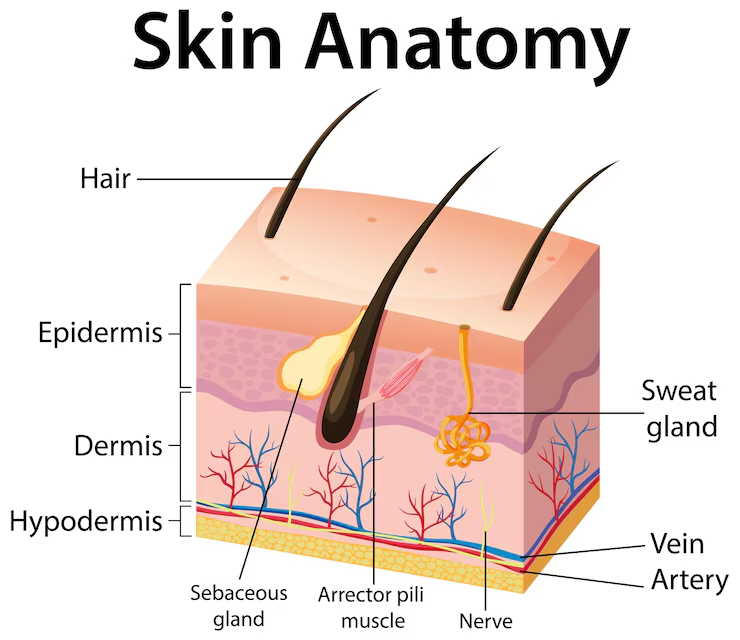
Epidermis
The thin, outermost layer of the skin that you can see and touch

Basement Membrane
a thin, dense sheet of specialized extracellular matrix that separates cell layers like epithelium and endothelium from underlying connective tissue

Melanocytes
specialized cells in the outer layer of your skin, hair, and eyes that make melanin
Dermis
thick middle layer of skin located directly beneath the epidermis and above the subcutaneous hypodermis layer
Connective Tissue
Most abundant tissue in your body
Provides support, protection, framework, fill space
Stores fat, produces blood cells, and fights infection
Composed of scattered cells within a matrix
Made up of ground substance and fibers
Most have a good blood supply

Three common types of connective tissue
Mast Cells
Macrophages
Fibroblasts
Collagenous Fibers
Traits
Strong, flexible, not very elastic
Location
Bones, ligaments, tendons
Elastic Fibers
Traits
Not as strong, but very elastic
Location
Ears, and vocal cords
Loose C. T. or Areolar Tissue
Binds skin to underlying organs and organs to organs
Forms thin membranes throughout the body
Adipose Tissue
Fat beneath the skin
protective cushion, insulation to preserve body head
stores energy
Fibrous Connective Tissue
Thick collagenous fibers and elastic fibers.
Few cells, poor blood supply, slow healing
Tendons = Muscles to Bone
Ligaments = bone to Bone
Cartilage
Chondrocytes
Hyaline Cartilage: Covers ends of joints
Elastic Cartilage: External ear and larynx
Fibrocartilage: Between vertebrae
Bone Tissue
Osseous tissue. Rigid due to mineral salts
Blood Tissue
Circulates throughout the body
Muscle Tissue
Skeletal: Voluntary (Striated)
Smooth: In hollow organs
Stomach: Involuntary
Cardiac: Wall of the heart
Nervous Tissue
Found in brain, spinal cord, and nerves
Neurons
Transmit signals
Neuroglia
Protect and support neurons
Mast Cells
Prevent Clots
Macrophages
White blood cells that consume pathogens, foreign substances, and cellular debris
Fibroplasts
Produce Fibers