Econ 402 Chapter 6
 Call Kai
 Learn
Learn Practice Test
 Spaced Repetition
 Match
Match Flashcards
 Knowt Play
1/11

Earn XP
Name | Mastery | Learn | Test | Matching | Spaced | Call with Kai | Chat |
|---|
No analytics yet
Send a link to your students to track their progress
12 Terms
price ceiling (price cap)
-gov regulation making it illegal to charge a price higher than a certain level
-below equilibrium (efficient) (above would be inefficient as does not change consumer choices)
-ceiling → shortage (+ inc search activity)
Search activity: time spent looking for someone to do business with
-inc search activity = inc opportunity cost
-adding in search activity opportunity cost can make the full cost of housing higher than the price ceiling
illicit market (parallel/black market)
-encouraged by price ceiling
-often overcharged for small g/s
-level of illicit market is in relation to how enforced the price ceiling is
price ceiling graph sections
-b/c Q supplied < efficient Q → deadweight loss (grey triangle)
-producer surplus shrinks to blue triangle
-consumer surplus shrink to green triangle
-potential loss from inc search activity/opportunity cost is red rectangle (full loss of price ceiling = sum of deadweight + inc cost of search)
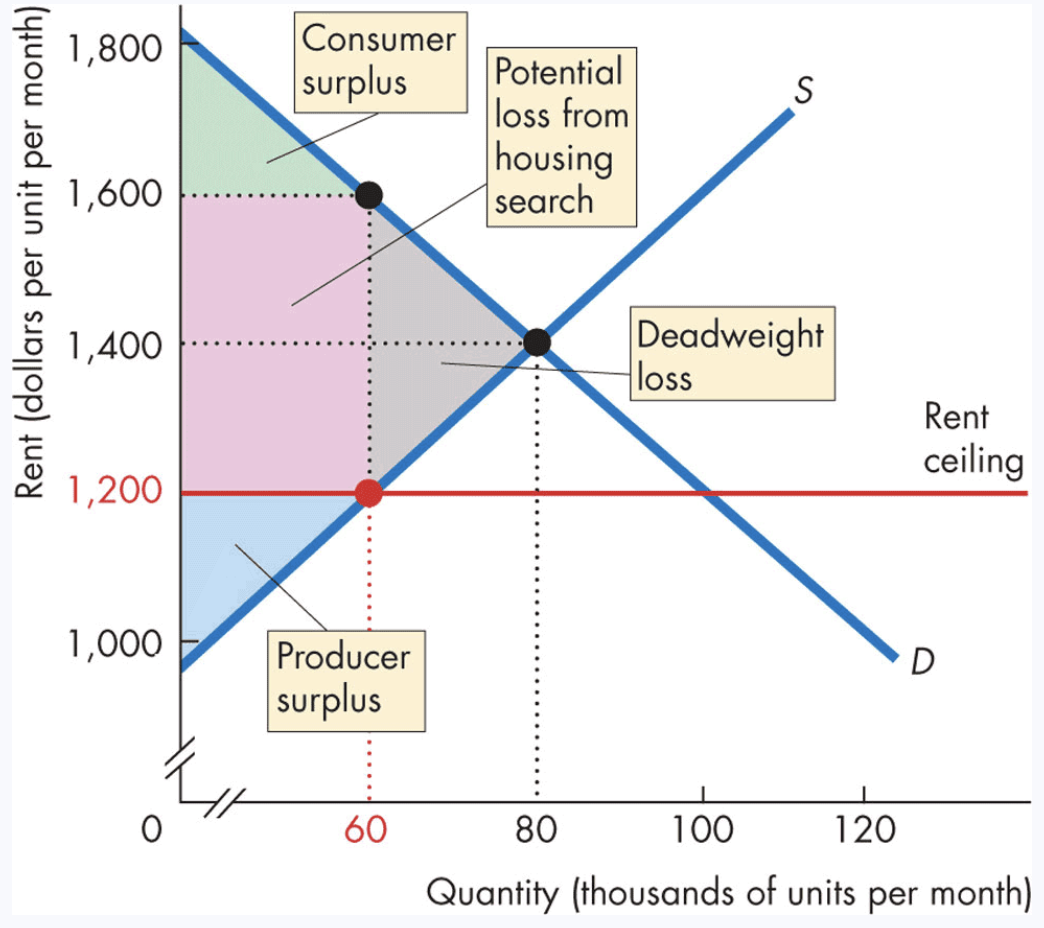
price ceiling effects
-price ceiling → shortage
Not fair:
-blocks volentary exchange
-might raise cost of housing more than price ceiling
Fair:
-benefits the less well off
price floor
-gov regulation making it illegal to charge lower than a certain price
-below equilibrium = ineffective, above = effective
-unregulated market lets laborers find jobs where they are most highly valued (efficient)
Minimum wage:
-surplus of labor (excess demand)
-demand curve= MSB from labor (value of g/s produced)
-MSB of labor > MSC → deadweight loss shrinks firms/workers surplus
--b/c Q of labor is leff efficient Q → deadweight loss
-firm/worker surplus shrink
-potential loss from inc job search is red rectangle
-full loss = deadweight + inc se
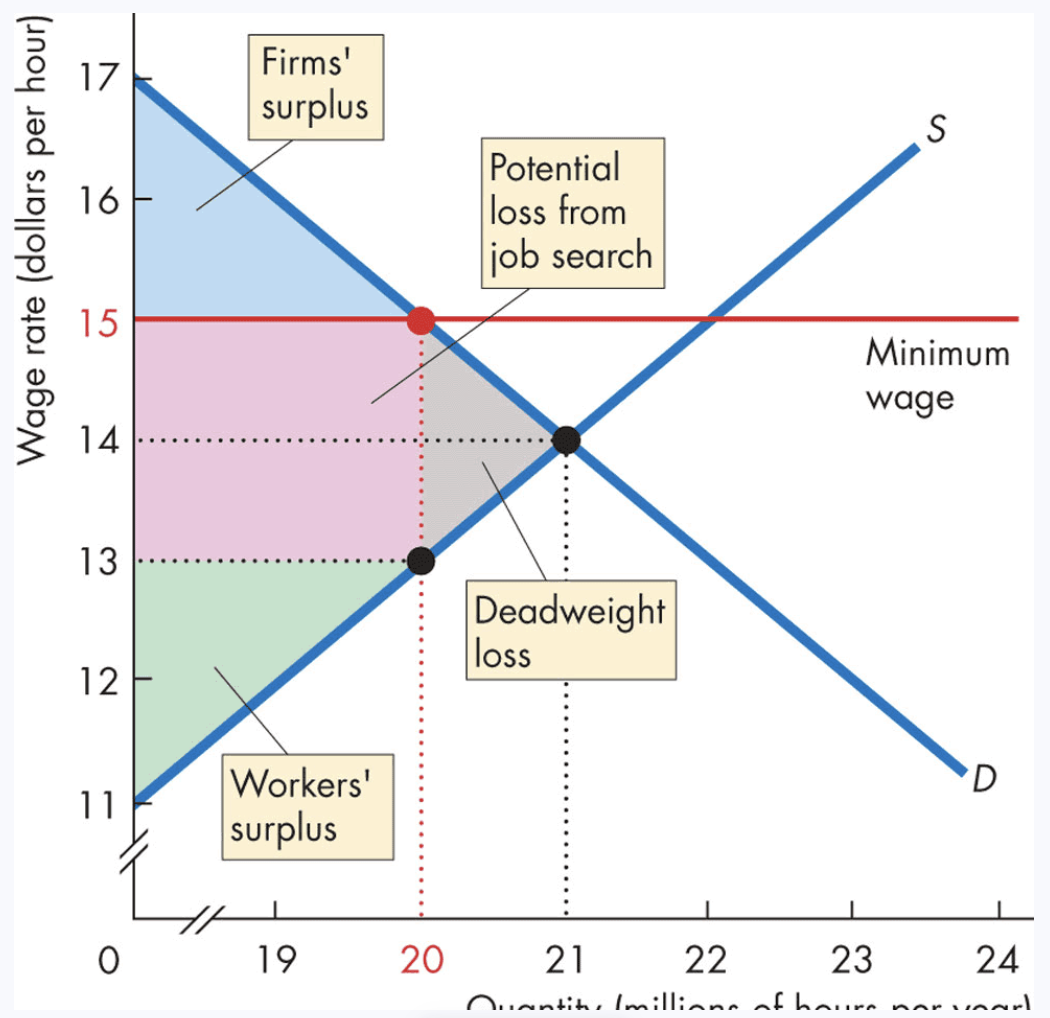
Taxes
tax incidence- division of burden of tax
-price payed rises by amount of tax → burden fully on buyer (D is perfectly inelastic or S is perfectly elastic)
-price payed rises by less than amount of tax → burden part on buyer and seller (Depends on elasticisty of s/d )
-price payed no change → burden fully on seller (D is perfectly elastic or S is perfectly inelastic)
tax on seller
-dec supply (add tax to min price seller willing to accept)
-EQ at new S and D curve
-amount paid by whom is D= difference in y axis, S= difference in x axis
tax on buyers
-dec D (subtract tax from D curve)
-EQ at new D and S curve
tax and efficiency
-tax makes MSB > MSC, shrink PS and CS and makes deadweight loss, tax rev as rectangle
-more steep a curve is, more tax payed
fairness of taxess
benefits principle
-ppl pay taxes equal to the benefit they recieved from services provided from gov
-those who benefit pay
-high fuel tax, alc tax
ability to pay principle
-pay taxes according to how much of the tax burden you cna handle
-tax rich more
quota
quota- produce up to this amount
-verticle line
-left EQ → no change
Right EQ:
-dec supply to quote ( new price is at quota line and to demand curve, supply is at supply curve)
-dec marginal cost (supply curve) b/c producing less and stop using resourced with highest marginal cost
-MSB = price (d curve) has inc. → MSB > MSC → deadweight loss
-get larger profit form producing one more unit (price exceeds marginal cost) _> incentive to cheat → inefficient quota (must make monitoring system)
subsidies
-payment from gov to producer
Effects:
-inc supply (like neg tax) (new S is S - subsidy amount)
-lowers price and inc QS (Proce by buyers in new S line, proce recived is old S line above new pt)
-inc marginal cost b/c producing more means using resourced not ideal (allocated effieinctly) to produce (MSC = price recieved by sellers)
-amount payed by gov = amount of subsidy mult by QS after inc production
-MS= market price which dec. MSC has inc. MSC>MSB → overproduction → ineffiecnt
illegal markets
-drug markets
-when g/s is illegal → cost of trading it inc (by how much depends on who bears the penalties) (larger penalties + more policing = higher cost)
penalty for sellers
-dec S by amount of penalty (add CBL to S)
penalty for buyers
-dec D by amount of penalty (demand - CBL)
penalty for sellers and buyers
-both S and D dec due to cost of breaking the law (CBL)
-heaver CBL for sellers → price rise above EQ
-heaver CBL for buyers → price below EQ
with enough penalty and policing → dec demand/supply to bring Q bought to zero
-in reality not possible b/c not enough policing resources and cost
-alternative is to heavily tax the drugs
taxing drigs
-high axes lead to tax evaders
-adds to CBL for breaking tax law