NEURO2020 WEEK 10
 Call Kai
 Learn
Learn Practice Test
 Spaced Repetition
 Match
Match Flashcards
 Knowt Play
1/29

There's no tags or description
Looks like no tags are added yet.
Name | Mastery | Learn | Test | Matching | Spaced | Call with Kai | Chat |
|---|
No analytics yet
Send a link to your students to track their progress
30 Terms
MOTIVATION
Motivation entails emotions and affective responses to stimuli
Pleasant = useful for survival
Pleasure/displeasure codes for the survival value of stimuli
REWARDS
Biologically
Food, water, sex, social closeness
Social psychology
Achievement, intimacy, power, exploration
Needs driven
Goals to satisfy a need or deficiency (like eating when hungry)
Incentive driven
Goals that give pleasure but not necessarily satisfying a physiological need
MOTIVATED BEHAVIOUR TYPES - APPROACH
Individual actively seeks to get close to the goal
Action is terminated when the goal is attained
MOTIVATED BEHAVIOUR TYPES - AVOID
Inefficient strategy as an individual is never sure if they have done enough to attain the goal of avoidance. The absence of the outcome is the only cue to success.
Active Avoidance
execution of behaviour to avoid an unpleasant stimulus or outcome
Passive avoidance
inhibition of a behaviour to avoid an unpleasant stimulus or outcome
TWO PHASES OF MOTIVATION
Motivation Phase
The organism works to attain a reward
Consummation Phase
The organism evaluates the reward
If better than expected – motivation increases
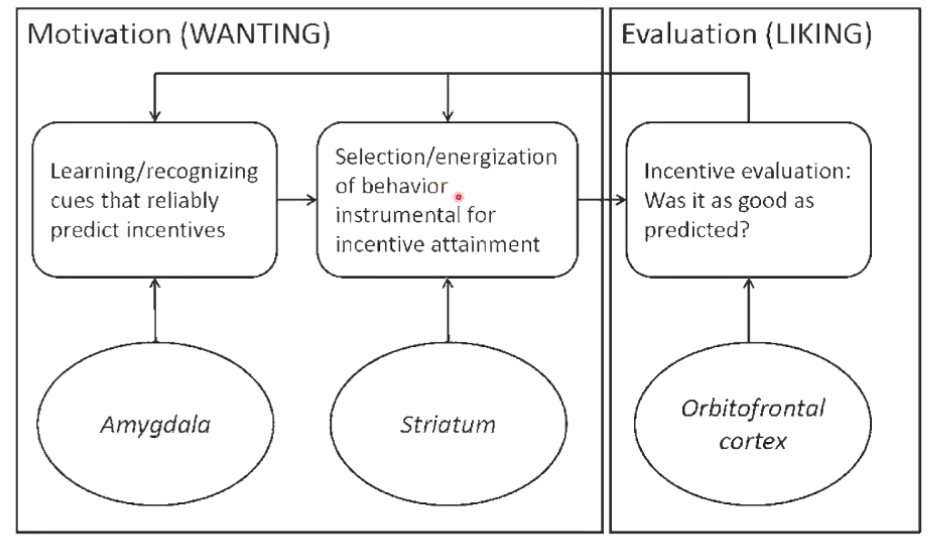
AMYGDALA
Facilitates learning of signals indicating an attractive stimulus is nearby
Enables 'honing in' on rewards
Is connected to early sensory areas as well as higher cognitive areas
Sensory = knee-jerk response to something that looks like a snake
Cognitive = calmness and reflection of realising it is not
STRIATUM
Underlies the 'wanting' phase of motivation
Responsible for selection of behaviours aimed at incentives/away from disincentives
It is responsible for motivated movement
NUCLEUS ACCUMBENS
structure in the Dopamine reward system
Dopamine is released in response to a cue of a reward. If a reward is attained, this triggers the release of more dopamine.
stimulates strong behavioural urges
Responsible for incentives (both positive and negative)
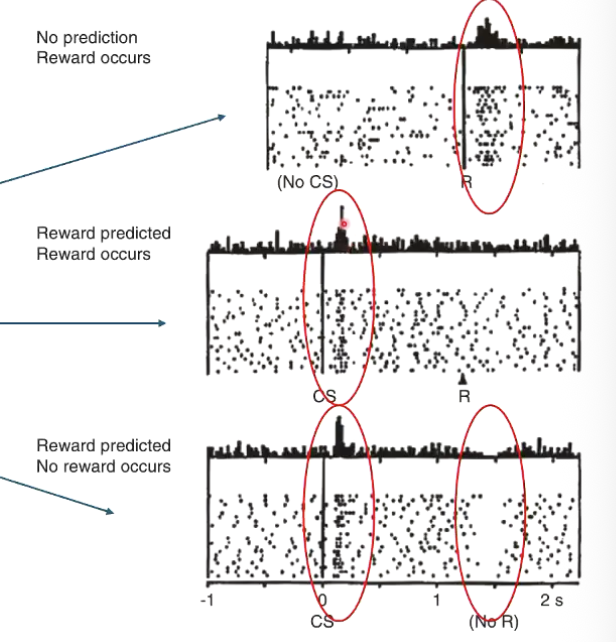
RESPONSES FROM DOPAMINE STIATAL CELLS
Monkey trained to associate glucose reward with predicted cue
Dopamine receiving cell fires strongly just after reward delivered
After training the dopamine cell responds strongly to the cue but stays at baseline to the actual reward
When a reward is predicted by the cue but not provided, the dopamine cell reduces its firing rate below baseline
Dopamine receiving neurons are thought to code for 'reward prediction errors'
DOPAMINE AND REWARDS
Rats in the high dose of dopamine approached the reward slower than rats with lower/no doses
However, they consumed just as much when they got there
Evidence that dopamine is involved in the 'wanting or incentive power' of the stimulus
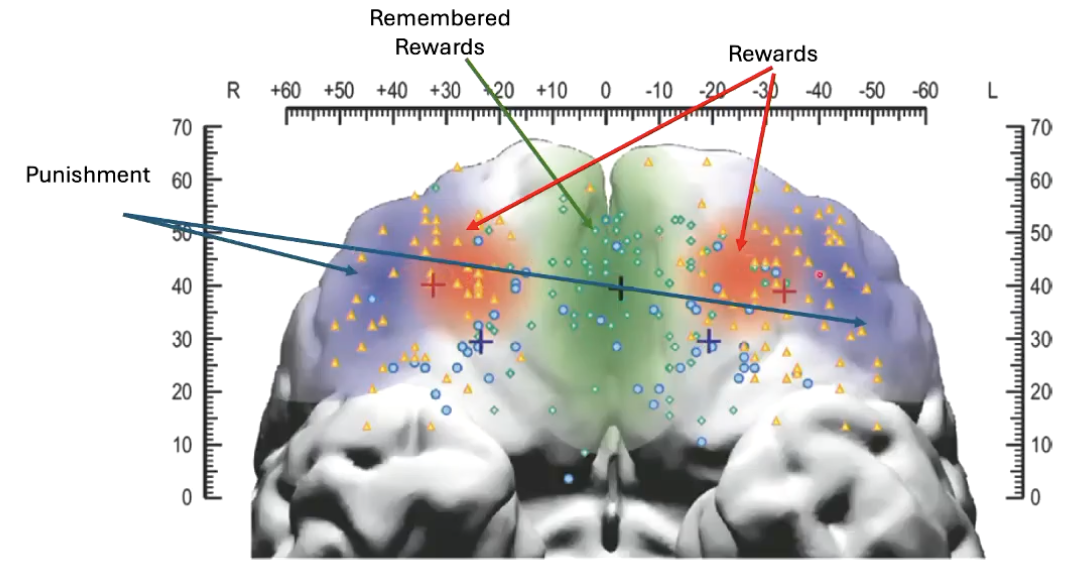
ORBITOFRONTROL CORTEX
Is connected with amygdala and striatum and dopamine system
Responsible for evaluation stage of motivation
OFC activity is correlated with the organism's desire for a given reward
OFC NEURON RESPONSE AND BEHAVIOUR
Recordings were collected from a single OFC neuron that responds to sweet
Initial = strong response to first drops of glucose
As more glucose given, OFC neuron reduced its firing rate
The monkeys acceptance of the glucose reduced as the firing rate of the OFC reduced
After a break, the neuron firing rate and monkeys acceptance returned to normal
REWARD AND ADDICTION
Addiction follows the formation of a habit that serves to attain a reward, pleasure, or relief from some ailment.
Action is flexible but resource intensive
Habit is an inflexible representation specific to the stimulus and context in which they were learned
BEFORE HABIT IS FORMED, ACTION IS:
Purposeful, goal directed
Action outcome
If outcome rewarding – behaviour reinforced
REPETITION AND ADDICTION
With repetition, Dorsal Striatum chunks the task so that it is represented as a single event
The strength of the chunked representation increases with repetition until it becomes automatic
Habit is an autonomic response to a sensory cue
HABIT
A chunked representation stays stable as long as it is performed and at least partially rewarded
As a habit gets stronger, it becomes less sensitive to outcomes (REWARD INVARIANCE)
Dorsal striatum pattern decays when all rewards lose value, rewards are removed, contingency is explicitly changed.
STRESS AND HABITS
Acute and chronic stress increase habit reliance
Impedes deliberate action control
Decreased activity in OFC and prefrontal cortex, which are areas for goal-directed learning
ADDICTION
Inability to refrain from behaviour despite adverse effects on health and social life, and despite repeated attempts to stop
Can be habitual user without being an addict
Compulsive, chronic and relapsing
Narrowing in diversity of motives
Not limited to drugs
ADDICTION AND BLOOD-BRAIN BARRIER
Many blood born chemicals cannot enter brain chemistry, but those that can:
Act diffusely throughout CNS (ex. Alcohol)
Bind to specific receptors (ex. Nicotine, THC, heroin)
Influence synthesis, transport, release and deactivation (cocaine, MDMA)
Influence chemical reactions elicited by post-synaptic neurons (LSD)
Drug metabolism
Break-down of drugs into non-active forms
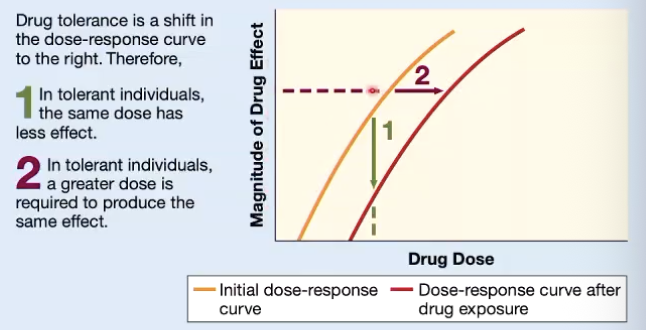
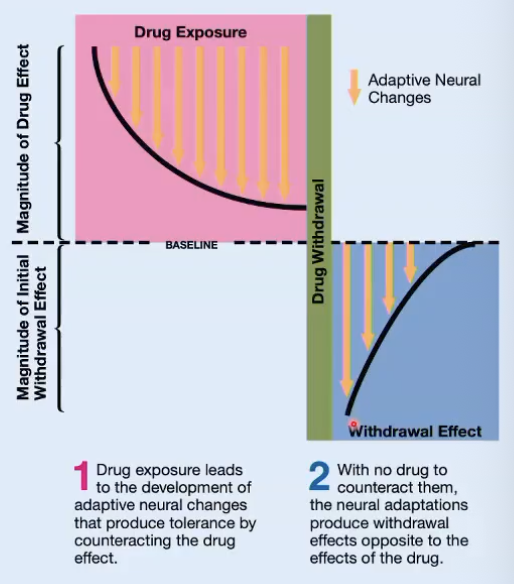
ADDICTION TOLERANCE
A state of decreased sensitivity to given drug after exposure to it
A given dose has less effect than it did previously
Shift in dose response curve to right
OCCURS WHEN DRUG GIVEN BEFORE CUE
METABOLIC TOLERANCE
Results from changes that result in less drug getting to the site of action
Ex. Liver gets more efficient at breaking down alcohol
FUNCTIONAL TOLERANCE
Results from changes that reduce the reactivity of sites of action
The number of receptors available, efficiency of receptor sites
Ex. Heroin – opioid receptors become less responsive
ADDICTION DEPENDENCE
After several days of exposure to a drug, sudden elimination results in adverse physiological responses
Withdrawal effect gets weaker over time
PATHWAY TO ADDICTION
A shift from goal-directed behaviour to compulsive/habitual drug seeking and consumption
Initial drug taking is voluntary and reflects hedonic value or serves a purpose
Habitual drug taking: the value of the drug declines but the anticipated reward increases. Wanting >> liking.
ATTENTION AND THREAT
Threatening stimuli capture our attention. People are faster to find an angry face amongst other expressions.
COGNITIVE MECHANISMS OF THREAT BIAS
Facilitated Attention:
we detect threatening stimuli faster than non-threatening stimuli
Difficulty Disengaging
we struggle to move our attention from threatening stimuli
FEAR-RELEVANT STIMULI
Some stimuli are frequently associated with danger in the natural environment - these are termed fear-relevant.
certain animals such as snakes, spiders
it aids survival for these fear-relevant animals to have priority in our attentional and cognitive systems
FEAR-RELEVANT ANIMALS AND ATTENTION
We are faster to detect the target when it appears on the same side as the fear-relevant animals.
stronger effects found in individuals with greater levels of fear as they often struggle to disengage from threatening stimuli
FEAR AND VISUAL SEARCH
Spider fearful participants showed generally more attentional capture and distraction by spider stimuli than non-fearful controls. Therefore, the affective content of stimuli can influence our attention and fear-relevant animals can involuntarily capture our visual attention.
EMOTION AND MEMORY
Events that evoke high levels of emotion are likely important to us
the hippocampus (memories) is right next to the amygdala (emotion)
the hippocampus and amygdala activate together to encode emotional information into long term memory = better retention