Udemy CFA Study
 Call Kai
 Learn
Learn Practice Test
 Spaced Repetition
 Match
Match Flashcards
 Knowt Play
1/61

Earn XP
Description and Tags
Udemy CFA Study
Name | Mastery | Learn | Test | Matching | Spaced | Call with Kai | Chat |
|---|
No analytics yet
Send a link to your students to track their progress
62 Terms
Which of the following is not one of the 9 major sections of GIPS?
A. Derivatives
B. Private Equity
C. Real Estate
Answer: A
The nine sections of GIPS are the following:
0. Fundamentals of Compliance
1. Input Data
2. Calculation Methodology
3. Composite Construction
4. Disclosure
5. Presentation and Reporting
6. Real Estate
7. Private Equity 8. Wrap Fee/ Separately Managed Account (SMA) Portfolios
Is the following compliance statement correct?
ABC Inc. claims compliance with the Global Investment Performance Standards (GIPS®) and has prepared and presented this report in compliance with the GIPS standards. ABC Inc. has been independently verified for the periods January - December of the current year. The verification report(s) is/are available upon request. Verification assesses whether (1) the firm has complied with all the composite construction requirements of the GIPS standards on a firm-wide basis and (2) the firm's policies and procedures are designed to calculate and present performance in compliance with the GIPS standards. Verification does not ensure the accuracy of any specific composite presentation."
A. Yes
B. No, because of the incorrect description of what is assessed by the verification process
C. No, because verification must ensure the accuracy of the presented composites
Answer: A
This is an example of a correct statement by a GIPS-compliant firm that has chosen to verify its compliance. The verification process is focused on processes and procedures in the firm. It does not ensure the accuracy of any specific composite performance.
Which of the following statements is most likely correct in regard to composites construction?
A. Composites usually "suffer" from a survivorship bias
B. Composites must be defined on an ex-post basis
C. A composite's return is calculated as the asset-weighted average return of all portfolios included in that composite
Answer: C
As per GIPS, a composite's return is defined as the asset-weighted average of the performance results(return) of all portfolios included in the particular composite.
Answer A is incorrect because when presenting a composite's return, we should take into account the return of all portfolios that are part of the particular composite, including portfolios of current and past customers. Thus, the survivorship bias is basically eliminated, and composites' return is presented in a fair and accurate manner.
Answer B is incorrect because composites are defined in advance, on an ex-ante basis.
The Fundamentals of Compliance section of GIPS least likely:
A. requires that portfolios are valued at fair value.
B. prohibits partial compliance claims.
C. requires that firms establish and document adequate policies and procedures for GIPS compliance.
Answer: A
All statements given in the answers are true with respect to GIPS. However, the requirement that portfolios are valued at fair value is given in Section 1: Input Data, not in Section 0: Fundamentals of Compliance.
Which of the following distinct business entities can claim compliance with the Global Investment Performance Standards (GIPS)?
A. A multinational financial services holding company
B. A local subsidiary of a multinational commercial bank
C. A subsidiary undertaking investment management services
Answer: C
The standards define a "firm" as an investment management firm, subsidiary, or division "held out to clients or prospective clients as a distinct business entity". This means that its operations should be held independently and autonomously.
A multinational financial services holding company is unlikely to be operating solely as an investment firm. Moreover, the scope of its business could make it very difficult to claim compliance on a firm wide basis. Therefore, A is an incorrect answer.
A commercial bank subsidiary does not provide investment management services, so answer B is incorrect, too. A subsidiary undertaking investment management services meets all the criteria for a firm definition stipulated in the standards.
Which of the following statements is not true for interpretation of interest rates?
A. Interest rates are also called opportunity costs because they measure the value investors forgo
when choosing a particular course of action.
B. Interest rates are used when discounting or compounding cash flows and express the time value
of money.
C. Interest rates can be interpreted as required rates of return set by central banks.
Answer: C
Interest rates can be interpreted as discount rates, opportunity costs, and required rates of return. Both A and B correct. However, only the first part of answer C is correct, the second is wrong. Required rates of return are usually determined by investors. They aren't set unilaterally by governmental agencies.
Which of the following statements is most likely to be true about the nominal risk-free interest rate?
A. Nominal risk-free rate is expressed as the sum of the real-risk free rate and the inflation premium.
B. The interest rate on a corporate bond is considered to be an example of a nominal risk-free rate.
C. Nominal risk-free rate is the rate for a completely risk-free security in a zero-inflation environment.
Answer: A
The sum of the real risk-free interest rate and the inflation premium is called the nominal risk-free interest rate, which makes A correct. The interest rate on a corporate bond would most likely require a combination of premiums for default, liquidity, and maturity. US Treasury bills are good examples of securities which offer nominal risk-free rates as they are essentially risk-free and backed by the government. The real risk-free rate is a theoretical concept which assumes that there is no inflation or default risk (the chance of not paying back the borrowed funds).
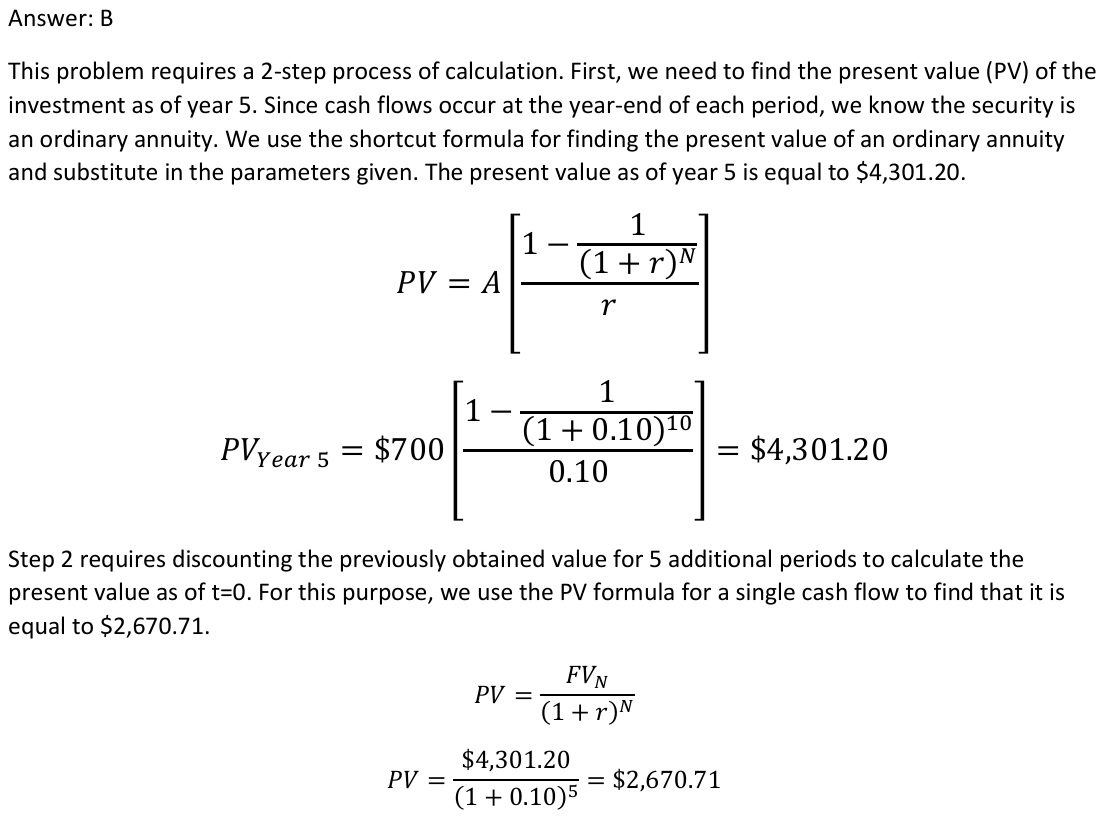
A 10-year annuity pays $700 at the end of each year starting from year 6 onwards. The annual interest rate is 10% during all the years. The present value (PV) of the investment is closest to:
A. $2,570.71
B. $2,670.71
C. $2,770.71
Answer B, see image for explanation
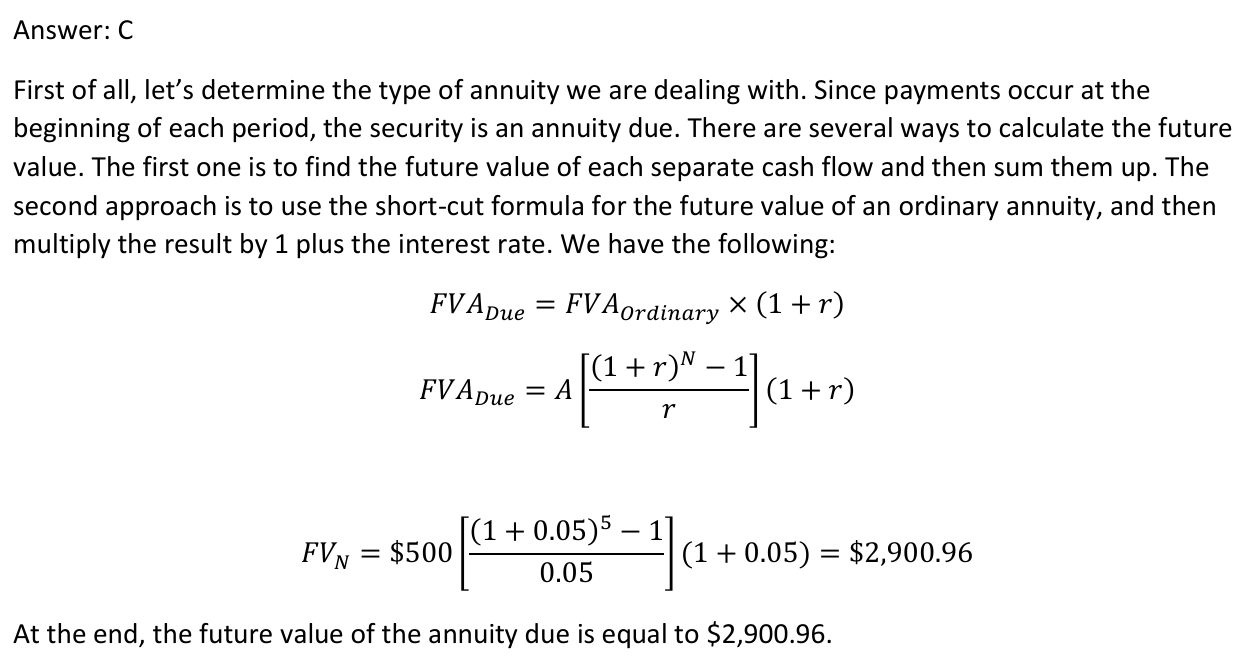
Melissa invests in a security that pays $500 at the beginning of each of the next 5 years, starting from
today. If the annual interest rate is equal to 5%, the future value (FV) of the security is closest to:
A. $2,800.96
B. $2,850.96
C. $2,900.96
Answer C, see image for explanation
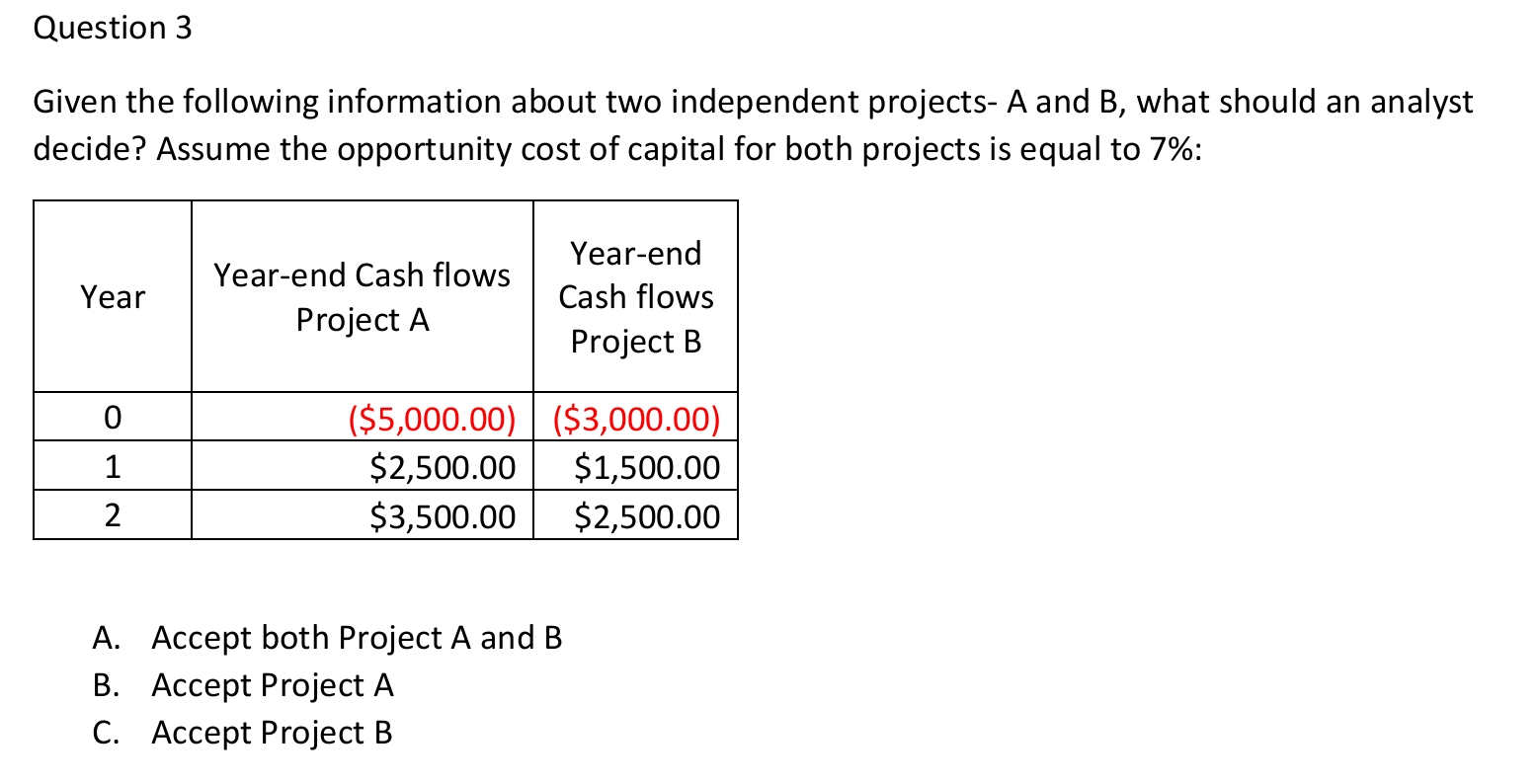
See image
Answer A, see image
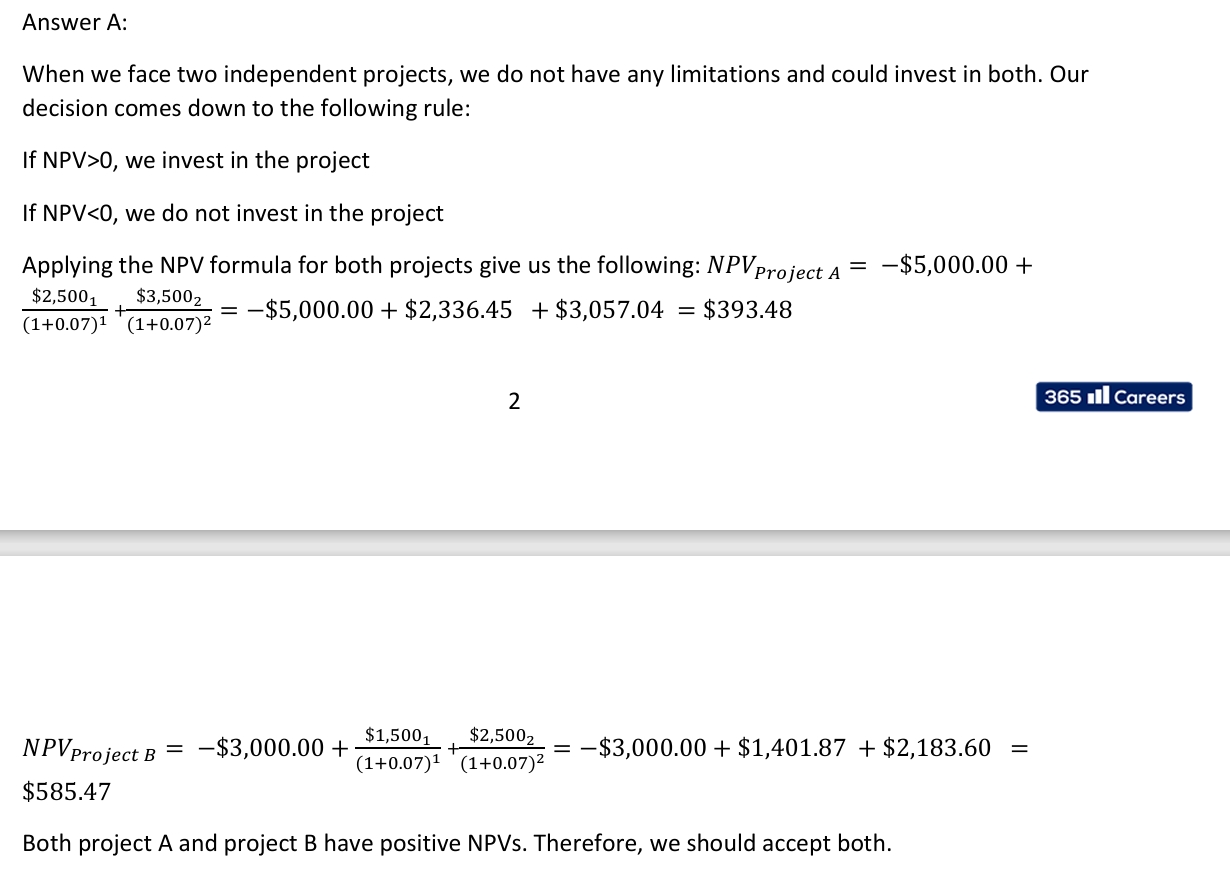
Melissa buys a share of stock for $55 at Year=0 and later another share at $60 at Year=1. The stock pays $5 dividend per share at the end of Year 1 and Year 2. The stocks are sold for $140 at the end of Year 2. What is the money-weighted rate of return of the portfolio? A. 22.55%
B. 23.55%
C. 24.55%
A, See image
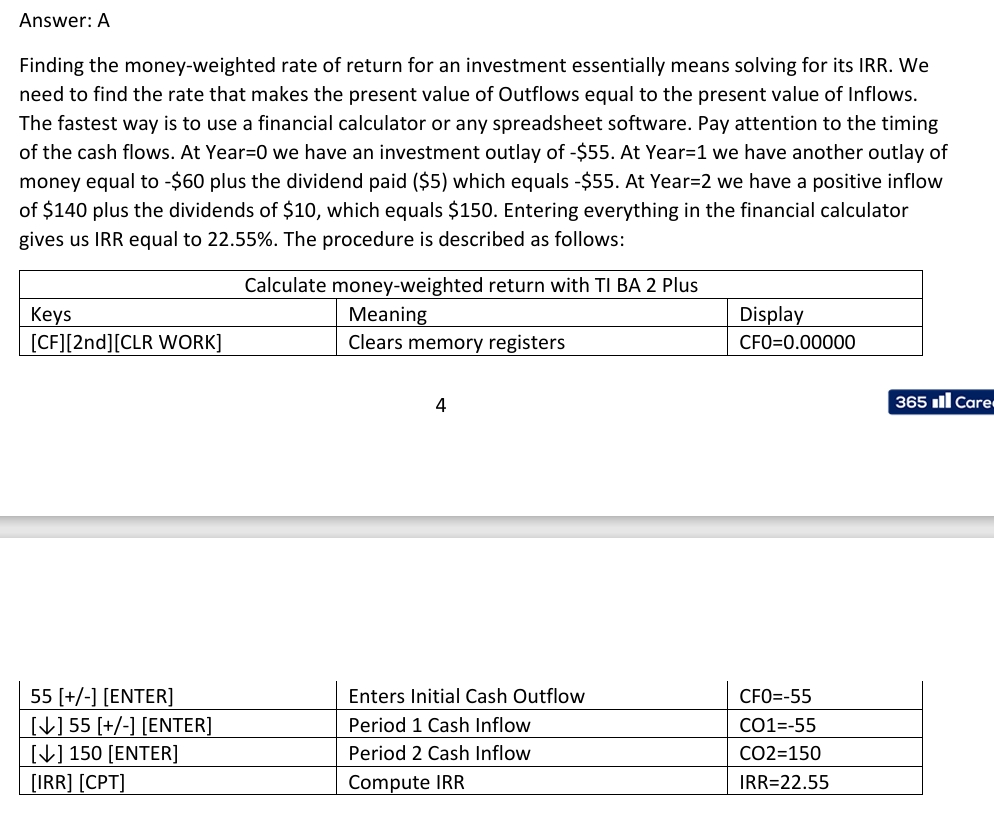
Melissa buys a share of stock for $55 at Year=0 and later another share at $60 at Year=1. The stock pays
$5 dividend per share at the end of Year 1 and Year 2. The stocks are sold for $140 at the end of Year 2.
What is the time-weighted rate of return of the portfolio?
A. 20.6%
B. 21.6%
C. 22.6%
Answer: B
We first break the investment horizon of two years into smaller evaluation periods. For Year 1 the
holding period return is $60 + the dividend of $5 minus the beginning value of $55. This is divided by $55
to find a return of 18.2%. For year 2 we have an ending value of $140 plus $10 in dividends minus the
beginning value of $120 divided by $120. Pay attention that the beginning value is equal to the price of
the second stock multiplied by 2. That’s how we calculate a holding period return equal to 25%. Now we
only have to link both returns and find the time-weighted rate of return. Since we have two years of
5
investment horizon, we take the geomatic mean of the two holding periods. The time-weighted rate of
return is equal to √{(1.182)(1.25) }−1= 21.6%
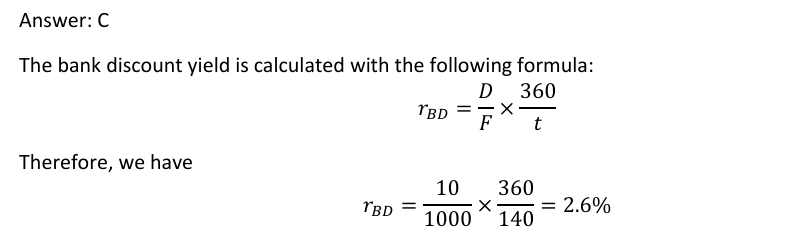
Calculate the bank discount yield of a T-bill which is priced at $990 and has a face value of $1000 and
140 days until maturity.
A. 2.4%
B. 2.5%
C. 2.6%
Answer C, See image
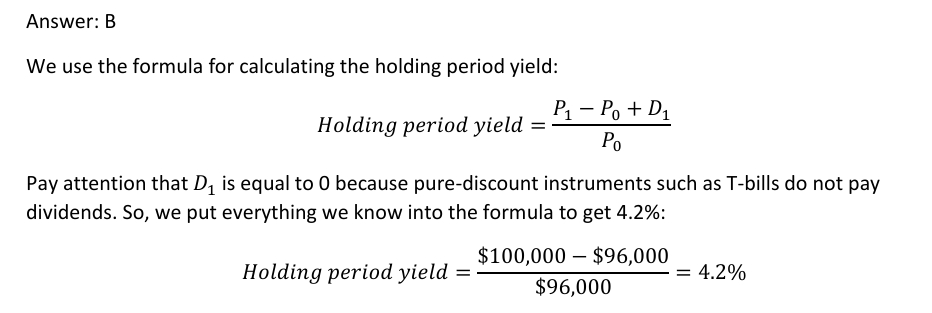
Calculate the holding period yield of T-bill priced at $96,000 with a face value of $100,000 and 180 days
to maturity.
A. 4.1%
B. 4.2%
C. 4.5%
Answer B, see image
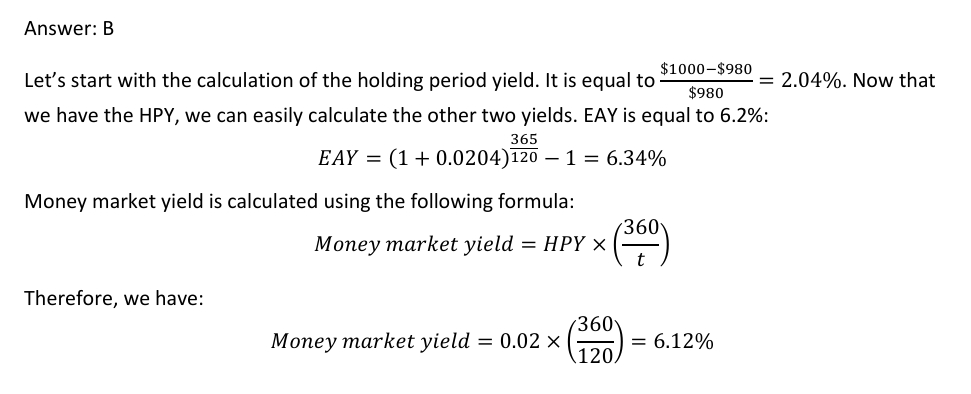
Imagine Jessica purchased a T-bill at $980 which matures at $1000 in 120 days. Which of the following yields is closest to 6.3%?
A. Holding period yield (HPY)
B. Effective annual yield (EAY)
C. Money market yield (CD yield)
Answer B, see image
Question 13
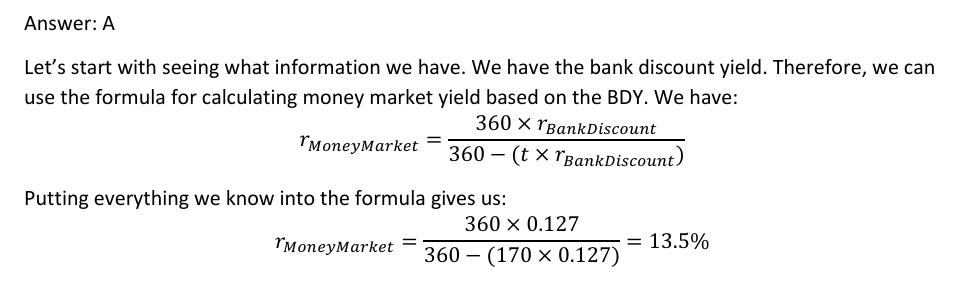
Imagine that Jana purchased a $1000 T-bill which matures in 170 days for a price of $940. What is the
money market yield given that the bank discount yield is equal to 12.7%?
A. 13.5%
B. 14.2%
C. 16.7%
A, see image
What is the bond equivalent rate of a 3-month loan which has a holding period rate of 4%?
A. 7.4%
B. 7.9%
C. 16.3%
Answer: C
First, we need to convert the 3-month yield into a semiannual yield. So, we have 1.04^2−1=~8.2%.
Then, we multiply by 2 to find the bond equivalent rate, which is 16.3%
Which is most accurate about the legal and contractual infrastructure of a company?
A. Both are company-driven infrastructures.
B. Contractual infrastructure is more company-driven while legal infrastructure is driven by
different governmental agencies and regulators.
C. Legal infrastructure is company-driven.
Answer: B
Legal and government infrastructures are usually externally-driven and established by different
government agencies or regulators. A contractual infrastructure, on the other hand, is typically
company-driven as it manages the relationships between the firm and its own stakeholders. A good
example of the latter is an agreement between a company and one of its supplier firms.
Which of the following statements is least likely correct?
A. Financing costs are not included in a project’s incremental cash flows
B. Cash flows are calculated on an after-tax basis
C. Accounting income is relevant for calculating the NPV of a project
Answer C:
In capital budgeting, the first principle that should guide us is that decisions are always based on cash
flows and not on accounting income. All intangible benefits and costs included in accounting statements
are not considered until they translate into cash flows and enter the capital budgeting cash stream.
Which statement about two mutually exclusive projects is most accurate?
A. If projects are profitable, we should accept both
B. We should accept the project with the highest profitability according to NPV analysis
C. If they have a ranking conflict related to their respective values for IRR and NPV, we should
accept the one which has the higher IRR
Answer B:
Two or more projects are mutually exclusive when a company must choose only one of them. The IRR
method assumes that the reinvestment rate is the internal rate of return. In addition, the IRR technique
proves insufficient when it comes to comparing projects of different size. On the other hand, the NPV
method suggests reinvestment at the opportunity cost of capital. This is а much more realistic and
economically relevant assumption because it incorporates the market-determined opportunity cost of
capital as a discount rate. Therefore, the NPV is actually the net change in shareholders’ wealth after
choosing a particular investment. And this is what we need to know. At the end of the day, investors are
interested in the absolute amount of wealth generated by a given project. That’s why when we have a
ranking conflict, we should choose the project with the higher NPV.
See image
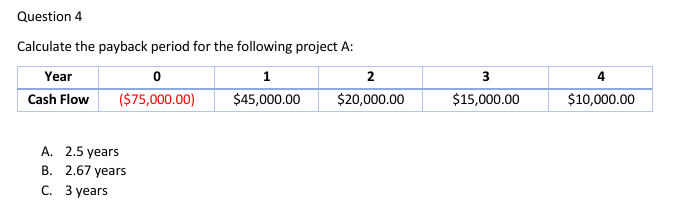
Answer B:
The payback period helps us figure out the number of years to recover our initial investment. For project
A, we recover $65,000 until the end of year 2 and we still need to gain $10,000 more from Year 3 in
order to repay our initial investment. So, we have $10,000/$15,000 which equals approximately 0.67. In
the end, the payback period is 2+0.67 which equals 2.67 years.
See image
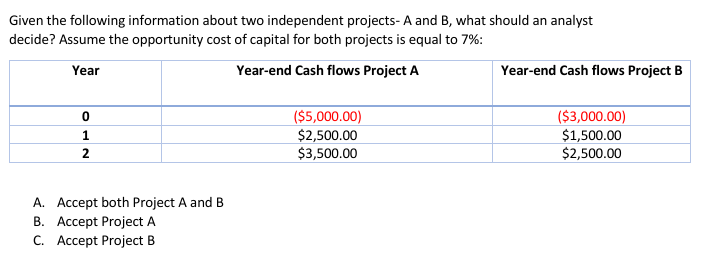
Answer A: see image

Which of the following statements is least likely accurate?
A. A project which has an internal rate of return, which is less than the opportunity cost of capital
will have a negative NPV
B. The net present value is equal to the sum of future cash flows discounted at the opportunity
cost of capital
C. Internal rate of return less than the opportunity cost of capital means the project is profitable
and should be accepted
C: If we find that the IRR for a project is higher than the opportunity cost of capital, we should accept it. On
the contrary, if the opportunity cost of capital is higher than the IRR, we should reject the project. When
the IRR is less than the cost of capital, the NPV will be negative, and effectively we will decrease our
wealth.

See image
B, see image
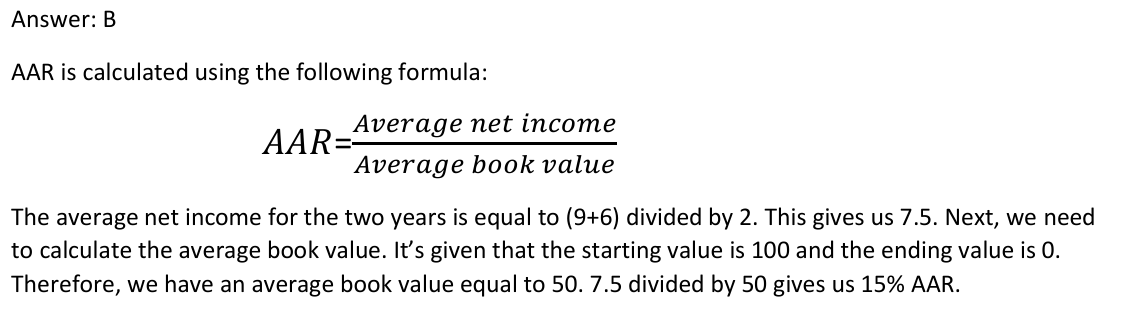
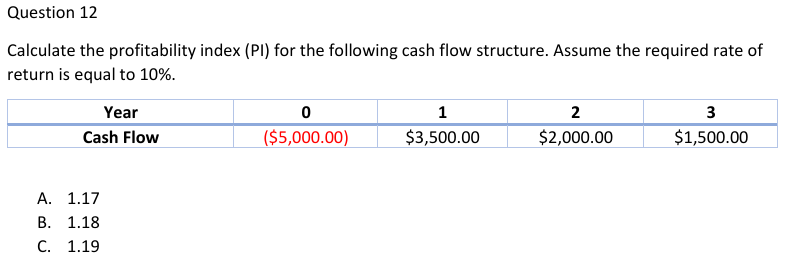
See image
C, see image

Company A has $1 million of outstanding senior debt with a coupon rate of 10%. The yield to maturity is equal to 12%. The corporate tax rate of the company is 40%. What is the after-tax cost of debt?
A. 6.8%.
B. 7.2%.
C. 7.8%.
B) The after-tax cost of debt is calculated using 𝑟_𝑑(1 − 𝑡). Therefore, we have (0.12)(1-0.4)=0.072 or 7.2%
Corporation Alpha has the following target capital structure:
• Common equity 60%.
• Debt 20%.
• Preferred stock 20%.
The required rate of return for equity is 10%, while the required rate of return for preferred stock is 8%. Debt holders ask for 5% return for their investment. What is the after-tax rate of return for the company if the corporate tax is 40%?
A. 5%.
B. 7.4%.
C. 8.2%.
C) Here we can apply the WACC formula directly. 𝑊𝐴𝐶𝐶 = 𝑤_d𝑟_𝑑(1 − 𝑡) + 𝑤_𝑝𝑟_𝑝 + 𝑤_𝑒𝑟_𝑒=(0.2)(0.05)(1 -0.4)+(0.2)(0.08)+(0.6)(0.10)=0.082 or 8.2%
A company has a next-year dividend of $3. The share price of the company is equal to $25. Calculate the cost of equity if the long-term growth rate is estimated to be 7%?
A. 19%.
B. 20%.
C. 22%.
The cost of equity is equal to D/P+g= (3)/(25) + 0.07= 0.19 or 19%
Which of the following statements is most accurate regarding the optimal capital budget?
A. It is the point where the marginal cost of capital is equal to the investment opportunity schedule.
B. It is the point where IRR makes the NPV equal to zero.
C. The optimal capital budget allows us to choose the optimal capital structure of the company.
Answer: A Statement A is accurate. This is the point where the IRR equals the weighted average cost of capital, and the shareholder value is optimized. Statement B is wrong. The optimal capital budget is determined by the intersection of the marginal cost of capital and the investment opportunity schedule. It’s not the point where NPV equals zero.
Which statement is most relevant in regard to evaluating a prospective project with a higher-than average risk profile?
A. The company’s WACC should be used to discount the cash flows of the project.
B. The company should not undertake projects riskier than its current risk profile as this would erode the shareholders' value.
C. The company should discount the cash flows of the project with an interest rate greater than WACC.
Answer: C
We use the WACC as a discount factor only when a project’s level of risk is consistent with the firm’s existing projects. If the project’s riskiness is higher, we should adjust the WACC upward. On the contrary, if the project has below-average riskiness, the cash flows should be discounted with a lower WACC.
Company X has a $50 million, 6% preferred stock outstanding. It has a market value of $45 million. What is the firm’s cost of preferred equity?
A. 3.7%
B. 6.7%
C. 8.7%
Answer: B kps = Dps / Pps, Dps=50x0.06=$3, kps = 3/ 45 = 6.7%
Question 7
What are the three components of CAPM that are needed to calculate the cost of common stock?
A. Risk-free rate, equity risk premium, and alpha
B. Risk-free rate, equity risk premium, and beta
C. WACC, cost of preferred stock, and the cost of debt
B) To estimate the cost of equity using CAPM we need to know three things in advance:
• The risk-free rate
• The market risk premium, and
• The stock beta
Company Alpha has a stock beta of 1.5. The risk-free rate is 5% and the market risk premium is 6%. The company’s cost of equity, based on CAPM, is equal to:
A. 14%
B. 16%
C. 18%
Answer: A
The formula for calculating the cost of equity, based on the CAPM is Cost of Equity = Risk-Free Rate of Return + (Beta × (Market Rate of Return - Risk-Free Rate of Return))
=5%+(1.5)(6)=14%
Which of the following statements is most accurate regarding the asset beta?
A. It includes the business risk for a company only, ignoring any financial risk
B. The asset beta is used when we need to incorporate the effect of taxes on companies
C. Companies with high leverage tend to have high asset betas
Answer: A
The Asset beta is the beta of a company with no debt on its balance sheet. It is also called unlevered beta because it includes the business risk only and ignores any financial risk.
What is the beta of Company X if the stock has a covariance relative to the S&P 500 which is equal to
0.040 and the market variance of the index is 0.020?
A. 3.00
B. 2.00
C. 1.50
Answer: B
Beta is basically used to show how a financial security behaves with respect to the rest of the market.
That is why we divide its Covariance with the rest of the market by the market variance. Using the
formula for calculating beta we have following: Covariance of Asset and Market/ Variance of market =.04/.02=2
Which of the following statements is most accurate regarding sales risk?
A. The sales risk refers to the uncertainty of how much we will sell and at what price.
B. The sales risk is affected by the relative mix of fixed and variable operating costs in the
production process of a company.
C. Companies in industries such as utilities, healthcare, and food are more dependent on business
cycle shifts, and therefore the sales risk is higher
Answer: A
Statement A is accurate. Sales risk refers to the uncertainty of how much we will sell and at what price.
It is affected by a large number of factors such as the elasticity of product demand, industry
competition, and the cyclicality of revenues. Both statements B and C are wrong. Statement B describes
the operating risk of a company. It is affected by the relative mix of fixed and variable operating costs in
the production process of a company. Firms with high fixed costs and low variable costs are generally
said to have high operating leverage. Statement C is also not accurate. Many companies do very well in
the expansion phase of the business cycle and perform poorly in the contraction phase. Some examples
are high-tech firms, retailers, and automotive firms. Usually, their growth corresponds to fluctuations in
the business cycle. On the other hand, firms in industries such as utilities, healthcare, and food are less
dependent on business cycle shifts. Such companies are called “defensive” because their earnings
remain stable regardless of the state of the overall economy.
Company Alpha is considering an expansion project. It has a debt-to-equity ratio equal to 2. Its
applicable tax rate is 40%. The expansion project has a similar line of business as Beta company, which
has a debt-to-equity ratio of 1.8 and a beta of 1.5. The tax rate of the company is equal to 35%.,
Calculate the beta of the project that Company Alpha is considering by using the pure-play method.
A. 1.48
B. 1.52
C. 1.88
B, see photo

John is a financial analyst. He works for the US-based Company Alpha which is considering an
investment in Argentina. What is the country risk premium for Argentina based on the following
financial data?
• The Yield on a 10-year US Treasury bond is equal to 5%
• The Yield on a 10-year Argentina government bond is equal to 10%
• The Annualized standard deviation of Argentina stock exchange is equal to 0.30
• The Annualized standard deviation of Argentina dollar-denominated government bond is equal
to 0.25
A. 5%
B. 6%
C. 7%
B) see photo

Which of the following statements is most accurate of break points in the marginal cost of capital
schedule?
A. These are points at which NPV is always equal to 0
B. Break points denote the amount of capital at which the weighted average cost of capital
changes
C. Break points do not change for different capital structures
Answer: B
Statement B is accurate. Each break point represents the amount of capital that causes a change in the
weighted average cost of capital. Statement C is wrong. The capital structure of a firm affects the
calculation of break points. To calculate the break points, we divide the amount of capital at which the
source’s cost of capital changes by the weight of the source in the capital structure. Statement A is also
not accurate. While NPV is affected by WACC it is not always equal to 0.
The following information applies to DeGrass Company.
• The company’s marginal tax rate is 40%
• The current market price of the company is $30
• Company’s bonds have a yield equal to 8%
• The current dividend of the company is $3
• DeGrass company has a long-term growth rate of 5%
• The target debt-to-equity ratio of the company is 0.67
The company’s weighted average cost of capital is closest to:
A. 10.8%
B. 11.2%
C. 12.1%
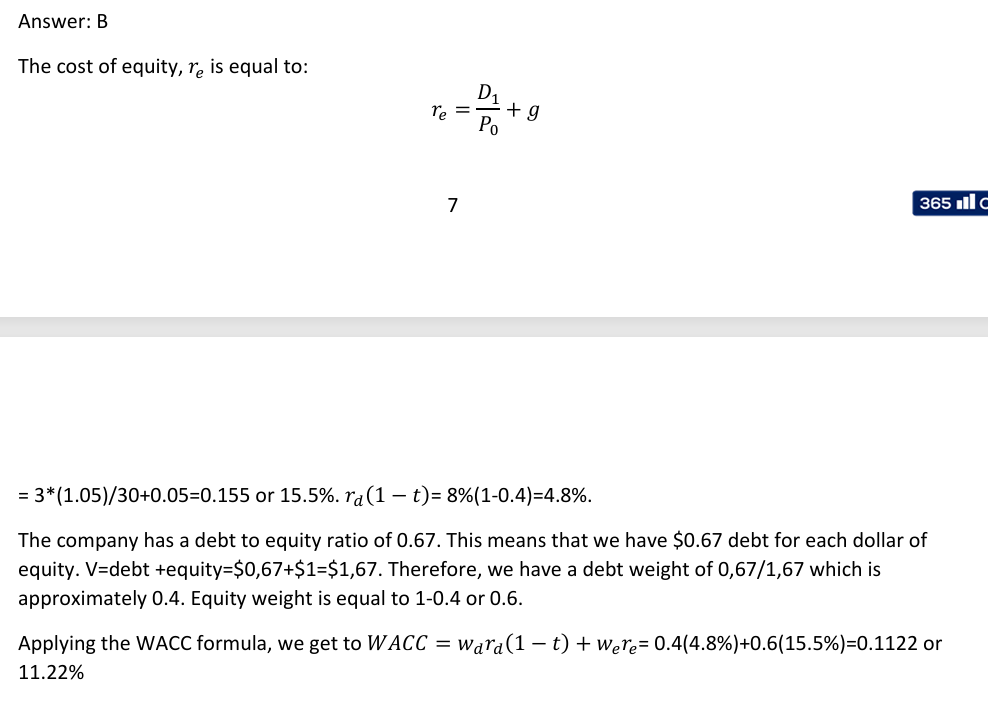
B) see photo

See image
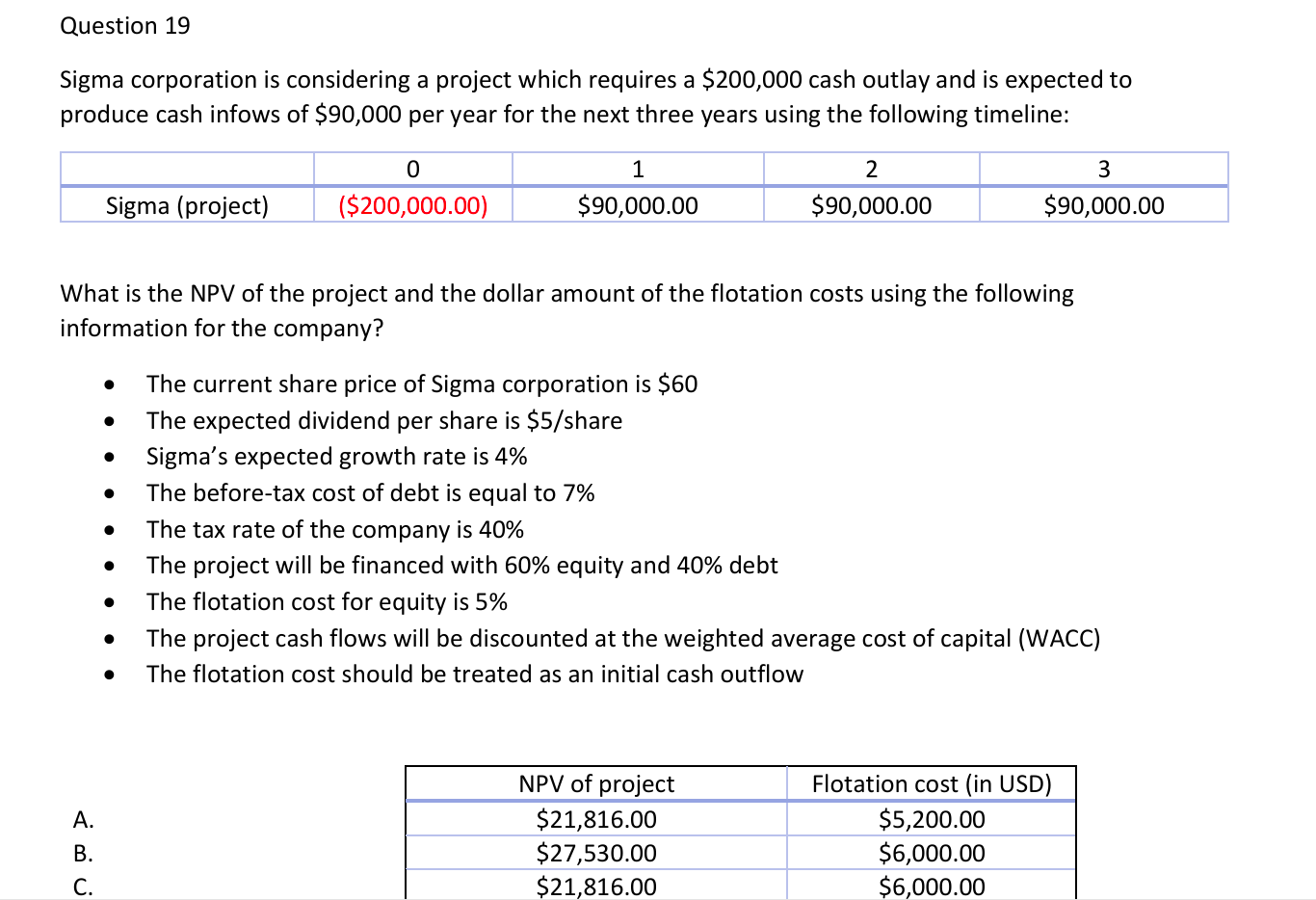
C) see photo
Business risk encompasses operating risk and:
A. Financial risk
B. Sales risk
C. Liquidity risk
Answer: B
Business risk is the risk associated with a firm’s operating performance. It encompasses both sales and
operating risks. When we say sales risk, we refer to the uncertainty regarding how much of our
production we will be able to sell and at what price. A large number of factors play a role here, such as
the elasticity of product demand, industry competition, and revenues cyclicality. On the other hand,
operating risk deals with additional uncertainty regarding a company’s earnings caused by fixed
operating costs.
Which of the following statements most accurately describes the financial risk that a company faces?
A. Financial risk refers to the uncertainty of net income and net cash flows attributed to the use of
variable operating costs
B. The greater the proportion of debt in a firm’s capital structure, the greater the financial risk
the company is exposed to.
C. The higher the financial risk a company faces, the higher its stock price
Answer: B
Statements A is wrong. Financial risk refers to the uncertainty of net income and net cash flows
attributed to the use of external financing that has a fixed cost. Examples of external financing are bank
loans and financial leases. Companies that finance their operations by borrowing capital are called
leveraged. Statement C is also wrong. The higher the financial risk, the lower the price of a stock
because such a company is more likely to default compared to a less leveraged firm. Statement B is
accurate.
Which of the following does not affect the level of operating leverage?
A. The interest expense of a company
B. The proportion of fixed and variable costs in a company’s cost structure
C. The percentage change in the operating income relative to a change in Sales
Answer: A
The interest expense does not affect the operating but the financial leverage of a company. Statement
B is accurate. Every company has a mix of operating variable and fixed costs. Variable costs, such as
expenses for purchased goods or materials and supplies, change constantly and depend on sale levels.
Fixed costs, such as rent and wages, stay the generally same and aren’t affected by changes in the sale
levels. The larger the fixed component, the more difficult it is to adjust the variable component to
changes in sales. Therefore, operating risk becomes higher. Statement C is also accurate. The degree of
operating leverage shows the sensitivity of operating income to changes in product demand, measured
by unit sales.
The unit contribution margin for a product is $30. Company X has fixed costs of production equal to
$150,000 for up to 150,000 units. At which of the following production levels, the degree of operating
leverage (DOL) is at its lowest point?
A. 50,000
B. 100,000
C. 150,000
C, see image

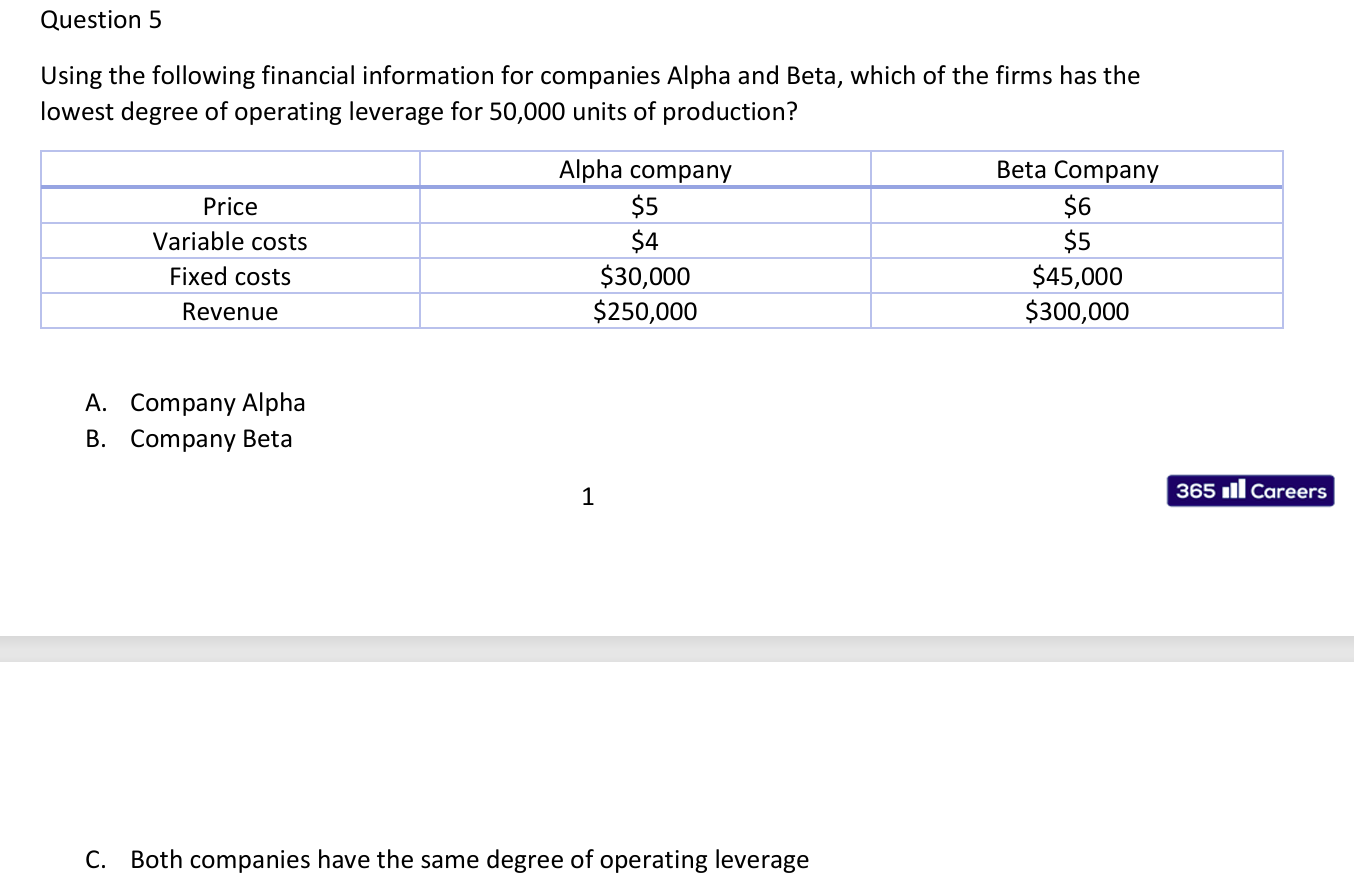
See image
A, see image

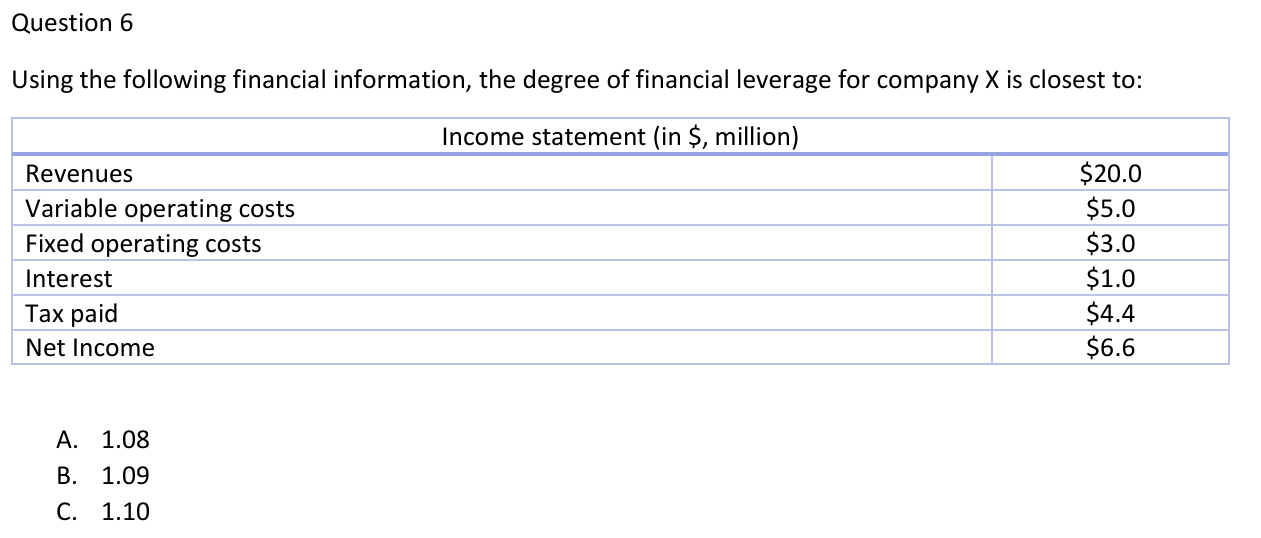
See image
B, see image


See image
C, see image


See image
C, see image
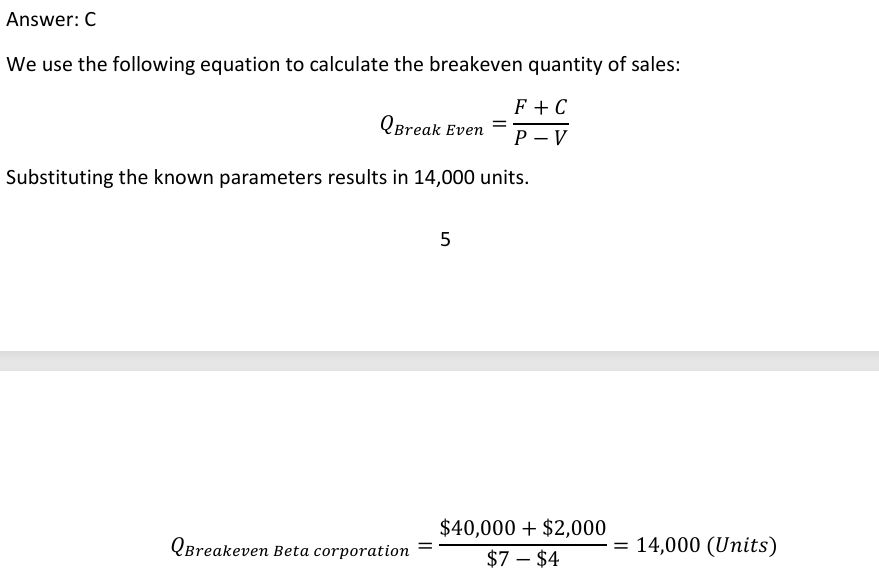
Company Z sells luxury pens for 50$ apiece. The product’s variable cost is 40$. Company Z has a fixed
operating cost of $300,000 and fixed financing costs of $150,000. The company’s operating breakeven
quantity of sales, in units, is closest to:
A. 30,000 Units
B. 31,000 Units
C. 32,000 Units
A, see image


See image
B, see image


See image
B, see image

Which of the following is an example of a primary source of liquidity?
A. Negotiating debt agreements
B. Generating cash from short-term investments
C. Liquidating short-term assets
Answer: B
The primary sources of liquidity are the sources that a firm uses for its regular daily operations. These
represent the most readily available funds which are held as cash or near-cash securities. More
precisely, primary sources of liquidity are cash balances from selling goods or services, collecting
receivables, and holding short-term instruments. Or trade credits from vendors and bank lines of credit.
An effective cash flow management of collections and payments could also be a source of liquidity. A
more centralized cash flow system would imply that cash is not tied up in subsidiaries and ensures it is
used more efficiently. Statements A and C are examples of secondary sources of liquidity.
Corporation Alpha is most likely faced with a drag on liquidity if its:
A. Largest vendor changes its payment terms form “2/10 net 30” to “2/10 net 50”
B. Weighted average collection period increases from 35 days to 45 days
C. Inventory turnover was below the industry standard during the last period and is well above
during the current period
Answer: B
Pulls on liquidity accelerate cash outflows. Statement A indicates that the vendor will be paid 20 days
later than the previous time. In other words, Alpha will be able to hold cash for longer. Thus, it can use
the money for other activities such as investing in money-generating securities. Drags on liquidity delay
or reduce cash inflows. Higher inventory turnover means that the company would be able to produce
more goods and that cash inflows will increase. The weighted average collection period in statement B is
increased from 35 to 45 days. The metric indicates the average days outstanding per dollar of receivable
or in other words, how long it takes to collect payments from customers. An increase in this ratio shows
that the company has difficulties collecting money from clients.
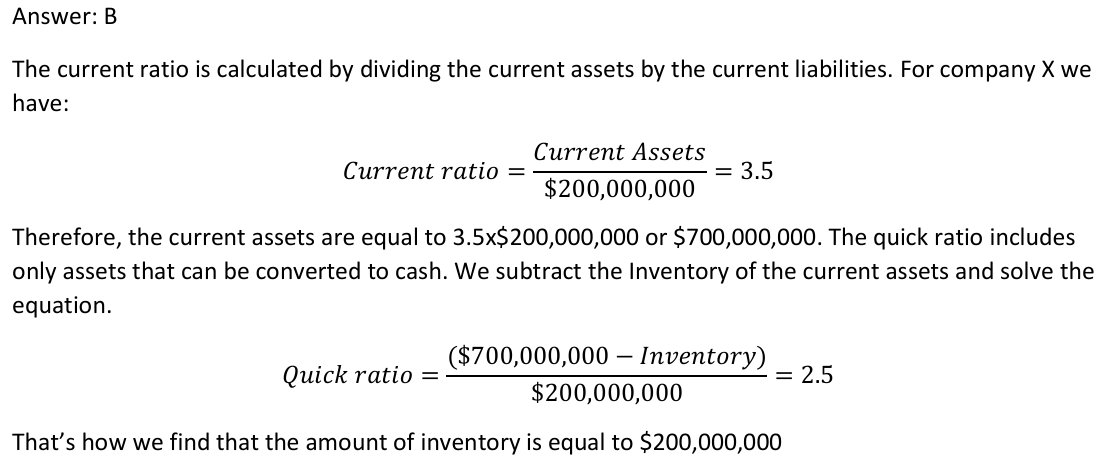
Question 3
Imagine that Company X has a quick ratio of 2.5 times and a current ratio of 3.5 times. The current
liabilities of the company are 200 million. The amount of the inventory is closest to:
A. $100,000,000
B. $200,000,000
C. $300,000,000
B, see image

See image
C, See image
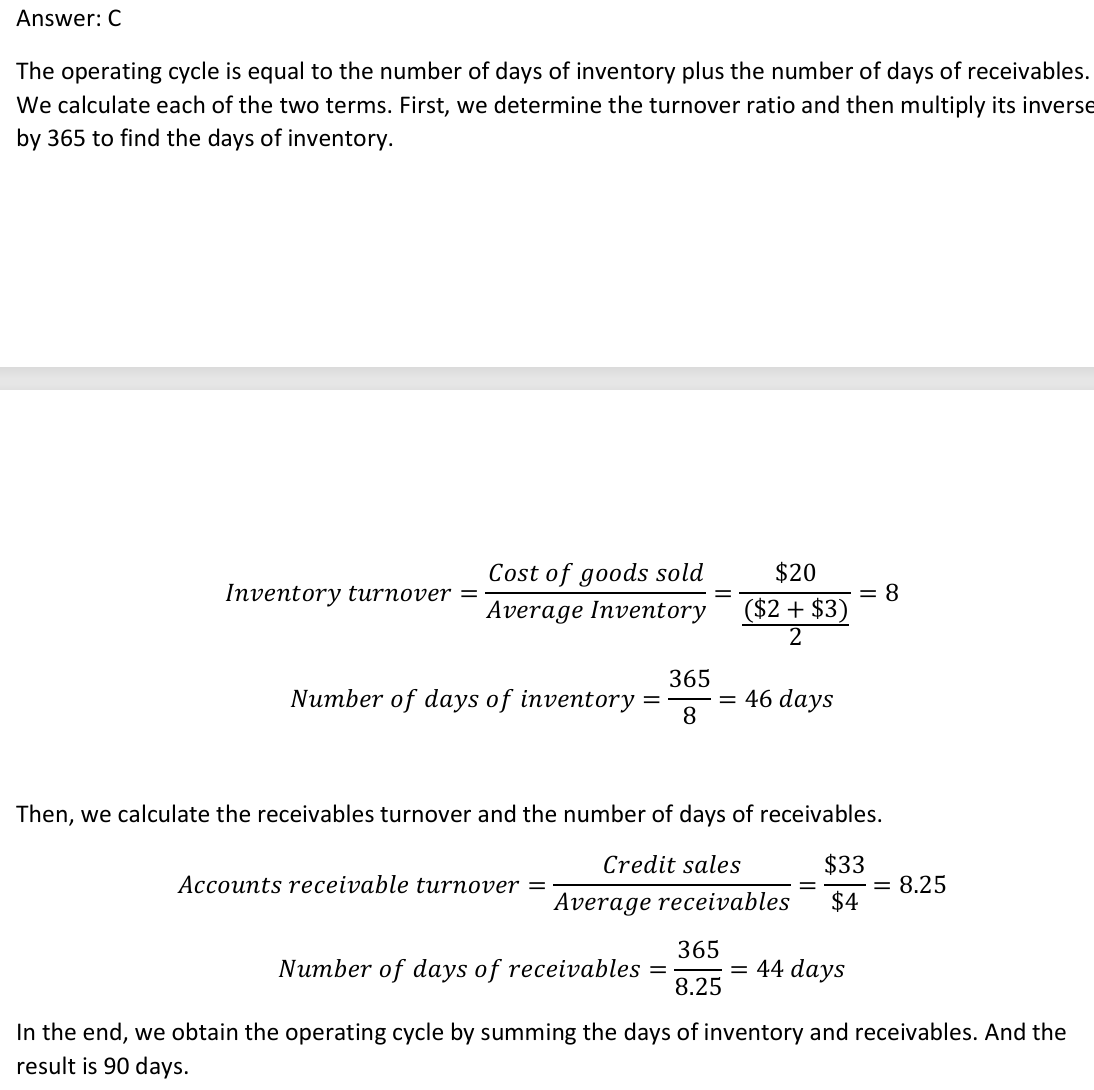

See image
B, see image


See image
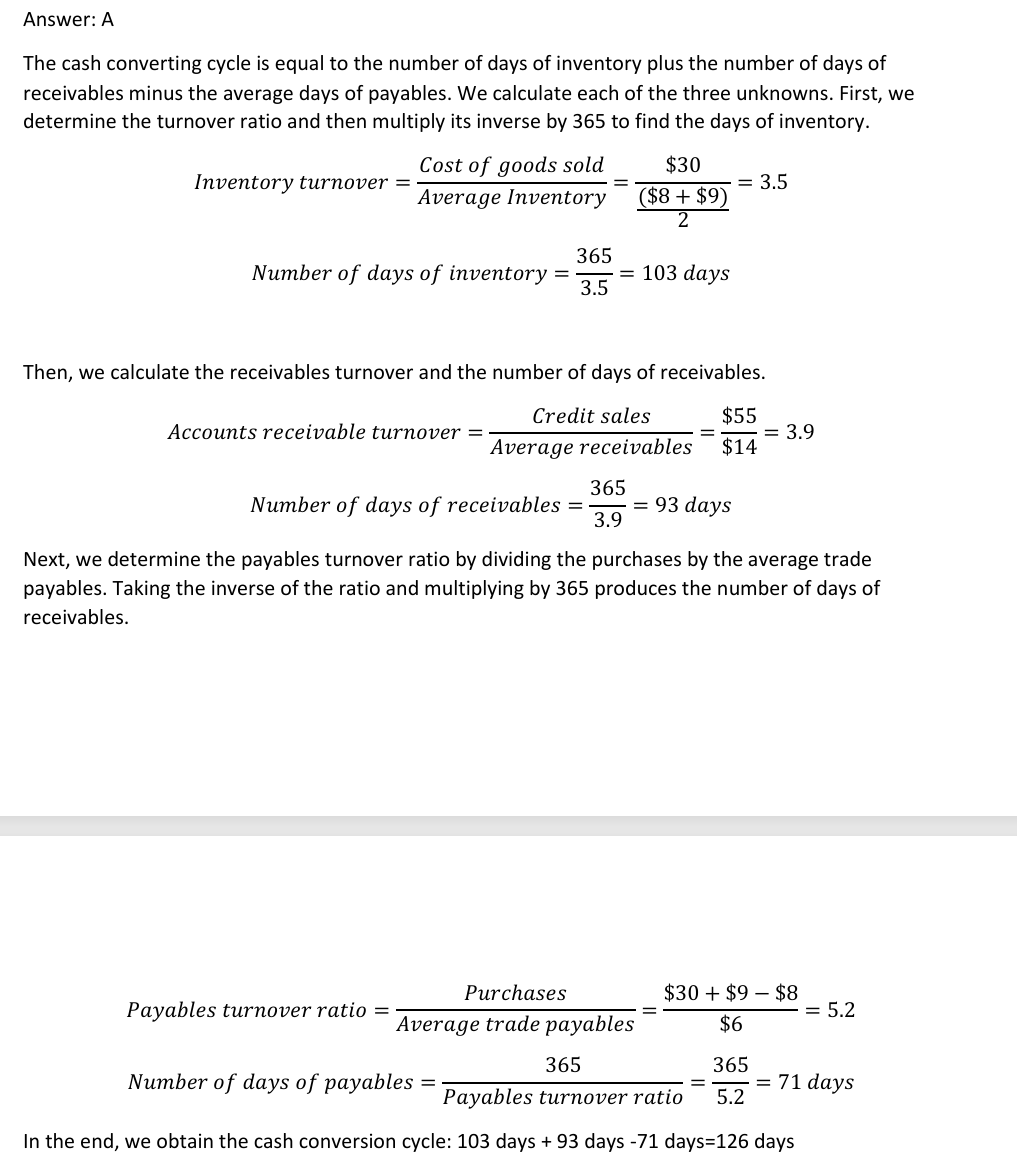
A, see image
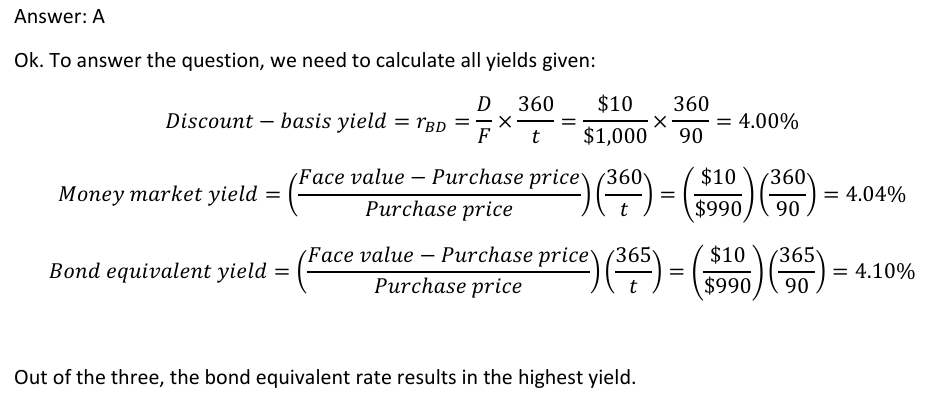
A U.S. Treasury bill sells for $990 with 90 days remaining to maturity. Its face value is equal to $1,000.
Which of the following methods most likely results in the highest yield?
A. Bond equivalent yield
B. Discount-basis yield
C. Monet market yield
A, See image
Which of the following statements about the aging schedule is least likely accurate?
A. It requires more information compared to calculating the average days of receivables
B. It categorizes accounts by the number of days since they have been paid
C. Analysis of the historical trends provides a clearer picture of what drives changes in the accounts
receivable
Answer: B
Both statements A and C are accurate. The primary drawback of the aging schedule and the weighted
average collection period is that they require more information than the number of days of receivables.
In most cases, this information is difficult to obtain. Nevertheless, analysis of the historical trends of
both measures provides a clearer picture of what drives changes that occur in the accounts receivable.
Thus, the simple metric of average days of receivables is insufficient. Statement B is wrong. The aging
schedule categorizes accounts by the number of days they have been on the firm’s books.
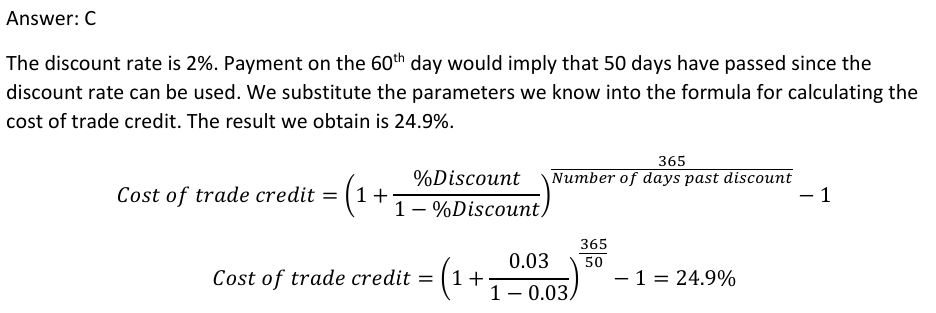
Imagine that company X uses trade credit with terms 3/10 net 60. What would be the effective
borrowing cost when a given invoice is paid on the 60th day?
A. 24.6%
B. 26.8%
C. 24.9%
C, see image
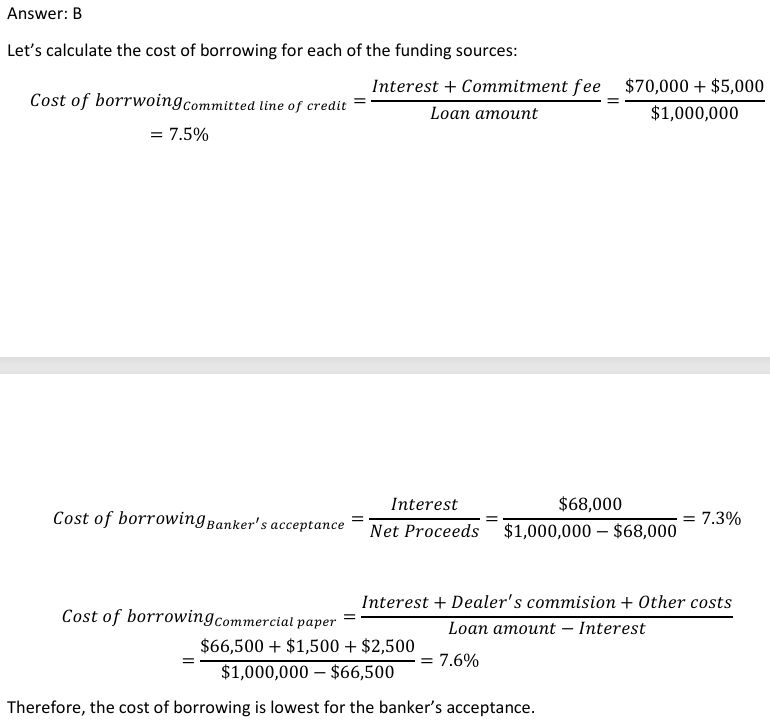
Corporation Sigma is considering three different sources of short-term financing: Suppose the firm needs $1,000,000 for a year. Which form of financing would result in the lowest cost of credit?
• Obtaining a committed line of credit at a 7%-rate and 0.5% commission fee
• A banker’s acceptance at a 6.8% rate, stated on an “all inclusive” basis
• A commercial paper at a rate of 6.65% which has a dealer’s commission of 0.15% and a credit enhancement fee of 0.25%
A. Line of credit
B. Banker’s acceptance
C. Commercial paper
B, see image