The Thyroid gland
 Call Kai
 Learn
Learn Practice Test
 Spaced Repetition
 Match
Match Flashcards
 Knowt Play
1/11

There's no tags or description
Looks like no tags are added yet.
Name | Mastery | Learn | Test | Matching | Spaced | Call with Kai | Chat |
|---|
No analytics yet
Send a link to your students to track their progress
12 Terms
What is the thyroid gland?
Gland in the neck that sits in front of the trachea
Produces hormones that regulate metabolism
What hormones does the thyroid gland produce?
Synthesises, secretes and stores Tri-iodothyronine and Tetra-iodothyronine (thyroxine)
Thyroid gland takes in iodine from diet and converts it into T3 and T4
Only gland to take in iodine
Increases metabolic rate
Essential for growth, development and healthy life
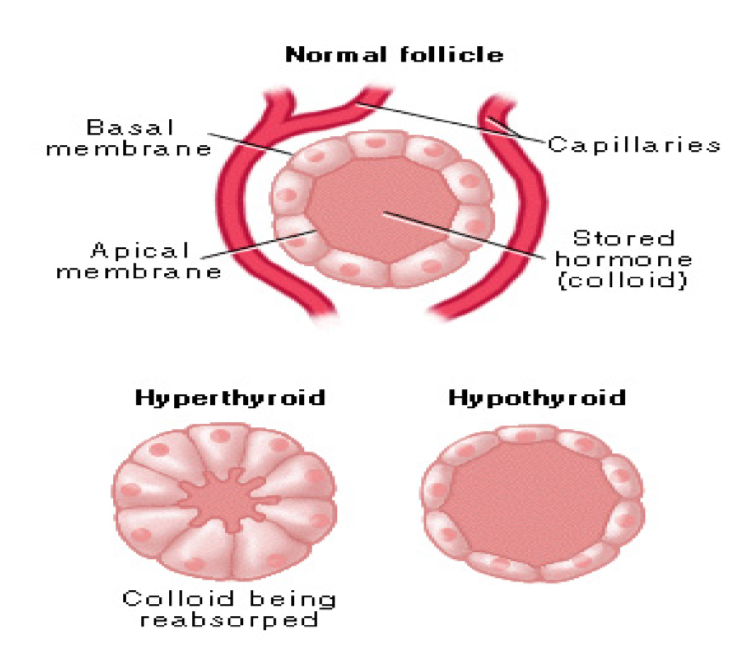
Difference between a normal thyroid, hypo and hyper thyroid
Stored in the lumen - colloid
Thyroid folliclle cells produce thyroglobulin protein and stored in the lumen

How are T3 and T4 made?
TSH receptors are on follicular cells. Binding causes thyroglobulin production
Thyroglobulin enters the colloid
Sodium iodide transporter is used to bring I- into the cells and then the pendrin transporter to get into the lumen
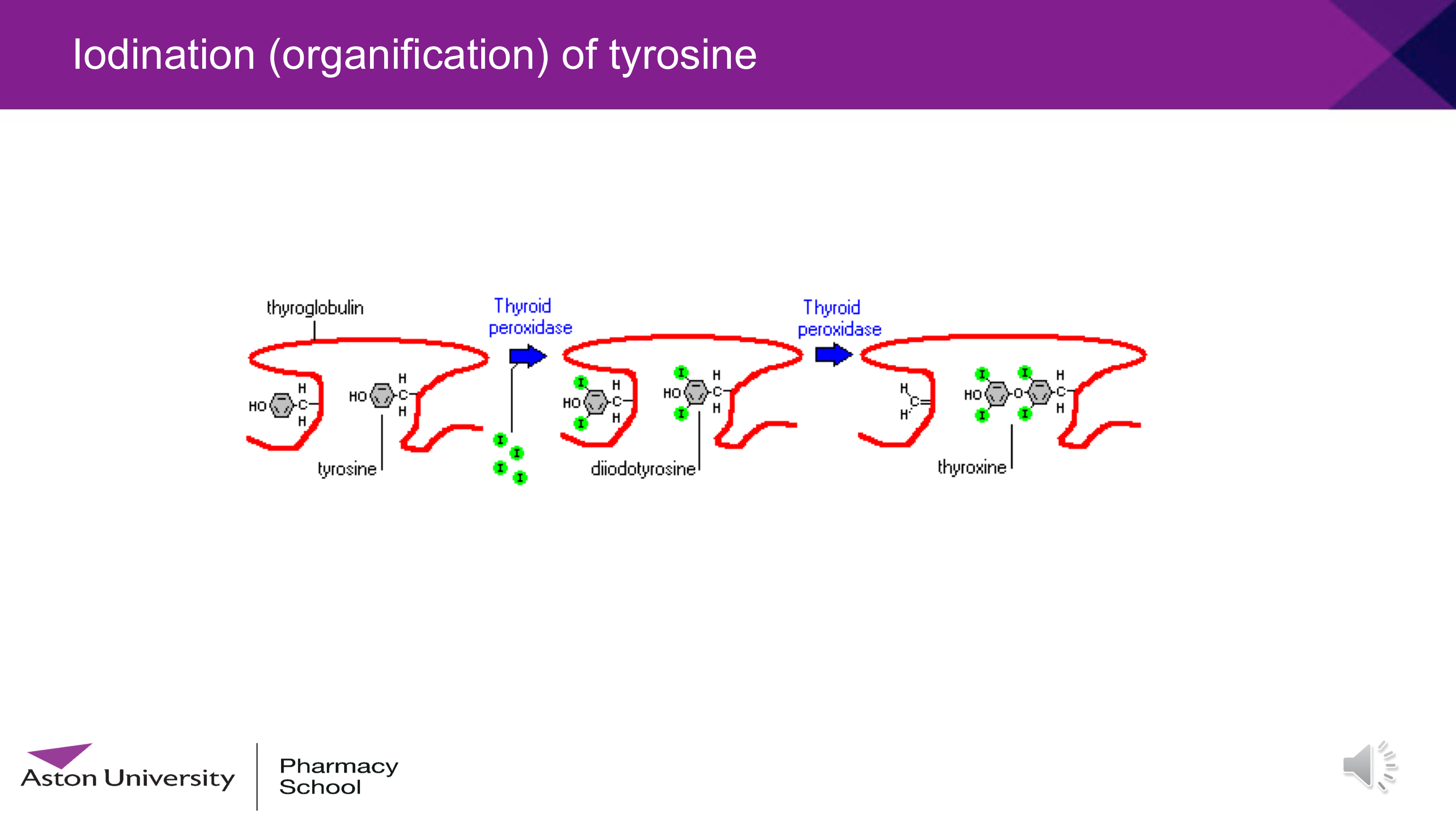
Iodide gets oxidised into atomic iodine by thyroperoxidase
Iodine attaches to tyrosine rings on thyroglobulin to make MIT/DIT
MIT+DIT= T3, DIT+DIT=T4
Thyroglobulin is taken into the follicle cells and then cut up into T3 and T4
These are then secreted into the bloodstream

What are the stages of T3 and T4 secretion?
Iodine uptake into cell
Active transport by carrier
Iodination of tyrosine residues on thyroglobulin (TG)
By thyroperoxidase enzyme
Called organic binding
Formation of T3 and T4 from MIT and DIT
Endocytosis of TG, enzymatic release of T3 and T4, secretion
What do the thyroid hormones do to metabolism?
Regulate metabolism in most tissues.
Modulate effects of other hormones (e.g. glucagon)
T3 more potent than T4
Increase metabolism of carbohydrates, proteins and fat
Increase oxygen use and heat production
Increased basal metabolic rate
Deamination, deiodination and conjugation with glucuronic and sulfuric acids
How do thyroid hormones affect growth and development?
Direct and indirect action on cells
Potentiates secretion and effects of growth hormone
Needed for normal skeletal development, and maturation of CNS.
Act by entering cell nucleus, T3 binds to receptor and switches it off.
Receptor normally STOPS transcription
So, T3 causes increase mRNA and protein synthesis in cells
How are thyroid hormones transported?
T3 and T4 transported bound to a protein carrier, TBG, little free.
TBG (thyroxine binding globulin)
LARGE pool T4, less active and mainly in circulation
SMALL pool of T3, mainly intracellular
T4 converted to T3 in target tissues, T3 is the active form
How is secretion of thyroid hormones controlled?
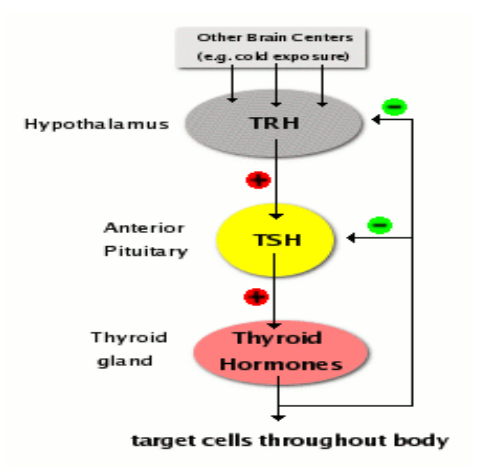
Negative feedback
Hypothalamus has a stimulus and releases Thyrotropin releasing hormone
Positive effect in anterior pituitary gland
Pituitary releases thyroid stimulating hormone
Thyroid gland is now stimulated and T3 and T4 are released
What does the hypothalmic pituitary thryoid axis do?
Plays the major role in regulating thyroid hormone homeostasis
Under the control of neurons in the median region of the PVN that synthesise and release TRH into the the pituitary gland
How is TSH brought to cells?
Rich blood supply of capillaries
What do the parafollicular cells do?
Produces calcitonin