6B. 9/3/26 - NSAIDs: Salicylates, Fenamates, Oxicams & COX-2 Inhibitors
 Call Kai
 Learn
Learn Practice Test
 Spaced Repetition
 Match
Match Flashcards
 Knowt Play
1/22

There's no tags or description
Looks like no tags are added yet.
Name | Mastery | Learn | Test | Matching | Spaced | Call with Kai | Chat |
|---|
No analytics yet
Send a link to your students to track their progress
23 Terms
What are Oxicams?
Piroxicam + meloxicam
Oxicams: core structure
Piroxicam + meloxicam
Acidic group = enol, NOT carboxylic acid; Enol donates H⁺ → negatively charged form; Negative charge is stabilized by an intramolecular interaction
Anion binds arginine in the COX active site
Both have 2 conjugated aromatic groups → stronger potency
Fused rings count as one aromatic group.
Oxicams: core structure
Recognizing them
Piroxicam →
Meloxicam →
Piroxicam → pyridine ring → think P = pyridine
a 6-membered ring
5 carbons + 1 nitrogen
Meloxicam → methylthiazole ring
a 5-membered ring
containing sulfur (S) and nitrogen (N)
with a methyl group (–CH₃) attached to it

Piroxicam

Meloxicam
Piroxicam vs meloxicam
chart
Piroxicam | Meloxicam | |
|---|---|---|
COX preference | COX-1 | COX-2 |
GI risk | Higher | Lower |
Half-life | ~50 hr | ~20 hr |
Metabolizing CYP | CYP2C9 | CYP2C9 |
Phase I | Aromatic hydroxylation | Benzylic hydroxylation |
Phase II | Glucuronide ether (glucuronic acid attaches to an –OH group) | Glucuronide ester (glucuronic acid attaches to a carboxylic acid –COOH) |
Piroxicam → ___ COX-1 inhibition in gut →
Meloxicam → ____ COX-1 inhibition in gut →
Piroxicam → more COX-1 inhibition in gut → greater GI toxicity
Meloxicam → less COX-1 inhibition in gut → lower GI toxicity.
What type of Nsaids are Piroxicam vs Meloxicam?
Both are still nonselective NSAIDs; they simply have a preference.
Meloxicam concern?
Greater COX-2 preference → somewhat greater cardiovascular concern.
Piroxicam Metabolism
CYP2C9
→ aromatic hydroxylation at para position on ring 2
→ aromatic OH
→ glucuronidation
→ glucuronide ETHER
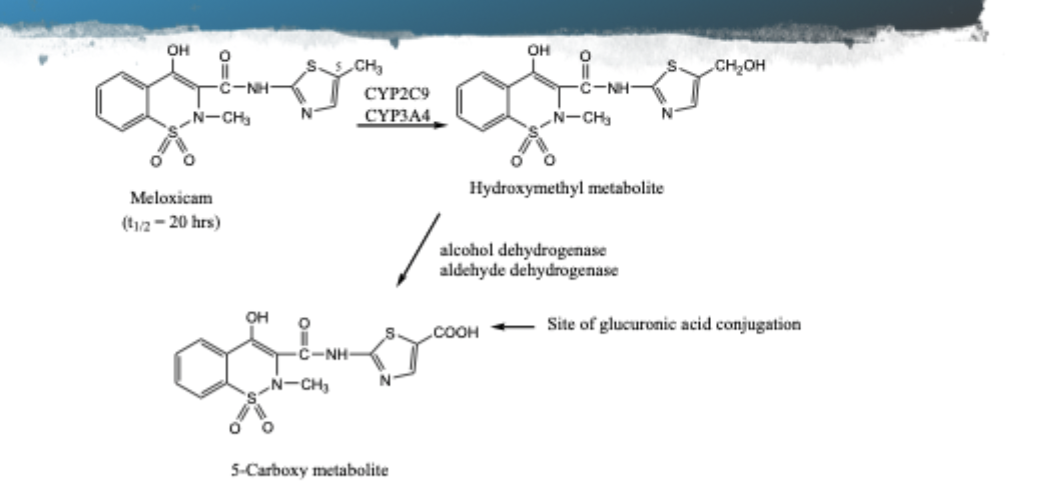
Meloxicam Metabolism
CYP2C9
→ benzylic hydroxylation
→ primary alcohol
→ aldehyde
→ carboxylic acid
→ glucuronidation
→ glucuronide ESTER.
Piroxicam vs meloxicam
Metabolic-speed theme
Aromatic hydroxylation = slower
Benzylic oxidation = faster
Professor connected this with piroxicam's longer half-life, while also noting tissue distribution


COX-2 selective drugs
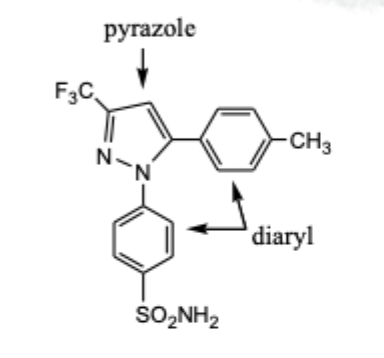
Major structural clue:
3 independent aromatic rings
→ bulky structure
→ does not fit COX-1 appropriately
→ can access COX-2.
What’s the marketed COX-2-selective drug?
Celecoxib
Why celecoxib is COX-2 selective?
Valine gatekeeper residues = smaller
→ allosteric site accessible
→ celecoxib fits.
COX-1
Isoleucine gatekeepers = larger
→ block allosteric site
active site itself too small for celecoxib.
Therefore:
Celecoxib → COX-2 allosteric site.
What is Celecoxib acidic group?
sulfonamide → ionizes → interacts with arginine in the allosteric region.
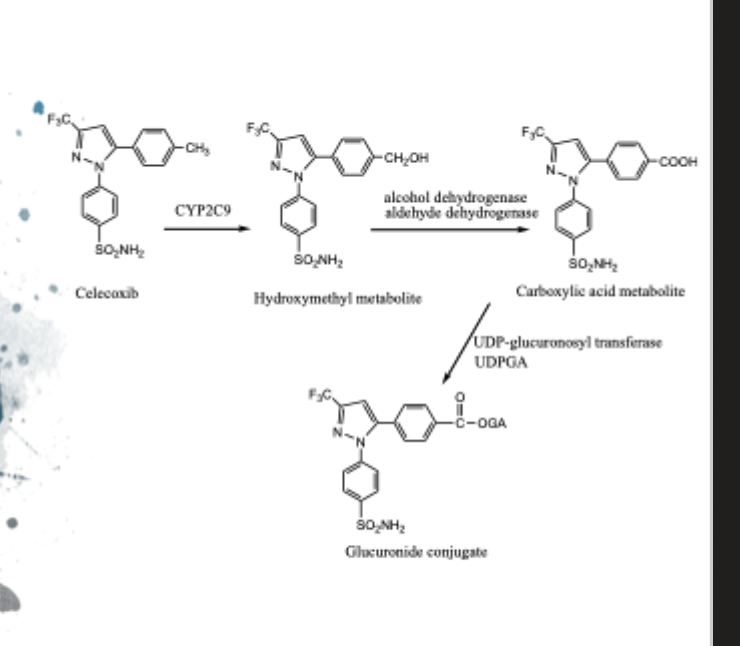
Celecoxib metabolism
Celecoxib
→ CYP2C9
→ benzylic oxidation
→ primary alcohol
→ aldehyde
→ carboxylic acid
→ glucuronidation
→ excretion.

TXA₂ vs PGI₂
Action | |
|---|---|
TXA₂ | Vasoconstriction + platelet aggregation ↑ |
PGI₂ | Vasorelaxation + platelet aggregation ↓ |
Why celecoxib has CV concern?
Celecoxib inhibits COX-2
→ PGI₂ ↓
→ TXA₂ : PGI₂ balance shifts toward TXA₂
→ vasoconstriction + platelet aggregation ↑
→ cardiovascular risk concern.