MST 100 - The History of Media (The Sociocultural Context)
 Call Kai
 Learn
Learn Practice Test
 Spaced Repetition
 Match
Match Flashcards
 Knowt Play
1/16

Earn XP
Description and Tags
Name | Mastery | Learn | Test | Matching | Spaced | Call with Kai | Chat |
|---|
No analytics yet
Send a link to your students to track their progress
17 Terms
society*
institutions and relationships
General term, institutes and relationships w/in which a relatively large group of people live
Abstract condition in which such relationships form
culture*
ways of life, knowledge, beliefs, practices, and expressions
Intellectual, spiritual, and aesthetic development
Intellectual and artistic works: High culture – Popular culture – Folk culture
A particular way of life, including knowledge, belief, art, morals, law, custom, and any other capabilities and habits acquired
why does media matter?
help us encounter and understand both society and culture
vital link how we see and understand our relationship with our society and culture.
media has a large impact on our society and culture in Canada. It creates and reinforces how we understand the world and ourselves within it.
What was communication limited by before mass media?
distance
speed
transportation
access
before print, there was…
writing
Memory can exist outside the human body
Knowledge can travel across time + space
But who can read? Write? Controls the records?
Europe, 1400s
The Renaissance led to renewed interest in:
Learning
Human potential
Reason
Ideas
A changing society creates new communication needs, e.g., the printing press.
what did print do?
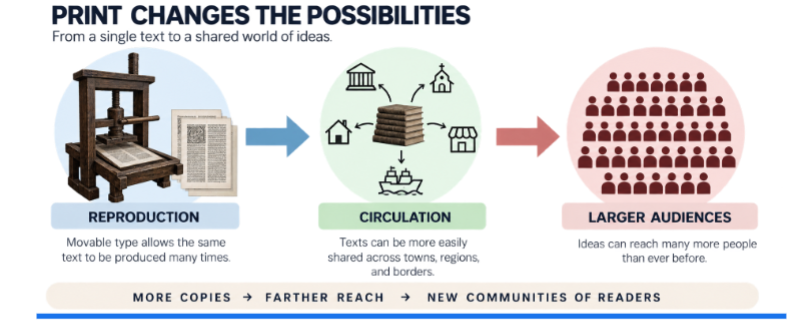
print changed possibilities
Before the printing press, reproducing text was time-consuming; the printing press changed that by making it quicker and easier to spread information.
why does print become important?

a feedback loop

Print expands access
ideas become harder to contain
More copies = more readers = info travels greater distances = less control over ideas
print expanded access, but did not mean it was distributed equally
The European Roots of Media and Western Society
Allowed individuals to develop and record their ideas
Could be more readily shared
the enlightenment
the time for
reason
science
rights
public debate
The industrial revolution, communication, and social form
All the changes created a communication need
All the moving parts need someone in charge to coordinate
the problem of distance returns
Industrial society has a communication problem
people move
goods move
market expand
cities grow
telegram breaks the link
Before
Communication was impacted by the speed of communication
Had to wait for a person or animal to transport it
After
Info moves faster than people
the early evolution of media
Media development in this context is close to geographical and social distances.
The media becomes increasingly layered. New media builds on older types of media.
New media respond to changing social needs
Telegraph → information across distance
Telephone → voice across distance
Photography → memory + distant events
Film → mass entertainment + leisure
from communcation to mass commuciaction
one → many
newspaper
film
radio