5: Amino Acids, Proteins, Protein Folding, Function
 Call Kai
 Learn
Learn Practice Test
 Spaced Repetition
 Match
Match Flashcards
 Knowt Play
1/122

There's no tags or description
Looks like no tags are added yet.
Name | Mastery | Learn | Test | Matching | Spaced | Call with Kai | Chat |
|---|
No analytics yet
Send a link to your students to track their progress
123 Terms
Hydrophobic
Having an aversion to water.
Hydrophilic
Having an affinity for water.
why is glucose hydrophilic
hydroxyl group capable of forming plenty of H bonds with water making glucose highly soluble in aqueous solutions
why is cholesterol hydrophobic
4 fused rings and aliphatic carbon chain highly hydrophobic. OH group is polar inserts into lipid bilayers
why is palmitate hydrophobic
long acyl chain has no ability to form H bonds with water as groups are non-polar
why is lactate hydrophilic
polar OH groups and ionised carboxyl groups allows lactate molecule to interact with water
isoelectric point of a prt (pI)
pH at which there is no overall net charge. number of +ve and -ve charges in the chain are equal
The protein serum albumin has an isoelectric point of 5.0. If this protein was placed in an electric field at physiological pH, would it move towards the positive or negative electrode? Explain your answer.
pH>pI deprotonated
physiological pH is 7
therefore albumin would be deprotonated. therefore it will be -vely charged and move to anode ie +ve electrode
when does deprotonation of a prt occur
when pH > pI
The protein serum albumin has an isoelectric point of 5.0. If this protein was placed in an electric field at physiological pH. Which direction would the same protein migrate at pH 5.0?
pH = pI so overall net charge. cannot be attracted to any electrodes
The protein serum albumin has an isoelectric point of 5.0. If this protein was placed in an electric field at physiological pH. Which direction would the same protein migrate at pH 4.0?
pH> pI + deprotonated
4=/= >pI of 5
will be protonated
will move to cathode
The isoelectric point of histones is very high, about 10.8. CT5.7 What charge will histones have under physiological conditions?
pH>pI deprotonated
physiological conditions 7.2
7.2 =/= > 10.8
protonated
+VE charge
Which type of amino acids must be present in large numbers in proteins +vely charged in physiological conditions?
basic protein so contains high: lys and arg. they have high pK values.
amino acids and their polarities and charges
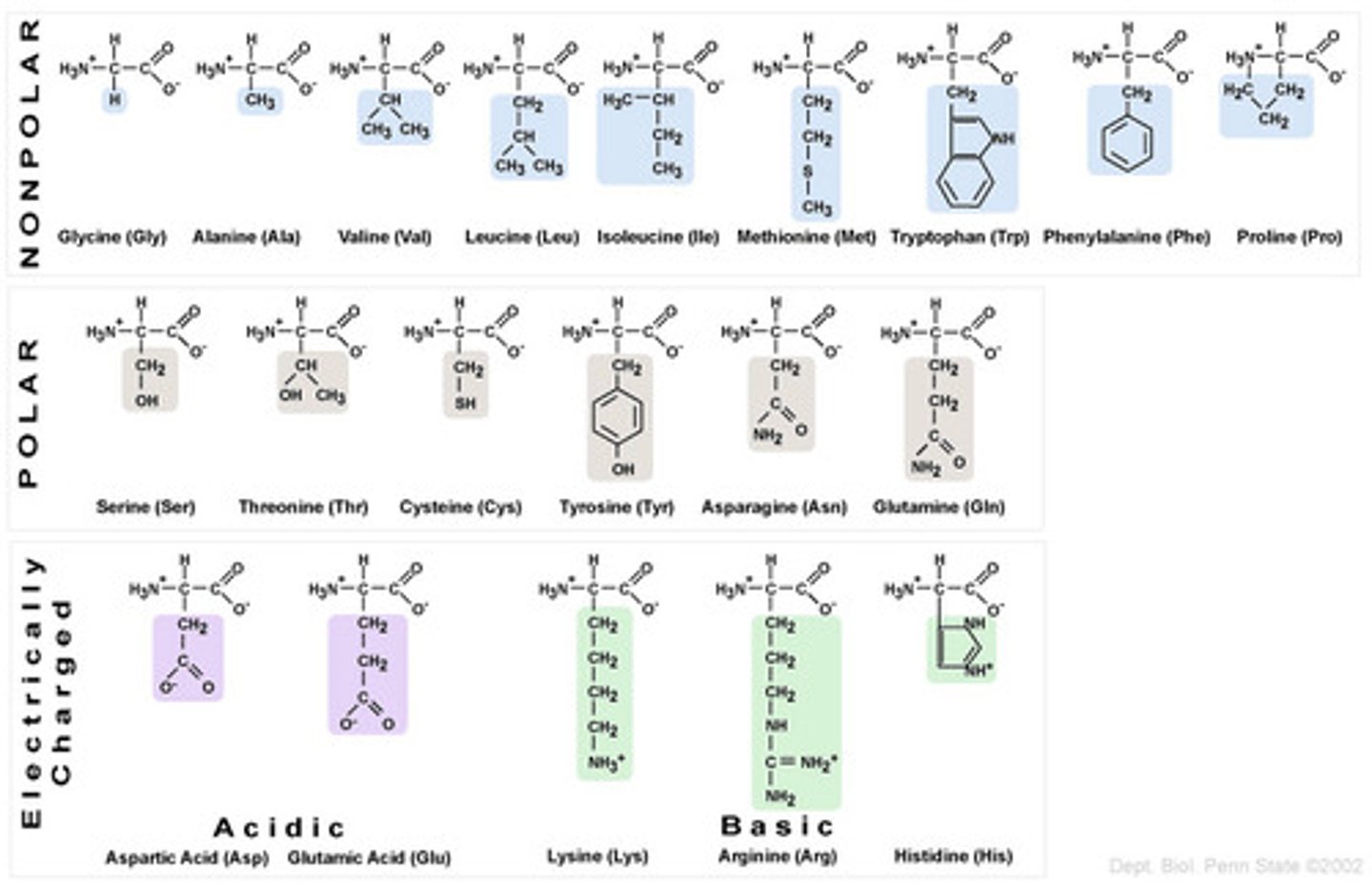
purpose of histone's positive charge. why is it a basic prt?
chromatin is a macromolecular complex composed of histone prts and DNA. +VE histones interact via electrostatic interactions with the -ve charged DNA
explain whether each of the following changes is likely to have a large or small effect on protein function.
arginine changed to lysine
both have +ve R groups. substitutions generally tolerated but prt stability can be impaired
explain whether each of the following changes is likely to have a large or small effect on protein function.
arginine changed to glutamate
positive to negative so big change likely to be severe
explain whether each of the following changes is likely to have a large or small effect on protein function.
alanine to glycine
small hyrophobic to another small hydrophobic minimal effect
explain whether each of the following changes is likely to have a large or small effect on protein function.
alanine changed to tryptophan
small hydrophobic changed to large hydrophobic. affect due to change in size
Why are peptide bonds important for the secondary structure of proteins?
peptide bonds form the link between adjacent AA and made by joining carboxyl group of one AA with AA of another. peptide has carbonyl and amide either side of the bond. both are able to form hydrogen bonds and these groups are the major determinant of 2* structure of prts.
cytoplasm role
metabolism of carbs, AA and nucleotides
lysosome function
enzymes cellular digestion
golgi complex function
export of prts and detoxification reactions
ER function
export of prts, membrane synth, lipid and steroid synth, detoxification reactions, prt synth
nucleus and nucleolus function
rna synthesis, rna processing and ribosome assembly (nucleolus), dna synthesis and repair
plasma membrane
cell morphology and movement, transport of ions and small molecules
give one condition or reagent that will disrupt IMF and explain how this works.
1.disulphide bonds: reducing agents eg mercaptoethanol/ dithiothreitol
2.hydrogen bonds: pH extremes
3. hydrophobic interactions: detergents/ organic solvents/ urea
4. ionic interactions: changes in pH or ionic strength
Proteins that span biological membranes often contain α-helices. The inside of the membranes are hydrophobic in nature, and they are approximately 3nm in width. what types of amino acids would exist in such a helix?
hydrophic AA as there are no water molecules within the bilayer for polar side chains to form H bonds with side chains of hydrophobic AA residues will make hydrophobic interactions with predominantly hydrophobic fatty acyl tail regions. other H bonding groups are involved with maintaining the structure of a-helix via intrachain h bonds
Proteins that span biological membranes often contain α-helices. The inside of the membranes are hydrophobic in nature, and they are approximately 3nm in width.
What would be the minimum number of amino acids needed to span such a membrane?
The pitch of an α-helix is 0.54nm i.e. the length of 1 complete turn of the helix 3.6 amino acids per turn Therefore, the length of an α-helix is 0.15nm per amino acid (0.54/3.6) Therefore, minimum no. of amino acids needed to span 3nm is 20.
An 11-year-old girl with a history of mild bronchial asthma presented with fever and increased breathing rate. An arterial blood gas was obtained upon arrival to the Emergency Department, showing a pH of 7.22, a pCO2 of 38 mmHg, and a serum bicarbonate level of 15 mEq/L. Her serum sodium and chloride were 141 and 110 mEq/L.
Using the pH values as a guide, what is the diagnosis of this patient?
metabolic acidosis as bicarbonate level is low at 15 mEq/L whereas pCO2 is almost normal rendering the primary disorder metabolic acidosis
What is the normal range for arterial blood gas pH?
7.34-7.44
Why might you expect this patient to be hyperventilating? metabolic acidosis
hyperventilation to decrease CO2 and reduce bicarbonate ion levels in the blood
Mark, a 50 year old farmer, has recently had a herd of cows destroyed due to 'mad cow disease' or Creutzfeldt-Jakob disease. He is worried that he may have contracted the disease as he is tired all the time due to insomnia and feels unbalanced.
What protein aggregates in CJD plaques?
prion proteins
In which anatomical and cellular locations are the plaques of proteins formed in CJD?
extracellular plaques, oligomers inside and outside of neurones,
What is the typical alterations within a proteins conformation that leads to protein aggregation?
transformation of alpha helix normally folded prt into beta sheets in misfolded prts
Initial neurological symptoms of CJD
difficulty walking caused by balance and co-ordination problems, slurred speech, numbness or pins and needles in diff parts of the body. psychological symptoms eg anxiety, depression, social withdrawal, insomnia
Mark, a 50 year old farmer, has recently had a herd of cows destroyed due to 'mad cow disease' or Creutzfeldt-Jakob disease. He is worried that he may have contracted the disease as he is tired all the time due to insomnia and feels unbalanced.
Is it likely that Mark has contracted CJD from his herd of cows?
small probability infected material from cows may have come into close contact with the farmer, more likely symptoms are bc of a stressful time
How would a doctor diagnose CJD?
neurological tests to rule out other conditions. definitive diagnosis only from death and brain biopsy
Diane is 46 years old. She has been married for 22 years and has 3 sons, the youngest of whom is 16. She works as a telesales operator, which involves a lot of evening work. Her husband runs his own business and works very long hours. Experiences of relatives and friends: over the past few years, Diane's family have become aware that Mum is not coping as well as she did, and she seems to have very little energy. Her husband is concerned about her. She has gained weight, her hair has become "scrappy", and her skin is not as attractive as it was. She seems to have lost much of her enthusiasm for life. Her youngest son remarked the other day that Mum's voice seems to have changed. Diane has noticed: she is finding it very difficult to cope with her work/life balance and it seems to take all her energy, she is becoming increasingly concerned about her appearance, she has gained a stone in weight over the past year, just cannot do anything with her hair and finds herself buying more and more different varieties of face cream, which do not seem to have much effect, she is having trouble keeping up at work and tends to forget things much more than she used to, her periods, though still regular, have become heavy.
What hormones does the thyroid gland store and secrete?
thyroxine t4, tri-iodothyronine t3. iodinated forms of thyroglobuline stored in colloid. calcitonin by PT glands
most biologically active thyroid hormone
t3
Thyroid hormones are derivatives of the amino acid tyrosine bound covalently to iodine. List in order of relative strength (greatest to least) the different types of biological bonds that stabilise a proteins structure.
covalant>ionic> hydrogen> hydrophobic
Diane has found some websites selling cream that claim to have a 100% improvement in skin smoothness. What factors should you consider when advising Diane about information on websites?
Source Appropriate for your purpose Bias / Objectivity Currency Academic Good Practice
peptide bond formation
second stage of elongation; peptide bonds form between amino acids that are linked to tRNAs in the P and A sites. produces water as a biproduct
What is an amphipathic molecule and give an example?
A molecule that has a polar and non-polar region e.g. phosphatidylcholine (type of phospholipid found in eggs, soyabeans), bile acids, cholesterol
What is the importance of the R group in an amino acid?
Determines its acid-base behaviour and amino acids are classified according to the R group.
A 47 year old cattle farmer is admitted to A&E with gait abnormalities and behaviour changes. It is suspected that he may have a rare disease known as Variant Creutzfeldt-Jakob disease (vCJD). What is the pathophysiology behind vCJD?
altered conformation of the human prion protein formed as beta sheets not alpha helix. this can accumulate in nerve cells causing them to degenerate. forming sponge like form of the brain.
What are the other symptoms associated with (vCJD)?
creutzfeldt jakob disease
Tingling in hands and feet, psychosis, dementia, gait disturbances/paralysis, coma and behaviour changes.
Give 3 examples of the roles proteins have in cells.
Catalysts, transporters, structural support, immune protection, ion channels, machines, receptors and ligands in cell signalling
amyloid fibril stain
congo red. can block amyloid fibril production in cells. drawback of getting these molecules into the cell in the first place.
Amyloidosis: Pathogenesis
fibrils form that contained b sheets from one protein molecule associate with the same region from another molecule. continues resulting in formation of large insoluble aggregates that form the fibril.
how molecules that relieve Alzheimer's works
small hydrophobic aromatic compounds block the formation of amyloid fibrils. aromatic AA stabilise the interaction of B sheets between adjacent proteins. aromatic compounds interfere with fibril formation by blocking interactions of the aromatic side chains.
how are H bonds arranged in an alpha helix
parallel to the axis of the helix
where are groups on AA residues in a helix
outside of helix spiral
describe globular proteins
usually soluble, complex tertiary structure, compact shape, many different roles, several types of secondary structure eg haemoglobin
describe fibrous proteins
structural role, little or no tertiary structure, long strands and sheets, insoluble, single type of repeating structure. long strands or sheets. insoluble in water. single type of repeating secondary structure. eg collagen
amino acids and steroisomerism
all exhibit stereoisomerism but glycine as they all have a chiral carbon
classification of amino acids
chemical structure of their R group
amino acids without ionisable R group
exist as dipolar or zwitterion when dissolved fully dissolved in water at a pH of 7.
peptide bond in AA features
linked amino acids form peptide bond of carbonyl group of one amino acid and amine group of another. all atoms of the bond are on the same plane. there is no rotation about the bond due to double bond characteristics. this makes the peptide bond rigid and planar. carbonyl oxygen and amide hydrogen are in trans rotation as if they were in cis it would cause the molecule to be onesided and bulky and cause steric clashes
protein structure as a result of AA
AA contribute to folding with side chains of amino acids more important as they contribute to the charge of the protein.
isoelectric point
point at which protein has no overall net charge. acidic proteins have low pI and basic proteins have high pI.
secondary structure of protein formation
segment of polypeptide chain only considers main chain atoms of the polypeptide. bonds on either side of the peptide bond are not rigid but can rotate freely. when these angles remain the same throughout a segment of polypeptide then the protein adopts regular secondary structure. for example a-helix and b-pleated sheets
formation of tertiary structure
overall 3d structure of protein and formed as a result of interactions between R groups (eg hydrophobic, ionic, h bonds, disulfide bridges). folding of secondary structures so that amino acids far apart in the sequence interact. larger proteins tend to have distinct domains (regions of polypeptides that have distinct structures and serve particular roles eg ligand binding). this determines the function and properties of the protein.
quaternary structure
more than one polypeptide chain in a protein known as subunits resultant arrangement of these subunits to form a functional protein. eg haemoglobin, potassium channel
homomeric proteins
protein that contains identical subunits
heteromeric proteins
quaternary structure containing different subunit chains
fibrous proteins
provide support
globular
regulatory proteins
protein folding regulation
all information necessary for protein to fold correctly is contained in primary sequence. proteins fold spontaneously as they are synthesised with some requiring molecular chaperones
protein denaturation
loss of protein structure sufficient enough to cause loss of function as a result of broken bonds that maintain tertiary and secondary structure.
formation of monomeric units to macromeric units
monomeric units joined together by covalent bonds to form macromolecules. macromolecules and complexes held together by weak non-covalent interactions. multiple weak interactions increase the stability of the complex. breaking of them can cause loss of structure and function.
solubility of biomolecules
depends on the ability of the molecules to form hydrogen bonds. this is as a result of unequal sharing of electrons on H bond
amphipathic molecules in aqueous solution
polar and non polar regions. hydrophobic regions cluster together and hydrophilic regions interact with water forming an ordered shell of water that interacts with hydrophilic head groups.
formation of primary structure
formation of peptide bond of N terminal from one protein with C terminal of another with the elimination of water. this requires ATP. amino acid sequence of a protein encoded for by a gene. the nucleotide sequence of a gene determines the amino acid sequence. this then determines the folding of the polypeptide chain.
features of amino acid
aside from glycine, chiral centre (a-carbon), amino group, carboxyl group, hydrogen atom, distinctive side chain
L or D isomers in humans
all proteins exist in L form
why is tyrosine classified as hydrophilic when it is hydrophobic
tyrosine has phenol R group so is polar due to the presence of OH but it is hydrophobic due to aromatic portion of R group. however, has it has more hydrophilic tendencies than phenylalanine
zwitterion
at a specific pI, the carboxyl group and amino group can both ionise with overall netcharge being zero.
what happens when protein in low pH
becomes protonated (Nh3+, Cooh)
what happens when protein in high pH
becomes deprotonated (N2H, COO-)
PH of solution < group pKa
group will be protonated
pH solution> group pKa
group will be deprotonated
positively charged R grouped AAs
lysine, arginine, histidine
negatively charged R grouped AA
glutamate, aspartate
acidic proteins
many negetively charged amino acids and pI <7. eg serum albumin, haemoglobin, myoglobin
basic proteins
contain many +vely charged amino acids. pI >7 eg lysozyme, cytochrome C
dipeptide trp-arg
effective inhibitor of dipeptidyl peptidase IV ad possibly useful in diabetes as dipeptidyl peptidase IV deactivates glucagon so inhibition of it would increase glucagon therefore stimulate insulin release
SRP9
smallest protein. binds to ribosome and takes it to RER which helps target secretory proteins.
titin
spring in skeletal muscle. largest human protein
conjugated protein
those with prosthetic groups.
primary protein structure
covalent peptide bonds hold amino acids together. angles of the fold determine the conformation of the peptide backbone and hence the fold of the protein
how many amino acids a turn
3.6. 0.54 nm a pitch on right handed helix.
alpha helix stability
R groups outside forming a tightly packed core. backbone of C=O of one amino acid is H bonded to the NH of another. small hydrophobic residues are strong helix formers whereas Pro and Gly act as helix breakers. a helix more energetically favourable
why is Pro helix breaker
rotation around N-Ca bond is impossible
why is Gly helix breaker
tiny R group supports other formations and interacts with many different residues.
B strand
fully extended conformation. 0.35nm between amino acids. R groups alternate opposite sides of the chain. side by side arrangement make B sheet.
antiparallel B sheet
adjacent strands run in opposite directions with multiple inter-strand H bonds stabilising the structure. stronger as H bonds are in straight lines.
Parallel B sheet
H bonds are not straight and are not in straight lines therefore structure is weaker.
example of alpha helix
ferritin iron storage molecule