Module 7 - Intro
 Call Kai
 Learn
Learn Practice Test
 Spaced Repetition
 Match
Match Flashcards
 Knowt Play
1/68

There's no tags or description
Looks like no tags are added yet.
Name | Mastery | Learn | Test | Matching | Spaced | Call with Kai | Chat |
|---|
No analytics yet
Send a link to your students to track their progress
69 Terms
Systemic Drugs
Chemotherapeutic Drugs
2 Major Types of Drugs
2 Major Types of Drugs
Systemic Drugs
Chemotherapeutic Drugs
2 Major Types of _____
Systemic Drugs
Chemotherapeutic Drugs
Systemic Drugs – drugs that acts on the different system. It is a symptomatic treatment according to the clinical signs.
________ Drugs – drugs that acts on the different system. It is a symptomatic treatment according to the clinical signs.
Chemotherapeutic Drugs – drugs used to treat diseases based on the causative agents
_________ Drugs – drugs used to treat diseases based on the causative agents
Systemic Drugs – drugs that acts on the different system. It is a symptomatic treatment according to the clinical signs.
Systemic Drugs – drugs that ____ on the different ______. It is a ________ treatment according to the clinical signs.
Chemotherapeutic Drugs – drugs used to treat diseases based on the causative agents
Chemotherapeutic Drugs – drugs used to ______ diseases based on the ________ _______
Nervous System
Neuromuscular system
Two systems to be studied under systemic drugs?
Central Nervous System (CNS)
Peripheral Nervous System (PNS)
The Nervous System is made up of 2 basic parts:
Central Nervous System (CNS) - Components are located in the middle and are protected by bones
____________________ (____) - Components are located in the middle and are protected by bones
Central Nervous System (CNS) - Components are located in the middle and are protected by bones
Central Nervous System (CNS) - Components are located in the ______ and are protected by ______
Brain
Spinal cord
Components of the CNS
Cranial Nerve - from the brain
Spinal Nerve - from the spinal cord
Somatic Nervous System
Autonomic Nervous System
Peripheral nervous system are composed of the following
Somatic Nervous System
- Voluntary control
- Can be controlled by the brain
_________ Nervous System
- Voluntary control
- Can be controlled by the brain
Autonomic Nervous System
- Sustain hemostatic conditions within an organism
- Organized to modulate involuntary activities of the secretory glands, smooth muscles, and visceral organs.
________ Nervous System
- Sustain hemostatic conditions within an organism
- Organized to modulate involuntary activities of the secretory glands, smooth muscles, and visceral organs.
Somatic Nervous System
- Voluntary control
- Can be controlled by the brain
Somatic = Self-controlled
Somatic Nervous System
- _______ control
- Can be controlled by the _____
Autonomic Nervous System
- Sustain hemostatic conditions within an organism
- Organized to modulate involuntary activities of the secretory glands, smooth muscles, and visceral organs.
"AUTONOMIC runs on AUTOMATIC." Your body digests food, secretes sweat, and beats your heart on autopilot.
Autonomic Nervous System
- Sustain _________ conditions within an organism
- Organized to modulate ________ activities of the secretory glands, smooth muscles, and visceral organs.
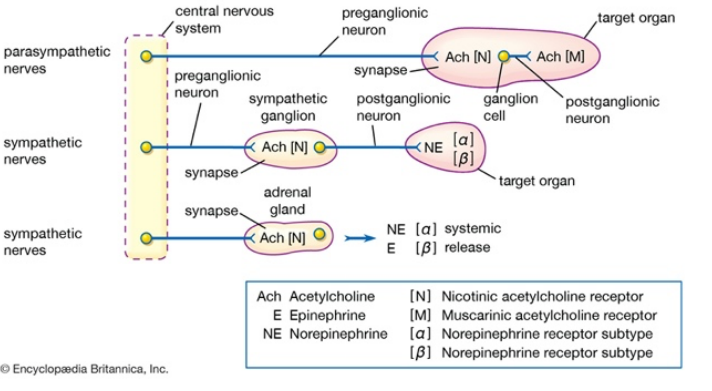
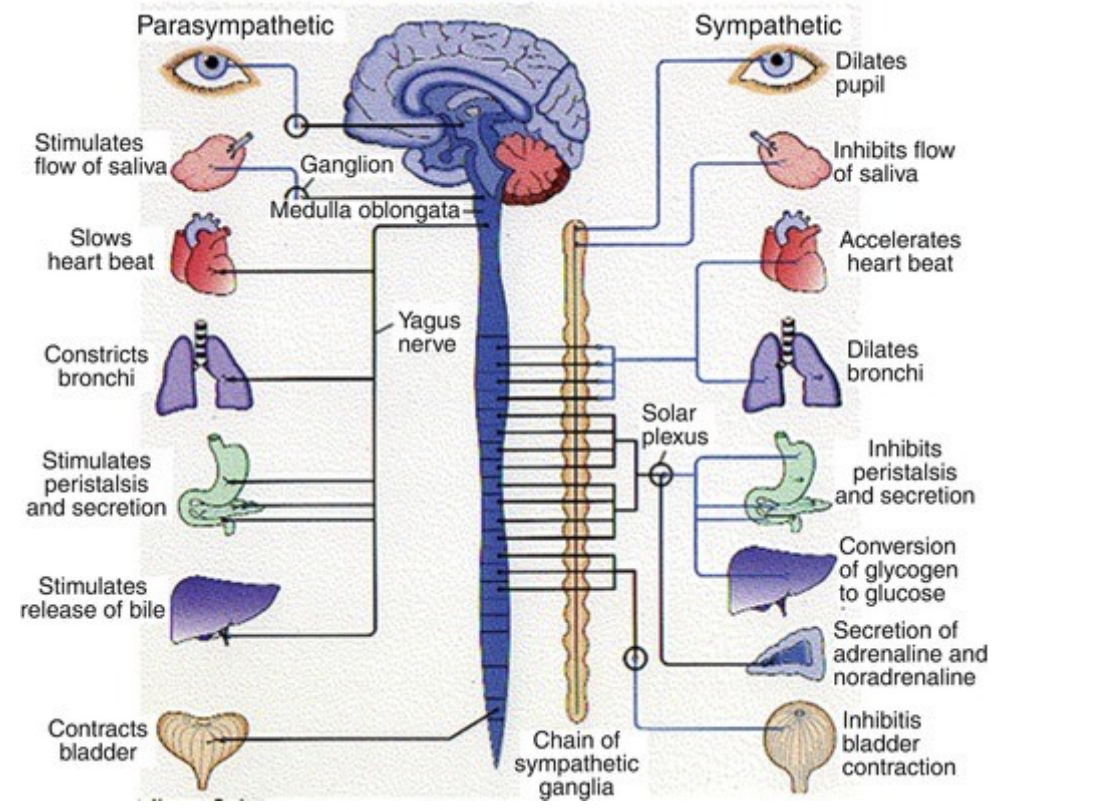
Sympathetic (Fight or Flight)
Parasympathetic (Rest & Digest)
Sympathetic = STRESS.
Parasympathetic = PEACEFUL
Autonomic nervous system is Divided into 2 parts:
Sympathetic (Fight or Flight)
Often referred to as the thoracolumbar outflow because of the anatomic origin.
Sympathetic (Fight or Flight) - Often referred to as the thoracolumbar outflow because of the anatomic origin
Sympathetic (Fight or Flight) - Often referred to as the ________ outflow because of the _______ origin
Sympathetic (Fight or Flight)
Sympathetic post ganglionic ganglia are long since most sympathetic ganglia are located close proximity to the spinal cord
Sympathetic (Fight or Flight)
_________ ____ _______ ganglia are long since most sympathetic ganglia are located close proximity to the spinal cord
Sympathetic (Fight or Flight)
Sympathetic post ganglionic ganglia are long since most sympathetic ganglia are located close proximity to the spinal cord
Sympathetic (Fight or Flight)
Sympathetic post ganglionic ganglia are ____ since most sympathetic ganglia are located _____ proximity to the _____ ____
Sympathetic (Fight or Flight)
One sympathetic ganglionic neuron may be innervated by preganglionic fibers originating from several different nerve body.
Sympathetic (Fight or Flight)
One sympathetic ganglionic neuron may be innervated by preganglionic ______ originating from several different ______ _____.
Parasympathetic (Rest & Digest)
Often referred to as the craniosacral outflow because tracts originate from the midbrain, medulla oblongata, and sacral spinal cord.
Post-ganglionic parasympathetic fibers are usually quite short because the ganglia are located within innervated organs
It usually effects specific effector system individually.
__________ (Rest & Digest)
Often referred to as the craniosacral outflow because tracts originate from the midbrain, medulla oblongata, and sacral spinal cord.
Post-ganglionic parasympathetic fibers are usually quite short because the ganglia are located within innervated organs
It usually effects specific effector system individually.
Parasympathetic (Rest & Digest)
Often referred to as the craniosacral outflow because tracts originate from the midbrain, medulla oblongata, and sacral spinal cord.
Post-ganglionic parasympathetic fibers are usually quite short because the ganglia are located within innervated organs
It usually effects specific effector system individually.
Parasympathetic (Rest & Digest)
Often referred to as the ________ ______ because tracts originate from the _______, _______ ______, and ______ spinal cord.
Post-ganglionic parasympathetic fibers are usually quite ____ because the ganglia are located _____ innervated organs
It usually effects specific effector system _______.
Parasympathetic (Rest & Digest)
Often referred to as the craniosacral outflow because tracts originate from the midbrain, medulla oblongata, and sacral spinal cord.
Post-ganglionic parasympathetic fibers are usually quite short because the ganglia are located within innervated organs
It usually effects specific effector system individually.
Parasympathetic (Rest & Digest)
Often referred to as the craniosacral outflow because tracts originate from the midbrain, medulla oblongata, and sacral spinal cord.
_____-____________ _______ _____ are usually quite short because the ganglia are located within _______ organs
It usually effects specific _________ ________ individually.
Adrenal Medulla is an extremely important component of the sympathetic nervous system
_______ ________ is an extremely important component of the sympathetic nervous system
Vagus Nerve
considered to be the most important parasympathetic nerve trunk
Vagus Nerve is the considered to be the most important parasympathetic nerve trunk. Arises from medulla oblongata and send efferent fibers to all thoracic and abdominal viscera from caudal Pharyngeal region to the cranial portions of the large colon.
Vagus Nerve is the considered to be the most important _____________ nerve trunk. Arises from _______ ________ and send _______ fibers to all thoracic and abdominal viscera from caudal Pharyngeal region to the cranial portions of the large colon.
Sympathetic and Parasympathetic outflow tracts comprise preganglionic neurons and postganglionic neurons
Sympathetic and Parasympathetic ______ tracts comprise _______ neurons and ________- neurons
The cell body of a preganglionic neuron is located within the Central Nervous System
The ____ _____ of a ___________ neuron is located within the Central Nervous System
The cell body of a preganglionic neuron is located within the Central Nervous System
The cell body of a _________ neuron is located within the _______ Nervous System
The synapse (junction) of a preganglionic axon with a postganglionic neuronal body occurs outside the CNS within an autonomic ganglion.
The ________ (_____) of a preganglionic axon with a postganglionic neuronal body occurs ______ the CNS within an autonomic ganglion.
The synapse (junction) of a preganglionic axon with a postganglionic neuronal body occurs outside the CNS within an autonomic ganglion.
The _______ (junction) of a ________ axon with a postganglionic _______ ____ occurs outside the CNS within an _______ ganglion.
Autonomic Ganglia are specialized nodular structures comprising numerous neuronal bodies.
__________ _____ are specialized nodular structures comprising numerous neuronal bodies.
Autonomic Ganglia are specialized nodular structures comprising numerous neuronal bodies.
Autonomic Ganglia are specialized _______ structures comprising numerous _______ _____.
Axon of a ganglionic cell passes peripherally and innervates its effector organ or organ substructures
______ of a _______ _____ passes peripherally and innervates its effector organ or organ substructures
Axon of a ganglionic cell passes peripherally and innervates its effector organ or organ substructures
Axon of a ganglionic cell passes ______ and ________ its ______ organ or organ _______
The junction of postganglionic axonal terminal with its effector cell is termed a Neuroeffector junction.
The junction of postganglionic axonal terminal with its effector cell is termed a ___________ ________.
The junction of postganglionic axonal terminal with its effector cell is termed a Neuroeffector junction.
The junction of ________ ______ terminal with its _______ cell is termed a Neuroeffector junction.
Parts of Neuron
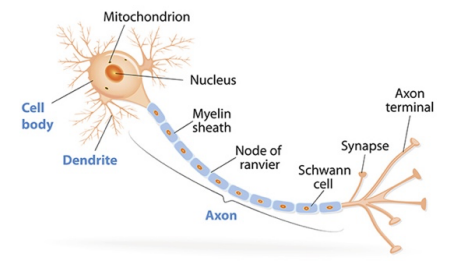
The functional part or the smallest part of the nervous system is the Neuron
The functional part or the smallest part of the nervous system is the _______
The functional part or the smallest part of the nervous system is the Neuron
The functional part or the ________ part of the nervous system is the Neuron
Cyton/Cell Body
Dendrites
Axon
Parts of Neurons:
Synapse is the space between neurons
________ is the space between neurons
Information is communicated from nerve to nerve and from nerve to the effector organ by a process termed Neurohumoral Transmission
Information is communicated from nerve to nerve and from nerve to the effector organ by a process termed ___________ __________
Information is communicated from nerve to nerve and from nerve to the effector organ by a process termed Neurohumoral Transmission
__________ is communicated from _____ to ______ and from nerve to the effector ______ by a process termed Neurohumoral Transmission
Information is communicated from nerve to nerve and from nerve to the effector organ by a process termed Neurohumoral Transmission, it involves the release from a terminal of a chemical (neurotransmitter substance), which then reacts with specialized receptor areas in the innervated cel
Information is communicated from nerve to nerve and from nerve to the effector organ by a process termed Neurohumoral Transmission, it involves the ______ from a terminal of a _______ (neurotransmitter substance), which then reacts with specialized ______ areas in the ______ cell
Acetylcholine
Norepinephrine
The 2 basic neurotransmitters are
Acetylcholine - coming from the parasympathetic or the craniosacral part
___________ - coming from the parasympathetic or the craniosacral part
Acetylcholine - coming from the parasympathetic or the craniosacral part
Acetylcholine - coming from the ___________ or the ________ part
Norepinephrine – coming from the sympathetic or the thoracolumbar part.
Norepinephrine – coming from the _______ or the ________ part.
Cholinergic Nerves – nerves the release Ach.
__________ Nerves – nerves that release Ach.
Adrenergic Nerves – nerves the release Norepinephrine.
_________ Nerves – nerves the release Norepinephrine.
Adrenergic Nerves – nerves the release Norepinephrine.
Adrenergic Nerves – nerves the release ___________.
Noradrenergic – used to designate neurons that releases Norepinephrine and Epinephrine respectively, especially when the CNS is considered.
___________ – used to designate neurons that releases Norepinephrine and Epinephrine respectively, especially when the CNS is considered.
Noradrenergic – used to designate neurons that releases Norepinephrine and Epinephrine respectively, especially when the CNS is considered.
Noradrenergic – used to designate neurons that releases ___________ and ________ respectively, especially when the ____ is considered.
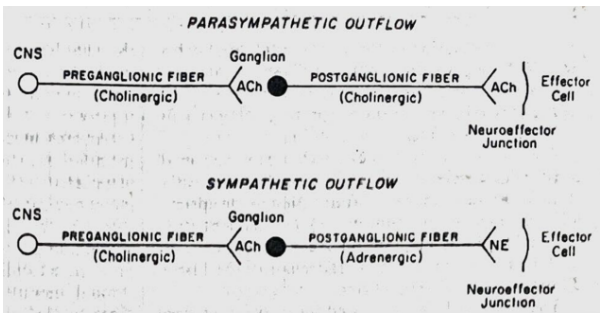
Cholinergic Nerve of the Sympathetic Outflow releases ACh in the preganglionic nerve while Adrenergic nerve releases norepinephrine in the postganglionic nerve.
__________ Nerve of the _________ Outflow releases ACh in the preganglionic nerve while Adrenergic nerve releases norepinephrine in the postganglionic nerve.
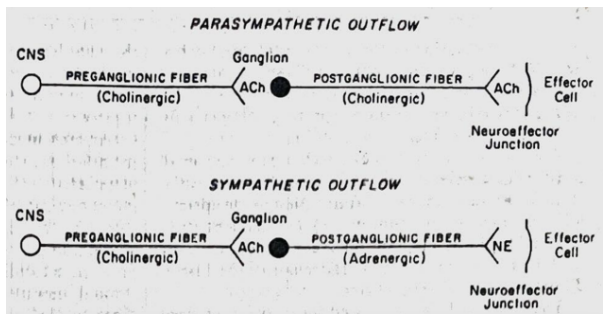
Cholinergic nerve of the Parasympathetic Outflow releases ACh in both pre and postganglionic nerve.
_________ nerve of the ____________ Outflow releases ACh in both pre and postganglionic nerve.
Cholinergic Nerve of the Sympathetic Outflow releases ACh in the preganglionic nerve while Adrenergic nerve releases norepinephrine in the postganglionic nerve.
Cholinergic Nerve of the Sympathetic Outflow releases ____ in the ______ nerve while Adrenergic nerve releases ________ in the _______ nerve.
Cholinergic nerve of the Parasympathetic Outflow releases ACh in both pre and postganglionic nerve.
Cholinergic nerve of the Parasympathetic Outflow releases ____ in both pre and __________ nerve.
Acetylcholine (Ach) must bind with the Nicotinic (N) Acetylcholine Receptor or Epinephrine Muscarinic (M) Acetylcholine Receptor.
Norepinephrine (NE) must bind with the Alpha (α) and Beta (β) Norepinephrine receptor.
Neurotransmitter – Receptor Binding Rule
Acetylcholine (Ach) must bind with the Nicotinic (N) Acetylcholine Receptor or Epinephrine Muscarinic (M) Acetylcholine Receptor.
Parasympathetic
When Acetylcholine binds with Nicotinic Receptor it will produce excitation to the organ (esp. the heart.)
When Ach binds with Muscarinic Receptor it will inhibit the organ (esp. the heart) but will produce excitation in the GIT.
Acetylcholine (Ach) must bind with the Nicotinic (N) Acetylcholine Receptor or Epinephrine Muscarinic (M) Acetylcholine Receptor.
___________
When Acetylcholine binds with Nicotinic Receptor it will produce _______ to the organ (esp. the _____.)
When Ach binds with Muscarinic Receptor it will _____ the ______ (esp. the heart) but will produce ______ in the ____.
Norepinephrine (NE) must bind with the Alpha (α) and Beta (β) Norepinephrine receptor.
- Sympathetic
- When Norepinephrine binds with the Alpha (α) receptor it will produce excitation to the organ.
- When Norepinephrine binds with the Beta (β) it will produce inhibition to the organ.
Norepinephrine (NE) must bind with the Alpha (α) and Beta (β) Norepinephrine receptor.
- ________
- When Norepinephrine binds with the _____ receptor it will produce _______ to the organ.
- When Norepinephrine binds with the _____ it will produce ________ to the organ.
Ach bind with Nicotinic receptor = excitation to organ while when it binds with muscarinic receptor = inhibit the organ but excites the GIT
NE bind with alpha and beta NE receptor. alpha = excitation to organ; beta=inhibition to organ
Differentiate Neurotransmitter – Receptor Binding Rule
NE alphas
α1 is located in the dendrites, which receive the message that is why it is post-synaptic synapse, it is found in vascular smooth muscle.
α2 is located in the axon, pre-synaptic synapse, found in brain and periphery
NE alphas
__ is located in the dendrites, which receive the message that is why it is post-synaptic synapse, it is found in vascular smooth muscle.
__ is located in the axon, pre-synaptic synapse, found in brain and periphery
NE alphas
α1 is located in the dendrites, which receive the message that is why it is post-synaptic synapse, it is found in vascular smooth muscle.
α2 is located in the axon, pre-synaptic synapse, found in brain and periphery
NE alpha receptors
α1 is located in the _______, which receive the ______ that is why it is ____-____ _____, it is found in ________ smooth muscle.
α2 is located in the ____, ___-_____ _______, found in _____ and _______
NE beta receptors
β1 excitation / stimulate the heart or blood vessel (exception to the rule).
β2 inhibition / dilation of bronchioles in the lungs.
NE beta receptors
__ excitation / stimulate the heart or blood vessel (exception to the rule).
__ inhibition / dilation of bronchioles in the lungs.
NE beta receptors
β1 excitation / stimulate the heart or blood vessel (exception to the rule).
β2 inhibition / dilation of bronchioles in the lungs.
NE beta receptors
β1 ________ / stimulate the ____ or _____ ______ (exception to the rule).
β2 ________ / ______ of ______ in the lungs.