Chem HHS unit 10 review
 Call Kai
 Learn
Learn Practice Test
 Spaced Repetition
 Match
Match Flashcards
 Knowt Play
1/52

There's no tags or description
Looks like no tags are added yet.
Name | Mastery | Learn | Test | Matching | Spaced | Call with Kai | Chat |
|---|
No analytics yet
Send a link to your students to track their progress
53 Terms
Acid
“acidus” meaning sour
compounds that produce hydrogen ions (H+) when dissolved in H2O
H+ is, in reality, a single proton (very tiny)
Ex: HNO3, SO4, H3PO4, HC2H3O2
Qualities:
Fizzes: metal reaction, antacid, marble rock (CaCO3)
Red: pH paper and bromothymol blue
Clear/nothing: phenolphthalein
Feel test: watery
Taste test: sour
Base
produces hydroxide (OH-) ions when dissolved in H2O
Ex: KOH, LiOH, Mg(OH)2 - all metals
Qualities:
Blue: pH paper and bromothymol blue
Nothing: metal reaction, antacid, and marble rock (CaCO3)
Pink: phenophthalein
Feel test: slippery
Taste test: bitter
Classify the following as an acid, base, or salt
Ca(OH)2
K2Cr2O7
HBr
Al2O3
H2C4H4O6
RbOH
HOH
Al(OH)3
base
salt
acid
salt
acid
base
water
base
For Ca(OH)2 above, if it comes to equilibrium in water and [Ca2+] = 0.016 M, [OH-] = 0.023 M, what is the Kb at room temp?
[.016] x [.023]2 = 8.5 × 10⁻⁶
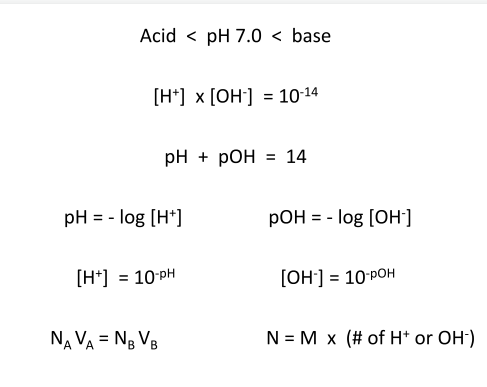
Acid/Base reactions
Acids and bases (double replacement) neutralize each other to make liquid water and aqueous salt
acid(H+) + base(OH-) ———→ water (HOH) + salt
Write the products of these acid/base double replacement reactions:
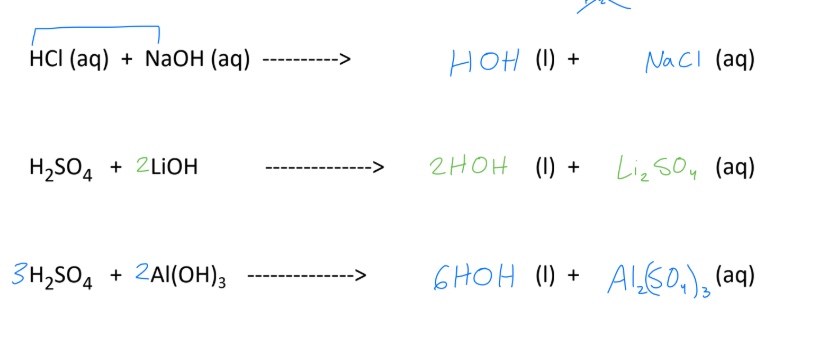
HCl (aq) + NaOH (aq) ——>
H2SO4 + LiOH ——>
H2SO4 + Al(OH)3 ———>
don’t forget to balance and add the state (aq, l, s, etc.)!
Formulas
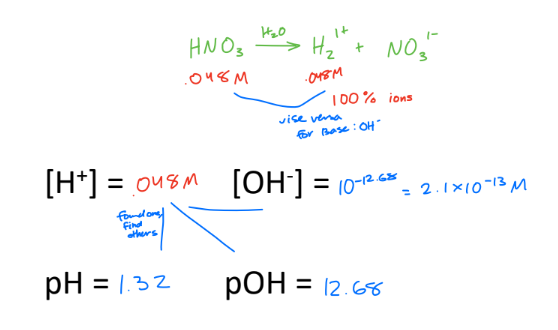
You start with a 0.048 M solution of HNO3. Show how it ionizes. Also, what is its [H+], [OH-], pH, and pOH?
strong acid or base
nearly completely ionizes in water
HCl, HNO3, H2SO4 —- large Ka
NaOH, KOH —- large Kb
Ex: HCl ———> H+ + Cl- ka = 1.3 × 10⁶
0% 100%
assumed to completely dissociate in water
The larger Ka —> more H+ ions at equilibrium —> the stronger the acid (lower pH)
ph scale:
acid: 0-2
base: 12-14
weak acid or base
ionizes only slightly in water
citric acid, H3PO4, HC2H3O2 —— small Ka
Ca(OH)2, Mg(OH)2 —— small Kb
Ex: HC2H3O2 -------------> H+ + C2H3O2- Ka = 1.8 x 10⁻⁵
99% 1%
dissociate only to a limited extent
The smaller Ka —> fewer H+ ions at equilibrium —> the weaker the acid (higher pH)
Since strong acids essentially dissociate 100%, only acids have Ka values associated with them
The dissociation of weak bases is treated the same way, except instead of Ka, we use Kb (base dissociation constant)
need to know ka to find pH
ph scale:
acid: 3-6
base: 8-11
Calculate the pH of a 1.00 M solution of acetic acid, HC2H3O2
**HC2H3O2 is a weak acid with an acid dissociation constant of 1.8 x 10 -5
pH = 2.4
What is the Ka for benzanoic acid (HC7H5O2) if [HC7H5O2] = .500 M and the pH = 2.60?
1.3 × 10⁻⁵
The pH of a 0.40 M solution of ammonia, NH3OH is 11.4 (Kb = 1.8 x 10⁻⁵)
The pH of a 0.40 M solution of KOH is 13.6 (strong base, 100% ionizes)
How do the differences in pH values demonstrate the difference between a strong vs. weak base?
Even though the strong and weak base have the same initial concentration, because the strong base dissociates completely, it has a greater [OH-] present in solution. This explains why it has a high PH compared to the weak base.
Polyprotic acids
monoprotic acid – any acid that contains 1 ionizable H+
ex: HCl, HNO3, HC2H3O2
HC2H3O2 (l) -----> H+ (aq) + C2H3O2- (aq)
diprotic acid – an acid that releases 2 H+
ex: H2SO4, H2CO3
triprotic acid – an acid that releases 3 H+
ex: H3PO4, H3BO4
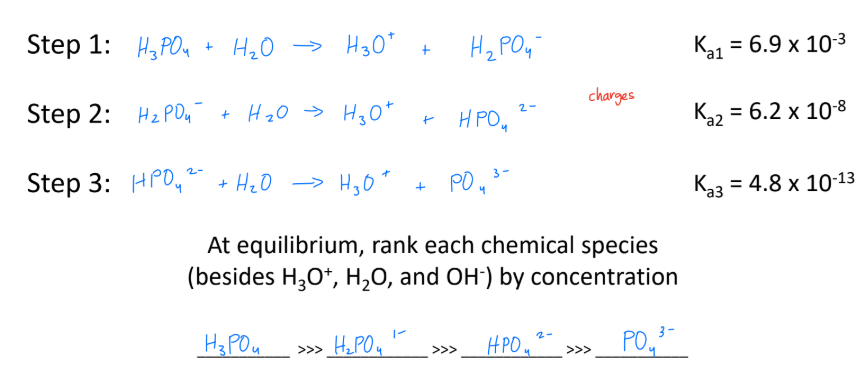
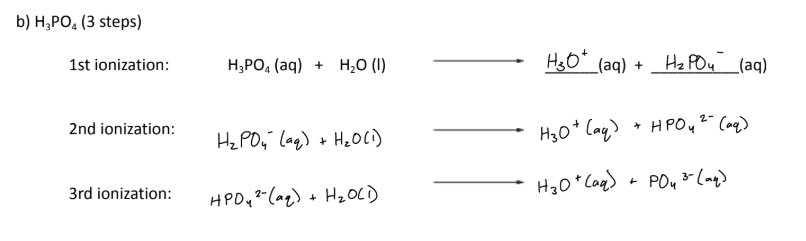
Provide each dissociation step for phosphoric acid—H3PO4
Ka1 = 6.9 × 10⁻³
Ka2 = 6.2 × 10⁻⁸
Ka3 = 6.9 × 10⁻¹³
At equilibrium, rank each chemical species (besides H3O+, H2O, and OH-) by concentration
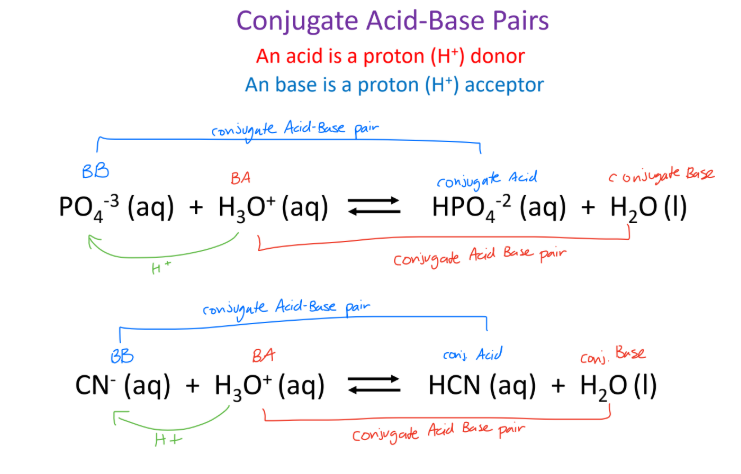
Two concepts of acids and bases
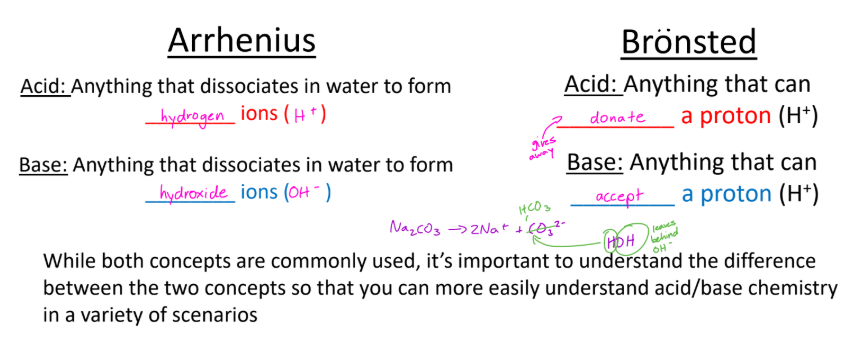
Bronsted Acids & Bases
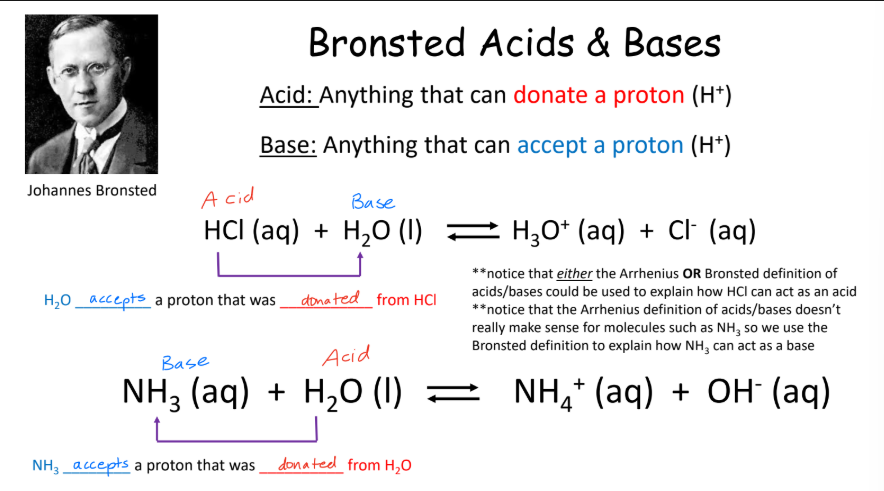
Conjugate Acid-Base Pairs
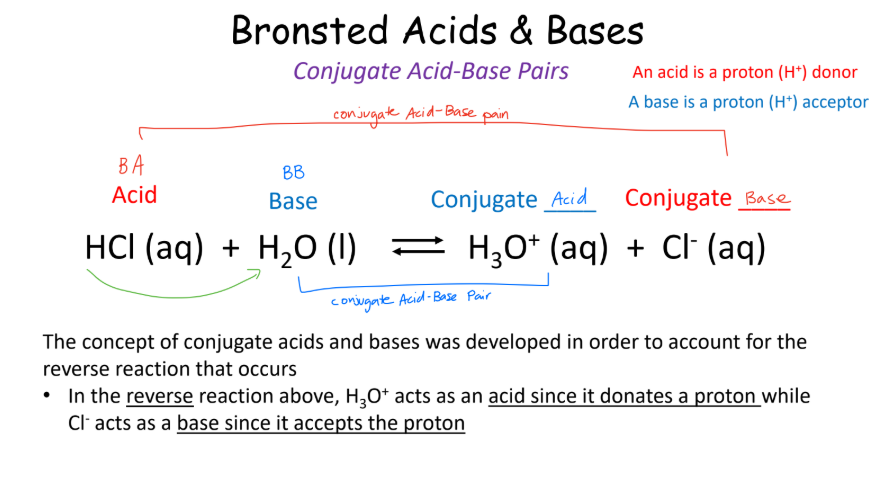
Conjugate Acid-Base Pairs examples
PO4-3 (aq) + H3O+ (aq) ==== HPO42- (aq) + H2O (l)
CN- (aq) + H3O+ (aq) ==== HCN (aq) + H2O(l)
Metals and Water
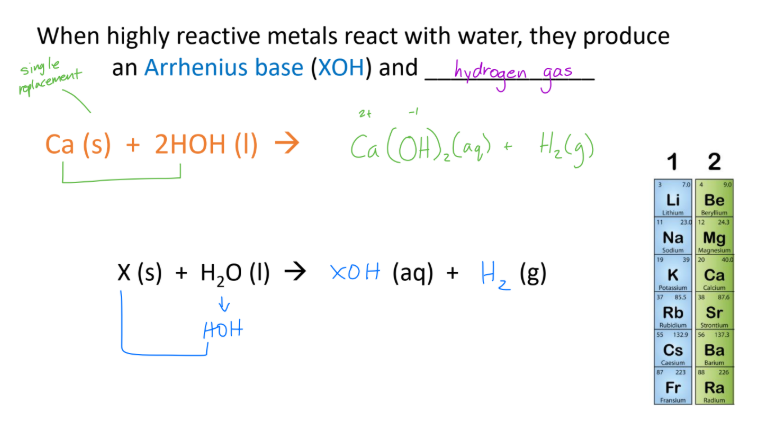
Metals and water examples
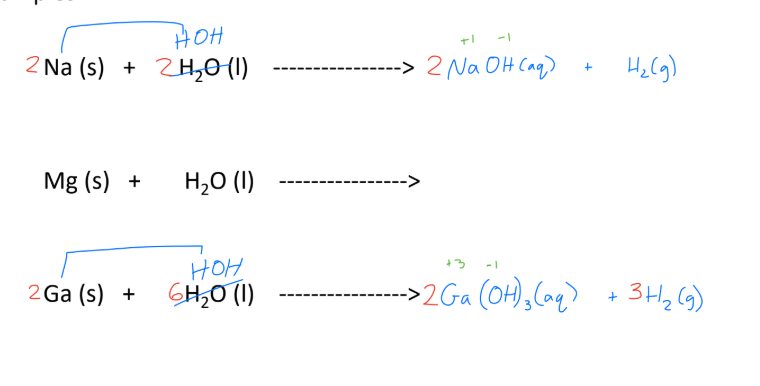
Na (s) + H2O (l) ——>
Ga (s) + H2O (l) ——>
don't forget to balance!
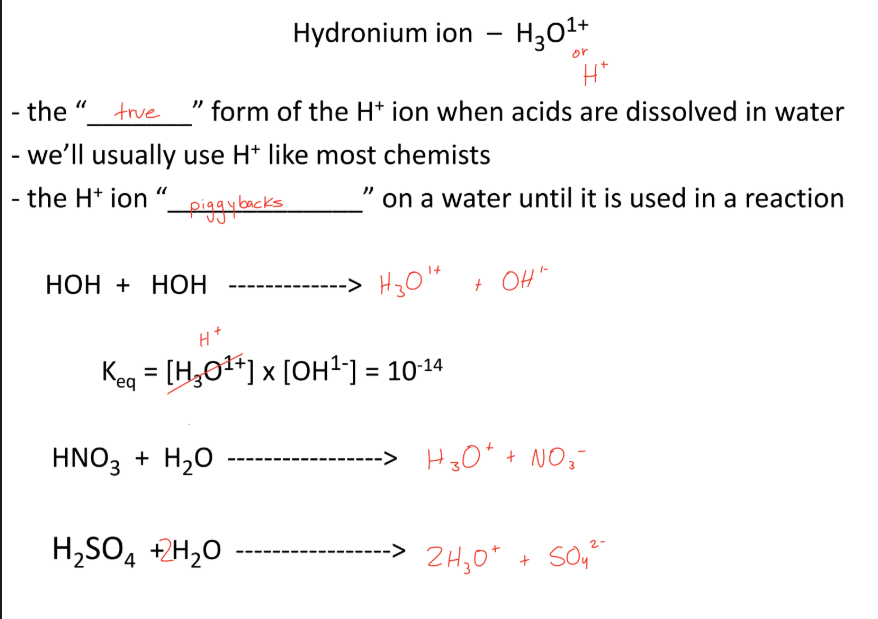
Hydronium ion
![<p>Use these formulas: pH = -log [H<sup>+</sup>]</p><p>[H<sup>+</sup>] x [OH<sup>-</sup>] = 1.0 x 10<sup>-14</sup></p>](https://assets.knowt.com/user-attachments/c9568944-c7c1-4410-b3f6-71164ae124c5.png)
Use these formulas: pH = -log [H+]
[H+] x [OH-] = 1.0 x 10⁻¹⁴
pH = 1.46
pH = 8.07
[H+] = 9.52 x 10⁻¹⁴ M
[H+] = 1.9 x 10⁻¹² M
pH = 3.17
[H+] = 1.3 x 10⁻⁹ M
[OH-] = 2.0 x 10⁻⁵ M
H+ and OH- in beaker review
In any solution, there pH will always be some amount of H+ and OH
How much H+ there is compared to OH- will determine how acidic or basic the solution is
Ex: specific numbers don’t matter, all that matters is amount shown
pH = 7 —→ when solution is neutral: H+ = OH-
4 H+ and 4 OH- drawn in beaker
pH = 6 —→ when solution is slightly acidic: H+ » OH-
12 H+ and 1 OH- drawn in beaker
pH = 8 ——> when solution is slightly basic: H+ « OH-
1 H+ and 10 OH-
a) You have a beaker of water that has a [H+] = 10-7 M. Calculate the [OH1-] = ___________
The pH = ______ The pOH = ______
b) Now use your values of [H+] and [OH1-] to make a particle diagram simulating how many H+ and OH1- ions are found in the beaker of water below. When you draw the H+ and OH1- ions, be mindful of how many H+ ions there would be compared to how many OH1-
[OH-] = 10-7
pH = 7
pOH = 7
![<ol><li><p>[OH-] = 10<sup>-7</sup></p></li><li><p>pH = 7</p></li><li><p>pOH = 7</p></li></ol><p></p>](https://assets.knowt.com/user-attachments/031627e7-2ea7-409e-9cc9-2bc80e925db7.png)
a) You have an acid that has a [H+] = 0.000048 M. Calculate the [OH1-] = ______________
The pH = ______ The pOH = ______
b) Now use your values of [H+] and [OH1-] to make a particle diagram simulating how many H+ and OH- ions are found in the beaker of water below: (of course you can’t show exact numbers of particles because of the exponential nature of pH and logarithms, just show one having more and the other having less)
[OH-] = 2.0 x 10⁻¹⁰
pH = 4.3
pOH = 9.7
![<ol><li><p>[OH-] = 2.0 x 10<sup>-10</sup></p></li><li><p>pH = 4.3</p></li><li><p>pOH = 9.7</p></li></ol><p></p>](https://assets.knowt.com/user-attachments/f054c286-8f0a-4ab8-a8d0-fbaf6fa3722d.png)
a) You have a base that has a [OH-] = 0.00060 M. Calculate the [H+] = ______________
The pH = ______ The pOH = ______
b) now use your values of [H+] and [OH1-] to make a particle diagram simulating how many H+ and OH1- ions are found in the beaker of water below:
[H+] = 1.6 x 10⁻¹¹
pH = 10.8
pOH = 3.2
![<ol><li><p>[H+] = 1.6 x 10<sup>-11</sup></p></li><li><p>pH = 10.8</p></li><li><p>pOH = 3.2</p></li></ol><p></p>](https://assets.knowt.com/user-attachments/2d6d736c-79c7-47ca-afb8-9879502e22a0.png)
Circle the appropriate answer to fill in the blanks:
In a concentrated acid, the amount of H+ ions is very high/very low.
In that same concentrated acid, the amount of OH- ions is very high/very low.
In a concentrated base, the amount of H+ ions is very high/very low.
In that same concentrated base, the amount of OH- ions is very high/very low.
very high
very low
very low
very high
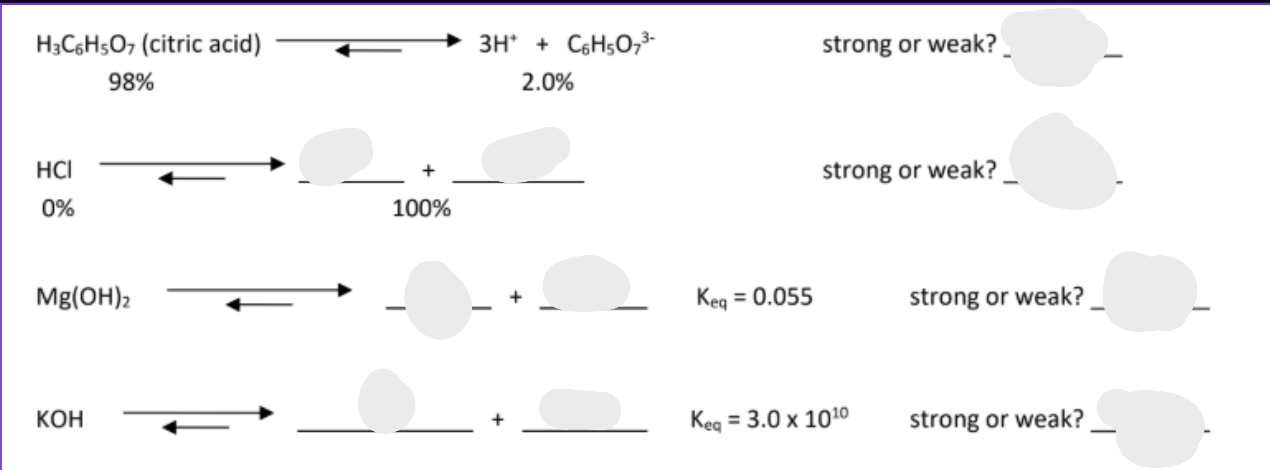
Classify each of the following as strong or weak. Finish any ionization reactions that are incomplete.
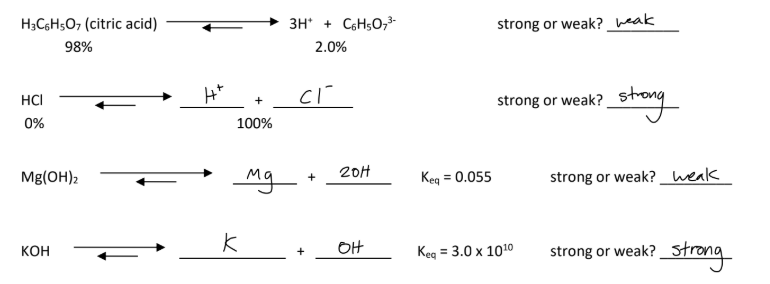
Simple ionization: H2SO4 —→
2H+ + SO42-
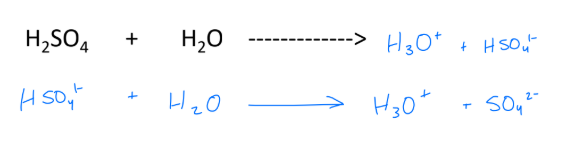
more complex ionizing to make hydronium ex:
H2SO4 + H2O ——>
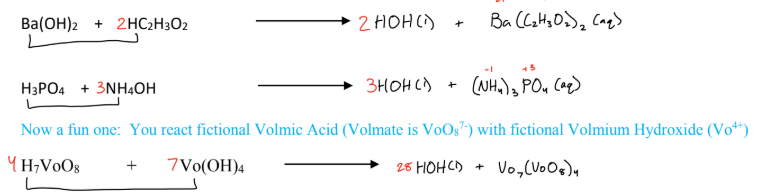
acid/base neutralization ex:
Ba(OH)2 + HC2H3O2 ——>
H3PO4 + NH4OH ——>
(fun one!) H7VoO8 + Vo(OH)4 —→
don’t forget to balance!
You titrate some 1.25 M H2SO4 into an unknown concentration of Ca(OH)2. It takes 15.7 mL of the acid to neutralize 19.5 mL of the base. What is the concentration of the base?
1.01 M

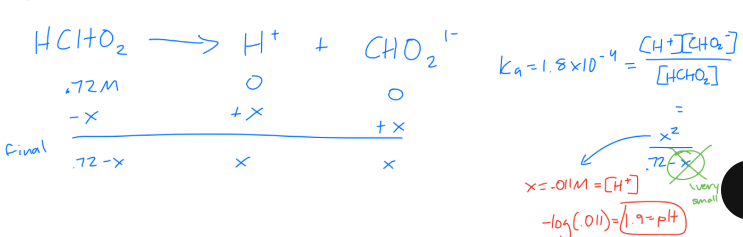
Weak formic acid (HCHO2) has a Ka = 1.8 x 10⁻⁴ and the original acid's concentration is [HCHO2] = 0.72 M.
What is the pH?
1.9
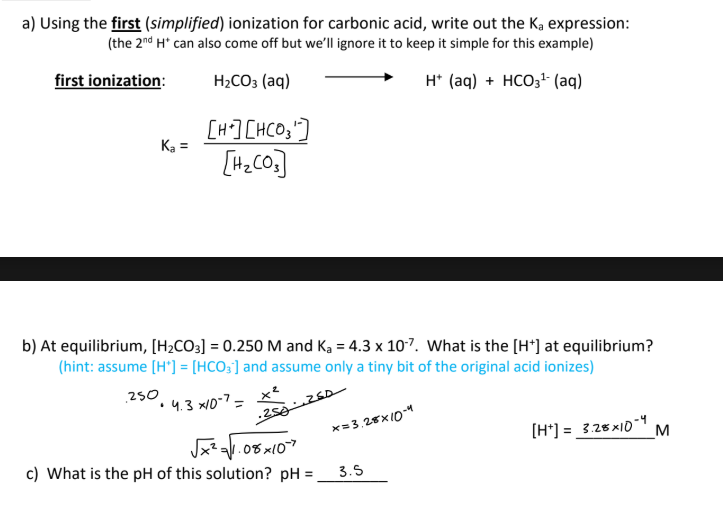
a) Using the first (simplified) ionization for carbonic acid, write out the Ka expression: (the 2nd H+ can also come off but we’ll ignore it to keep it simple for this example)
first ionization: H2CO3 (aq) ——> H+ (aq) + HCO31- (aq)
b) At equilibrium, [H2CO3] = 0.250 M and Ka = 4.3 x 10⁻⁷. What is the [H+] at equilibrium? (hint: assume [H+] = [HCO3-] and assume only a tiny bit of the original acid ionizes)
c) what is the pH of this solution?
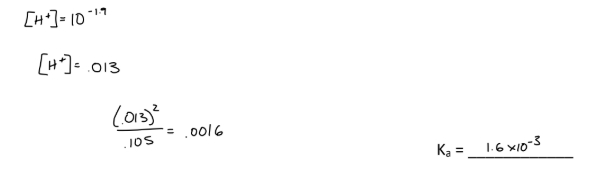
A 0.105 M solution of HCN has a pH = 1.9. Calculate the Ka of this solution:
Ka = 1.6 × 10⁻³
You have a strong acid, HNO3 with an initial concentration of 5.5 M. What is its pH?
pH = -.74
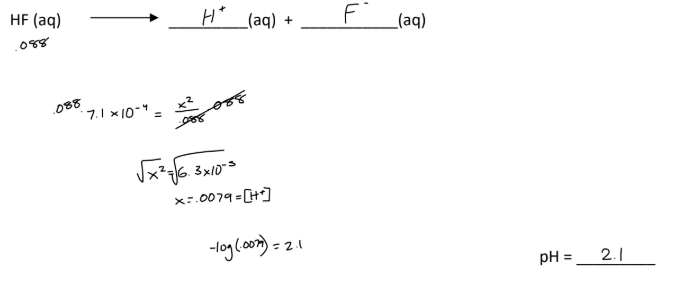
Hydrofluoric acid (HF) is a weak acid with a Ka = 7.1 x 10⁻⁴. What would the pH of this acid be if it was a 0.088 M solution?
pH = 2.1
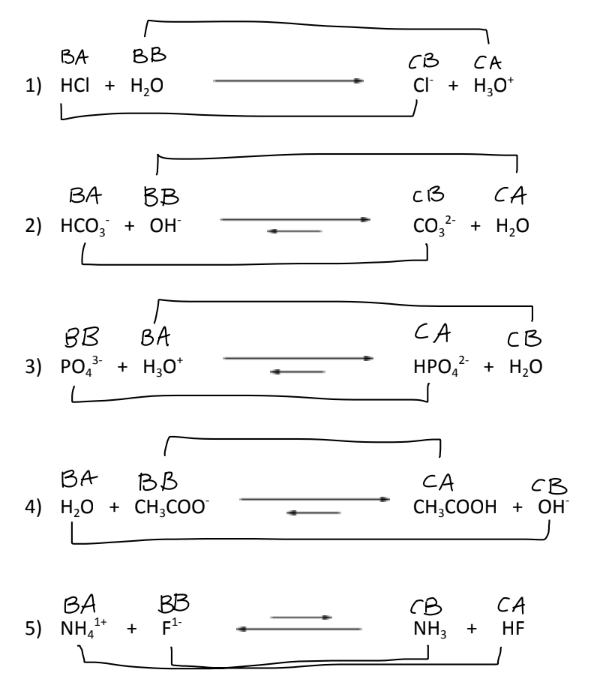
Label the following: Bronsted acid (BA), BB, conjugate acid (CA), or CB. Then draw lines connecting acid-base pairs.
1) HCl + H2O <—→ Cl- + H3O+
2) HCO3- + OH- <—→ CO32- + H2O
3) PO43- + H3O+ <—→ HPO42- + H2O
4) H2O + CH3COO- ←——> CH3COOH + OH-
5) NH41+ + F1- ←——> NH3 + HF
H3PO4 (Hydronium ion and Polyprotics stuff ex)
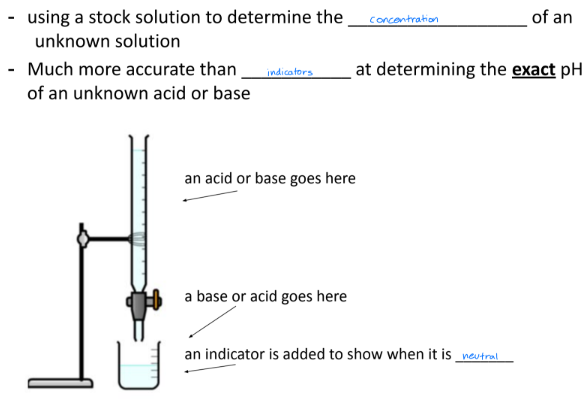
Titration procedure
Normality
the moles of H+ or OH- per liter of solution
like Molarity but it measures how many H+ and OH- ions are present in the solution, which is important for neutralization
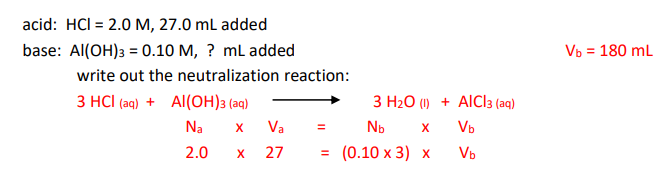
Normality = molarity x (# of H+ or OH-)
So Normality tells you how many moles of H+ and moles of OH- are accessible for neutralizing
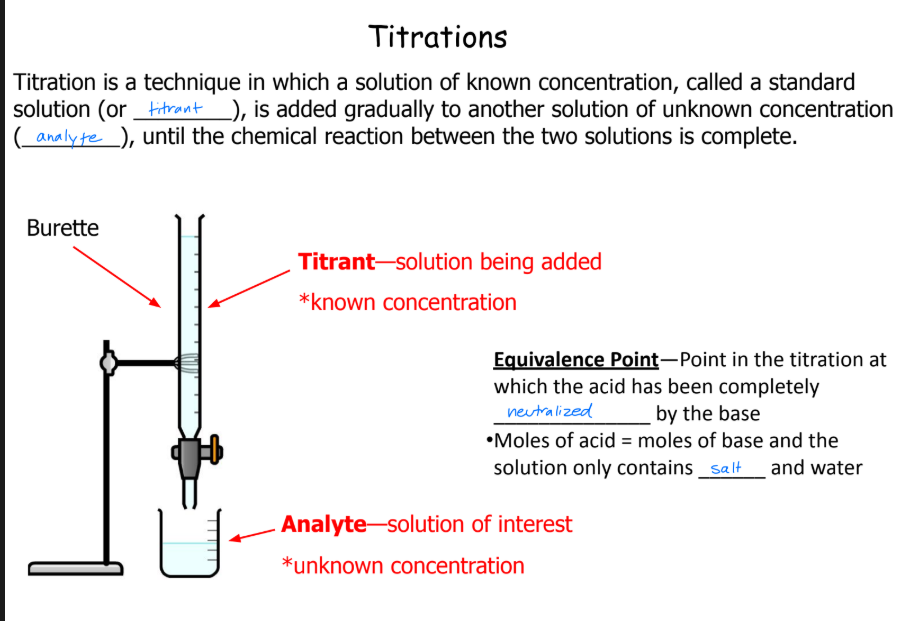
When you neutralize an acid and a base the moles have to be equal
Procedure for a titration:
End point – the point when the indicator changes color
Phenolphthalein – changes from clear to pink at about pH = 8.0
(close enough to neutral for us!)
Titrations
acid: HCl = 2.0 M, 27.0 mL added base: Al(OH)3 = 0.10 M, ? mL added
write out the neutralization reaction:
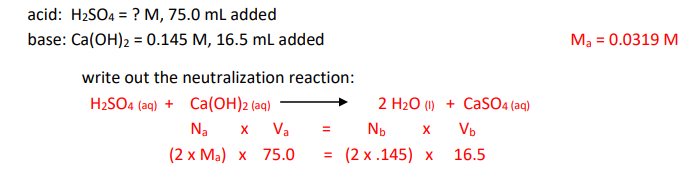
acid: H2SO4 = ? M, 75.0 mL added base: Ca(OH)2 = 0.145 M, 16.5 mL added
write out the neutralization reaction:
You start with 15.0 mL of 0.050 M H3PO4. You add 4.50 mL of an unknown concentration of Ca(OH)2 and it neutralizes. What is the Normality and the Molarity of the Ca(OH)2?
(0.050 x 3) x 15.0 = Nb x 4.50
N = 0.50 N
M = 0.25 M
a) You start with a stock solution of 0.0080 M KOH. What is its pH (assume 100% ionization)?
b) You place 20.0 mL of this base in a flask and add 3 drops of phenolphthalein. It turns pink. You start adding a solution of H3PO4. After you add 12.5 mL of acid you reach the endpoint and the solution turns clear (neutralized). What is the Normality of your H3PO4?
c) What is the Molarity of the acid?
a) [OH- ] = 0.0080 M —> pOH = -log (0.0080) = 2.1 —> pH = 11.9
b) Na x 12.5 = 0.0080 x 20.0 —> Na = 0.013 N
c) N = 3 x M —→ M = 0.013 ÷ 3 = 0.0043 M
An acid has a molarity of 0.450 M and a normality of 1.35 N. Is it a monoprotic, diprotic, or triprotic acid?
triprotic acid
Label the following as Arrhenius acid, Arrhenius base, or Salt:
KBr
H3PO4
HC2H3O2
Mg(NO3)2
Ba(OH)2
salt
acid
acid
salt
base
How can HCl be a stronger acid than H3PO4, even though H3PO4 gives off 3H+?
only a small % of H3PO4 ionizes, making fewer H+ than the same amount of HCl (100% ionizes)
HCl is a stronger acid than (H3PO4) Phosphoric acid because acid strength depends on how easily an acid releases its protons, not on the total number of protons available. While H3PO4 has three protons, it is a weak acid that only partially dissociates, whereas HCl is a strong acid that completely dissociates in water.
HCl (Strong Acid): When dissolved in water, almost 100% of HCl molecules split into H+ and Cl-. The reaction goes completely to the right
HCl ——> H+ + Cl-
H3PO4 (Weak Acid): Only a small fraction of H3PO4 molecules ionize in water. Most of the molecules remain as H3PO4. The first dissociation is only partial:
H3PO4 —→ H+ + H2PO4-
Why can HNO3 considered strong, even when it is very diluted?
strength is related to % ionization, and HNO3 nearly ionizes 100%, no matter what concentration
What is the Ka of a 1.5 M solution of HCN that has a pH of 2.65?
Ka = 3.3 × 10⁻⁶