BN chapter 2
 Call Kai
 Learn
Learn Practice Test
 Spaced Repetition
 Match
Match Flashcards
 Knowt Play
1/48

There's no tags or description
Looks like no tags are added yet.
Name | Mastery | Learn | Test | Matching | Spaced | Call with Kai | Chat |
|---|
No analytics yet
Send a link to your students to track their progress
49 Terms
central nervous system (CNS)
brain (in skull)
spinal cord (in spine)
the main control center for the body, processing sensory information and coordinating responses.
peripheral nervous system (PNS)
located outside skull and spine
serves to bring info into the CNS and carry signals out of CNS
regulates the internal environment of the body (organs, glands)
made up of the somatic and autonomic nervous system
somatic nervous system
part of the PNS
regulates the nervous systems interaction with the environment
afferent nerves (sensory)
efferent nerves (motor)
afferent nerves
sensory
efferent nerves
motor
autonomic nervous system
part of the PNS
regulates the internal environment
consists of sympathetic and parasympathetic divisions
controls involuntary bodily functions
neuron exiting the CNS synapses on a second-stage neuron before the target organ (first stage: pre ganglionic) (second stage: post ganglionic)
ganglion
cell body cluster in the PNS
sympathetic nervous system
part of the autonomic nervous system
thoracolumbar
fight or flight
second-stage neurons start far from the target organ (long)
parasympathetic nervous system
part of the autonomic nervous system
craniosacral
rest and restore (digest)
second-stage neurons start close to the target organ (short)
I
olfactory - smell
II
optic - vision
III
oculomotor - eye
IV
trochlear - eye
V
trigemial - facial sensations
VI
abducens - eye
VII
facial - taste, facial expressions, tears, and spit
VIII
auditory-vestibular - audition and balance
IX
glossopharyngeal - taste, swallowing, and saliva production
X
vagus - autonomic functions, heart rate, digestion, and sensation from the throat.
XI
spinal accessory - movement of neck and head
XII
hypoglossal - movement of the tongue
meninges
CNS - encased in bone and covered by 3 meninges
duramater
arachnoid
piamater
duramater
meninge
tough outer membrane
looks like a swim cap
arachnoid membrane
meninge
weblike
beneath is called subarachnoid space
piamater
meninge
adheres to CNS surface
delicate inner membrane
contains blood vessels and nerves
Ventricles
central canal: runs the length of spinal cord
4 cerebral ventricles
2 lateral ventricles
3rd ventricle
4th ventricle
fluid-filled cavities in the brain
produce cerebrospinal fluid (CSF) → serves as a cushion, protects and keeps brain from moving around
choroid plexus: network of capillaries in ventricles
physical protection of the brain
skull
meninges
cerebrospinal fluid (CSF)
chemical protection of the brain
the blood-brain barrier: tightly packed cells of blood vessel walls prevent entry of many molecules
protects against toxins and pathogens
the brains blood supply
carotid arteries - either side of neck
vertebral arteries - travel up through back of skull - give rise to basilar artery
gains the carotid arteries at base of brain to form the circle of willis
Regular caps vs. BBB caps
in BBB most materials are moved from the blood by special transporters

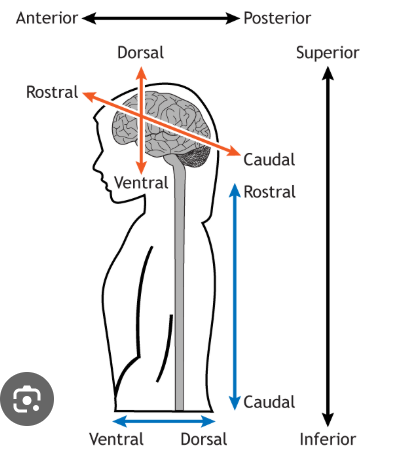
top of head
dorsal/superior
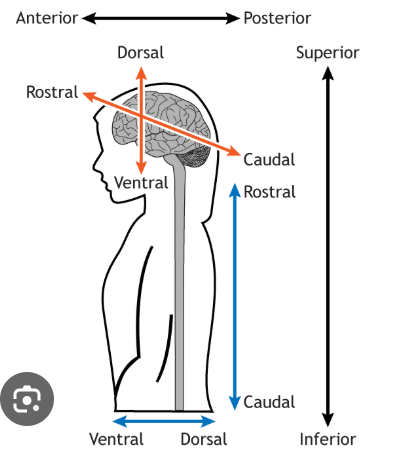
back
dorsal

belly
ventral
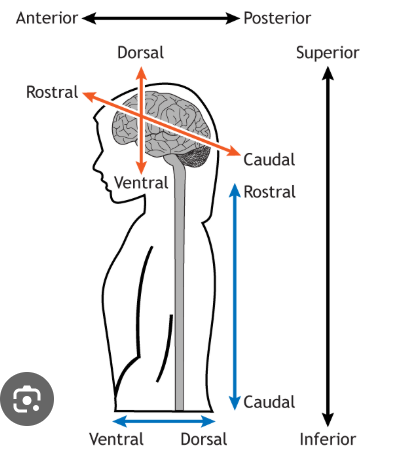
toward nose
anterior/ rostral

toward butt
posterior/caudal

toward middle
medial

towards side
lateral

close
proximal
far
distal
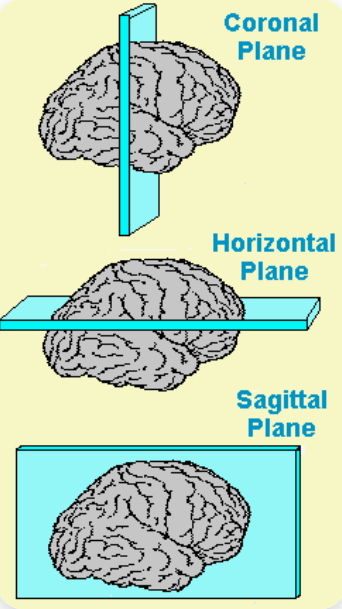
horizontal
a slice parallel to the ground
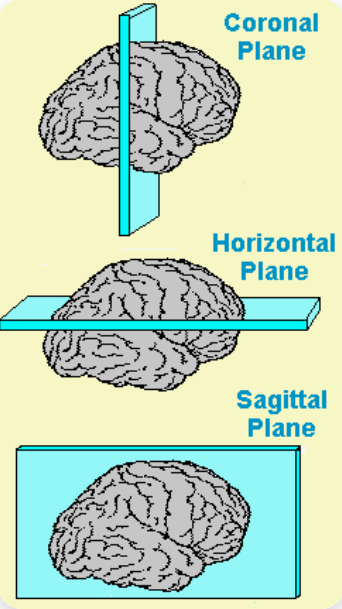
frontal (coronal)
like slicing bread or salami

sagittal
a midsagittal section separates the left and right halves
spinal-cord
cross-section
the spinal cord
gray matter, white matter, dorsal horn, ventral horn
gray matter
primarily cell bodies (inner component)
white matter
mainly myelinated axons (outer component)
dorsal horn
afferent, sensory
info. coming into the CNS
ventral horn
efferent, motor
info. going out to PNS