Anatomy Mini Test - Intro to Anatomy & Physiology
 Call Kai
 Learn
Learn Practice Test
 Spaced Repetition
 Match
Match Flashcards
 Knowt Play
1/84

There's no tags or description
Looks like no tags are added yet.
Name | Mastery | Learn | Test | Matching | Spaced | Call with Kai | Chat |
|---|
No analytics yet
Send a link to your students to track their progress
85 Terms
Anatomy
the study of the structure of body parts and their relationships to one another
Physiology
the study of the function of body parts and how they work together
Anatomy and Physiology are interrelated. Name some examples:
Capillaries in lungs → thin for gas exchange
Dislocated shoulder → prevent flexing of arm
Levels of Organization In The Body From Simplest To Most Complex
Chemical → Cellular → Tissues → Organ → Organ System → Organism
Chemical Examples:
Atoms, Molecules (ex. H20)
Cellular (Individual Cells) Examples:
-Smallest living unit
Ex: blood cell, muscle cell, etc.
Tissues:
A group of cells with a common function
Tissue Examples:
Blood, muscle, bone
Organ:
2 or more tissues with a common function
Organ Examples:
Blood Vessel
Organ System:
Organs that work together to perform a common function
Organ System Examples:
Cardiovascular System
Organism:
Sum total of organ system working together
Organism Examples:
A human being (single celled organisms count)
Necessary Life Functions:
Maintaining boundaries, Movement, Responsiveness, Digestion, Metabolism, Excretion, Reproduction, Growth
Maintaining boundaries:
Keep internal ans external environments separate.
Maintaining Boundaries.. Cellular Level and Organismal Level
Cellular Level: Cell membrane
Organismal Level: Skin
Movement:
Of whole body or body parts and of substances within the body
Movement Examples:
Whole Body: Running
Responsiveness:
Ability to sense changes in environment and respond to them; primarily a function of the nervous system.
Responsiveness Examples:
If you step on a nail → you withdraw foot
Rising blood CO2 → increase breathing rate
Digestion:
Breaking down of food into something usable by cells
Metabolism:
All chemical reactions in body
Metabolism Examples:
Chemical digestion of food; making ATP
Excretion:
Removing wastes / unwanted substances from the body
Excretion Examples:
CO2, Feces, Urine
Reproduction:
Cellular Level: Growth and repair
Organismal Level: For perpetuation of species (making more of)
Growth:
Increase in size of body part or organism.
Usually due to increase in number of cells but can also be due to increase in size of cells (ex. muscle)
Survival Needs:
Nutrients, Oxygen. Water, Normal Body Temperature, Atmospheric Pressure
Nutrients:
Substances needed for energy & cell building
Nutrients Examples:
Fats, Carbs, Proteins, Vitamins
Oxygen:
Required for chemical reactions that release energy from food
Water:
Body is 50-60% water; serves as a medium for chemical reactions
Normal Body Temperature:
Needed to maintain approperiate rate of chemical reactions
Atmospheric Pressure:
Needed for proper gas exchange in lungs
Anatomical Position:
Body is in standing position, with head and feet facing forward, the arms at the sides, and the palms facing forward
Right and Left:
Anatomical Right: the body’s right side, NOT your right
Anatomical Left: the body’s left side
Superior/Cranial:
Toward the head end of the upper part of the body; above
Inferior/Caudal:
Away from the head end or toward the lower part of the body; below
Anterior/Ventral
Toward or at the front of the body; in front of
Posterior/Dorsal
Toward or at the back of the body; behind
The calf of the leg is ___ to the shin
posterior
The mouth is ___ to the chin
superior
The eye is ___ to the eyebrow
inferior
The breastbone is ___ to the backbone
anterior
Medial
Toward or at the midline of the body
NOTE: “middle” in a name means a part is between two other similar things
Lateral
Away from the midline of the body; towards the side
Proximal
Closer to the point of origin
For the limbs: closer to the point of attachment to the body trunk
For a tube: closer to the end where material enters
Distal
Farther from the point of origin
For the limbs: farther from the point of attachment to the body trunk
For a tube: closer to the end where material exits
Are the terms Superior and Inferior used with limbs?
NO! Instead, use Proximal and Distal
Superficial/External
Toward or at the body surface
Deep/Internal
Away from the body surface
The ears are __ to the nose
lateral
The knee is __ to the ankle
proximal
The breastbone is __ to the belly button
superior
The skull is __ to the scalp
deep
The hand is __ to the forearm
distal
The belly button is __ to the stomach
superficial
The pinkie finger is __ to the thumb
medial
The Two Divisions:
Axial and Appendicular
Axial:
Refers to the head, neck, and trunk
Appendicular:
Refers to the appendages, or limbs (arms and legs)
Sagittal Plane
Vertical plane
Divides body into right and left portions
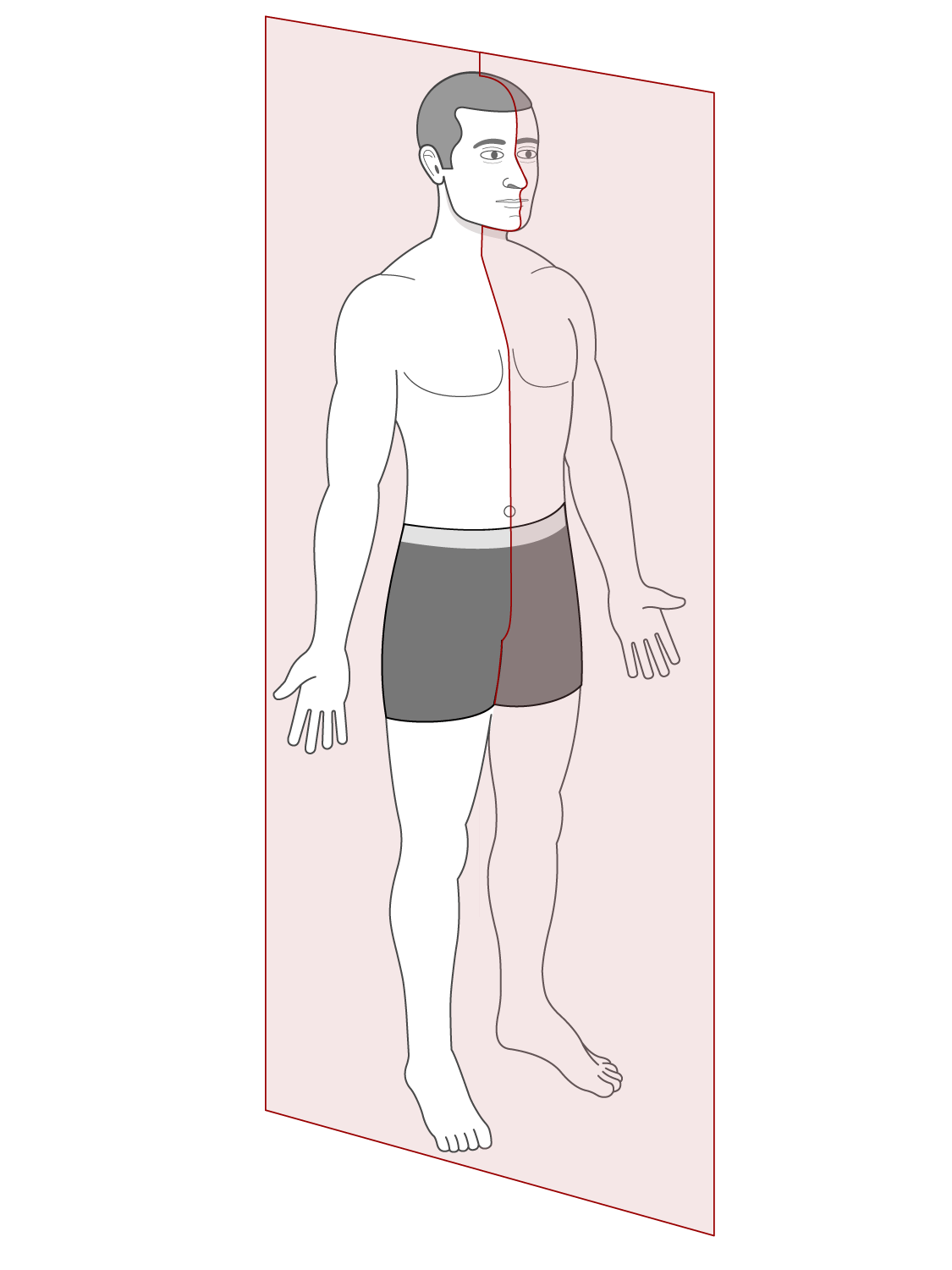
Midsaggital
Saggital plane in the midline

Frontal or Coronal Plane
Vertical Plane
Divides body into anterior and posterior portions

Transverse or Horizontal Plane
Also called a cross section
Horizontal plane
Divides body into superior and inferior portions

The knee is a part of the __ division
Appendicular
The ears are part of the __ division
Axial
A slice that passes through both shoulders and both hips is in the ___
Frontal/Coronal Plane
A slice that passes through the breastbone, vertebral column, and belly button is in the _____
Midsagittal plane
A slice that passes through both eyes and the back of the head is in the __
Transverse/Horizontal plane
A slice that passes through the knee, the heel, and between two toes is in the __
Sagittal plane
Integumentary System:
Organs: Skin, Hair, Nails
Function: Forms the external body covering; synthesizes Vitamin D, site of cutaneous receptors, sweat and oil glands
Skeletal System:
Organs: Bones and joints
Function: Protects and supports body organs; framework for muscles; forms blood cells; stores minerals
Muscular System:
Organs: Skeletal muscle
Function: Allows manipulation of environment, locomotion, and facial expression; maintains posture; produces heat
Nervous System:
Organs: Brain, sensory receptors, spinal cord, nerves
Function: Fast-acting control system of the body; responds to internal and external changes by activating appropriate muscles and glands
Endocrine System:
Organs: Pineal, pituitary, thyroid, and adrenal glands and the thymus, pancreas, ovary, and testis
Function: Secretes hormones that regulate processes such as growth, reproduction, and nutrient use
Cardiovascular System:
Organs: Heart, blood vessels
Functions: Transports blood, which carries oxygen, carbon dioxide and nutrients; pumps blood
Lymphatic System/Immunity:
Organs: Lymph nodes, red bone marrow, spleen, thoracic duct, and lymphatic vessels
Function: Picks up fluid leaked from blood vessels and returns it to blood; disposes of debris; houses white blood cells; mounts attack against foreign substances within the body
Respiratory System
Organs: Nasal cavity, pharynx, larynx, trachea, bronchus and lungs
Function: Keeps blood constantly supplied with oxygen. and removes carbon dioxide; gaseous exchange
Urinary System
Organs: Kidneys, ureters, urinary bladder, urethra
Function: Eliminates nitrogeneous wastes from the body; regulates water, electrolyte and acid-base balance
Digestive System
Organs: Oral avity, esophagus, stomach, small and large intestines
Function: breakdown of food into substances that can be absorbed (for energy)
Male Reproductive System
Organs: Peens, testis, scrotum, ductus deferens, and prostate gland
Function: Produces sperm and male sex hormone; aid delivery of sperm to female reproductive tract
Female Reproductive System
Organs: Mammary glands, ovary, uterus, vagina, and uterine tubes
Functions: Produces eggs, female sex hormones, and milk; provides site for development of fetus