water
 Note
Note Call Kai
 Learn
Learn Practice Test
 Spaced Repetition
 Match
Match Flashcards
 Knowt Play
1/15

There's no tags or description
Looks like no tags are added yet.
Name | Mastery | Learn | Test | Matching | Spaced | Call with Kai | Chat |
|---|
No analytics yet
Send a link to your students to track their progress
16 Terms
what is water 2 points
-water is a dipolar structure, with a postively charged end (hydrogen) and negative charged side( oxygen) but has no overall charge
- it means adjacent water molecules are attracted to and become bonded to each other with a hydrogen bond between them which also gives them their important properties.
what is a dipolar structure
a polar molecule with a positive and negative charge end.
water covers how much of earths surface?
how much percent does water make up for organisms?
70%
65-95%
7 properties of water duo to hydrogen bonds ( no description needed )
water is an excellent solvent
it has high specific heat capacity
high latent heat of vaporisation
metabolite
cohesion
high density
transparent
the importance of hydrogen bonds in water
it forms easily as there is a weak attractive force between a positively charged hydrogen atom and a negatively charged oxygen.
the water molecules are weak individually but overall they are strong making it difficult to separate the molecule from each other
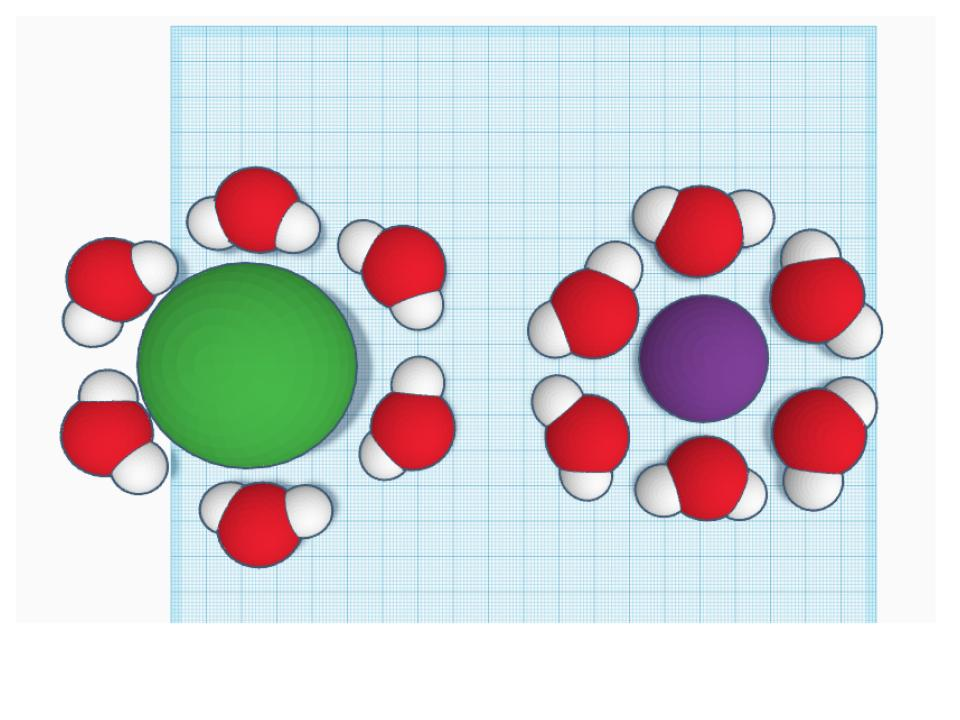
why is water an excellent solvent. 2 points and describe the photo
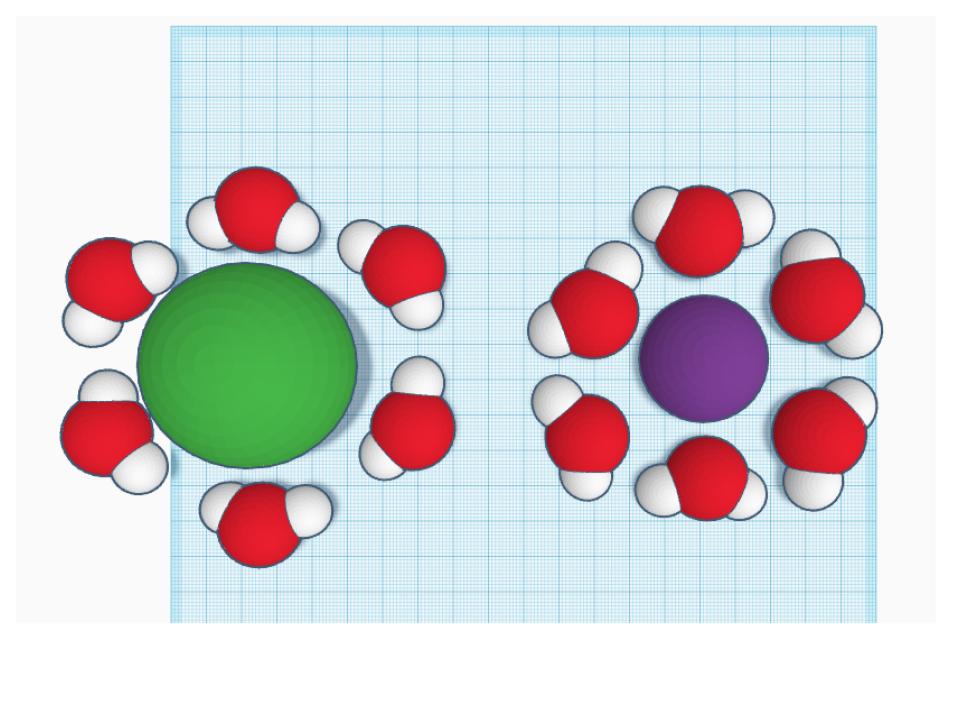
due to its dipolar nature it attracts charged particles and other polar molecules allowing it to dissolve.
it is involved in many biochemical reactions e,g hydrolysis and condemnation allow polar molecules e.g glucose and amino acids to dissolve and be transported via the blood around the body.
photo when water are added to an ion solution - cation 0- oxygen faces the ion while hydrogen faces the anion
what happens to na+cl_ ( a polar molecule ) is added to water a ( dipolar structure)
When the salt is added to water the sodium and chloride ions split apart (dissociate). They do this because the force of attraction between the negatively charged part of the water molecule and the positively charged sodium ion is greater than the forces of attraction between the Na+ and the Cl- ion.
why does water have a high specific heat capacity? example of whyy it is needed in animals and cells and tissue
A large amount of heat is needed to increase the temp in the body due to the large numbers of hydrogen which are hard to break. they prevent large flauncatation of temperature. e,g aquatic environment will therefore be relatively be thermally stable.
The high water content of cells and tissues helps them to maintain a constant temperature it is essential in endothermic organisms that need to maintain a constant body temperature in order to optimise enzyme activityand thereby regulate metabolism.. In this way water acts as a temperature buffer.
why does water have a high latent heat of vaporization? and example in organisms
Because large amount of heat energy are needed to vaporise water, so its often used das a cooling mechanism e.g sweating in organisms this helps regulate body temp
why is water a metabolite? and 2 example
as it, iS IN involved in many biochemical reaction e.g hydrolysis (when water splits a molecule) and condensation and as a reactant in photosynthesis
.Water also acts as a reactant for example, in:
1. Light-dependent stage of photosynthesis when photolysis splits water to release electrons
2. Hydrolytic reactions (e.g. digestive enzymes).
why is cohesion in water done -2 points? an example in plants and water
Water molecules attract to each other and form hydrogen bonds between themselves because individually they are weak, the molecules stick together in a lattice. the sticking together is called a cohesion
This cohesion between water molecules at the surface produces surface tension so this allows water to be drawn up the xylem vessels of trees and creates surface tension, allowing insects such as pond skaters to walk on water
what is hydrolysis and condensation + example
hydrolysis (when water splits a molecule) e.g maltose water - glucose+glucose
condensation - water is a product glucose+ frucose- sucrose+ water
why does water have a high density?
water had a maximum density of 4.c water then expands when it freezes, its density (mass per unit volume) will decrease. This means that ice is less dense than water, and will therefore float on top of it.as a result ice floats and act as an insulator , preventing the water beneath from freezing completely, therefore protecting aquatic life.
why is water transparent?
Water is colourless and is therefore transparent to light This means that sunlight can reach the cells and pass through them so that photosynthesis may occur.