PKP
 Call Kai
 Learn
Learn Practice Test
 Spaced Repetition
 Match
Match Flashcards
 Knowt Play
1/82

There's no tags or description
Looks like no tags are added yet.
Name | Mastery | Learn | Test | Matching | Spaced | Call with Kai | Chat |
|---|
No analytics yet
Send a link to your students to track their progress
83 Terms
Why is personality psychology relevant and what goals does it pursue?
Relevance:
Focus on the whole person; integrates cognition, emotion, motivation, behavior, and social/cultural context (vs. isolated processes such as memory or perception)
Historical-cultural impact; concepts influence everyday thinking (ego; introversion; unconscious motives; self-esteem; personality types) with core topics:
human universals (characteristics shared by all humans);
individual differences (systematic variation between people);
individual uniqueness (what makes each person distinct)
Goals of scientific personality theories:
Scientific observation: (a) large/diverse samples; (b) objectivity and bias reduction; replicability; (c) specialized methods to study mental processes, emotions, and biological systems
Systematic theory: coherent framework; explanations logically integrated; no contradictory assumptions
Testability: empirically verifiable predictions; evidence-based claims despite complex constructs (such as motives; emotions; goals; conflicts; unconscious processes)
Comprehensiveness: explains all major personality characteristics / questions; lifespan development; causes; stability; change
Practical applications: development of interventions; therapies; methods to improve well-being
Which questions does personality psychology seek to answer, and how does it address them?
Personality = psychological qualities (C) contributing to (i.e. causally explaining on both collective and idiosyncratic levels) (A) enduring (stable across time/situations) and (B) distinctive (individual-difference producing) patterns of (D) feeling, thinking, and behaving; goal = explain causal factors underlying these patterns
Core questions: (1) What? → What characteristics make up personality? (2) How? → How did these characteristics develop? (3) Why? → Why does a person behave as they do?
Major domains used to answer these questions:
Structure (what personality stably consists of; “building blocks”); theories with differing units of analysis:
Traits: continuous / quantitative dimensions (e.g., conscientiousness; extraversion)
Types: qualitative categories (e.g., resilient; overcontrolled; undercontrolled)
Systems: integrated (well / poorly) organization of interacting personality components (simple / complex)
*Hierarchy: higher-level structures/goals may regulate lower-level tendencies/actions (e.g. trait theories); alternative view = fluid reciprocal influences rather than fixed hierarchy
Process (how personality operates); Dynamic psychological activity: motives; thoughts; emotions; desires; actions
Different theories emphasize different motivational systems: biological drives; future goals; conscious reasoning; unconscious motives; self-enhancement; social obligations → Explains ongoing flow and regulation of behavior
Growth and Development (how personality develops/originates); explains (A) universal developmental patterns and (B) individual differences
Genes ↔ environment interaction (not nature vs. nurture!); environmental experiences can activate or modify genetic influences (epigenetics); not blank slate / genetic determinism!
Genetic/evolutionary influences → temperament (fearfulness; shyness / potential change with exposure) & underlying brain systems; inherited psychological mechanisms promoting survival/reproduction with emphasis on human universals (motives; emotions; social behavior), vgl. Pinker: some psychological tendencies deeply rooted in evolutionary history, relatively resistant to social intervention, BUT criticism → speculative explanations, underestimation of developmental/environmental influences
Environmental determinants:
(A) Culture → values; self-concepts; emotional expression; goals; social roles; beliefs about what matters in life; influences individualism vs. collectivism, relationships, interpretation of the world (female assertiveness + self-focus of American undergrads) + cultural influences can change historically
(B) Social class → status; roles; duties; privileges; opportunities; cognitive/emotional development; shapes self-perception, perception of others, and responses to situations
(C) Family → (a) parental behavior; (b) role modeling; (c) reinforcement; creates similarities and differences among siblings; gender and birth-order effects (e.g., firstborns often more achievement-oriented and conscientious)
(D) Peers → socialization into behavioral norms and social rules; lasting influence on personality development; peer experiences may explain sibling differences better (!) than family experiences; conflict-ridden friendships associated with more antagonistic and disagreeable behavior styles.
Psychopathology and Behavior Change (how personality changes / metamorphoses) → Explains psychological disorders, suffering, resistance to change + basis for therapy, interventions, and improving well-being → can theories can explain and facilitate meaningful change?
What are the major personality theories, and how does one go about evaluating them?
Major personality theories:
Psychodynamic theory: mind = energy system; personality = unconscious (!) conflict among biological drives, social constraints, and mental control systems; behavior driven by unconscious motives/conflicts originating in childhood
Phenomenological theory: emphasis on conscious experience, self-development, personal growth, self-actualization; humans = active (!) agents striving for fulfillment and a coherent positive self
Trait theory: (a) identifies and (b) measures stable individual differences; seeks major trait dimensions; traits used to describe and predict behavior across situations and time
Biological/Evolutionary theory: emphasis on genes, brain systems, evolved psychological mechanisms; personality explained through inherited predispositions, neural processes, and adaptations promoting survival/reproduction
Behaviorism: personality = RESULT (!) of learned behavioral patterns shaped by rewards and punishments; focus on learning history rather than traits, motives, or unconscious processes
Personal Construct Theory: personality reflects individual interpretations of reality; people develop unique constructs (mental frameworks) for understanding events, relationships, and experiences
Social-Cognitive Theory: reciprocal interaction between person and environment; emphasis on learning, cognition, self-regulation (!), personal agency; people both shape and are shaped by their environments
Evaluation of personality theories:
Organize knowledge: integrate findings into a coherent framework
Generate knowledge: stimulate new research and discoveries
Identify new questions: open previously unexplored areas of inquiry (e.g. psychodynamic theory → unconscious processes; childhood influences; Evolutionary theory → ancestral adaptations; Behaviorism → challenges to free will)
Toolkit perspective: No theory explains everything; Theories ≠ right vs. wrong; each provides unique concepts, methods, and explanatory tools → Evaluation criterion = usefulness for advancing understanding, not absolute correctness
What are the fundamental issues personality theories must address?
Philosophical view of human nature: Humans as (A) rational decision-makers vs. (B) irrational, drive-driven organisms vs. (C) information-processing / self-regulating systems → influenced by scientific evidence, personal beliefs, historical context, and culture
Internal vs. external determinants of behavior: Behavior caused primarily by (A) internal processes (e.g., unconscious motives / Freud; trait(s) theories!) vs. (B) environmental / external influences (e.g., rewards & punishments / Skinner; social learning (theories)) → Modern theories acknowledge both but differ in emphasis
Consistency across situations and time: Debate over (A) what constitutes personality consistency (stable-trait perspective vs. adaptive-flexibility perspective), (B) reasons behind it (inherited traits or stable environmental influences), (C) Question of how much personality can change
Self and unity of experience: Despite information overload (changing thoughts, emotions, experiences + relatively independent memory systems), individuals experience themselves as a coherent whole
Explanations: (A) integrated psychological systems or (B) self-concept / autobiographical self organizing experience into a coherent narrative
Consciousness and the unconscious: Much mental activity occurs outside awareness; some theories emphasize unconscious motives; others emphasize self-reflection and deliberate choice
Influence of past, present, and future: Are people prisoners of their past or active agents shaping their future? (psychodynamic theories → childhood experiences; enduring developmental influences vs. social-cognitive/constructivist theories → current cognition; future goals; lifelong capacity for change)
Can personality be a science? → Tension between person as (A) collection of parts (reductionism) vs. person as (B) coherent system whose whole exceeds the sum of its parts (holism)
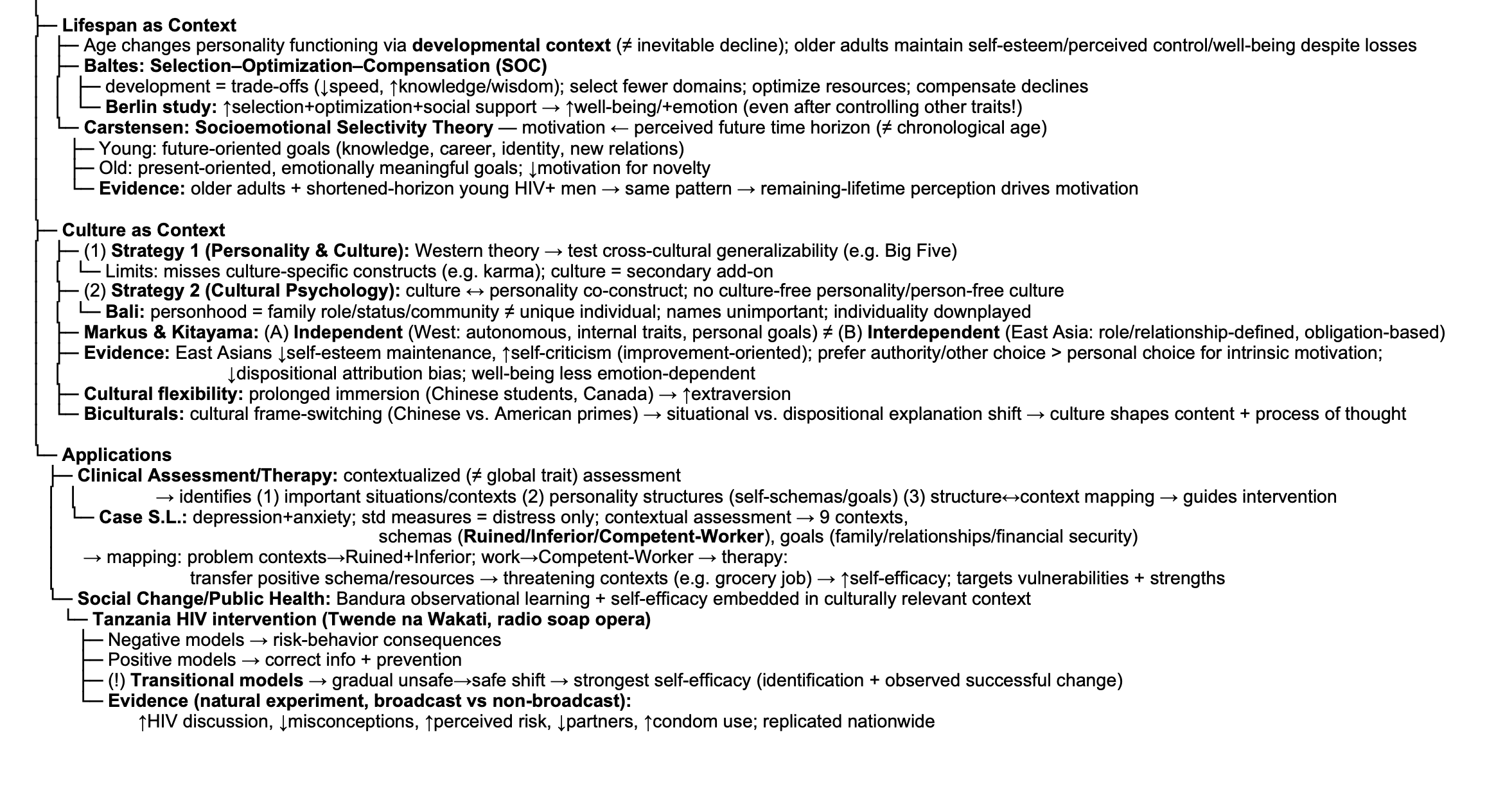
Tree (PKP Kap. 1) 1/2
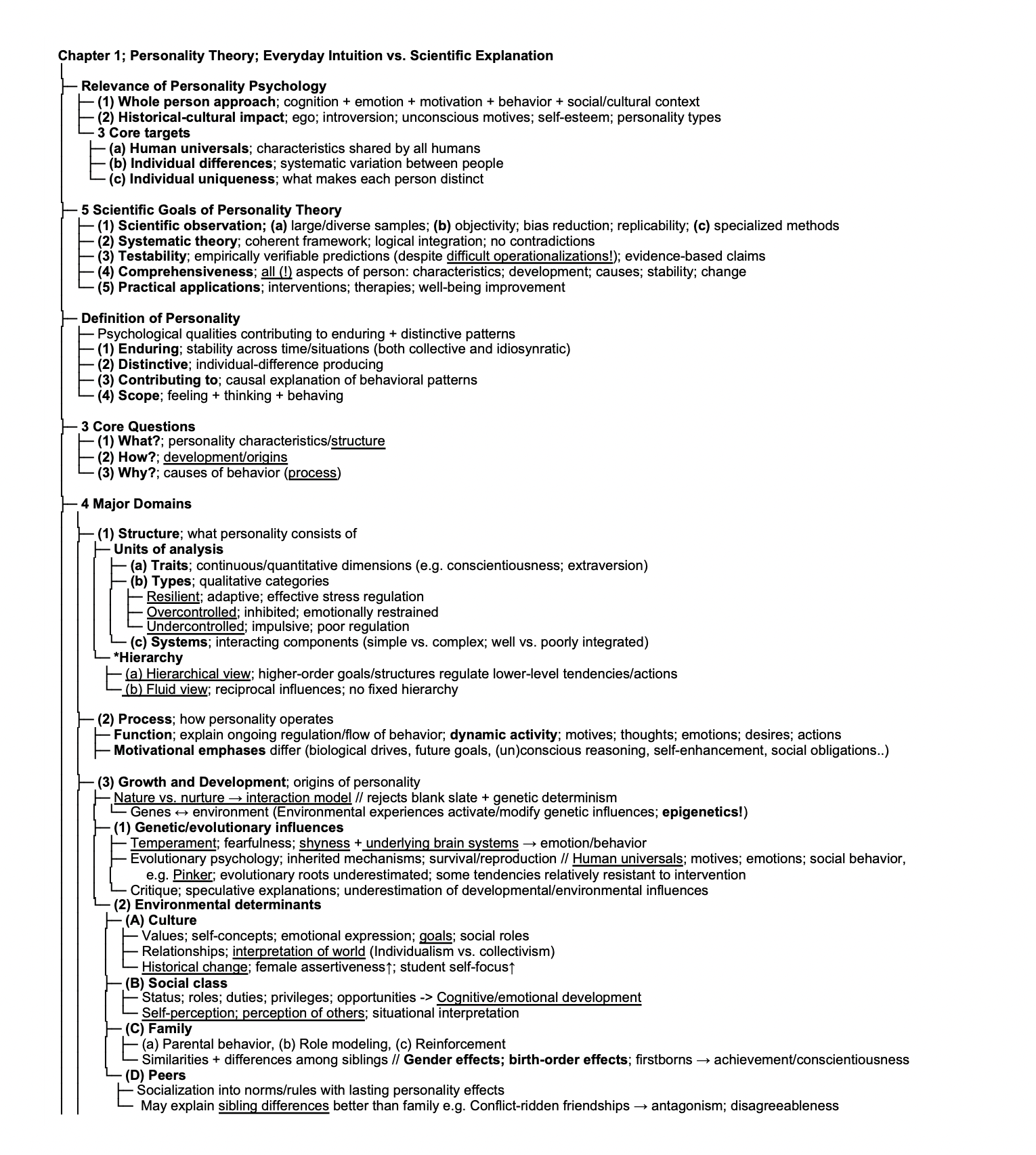
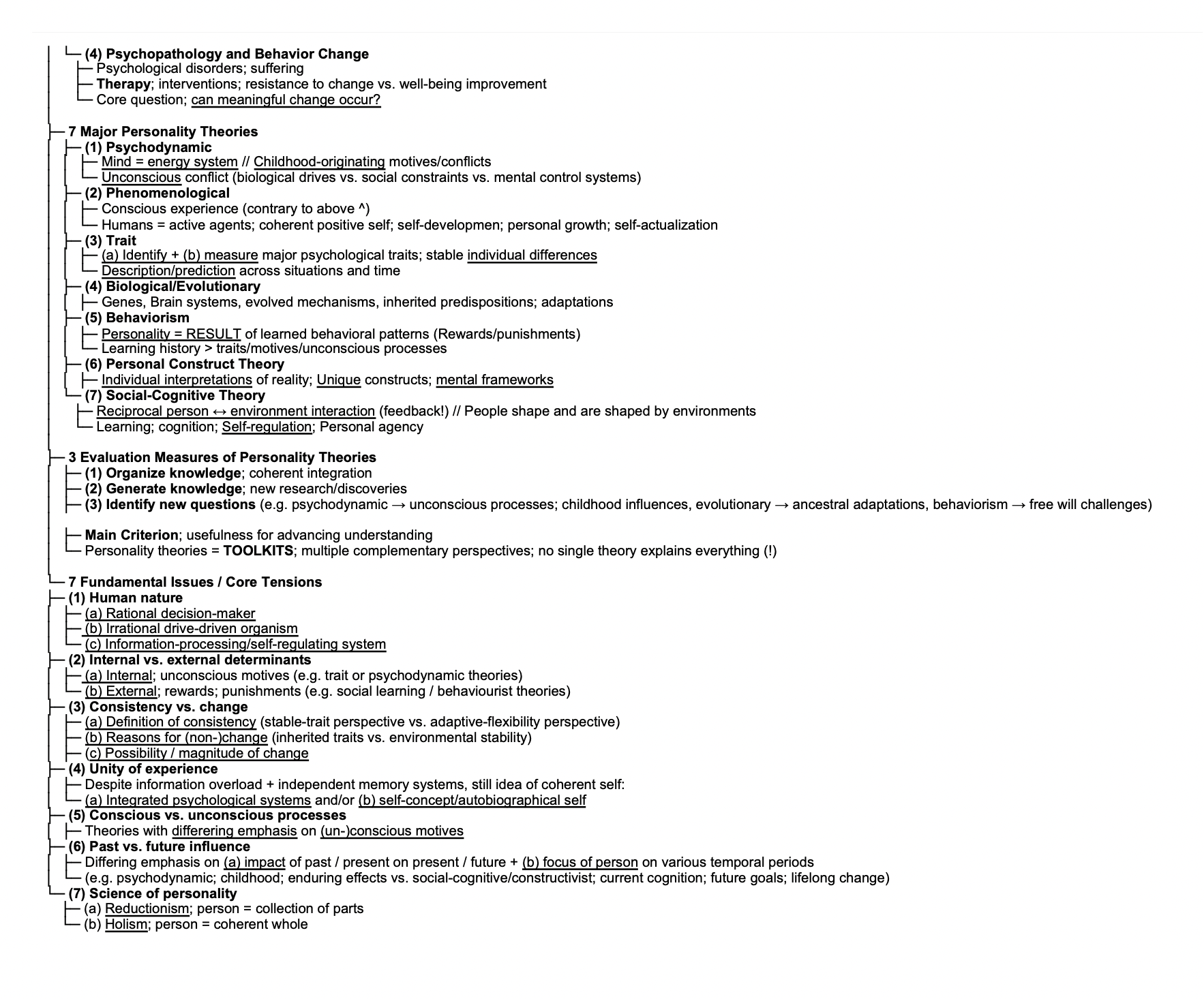
Tree (PKP Kap. 1) 2/2
How does Cervone describe the relationship between personality theory and personality research, and what methodological function does the case of Jim serve?
Theory ↔ research (inseparable); theory determines research questions, relevant phenomena, criteria of evidence, measurement methods; research tests/evaluates theory; theory-free research = impossible | theory without research → speculation; research without theory → meaningless fact gathering; different theories → different data sources/research strategies (experiment; case study; correlational research); no method inherently superior; each captures different aspects of personality → understanding requires integration of theory, measurement, and research.
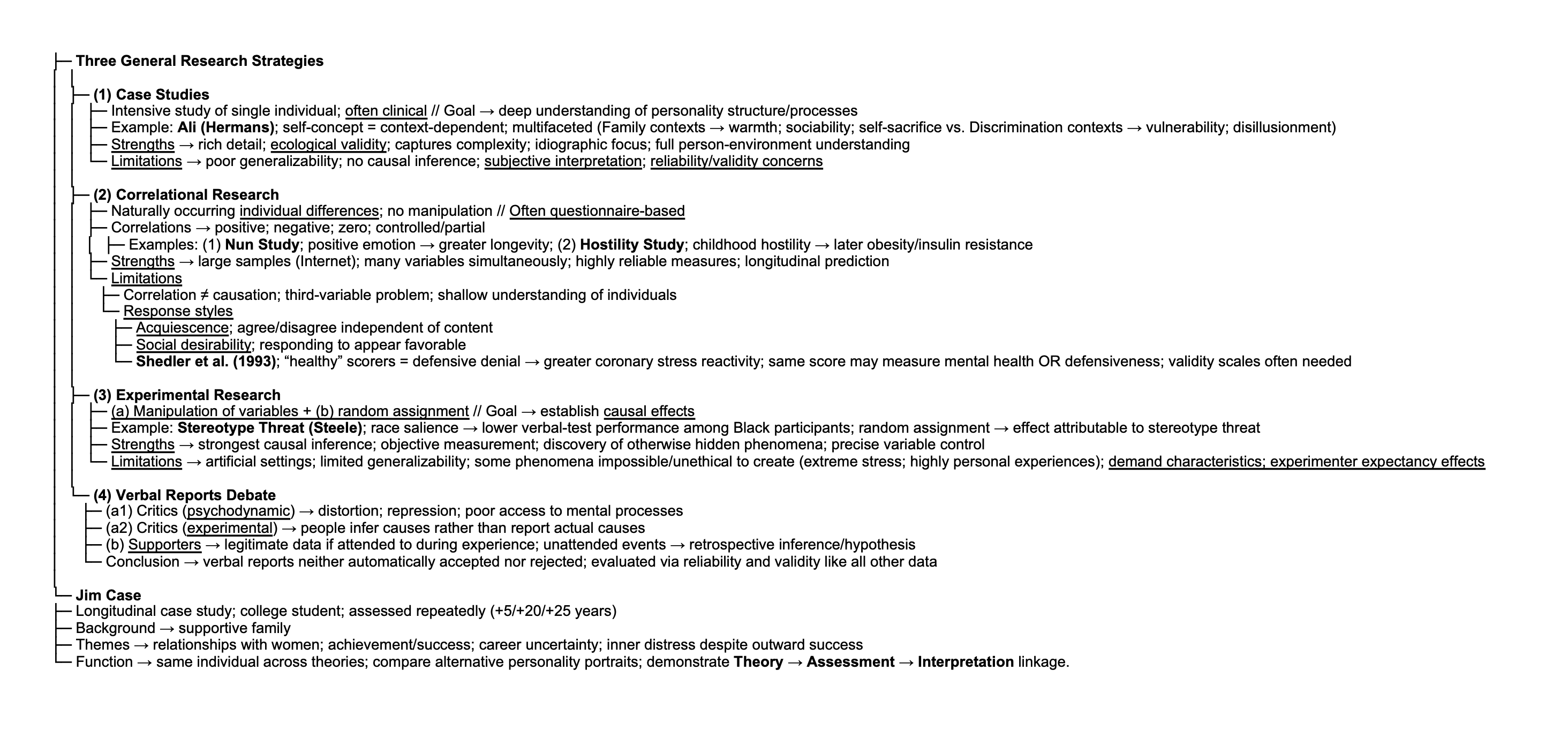
Jim (longitudinal case study); college student; assessed repeatedly (college; +5/+20/+25 years); background: supportive family; central themes: relationships with women; achievement/success; career uncertainty; inner distress despite outward success; methodological function: same individual examined through different theories and assessment methods → comparison of alternative personality portraits; demonstration of theory → assessment → interpretation linkage.
In what ways can data be differentiated in personality psychology?
Data source differentiation: LOTS = psychological data ≠ biological data; additional brain data increasingly complement LOTS.
L-data (life records = objective outcomes, but often n/a: e.g. grades, employment, criminal records),
O-data (observer ratings; e.g. parents, friends, teachers, trained observers + interrater reliability, BUT observer disagreements and external!),
T-data (performance-based tests/laboratory tests, esp. recent; e.g. delay of gratification, reaction times, emotion recognition),
S-data (self-reports/questionnaires; subjective (!) self-description, common/useful because convenient, great predictive ability, BUT item-phrasing effects, self-deception, lack of awareness, impression management!!)
Data-source correspondence: multi-method convergence → greater confidence that findings reflect true personality characteristics rather than method artifact
S-data ↔ T-data often weak agreement (broad cross-situational self-judgments vs. situation-specific laboratory behavior),
S-data ↔ O-data generally stronger agreement; agreement moderated by (a) evaluativeness of trait (high evaluativeness → self-serving bias), (b) observability of trait (sociability > neuroticism), (c) judgeability of person.
Measurement format differentiation: Nomothetic → general laws across persons; Idiographic → understanding the unique individual.
Nomothetic/fixed + structured (same items; same scoring; objective; efficient; cross-person comparison); limitations: (a) irrelevant items, (b) unique personality aspects omitted.
Idiographic/flexible + unstructured (person-tailored; unstructured questions; self-descriptions; autobiographical narratives); captures unique experiences, values, goals, concerns.
Biological/brain data: neither measures subjective experience directly; value = psychological data + brain data → personality processes ↔ underlying neural mechanisms.
EEG (electrical brain activity via scalp electrodes),
fMRI (magnetic properties of blood tracked by scanner becuase blood-flow changes indicating active brain regions);
How does personality assessment work and what are the goals of research?
Personality assessment = standardized procedures for measuring personality differences and understanding individuals → Functions (!): prediction; theory testing; diagnosis; intervention; theory determines assessment target and therefore data source.
Assessment targets: → theory dictates what is measured and how (!)
(1) Average behavior (stable tendencies reveal personality structure // S-data/O-data),
(2) Behavioral variability (cross-situational differences reveal personality dynamics),
(3) Conscious experience (beliefs; goals; thoughts; emotions; subjective perceptions // S-data),
(4) Unconscious mental events (unaware motives/thoughts // T-data).
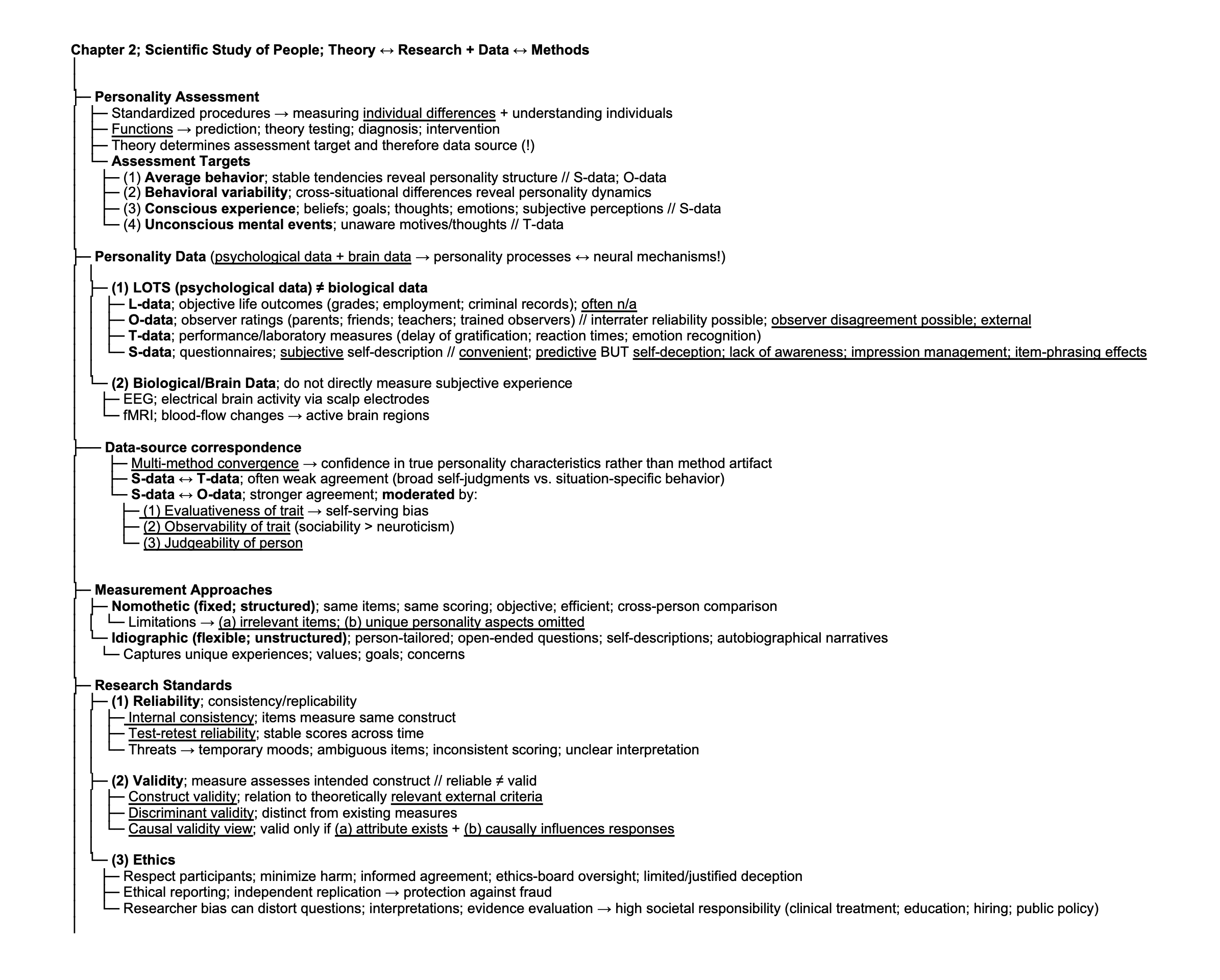
Goals of research: theory-guided assessment + reliable measures + valid constructs + ethical conduct/reporting.
(1) Reliability (consistency/replicability); (a) Internal consistency (items measure same construct), (b) Test-retest reliability (stable scores across time) | Threats: temporary moods; ambiguous items; inconsistent scoring; unclear interpretation.
(2) Validity (measure assesses intended construct, reliable ≠ necessarily valid!); (a) Construct validity = systematic relation to theoretically relevant external criteria, (b) Discriminant validity = distinct from existing measures, (c) Causal validity view: valid only if (A) attribute exists and (B) causally influences responses
(3) Ethics: respect participants; minimize harm/stress; informed agreement; ethics-board oversight; limited/justified deception; ethical reporting of results; independent replication protects against fraud; researcher biases can distort questions, interpretations, and evidence evaluation; high societal responsibility (clinical treatment; education; hiring; public policy).
Discuss the three general research strategies in personality psychology and their strengths and limitations.
Case studies; intensive investigation of single individual; often clinical; goal = deep understanding of personality structure/processes;
Strengths: rich detail; ecological validity; captures complexity; idiographic focus; useful when full person-environment system must be understood
Limitations: poor generalizability; causality cannot be established; subjective interpretation; potential reliability/validity problems.
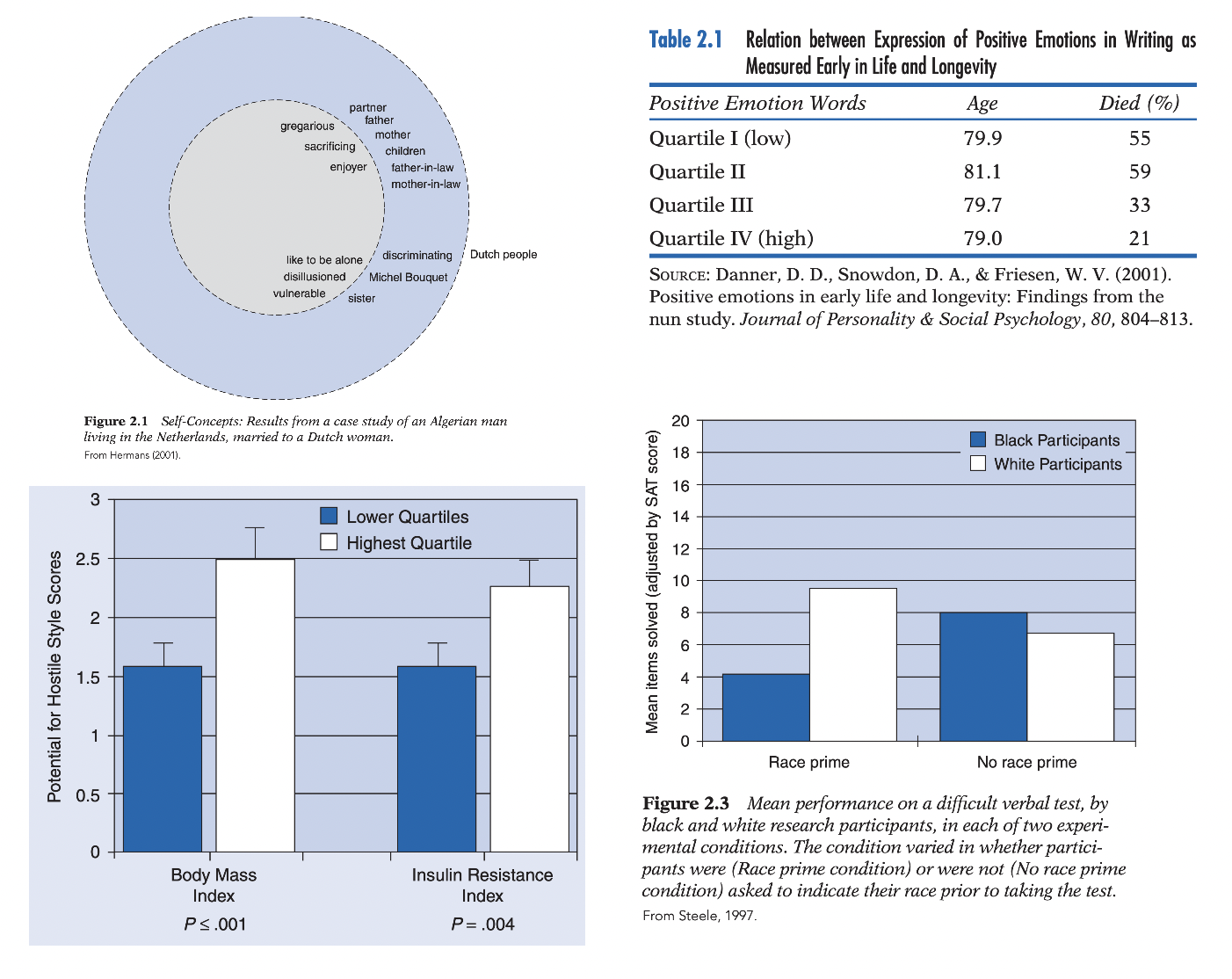
Examples: Ali (Hermans) → self-concept = context-dependent, multifaceted (family contexts → warmth/sociability/self-sacrifice; discrimination contexts → vulnerability/disillusionment)
Correlational research; examines relations among naturally occurring individual differences without manipulation; uses correlations (positive; negative; zero; simple or controlled); often questionnaire-based;
Strengths: large samples (especially Internet); many variables simultaneously; highly reliable measures; longitudinal prediction possible
Limitations: correlation ≠ causation; shallow understanding of individuals (see Shedler et al. (1993); third-variable problem; response styles: (a) Acquiescence (general tendency to agree/disagree independent of content); (b) Social desirability (responding to appear favorable);
Shedler et al. (1993): some “healthy” questionnaire scorers = clinically distressed individuals using defensive denial; greater coronary stress reactivity than openly distressed individuals → same questionnaire score may measure mental health in one person but defensiveness in another; validity scales often needed.
Examples: (1) Nun Study (positive emotion → greater longevity, see attachment), (2) Hostility → later obesity/insulin resistance (see attachment)
Experimental research; manipulation of variables + random assignment; goal = establish causal effects
Strengths: strongest causal inference; objective measurement; discovery of phenomena not observable naturally; precise variable control
Limitations: artificial settings; limited generalizability; some phenomena cannot be ethically/realistically created (extreme stress; highly personal experiences); potential demand characteristics and experimenter expectancy effects.
Example: stereotype threat (Steele); race salience manipulation → lower verbal-test performance among Black participants; random assignment → effect attributable to stereotype threat;
Verbal reports:
Critics (psychoanalytic/dynamic traditions) → distortion, repression, poor access to mental processes; experimental critics → people often infer causes rather than report actual causes;
Supporters → verbal reports are legitimate data if participants actually attended to the relevant process; if not attended → retrospective inference/hypothesis;
→ conclusion: verbal reports neither accepted nor rejected automatically; evaluated via reliability and validity like all other data.
Tree (PKP, Kap. 2) 1/2
Tree (PKP, Kap. 2) 2/2
Who was Freud, and how did he view humans (and go about studying them)?
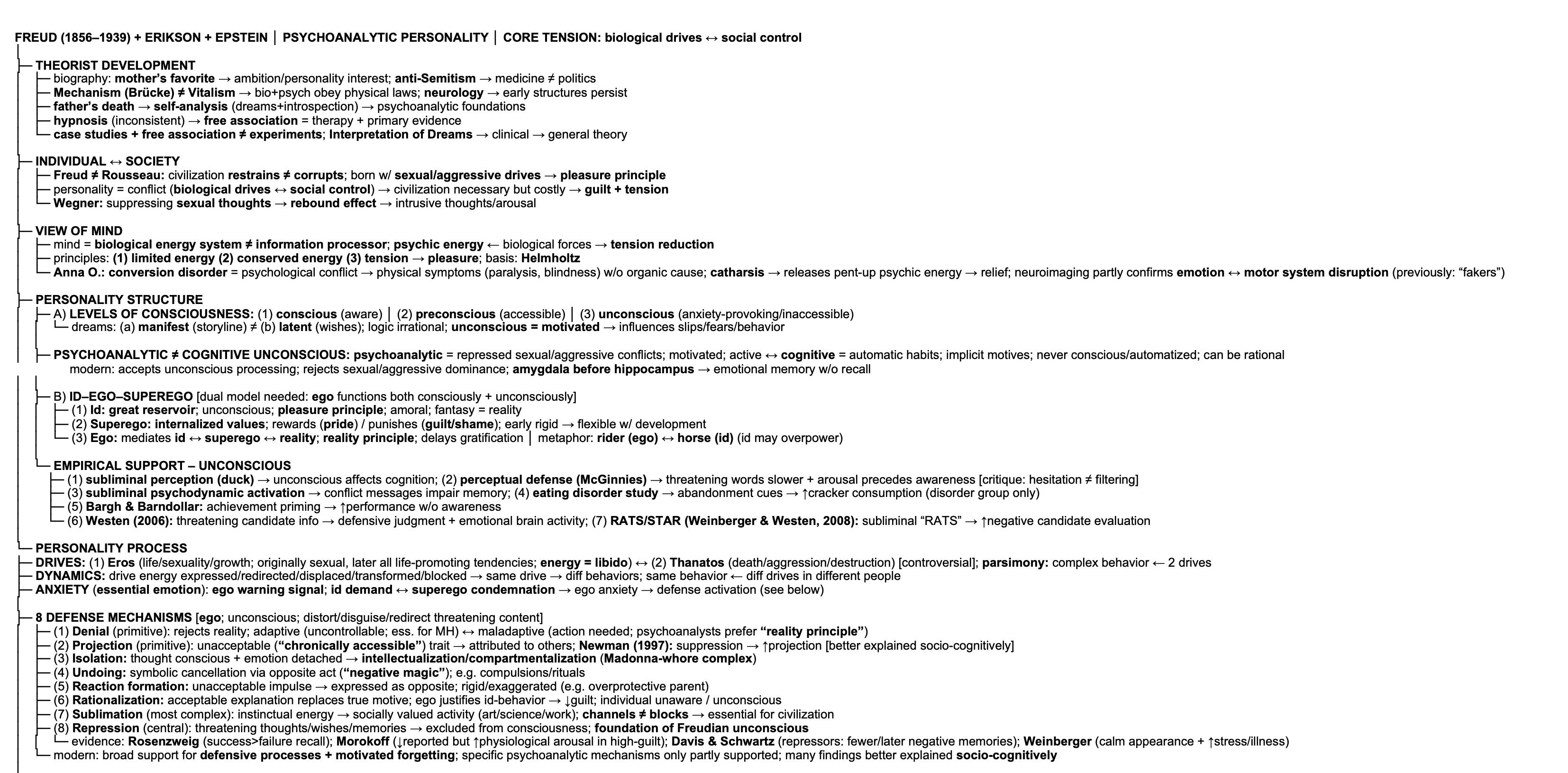
Freud (1856–1939): Development of the theorist; mother’s favorite child (among many) → interest in confidence, ambition, personality; anti-Semitism → medicine instead of politics/government; Mechanism (Brücke) ≠ Vitalism → biological and psychological phenomena obey physical laws; neurology research → early structures persist throughout life; father’s death → depression/anxiety → lifelong self-analysis (dreams + introspection) → foundations of psychoanalysis; hypnosis abandoned (inconsistent) → free association (!) (uncensored thoughts) = therapy + primary evidence; The Interpretation of Dreams (initially rejected)→ transition from clinical practice to general theory of mind; psychoanalysis emerged from medical science + clinical observation + self-analysis + historical context.
Individual ↔ society: Freud ≠ Rousseau; humans born with sexual/aggressive drives pursuing the pleasure principle; civilization restrains rather than corrupts instinctual expression; personality emerges from conflict between biological drives and social control → Civilization is necessary but psychologically costly because it requires continual suppression of instinctual wishes (pleasure principle!), producing guilt and tension; supporting this, Wegner found that suppressing sexual thoughts produces a rebound effect, increasing later intrusive thoughts and emotional arousal (e.g. phobias, obsessions..).
View of personality science: psychology should resemble physics; emphasis on lawful explanations and precise theory; relied primarily on case studies + free association rather than experiments or standardized tests because he believed intensive clinical analysis uniquely revealed unconscious processes; BUT modern psychology values his theoretical insights and rich clinical observations but generally rejects case studies alone as sufficient scientific evidence (!)
View of humans: Mind = biological energy system ≠ information processor; psychic energy originates from biological forces seeking expression/tension reduction (quiescence); principles: (1) limited energy (investment in one domain reduces availability elsewhere); (2) conserved energy (blocked impulses redirected via path of least resistance rather than disappearing); (3) tension reduction through behaviour → pleasure; based on Helmholtz’s conservation of energy
Anna O.: hysteria (conversion disorder) improved after catharsis (emotional reliving of traumatic memories) → release of pent-up psychic energy + evidence that forgotten experiences continue operating unconsciously; blocked sexual/aggressive energy redirected into alternative behaviors (incl. cultural productivity); modern neuroimaging partly supports emotion → emotional + motor-system interactions in conversion disorder (previously thought “fakers”).
Describe the psychoanalytic personality structure, as well as its contemporary acknowledgements.
Personality structure: two complementary models; (1) levels of consciousness (where mental contents reside) + (2) id–ego–superego (what mental systems do); Freud introduced the second because one coherent system (ego) could function both consciously and unconsciously, so consciousness levels alone could not explain personality. → Contemporary view of the unconscious: Psychoanalytic unconscious ≠ Cognitive unconscious (!)
Levels of consciousness: (a) Conscious (currently aware thoughts); (b) Preconscious (not currently conscious, but easily retrievable); (c) Unconscious (anxiety-provoking wishes, traumatic memories, unacceptable desires → inaccessible under normal conditions because awareness would produce psychological pain).
Dreams: Manifest content (storyline) ≠ Latent content (hidden wishes/conflicts); dream logic = irrational (contradictions coexist; time/space distorted; symbols replace direct meaning); dreams allow forbidden wishes to be fulfilled safely (symbolically rather than directly). Implication: unconscious contents remain active → influence slips of the tongue, emotions, attractions, fears, behavior; unconscious = motivated (!), not merely hidden/passive.
Clinical observations: Hypnosis → forgotten memories + intense emotional reactions (rage, sobbing, anxiety) became accessible → initial support for unconscious mental contents influencing behavior.
Loads of research + criticism thereof (!)
Id, Ego, Superego (functional systems):
Id: original “great reservoir” of psychic energy; source of sexual/aggressive drives; entirely unconscious; follows pleasure principle; seeks immediate gratification; ignores morality (“totally non-moral”) and reality; cannot tolerate frustration; fantasy = actual gratification = equally satisfying.
Superego: internalized parental/social values; operates as internal judge; rewards acceptable behavior (pride, self-approval) and punishes unacceptable behavior (guilt, shame, inferiority); early superego rigid/perfectionistic (judges thoughts as harshly as actions) but becomes more flexible with development.
Ego: mediator between id ↔ superego ↔ external reality; follows reality principle (!); delays gratification, distinguishes fantasy from reality, tolerates tension, redirects instinctual energy, plans strategically, negotiates compromises among drives, morality, and environmental constraints; develops throughout childhood. Metaphor: ego ≠ executive; ego = rider, id = horse (id supplies the energy and may ultimately overpower the rider).
What’s the contemporary evidence / acknowledgement of Freud’s psychoanalytic structural assumptions?
→ Contemporary view of the unconscious: Psychoanalytic unconscious ≠ Cognitive unconscious.
Psychoanalytic = repressed sexual/aggressive wishes, emotional conflicts, irrational motives, kept unconscious for motivated reasons and continuing to influence behavior.
Cognitive = automatic habits, learned associations, cultural assumptions, implicit motives, routine information-processing (outside awareness because never conscious, unprocessable, or automatized) → can be logical, rational, intelligent. Modern psychology accepts unconscious processing but generally rejects Freud’s claim that sexual/aggressive conflicts dominate mental life; nevertheless, neuroscience supports parts of Freud’s view (early emotional memories may influence later behavior without conscious recollection because amygdala develops before hippocampus, and neural systems appear capable of motivated forgetting).
Experimental support for unconscious processing: (tachistoscope frequently used)
Subliminal perception (Duck experiment) → hidden duck influenced later imagery despite no conscious perception → unconscious perception affects cognition.
Perceptual defense (McGinnies) → threatening words recognized more slowly; physiological arousal (sweat gland activity) preceded conscious recognition → possible unconscious filtering of threatening stimuli (critique: participants may simply have hesitated to verbalize taboo words).
Subliminal psychodynamic activation → conflict-provoking messages (“Loving Daddy Is Wrong”) impaired memory; conflict-reducing messages (“Loving Daddy Is OK”) did not → unconscious motivational conflicts can influence cognition.
Eating-disorder studies → subliminal abandonment cues (“Mama Is Leaving Me”) increased cracker consumption only in women with eating disorders → unconscious conflict influences behavior.
Goal activation (Bargh & Barndollar) → achievement-word priming improved later performance without awareness → unconscious goals guide behavior.
Political judgment (Westen et al., 2006) → threatening information about preferred candidates elicited defensive judgments + increased activity in emotional brain regions → motivated unconscious processing.
RATS / STAR (Weinberger & Westen, 2008) → subliminal “RATS” produced more negative evaluations of political candidates than neutral primes → unconscious cues bias judgments.
Modern acknowledgement: strong evidence for unconscious processing, implicit motives, automatic goal activation, and some motivated forgetting; neuroscience also supports unconscious emotional memory (e.g., amygdala before hippocampus), BUT Modern criticism: evidence largely rejects Freud’s claim that the unconscious is mainly driven by repressed sexual/aggressive conflicts; many findings are better explained by social-cognitive mechanisms and are limited by methodological and replication issues.
How does Freud describe the process of personality, and which essential emotion does he mention?
Personality process: driven by biological psychic energy originating from bodily drives (≠ fixed instincts; flexible motivational forces seeking expression + tension reduction); central questions → (1) Which drives exist? (2) What happens to their energy?
Life (Eros) ↔ Death (Thanatos) instincts:
Eros → survival, self-preservation, sexuality, reproduction, growth; psychic energy = libido; originally sexually motivated; later encompasses all life-promoting tendencies (!)
Thanatos → destruction, aggression, self-harm, return to inorganic state; explains aggression/suicide towards others (highly controversial!).
Central: Parsimony: complex behavior ← interaction of only two drives; sexual/aggressive drives originate in the id.
Dynamics of functioning: drive energy may be expressed directly, redirected, displaced, transformed (e.g., socially acceptable forms), or blocked → same drive can produce different behaviors; same behavior may arise from different underlying drives // all ACROSS individuals!
Essential emotion = Anxiety: ego function; arises when instinctual wishes conflict with reality or superego; functions as a warning signal that danger is approaching. Typical conflict: id demands gratification ↔ superego condemns impulse ↔ ego experiences anxiety and initiates defense mechanisms to restore psychological stability (often in response to remembered or forgotten traumatic experiences).
Includes: 8 Defense mechanisms: Denial, Projection, Isolation (+ Undoing), Reaction Formation, Rationalization, Sublimation, Repression; modern research broadly supports defensive processes, motivated forgetting, and repressive styles, but evidence for Freud’s specific psychoanalytic mechanisms remains mixed, with many findings better explained by social-cognitive mechanisms than by repressed id-based conflicts.
What are defense mechanisms according to Freud?
8 Defense mechanisms: ego functions; unconscious strategies activated by anxiety to distort, disguise, redirect, or exclude threatening thoughts, wishes, and impulses → protect psychological stability by mediating id ↔ superego ↔ reality.
Denial (primitive): rejects painful reality/internal impulse (“this can’t be happening”, “I’m not angry”); conscious avoidance → automatic/unconscious (!); temporarily adaptive (esp. uncontrollable situations / for overall mental health!) but maladaptive when reality-oriented action is needed (preferred by psychoanalysists).
Projection (primitive): unacceptable impulse/trait attributed to others (hostility, laziness, etc., usually “chronically accessible”) while denied in oneself; Newman et al. (1997): suppressing a disliked trait increased judging others as possessing that same trait → support for projection, though explained better by social-cognitive mechanisms than id conflicts (!).
Isolation: thought remains conscious but emotion detached → intellectualization; compartmentalization (e.g., Madonna–whore complex: love or sex, but not both in one woman!).
Undoing: symbolic cancellation of unacceptable thought/action through another act (“negative magic”); examples: compulsions, rituals, excessive checking.
Reaction formation: unacceptable impulse expressed as its opposite; exaggerated, rigid behavior (e.g., overprotective parent masking hostility, serial killer, who “couldn’t hurt a fly”).
Rationalization (complex): acceptable explanation replaces true unacceptable motive (crimes in name of “love”); ego justifies id-driven behavior → reduced guilt/anxiety ( = superego behaviour); individual usually unaware / unconscious (!) of the true motive.
Sublimation (very complex): instinctual energy redirected into socially valued activities (art, science, sports, work); unlike other defenses, channels rather than blocks energy (!) → viewed as essential for civilization.
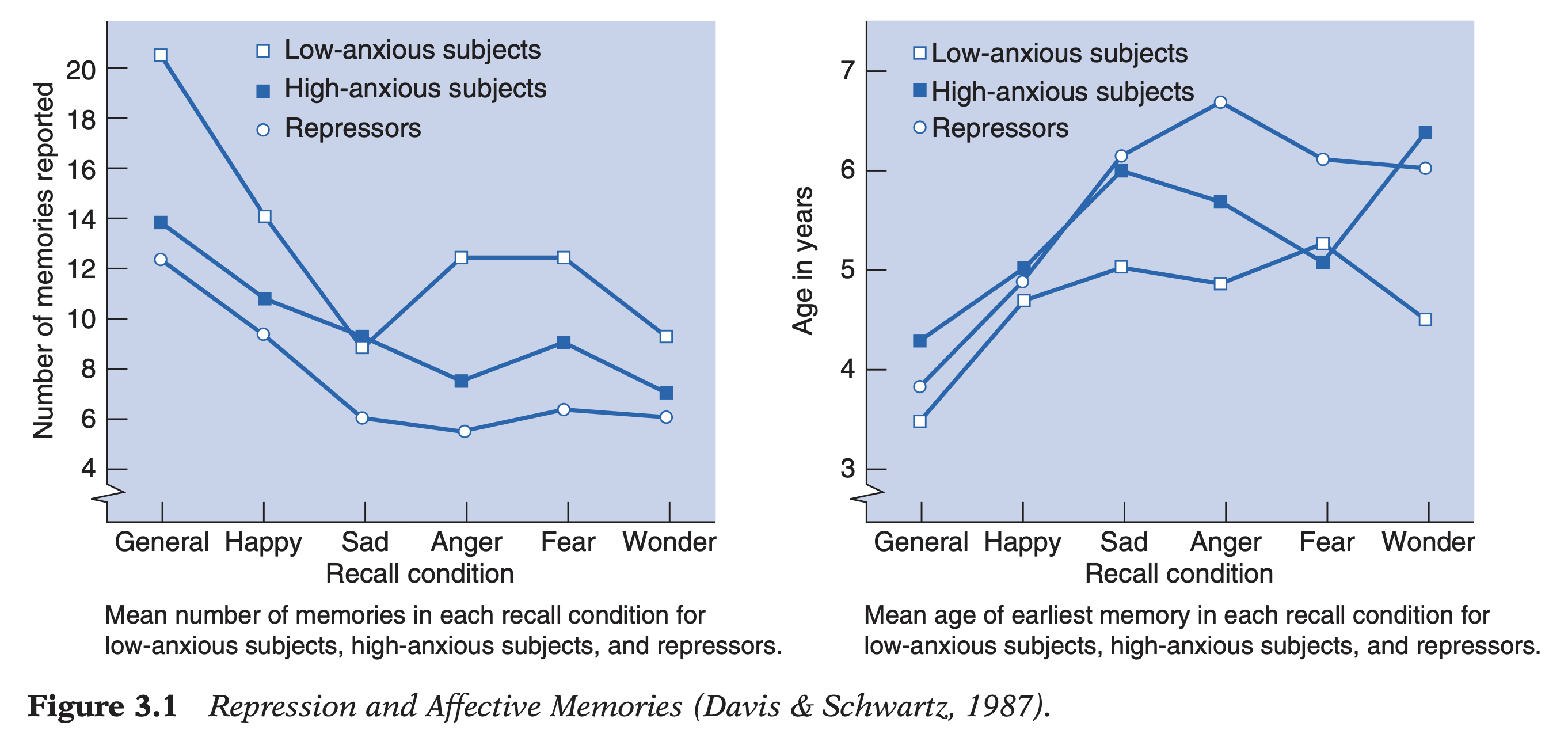
Repression (central defense): threatening thoughts, wishes, or memories excluded from consciousness → unconscious; foundation of Freud’s unconscious. Evidence: Rosenzweig (success > failure recall when invested), Morokoff (sex guilt: ↓reported but ↑physiological arousal with high-guilt group), Davis & Schwartz (repressors recalled fewer/later negative memories), Weinberger (repressive style: calm appearance but ↑stress responses/illness) → partial support, though evidence remains debated.
Modern research broadly supports defensive processes, motivated forgetting, and repressive styles, but Freud’s specific psychoanalytic explanations are only partly supported, with many findings better explained by social-cognitive mechanisms than by repressed id-based conflicts.
How does Freud describe the growth and development of the personality, and how was this further developed?
Freud: Personality development = universal sequence of psychosexual (“sensual”) stages; each stage defined by an erogenous zone providing gratification/tension reduction; conflicts at each stage permanently shape adult personality; first ~5 years most influential.
Oral stage (≈ 0–1 yr): mouth (feeding, sucking, biting); passive dependence on caregivers → trust/dependency; (1) early passive ↔ (2) later biting phase (aggression + pleasure merge); adult remnants: kissing, chewing gum, “food for thought.”
Anal stage (≈ 2–3 yrs): bowel control/toilet training; pleasure principle ↔ social demands; themes: autonomy, control, giving ↔ withholding, obedience ↔ defiance; may produce intentional soiling (reactance).
Phallic stage (≈ 4–5 yrs): genitals become central
boys: Oedipus complex (mother attraction + father rivalry) → castration anxiety (heightened by maternal seductiveness/father’s threats; happens often!!) → resolution via identification with father.
Girls: penis envy mirrors (!) Oedipus complex in boys → attachment shifts mother → father (“restore” penis symbolically) → resolution via identification with mother → superego, morality, gender identity (“superego = heir to Oedipus resolution”).
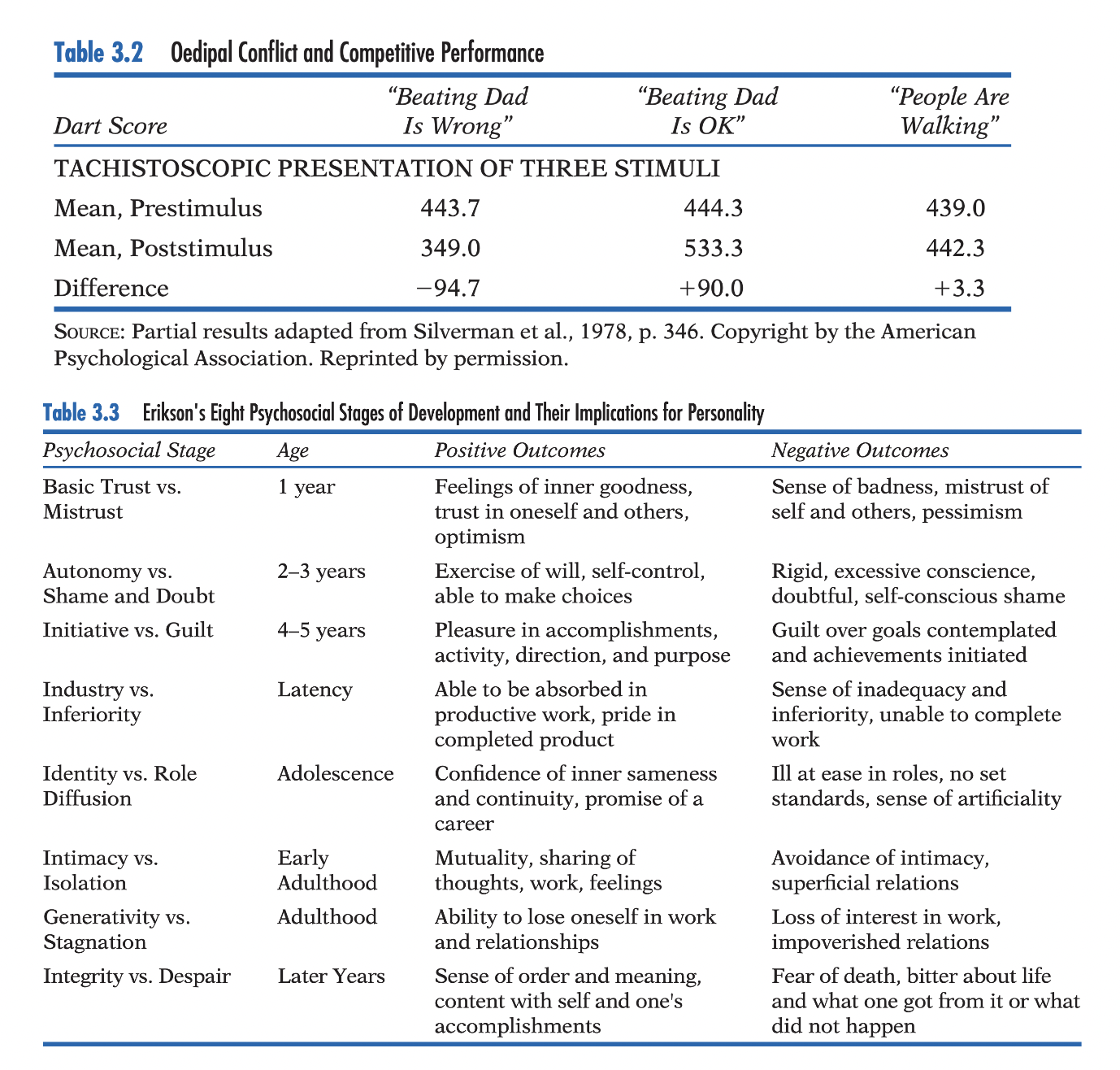
Evidence: Silverman et al. (1978): after Oedipal priming, subliminal “Beating Dad Is OK” improved dart performance whereas “Beating Dad Is Wrong” impaired it (effect disappeared when consciously presented); another study found greater opposite-sex parent preference and same-sex parent antagonism around age 4 (declining by ages 5–6).
Latency stage (≈ 6 yrs–puberty): reduced sexual interest; psychic energy redirected toward learning, friendships, hobbies, and social development.
Genital stage (puberty+): mature sexuality emerges; libido directed toward adult relationships; unresolved earlier conflicts may reappear; healthy outcome = capacity for love and productive work.
Erikson: Psychosocial expansion: Accepted Freud’s stage approach but emphasized psychosocial as well as instinctual influences; extended development across the entire lifespan (importance; past = future) through 8 psychosocial stages // Each conflict: successful resolution → psychological strengths; failure → vulnerabilities. Central aspect of theory: Identity (adolescence): central task = coherent sense of self, continuity with past, future direction, balancing self-view with others’ perceptions.
Later, Marcia’s identity statuses (exploration × commitment): argued identity formation strategies shape later self-concept, cognition, and interpersonal relationships.
Achievement: exploration + commitment → independent/complex thinking, intimacy, mature moral reasoning, resistance to conformity.
Moratorium: exploration without commitment → ongoing identity search; similarly complex thinking.
Foreclosure: commitment without exploration → conventionality, rigidity, routine, conformity.
Diffusion: neither exploration nor commitment → uncertainty, weak self-esteem, disorganized thinking, intimacy difficulties.
What are modern views on Freud’s growth claims about personality, and what other interesting research/discoveries have been made regarding Freud’s ideas on thinking?
Modern evaluation of Freud’s developmental claims: early attachment, parenting, and emotional relationships strongly influence personality, BUT personality remains plastic throughout life; later environments, relationships, therapy, and experiences can produce substantial change.
Jenny case (Gaensbauer, 1982): early abuse by father → depression, fear (esp. of males), distress; later nurturing foster care largely normalized functioning (even for males), although separation-related anger/distress persisted → early experiences leave emotional traces, but later supportive environments can modify development; repeated relationship patterns appear more influential than isolated traumatic events.
Attachment study (Lewis et al., 1984): insecure attachment at age 1 predicted (prospective) more later psychopathology (especially in boys; 40%), but many insecurely attached children developed normally (60%) → early attachment increases risk ≠ determines outcome, BUT retroactive path clear (80% of psychopathological cases had insecure style).
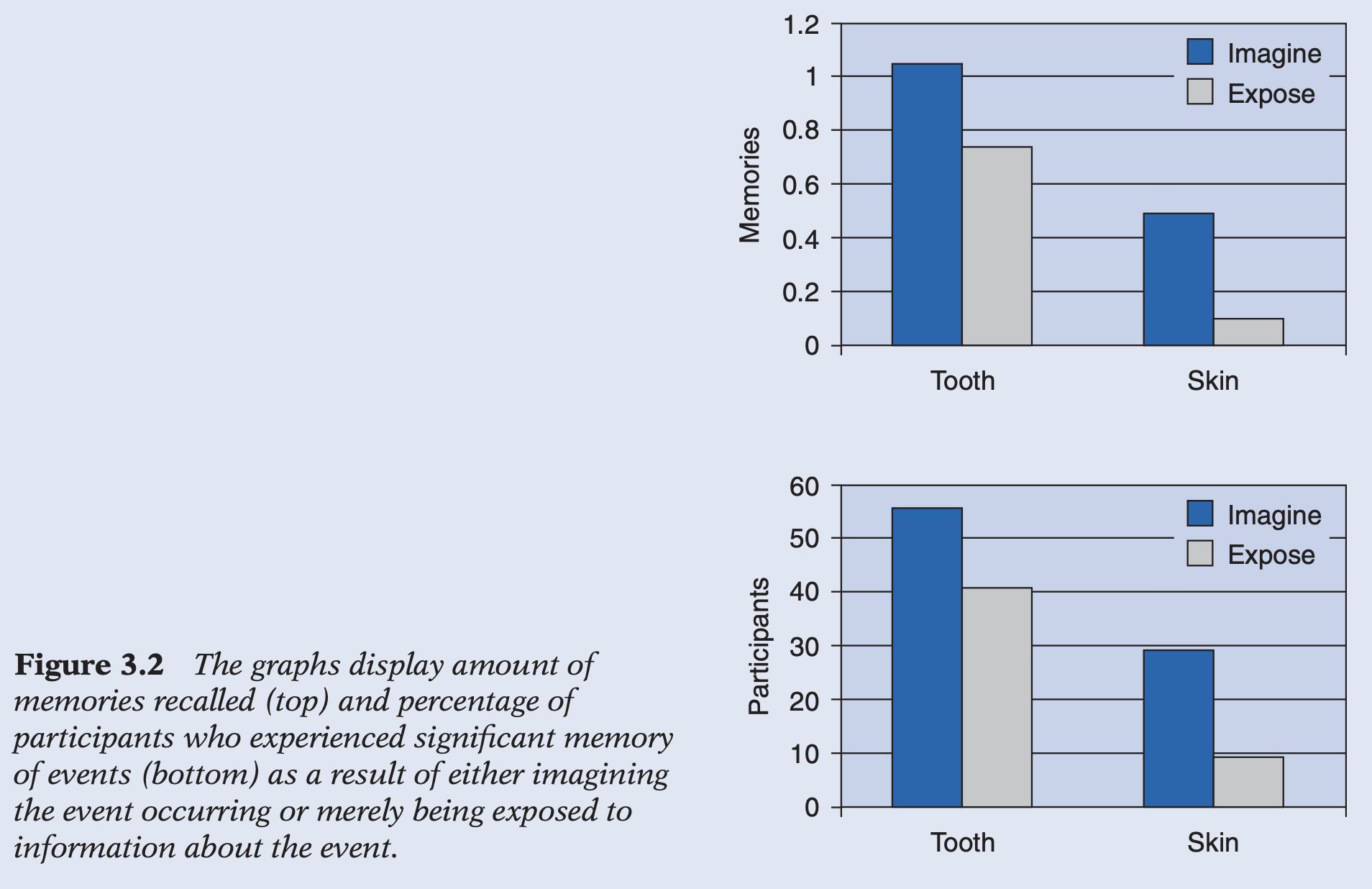
Recovered ↔ false memories: psychoanalysis → traumatic memories may be repressed then recovered during therapy; critics → some recovered memories may be false memories created by suggestion/imagination. Mazzoni & Memon (2003): merely imagining childhood events increased later belief and “memory” for those events (even an impossible skin-removal procedure) → genuine and false recovered memories currently cannot be reliably distinguished in individual cases.
Freud’s thinking processes: (1) Primary-process (id/unconscious) → emotional, symbolic, irrational, wish-driven, fantasy ≈ reality; characteristic of dreams and young children. (2) Secondary-process (ego/consciousness) → logical, analytical, reality-oriented, capable of delaying gratification; develops alongside the ego.
Modern development: Epstein: (1) Experiential thinking = intuitive, emotional, holistic; (2) Rational = slow, logical, evidence-based // Jelly bean experiment: despite knowing 1/10 > 8/100 odds, many participants chose 8/100 because it felt more likely → demonstrates conflict between intuitive and rational thinking, broadly supporting Freud’s idea that the mind operates through multiple interacting modes of thought, though not his psychoanalytic explanation.
Tree (PKP Ch. 3) 1/2
Tree (PKP Ch. 3) 2/2
How does psychodynamic personality assessment work, and what were Jim's results? Do these tests work?
Psychodynamic personality assessment: Goal = assess unconscious personality processes (valid + efficient!); direct questioning inadequate (unconscious wishes/conflicts + defense mechanisms conceal them). Freud → free association (slow; questionable validity) → later psychodynamic psychologists developed projective tests (faster assessment).
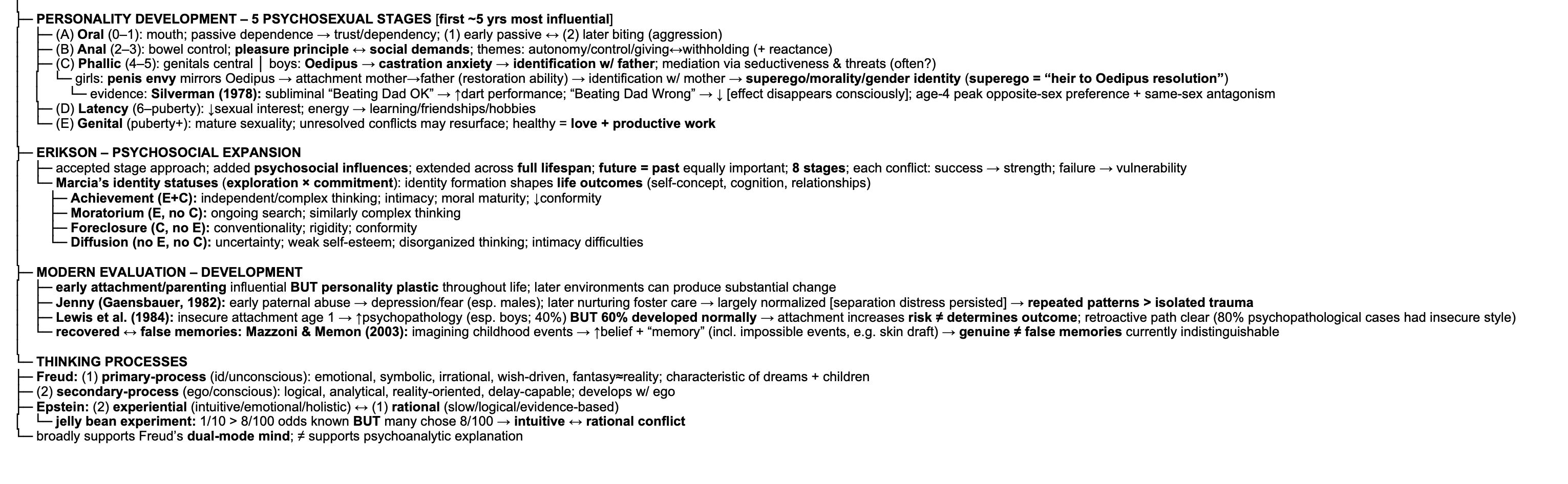
Projective tests: Use ambiguous stimuli (clarity deliberately minimized) → individuals unknowingly project motives, conflicts, defenses, interpersonal expectations, and characteristic cognitive organization onto stimuli; responses interpreted holistically ((3) overall response pattern > isolated answers); intended to capture personality (1) complexity and (2) bypass conscious defenses.
Rorschach Inkblot Test (H. Rorschach): 10 standardized symmetrical inkblots; participant reports perceptions + reasoning; examiner evaluates response organization, content, and testing behavior. (1) Reality-consistent percepts → intact reality testing; distorted percepts → impaired reality contact/bizarre thinking. (2) Recurring themes (aggression, dependency, hostility, humans vs. animals, symbolic images such as explosions = hostility; spiders = threatening mother; giants = threatening father) generate hypotheses about personality dynamics; (3) testing behavior (e.g., reassurance seeking, suspiciousness) also interpreted.
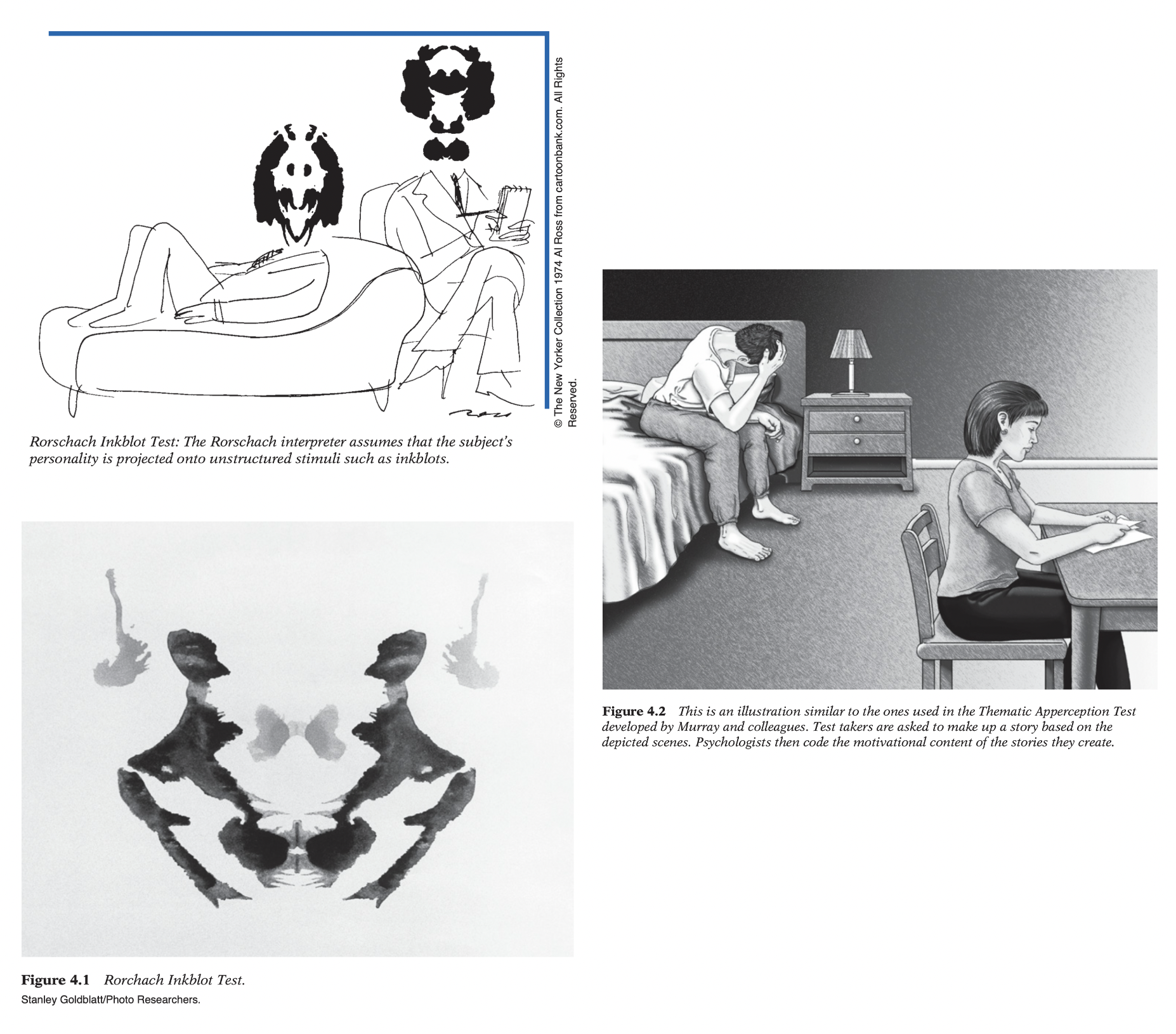
Thematic Apperception Test (TAT; Murray & Morgan): Ambiguous social scenes → participant constructs story (current situation; thoughts/feelings; antecedents; outcome). Assumption = projection of unconscious motives/conflicts/interpersonal expectations into narratives. Can be scored systematically or impressionistically; some cards sex-specific. Unlike the Rorschach, the TAT became important in motivation research: McClelland showed stories reveal implicit motives (esp. achievement), which differ from explicit motives and predict motivated behavior and memory for motive-relevant events beyond self-report.
→ Do projective tests work? Overall mixed (depends on prediction content!), but largely negative. Lilienfeld, Wood & Garb (2000): only a few procedures (especially McClelland’s TAT achievement scoring) showed meaningful predictive validity; most Rorschach indices and most TAT scoring systems failed to predict clinically relevant outcomes. Major limitations: (1) low interjudge reliability (different clinicians interpret identical responses differently) + (2) poor stimulus relevance (abstract stimuli poorly represent real-life contexts; better validity when stimuli directly match the construct, e.g., interpersonal scenes for interpersonal motives). → Does not directly invalidate Freud (he primarily used free association, not projective tests), but indicates that the psychodynamic tradition has produced relatively weak personality assessment methods, making assessment one of its weakest empirical contributions.
Jim (illustration of projective interpretation): (1) Rorschach: Only 22 responses (→ cautiousness; inhibition). Themes: anxiety, pessimism, phobic tendencies, compulsive defenses, intellectualization, sexual identity conflict, hostility toward women, interpersonal discomfort despite outward composure. Dracula/vampires → interpreted as oral sadism; later cotton candy → dependency/nurturance wishes → aggression interpreted as defense against dependency; (2) TAT: Stories consistently involved sadness, domination, rejection, hostility, sexual conflict, and exploitative male–female relationships. Jim alternated psychologically between victim and aggressor, idealized intimacy while fearing it, relied heavily on denial, and showed chronic conflict among dependency, hostility, sexuality, and fear of rejection.
→ Overall interpretation: Rorschach + TAT produced a coherent profile (strained relationships; hostility toward women; unresolved dependency needs; anxiety hidden beneath confidence; compulsive defenses; sexual conflict) not obvious in Jim’s autobiography → illustrates why psychodynamic clinicians valued projective tests for uncovering material beneath conscious self-description. Limitation: many conclusions (oral sadism, oral fixation—supported by his ulcer—symbolic meanings) depend heavily on psychoanalytic assumptions; other personality theories would interpret the same responses differently or regard many as insignificant → rich qualitative information, but highly subjective interpretation.
How did Freud describe e psychopathology? Give an example.
Freud’s psychopathology: Normal ≠ abnormal in kind, only degree; same unconscious processes operate in everyone. Neuroses arise when psychosexual development is disrupted → unresolved childhood conflicts persist into adulthood → symptoms.
Developmental basis:
Fixation (too little gratification → fear of progressing; too much gratification → no motivation to progress) → continued pursuit of stage-specific gratification in adulthood (e.g., oral fixation → overeating, smoking, drinking).
Regression = temporary return to earlier developmental mode under stress (see to which exactly below).
Personality types (fixation outcomes):
Oral: dependency, receiving, incorporation (“give me”); others valued for what they provide; narcissistic, demanding, dependent, jealous, pessimistic, prone to depression (empty, in need of nourishment).
Anal: power, control, order (“I control”); anal triad = (a) orderliness/cleanliness (reaction formation), (b) parsimony/stinginess (retaining possessions ↔ retaining feces), (c) obstinacy (toilet-training struggles); rigid, controlling, rule- and possession-oriented.
Phallic: fixation during Oedipal period; (A) male: competitiveness, exhibitionism, exaggerated masculinity → defense against castration anxiety; (B) female (hysterical personality): naive (!), exaggerated femininity, flirtatiousness, seductiveness, romantic idealization while denying sexual motives.
Psychopathology mechanism: Childhood instinctual wishes persist → associated with punishment, guilt, or danger → intrapsychic conflict (wish ↔ anxiety). Ego reduces anxiety through defense mechanisms (denial, projection, displacement, etc.); successful defenses keep wishes unconscious, failed defenses produce symptoms as disguised compromises between unconscious wishes and defenses. Adult disorders therefore represent repetitions of unresolved childhood conflicts, not entirely new problems.
Examples: Mother’s obsessive fear that harm will come to her child may disguise unconscious hostility toward the child; compulsive hand washing simultaneously expresses forbidden “dirty” wishes while defending against them through excessive cleanliness.
Psychological change (psychoanalysis): Goal = restart interrupted development by resolving unconscious conflicts. Free association + dream interpretation uncover unconscious material (manifest → latent content). Cure requires emotional insight, not merely intellectual understanding (!). Therapy reduces fixation, redirects defensive energy toward mature functioning, and strengthens ego control (”Where id was, ego shall be”).
Transference: Patients project feelings originally directed toward parents onto the therapist; analytic setting (neutral therapist/“blank screen”, couch, frequent sessions) strengthens this → transference neurosis, where childhood conflicts are emotionally reenacted. Resolution occurs through the corrective emotional experience: (1) conflict is less overwhelming, (2) therapist responds differently than parents, and (3) the mature adult ego can resolve previously unresolved childhood conflicts.
Example – Little Hans: Horse phobia interpreted as expression of the Oedipus complex. Early fascination with his penis (“widdler”) + mother’s threats of castration → castration anxiety (denial of sister not having as cope). Love for mother + rivalry with father → unconscious wish to replace father. Horse symbolized the father (large penis, physical resemblance, Hans pretending to be a horse); seeing a horse collapse triggered unconscious wishes that his father would similarly disappear (+ fear of punishment + identification with father). Dreams (e.g., large and crumpled giraffe) symbolically expressed Oedipal wishes. Recovery occurred through sexual education, psychoanalytic interpretation, and identification with the father, reducing hostility and castration anxiety. The case elegantly integrates Freud’s major concepts but is scientifically weak because observations were unsystematic, highly subjective, and largely based on second-hand reports.
What were the first major revision of Freud?
Biological instinct still:
Alfred Adler (Individual Psychology)
Core revision: (1) Unconscious sexual instincts → conscious social motives; (2) sexuality → inferiority & compensation.
Inferiority & compensation: All children experience inferiority relative to adults → universal striving to overcome inadequacy. Originally based on compensation for physical disabilities (e.g., stuttering → excellent public speaker), then generalized to all personality development.
Primary motivation: Striving for superiority, competence, effectiveness, and social interest (innate tendency toward cooperation as well as competition) // Healthy compensation → growth, cooperation, social contribution; unhealthy compensation → excessive power seeking and domination.
Style of life: Personality develops through each person’s characteristic way of compensating for inferiority.
Other revisions: Emphasized (1) conscious goals, self-perceptions, and future aspirations rather than unconscious childhood conflicts. Proposed (2) birth order effects (first-borns → conscientious/conservative; later-borns → unconventional/rebellious). Concepts such as inferiority complex, compensation, and birth-order effects became highly influential despite mixed empirical support.
Carl G. Jung (Analytical Psychology); many Jungian concepts remain difficult to test scientifically
Core revision: Sexual libido → generalized psychic life energy (sexuality + creativity + pleasure + spirituality + personal growth). Personality develops not only from unresolved childhood conflicts but also through movement toward future psychological integration.
Collective unconscious: Accepted Freud’s personal unconscious but added the collective unconscious—an inherited psychological layer shared by all humans through evolution. It contains archetypes, universal symbolic patterns expressed across myths, dreams, religions, and cultures (e.g., Mother archetype).
Integration of opposites: Psychological health requires balancing opposing forces: persona (social mask) ↔ authentic self; e.g. anima (feminine aspect in men) ↔ animus (masculine aspect in women). Excessive identification with one side creates imbalance. Modern psychologists broadly accept balancing opposing aspects of personality but question Jung’s biologically determined masculine/feminine classifications (+ evolutionbary psych).
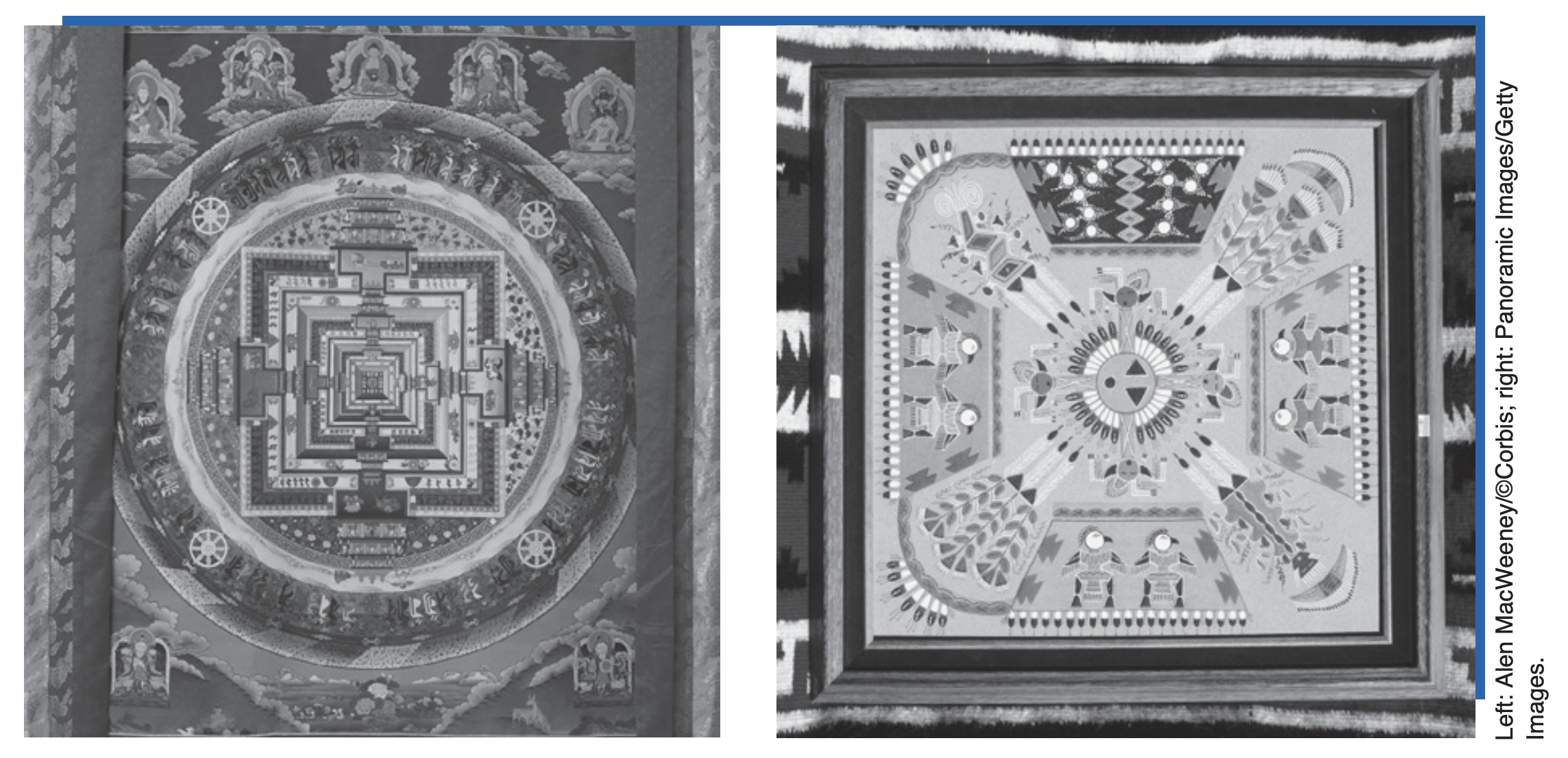
Individuation: Highest developmental goal = lifelong integration of opposing forces into a unified personality under guidance of the Self, the psyche’s organizing center. Mandalas symbolize this universal striving for wholeness (also an archetype).
Introversion–Extraversion: Introduced the influential distinction between introverts (psychic energy directed inward) and extraverts (energy directed outward); became quite influential
Shift to social relationships & culture:
Karen Horney
Core revision: Biological instincts → culture & interpersonal relationships. Rejected Freud’s view that femininity or concepts such as penis envy are biologically determined; argued that many gender differences arise from social expectations and cultural environments.
Basic anxiety: Personality problems originate from the child’s feeling of being isolated and helpless in a potentially hostile world; Three neurotic trends (Healthy people flexibly use all three; neurosis develops when one orientation becomes rigidly dominant. Horney therefore replaced Freud’s instinct theory with a more optimistic interpersonal theory emphasizing disturbed social relationships):
(1) Moving toward people: dependency, approval seeking, self-sacrifice.
(2) Moving against people: aggression, competition, dominance, denial of dependency.
(3) Moving away from people: withdrawal, detachment, avoidance of intimacy.
Harry Stack Sullivan
Core revision: Personality is fundamentally interpersonal. Emotional experiences—including anxiety—originate in relationships rather than instinctual drives.
Development of the self: Self-concept develops through reflected appraisals (how individuals believe others perceive them). Experiences create:
Good me: approval, security.
Bad me: criticism, anxiety.
Not me: overwhelming anxiety → rejected part of the self.
Development beyond childhood: Unlike Freud (and similar to Erikson), Sullivan emphasized the importance of school years and preadolescence. Peer relationships become increasingly important, and close same-sex friendships provide the foundation for later romantic intimacy.
What are modern psychodynamic developments?
Object Relations Theory
Core revision: Biological drives → significant others (“objects”); object = emotionally important person (usually caregiver).
Core idea: Early caregiver relationships → internalized mental representations (self + others) → enduring expectations, perceptions, interactions; personality explained by internalized relationship patterns, not instinct ↔ social constraint conflicts.
Self Psychology (within psychoanalythic tradition) & Narcissism
Core revision: Representations of others → representations of the self; disturbed relationships ← failure to develop stable, coherent, positive self.
(1) Narcissism (Kohut): Psychological energy invested in self; normal developmental process → pathological only after disrupted development. vs. (2) Narcissistic personality: Grandiosity; entitlement; fantasies of unlimited success/power; admiration seeking; reduced empathy (self-preoccupation); fragile self-esteem → criticism sensitivity; idealization ↔ devaluation of others.
Research: (1) NPI (self-reports) → more self-references; self-enhancement; mirror/video viewing; preference for admiring > caring partners; exhibitionistic, assertive, controlling, critical. Also self-aggrandizing attributions; simple self-concepts; cynical mistrust of others + (2) Experimental evidence: Manipulated success/failure → greater anger (esp. failure after success); larger self-esteem/happiness fluctuations; internal attributions for success; external attributions for failure → supports fragile grandiose self-image.
Attachment Theory (= strongest empirical successor to Freud; among the most empirically productive psychodynamic developments despite limitations)
Core revision: Attachment Behavioral System (ABS; Bowlby) = innate evolutionary system maintaining infant–caregiver proximity; caregiver = secure base → safe exploration + Internal working models: Repeated caregiver interactions → enduring mental representations of self + caregiver → later relationship expectations; stable personality structures.
Ainsworth – Strange Situation (Cross-cultural evidence: Universal attachment processes + cultural caregiving influence):
Secure (~70%) → separation distress; comfort on reunion; exploration resumes.
Anxious-avoidant (~20%) → little separation distress; reunion avoidance (very low rates in Korea).
Anxious-ambivalent (~10%) → extreme distress; simultaneous comfort seeking + resistance.
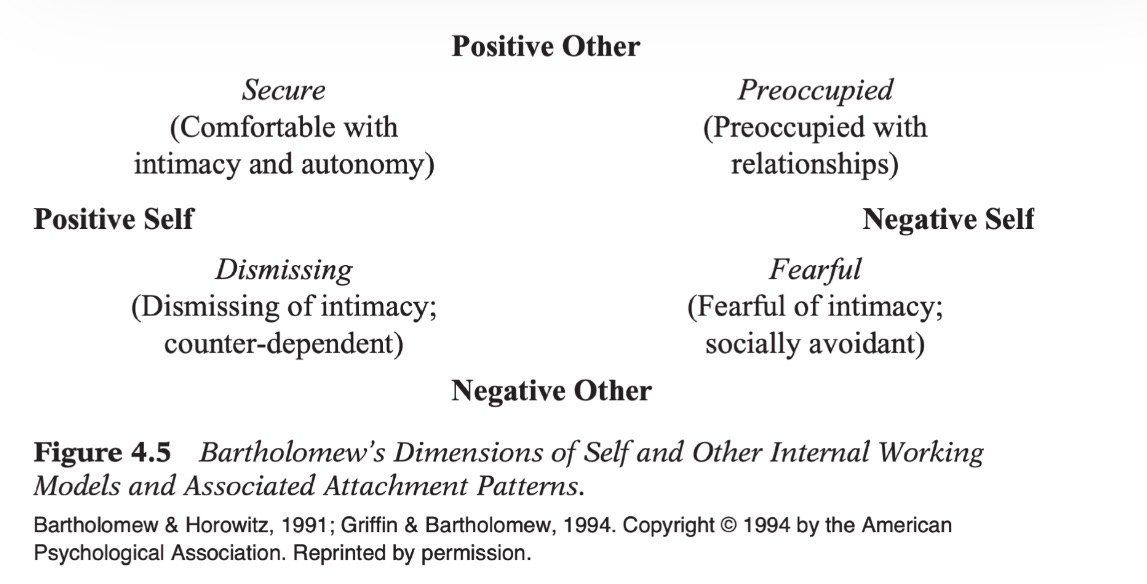
“Types → dimensions” (modern view); attachment better represented continuously than categorically; Bartholomew: Internal working model of self × internal working model of others → secure; preoccupied; fearful; dismissing BUUUT Current limitations: Attachment styles not perfectly stable; vary across relationships, contexts, genders; evidence still heavily self-report.
Attachment in Adulthood (Hazan & Shaver: Adult romantic love = continuation of infant attachment system; early internal working models → later relationship expectations/behavior)
Secure: trust; happiness; friendship; stable (but fluctuating / realistic) love; warmer childhood parental relationships (inter and intra).
Avoidant: intimacy avoidance; distrust; skepticism about lasting love; emotional distance/work → avoid dependence; jealousy; emotional highs/lows; lower job satisfaction.
Anxious-ambivalent: partner preoccupation; desire for complete union; intense jealousy/emotions/sexual attraction; reassurance seeking; relationship concerns interfere with work.
+ Broader findings: Predicts work orientation; stress psychopathology; interpersonal functioning; partner choice; religiosity; coping. Naturalistic airport studies confirmed attachment differences in actual behavior (not only self-report): avoidant women ↓ contact seeking/support during separations but warmer behavior without separation threat → infant attachment dynamics generalize to adult relationships.
Personality and the Brain
(1) Oxytocin: ↑ attachment security; ↑ positive interpretation of attachment-related situations, (2.1) Neural basis: Multiple emotional systems (esp. limbic system), not single attachment center; (2.2) Cerebellum: Traditionally movement → also attachment. After interpersonal loss: avoidant attachment → reduced cerebellar volume; more secure attachment → greater cerebellar volume → emotional regulation systems contribute to attachment.
Give a critical evaluation of Freud's theory.
Scientific observation (database): Free association = major innovation + major weakness; database = small, educated Viennese clinical sample; limited diversity/objectivity; Freud = observer + interpreter → confirmation bias, suggestion, subjective interpretation; poor scientific database for theory construction/testing.
Systematicity: Major strength; highly coherent integration of personality structure (id/ego/superego), instincts, anxiety, defense mechanisms, development, psychopathology, therapy; one of the most internally consistentpersonality theories.
Testability: Major weakness; almost any finding explainable via unconscious wishes, defenses, compromise formations→ difficult to falsify; highly flexible explanations, few genuinely testable predictions; excessive reliance on case studieslimited scientific progress.
Comprehensiveness: Greatest theoretical strength; attempts to explain development, dreams, unconscious motivation, sexuality, psychopathology, psychotherapy, social behavior, culture within one framework; exceptionally broad scope.
Applications: Psychoanalytic therapy often effective; outcome studies support clinical benefit. BUT: therapeutic success ≠ validation of Freud’s theory; many non-psychoanalytic therapies equally effective despite rejecting unconscious conflict/childhood sexual wishes → treatment effectiveness alone cannot confirm psychoanalytic explanations.
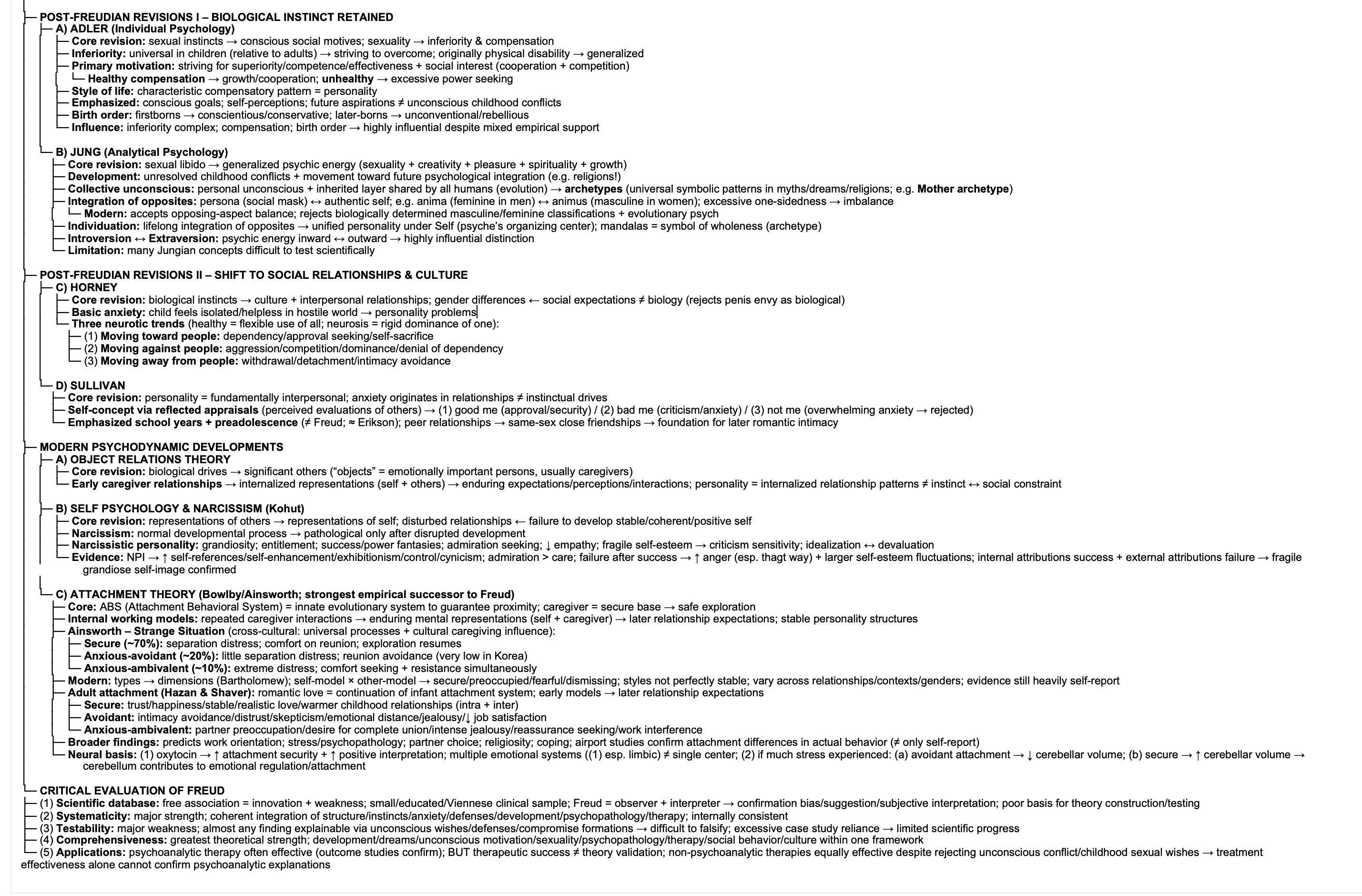
Tree (PKP. Kap. 4) 1/2
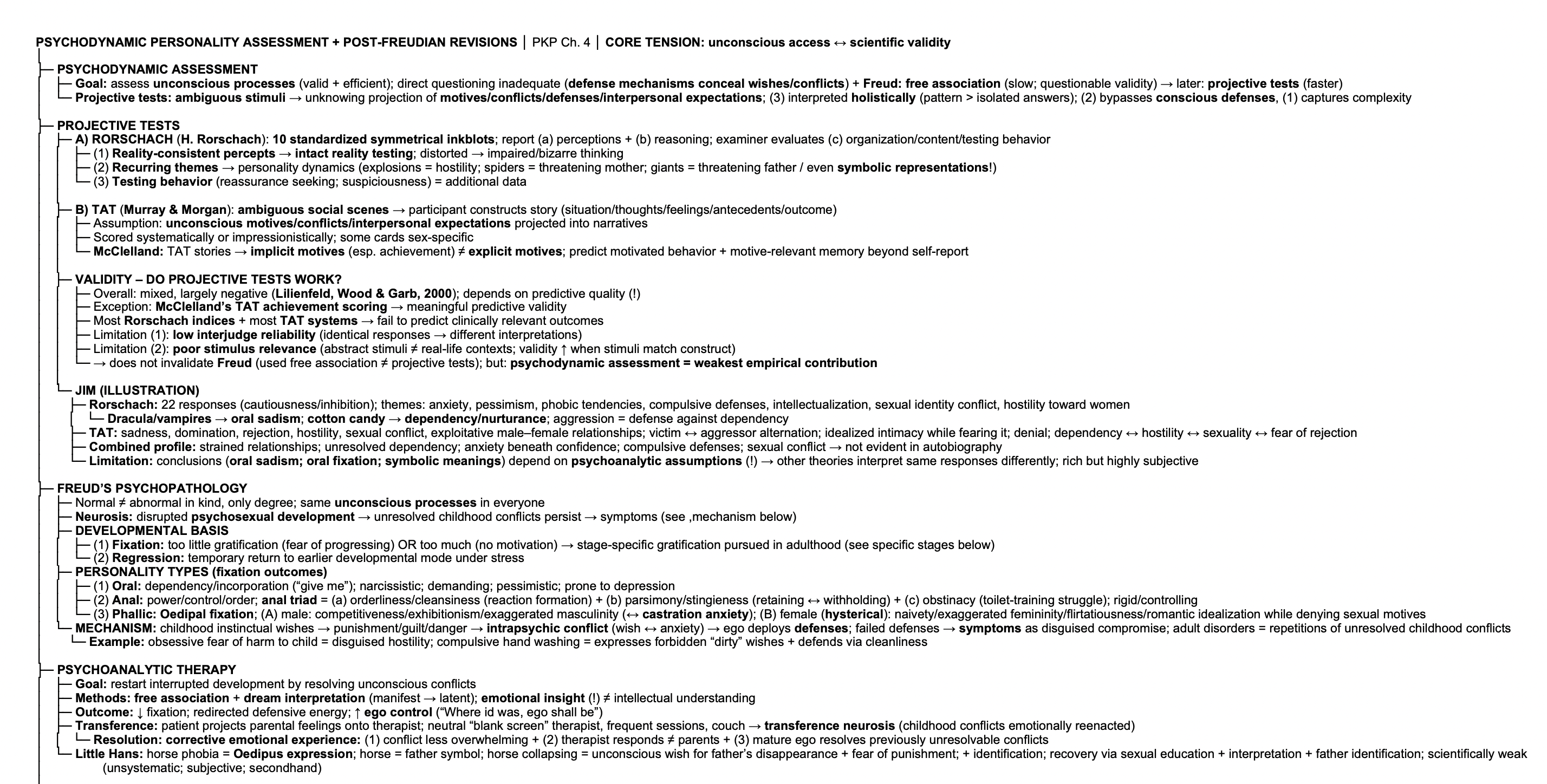
Tree (PKP. Kap. 4) 2/2
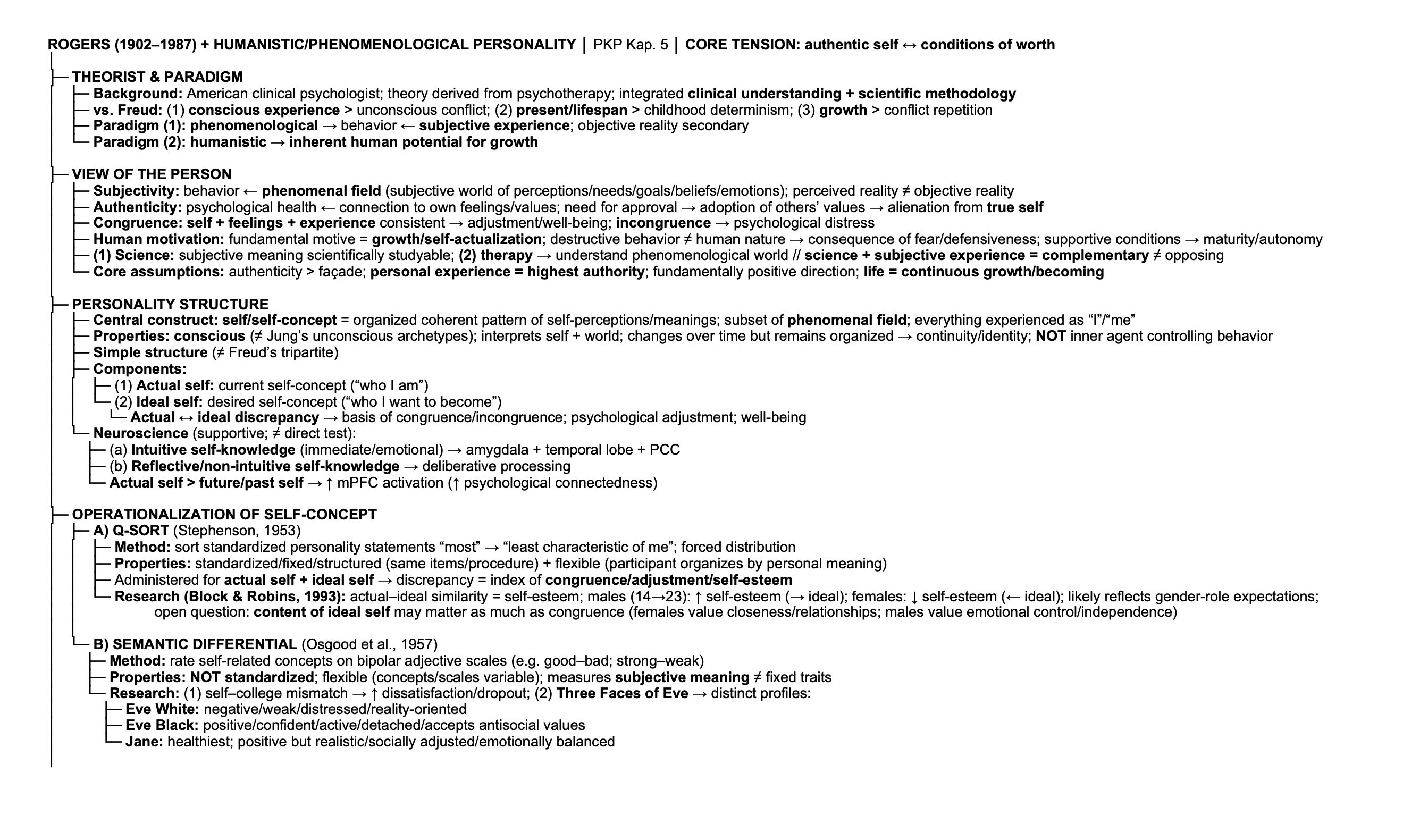
Who is Carl Rogers and what view does he hold of the person?
Carl Rogers (1902–1987): American clinical psychologist; founder of person-centered/humanistic personality theory; theory derived from psychotherapy; contrasted Freud ((1) conscious experience > unconscious conflict; (2) present/lifespan relationships > childhood determinism; (3) growth > conflict repetition); integrated clinical understanding + scientific methodology.
Paradigm: phenomenological (behavior ← subjective experience; objective reality secondary); humanistic (humans possess an inherent potential for growth).
View of the person:
Subjectivity: behavior ← phenomenal field (subjective world constructed from perceptions, needs, goals, beliefs, emotions); people respond to perceived reality ≠ objective reality.
Authenticity: psychological health ← remaining connected to one’s own feelings/values; need for approval → adoption of others’ values → alienation from the true self.
Congruence: self, feelings, and experience consistent → adjustment/well-being; incongruence → psychological distress.
Human motivation: fundamental motive = growth/self-actualization; destructive behavior ≠ human nature, but consequence of fear and defensiveness; supportive conditions → maturity, autonomy, constructive functioning.
Science of personality: personality psychology must scientifically study subjective meaning; therapy → understand the client’s phenomenological world; research → objectively test psychological principles; science + subjective experience are complementary, not opposing.
Core assumptions: authenticity > façade; personal experience = highest authority; humans possess a fundamentally positive direction; life = continuous process of growth and becoming.
→ Takeaway: Rogers views humans as consciously experiencing, subjectively interpreting, and inherently growth-oriented beings whose psychological health depends on authenticity and congruence between self and experience.
How does Rogers’ theory describe personality structure?
Structure: simple (≠ Freud); central construct = self/self-concept (organized, coherent pattern of self-perceptions/meanings; SUBSET of phenomenal field; everything experienced as “I”/“me”); conscious (≠ Jung’s unconscious archetype); interprets self + world; changes over time but remains organized → continuity/identity; not an inner agent controlling behavior.
Components:
Actual self: current self-concept (“who I am”);
Ideal self: desired self-concept (“who I want to become”)
Actual ↔ ideal self relationship → basis of later congruence/incongruence, psychological adjustment, well-being.
Neuroscience (supportive; ≠ direct test); Personality = organized, conscious self-structure; functioning depends largely on the relation between actual and ideal self.
(a) Intuitive self-knowledge (immediate, emotional) → amygdala, temporal lobe, PCC (posterior cingulate cortex) vs. (b) Reflective/non-intuitive self-knowledge → more deliberative processing.
Actual self > future/past self → greater mPFC activation (greater psychological connectedness).
Operationalizations & research:
Q-Sort (Stephenson, 1953): participants sort standardized personality statements from “most” → “least characteristic of me” (forced distribution); standardized + flexible; measures actual and ideal self, with their discrepancy indexing congruence, self-esteem, and adjustment (Block & Robins: males ↑, females ↓ self-esteem from 14→23).
Semantic Differential (Osgood et al., 1957): participants rate self-related concepts on bipolar adjective scales (e.g., good–bad); flexible/non-standardized; measures subjective meanings, predicts outcomes (e.g., self–college mismatch → dissatisfaction/dropout), and distinguished the three personalities in The Three Faces of Eve (Eve White, Eve Black, Jane).
How is the self-concept operationalized?
Goal: objectively measure the central personality structure (self-concept).
Q-Sort (Stephenson, 1953):
Sort predefined personality statements (“most” → “least characteristic of me”); forced distribution.
Standardized / fixed / structured (same items; same procedure; given task) + flexible (participants organize traits according to personal meaning).
Can also be administered for actual self + ideal self → discrepancy (actual–ideal) = index of congruence/psychological adjustment.
Research: Block & Robins (1993): self-esteem = actual–ideal similarity; males (14→23): ↑ self-esteem (closer to ideal); females: ↓ self-esteem (further from ideal); likely reflects gender-role expectations; open question: content of the ideal self may matter as much as congruence (females value closeness, relationships; males value emotional control, independence).
Semantic Differential (Osgood et al., 1957):
Rate concepts (e.g., My Self, My Ideal Self) on bipolar adjective scales (e.g. also good–bad; strong–weak).
NOT standarized; flexible (concepts/scales can vary); measures subjective meaning, not fixed traits, but subjective self-experience can be measured systematically (see below):
Research: greater self–college mismatch → greater dissatisfaction/dropout.
Three Faces of Eve: distinct profiles captured three personalities:
Eve White: negative, weak, distressed, reality-oriented.
Eve Black: positive, confident, active, detached from social reality, accepted antisocial values.
Jane: healthiest; positive but realistic, socially adjusted, emotionally balanced.
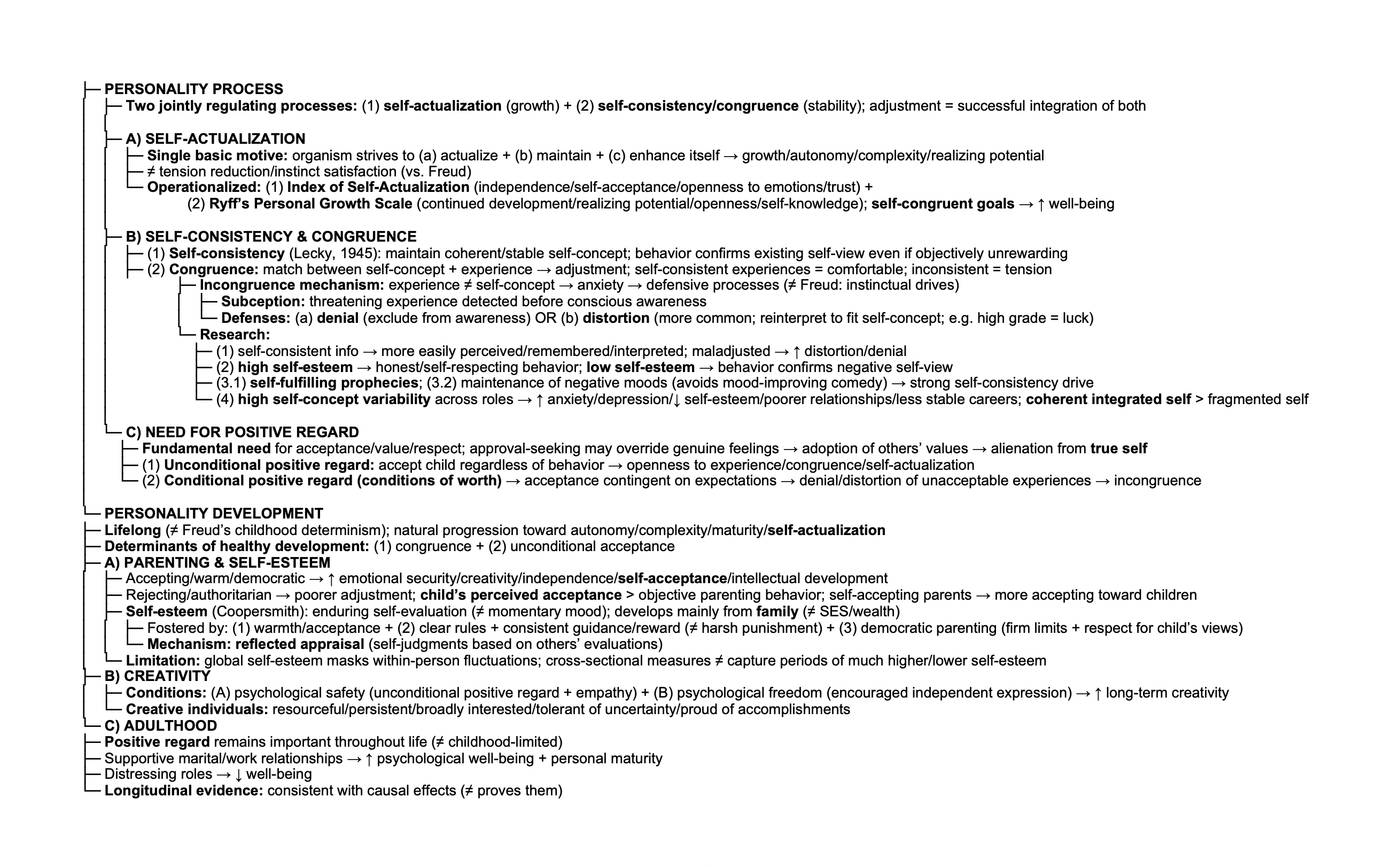
How does Rogers’ theory describe the personality process?
Core process: (1) self-actualization (growth) + (2) self-consistency/congruence (stability) jointly regulate personality; adjustment = successful integration of both.
Self-actualization: single basic motive; organism strives to (a) actualize, (b) maintain, (c) enhance itself → growth, autonomy, complexity, realizing potential (≠ tension reduction/instinct satisfaction); operationalized by Index of Self-Actualization (independence, self-acceptance, openness to emotions, trust) and Ryff’s Personal Growth Scale (continued development, realizing potential, openness, self-knowledge); self-congruent goals → ↑ well-being.
Self-consistency/congruence
(2.1) Self-consistency (Lecky, 1945): maintain coherent, stable self-concept; behavior tends to confirm existing self-view (even if objectively unrewarding);
(2.2) Congruence: match between self-concept and experience → adjustment; self-consistent experiences = comfortable; inconsistent experiences = tension.
Incongruence: experience ≠ self-concept → anxiety → defensive processes protecting self-concept (≠ Freud: instinctual drives) → Subception: threatening experience detected before conscious awareness → Defenses: EITHER (a) denial (exclude experience from awareness); OR (b) distortion (more common; reinterpret experience to fit self-concept; e.g., high grade = luck).
Research:
(1) self-consistent information perceived/remembered/interpreted more easily; maladjusted individuals show greater distortion/denial; (2) high self-esteem → honest, self-respecting behavior; low self-esteem → behavior consistent with negative self-view, (3.1) self-fulfilling prophecies, (3.2) maintenance of negative moods (e.g., avoiding mood-improving comedy) → strong drive for self-consistency
(4) Self-concept variability: high variability across roles → ↑ anxiety, depression, ↓ self-esteem, poorer relationships, less stable careers; moderate role specialization normal; coherent, integrated self > fragmented self.
(2.3) Need for positive regard: fundamental need for acceptance, value, respect; approval-seeking may override genuine feelings → adoption of others’ values → alienation from true self.
Positive regard: (1) unconditional (accept child regardless of behavior) → openness to experience, congruence, self-actualization; (2) conditional (conditions of worth!) → acceptance contingent on expectations → denial/distortion of unacceptable experiences → incongruence.
How does Rogers’ theory describe the growth and development of personality?
Development: lifelong (≠ Freud); natural progression toward autonomy, complexity, maturity, self-actualization. Determinants = healthy development = congruence + acceptance:
Social environment (unconditional positive regard vs. conditions of worth / conditional)
Internal self (open acceptance vs. denial/distortion of experience)
Research (Limitation: global self-esteem may mask substantial within-person fluctuations over time; individuals can experience periods of much higher/lower self-esteem than cross-sectional measures capture):
Parent–child relationships: (A) accepting, warm, democratic parenting → ↑ emotional security, creativity, independence, self-/body-acceptance, intellectual development; (B) rejecting/authoritarian parenting → poorer adjustment; child’s perceived acceptance > objective parenting behavior; self-accepting parents → more accepting toward children.
Self-esteem (Coopersmith): enduring self-evaluation! (≠ momentary mood); develops mainly from family interactions (≠ SES/wealth); fostered by (1) warmth/acceptance, (2) clear rules + consistent guidance/reward (≠ harsh punishment), (3) democratic (not dictatorial) parenting (firm limits + respect for child’s views); develops via reflected appraisal (self-judgments based on others’ evaluations).
Creativity: (A) psychological safety (unconditional positive regard, empathy) + (B) psychological freedom (encouraged independent expression) → ↑ long-term creativity; creative individuals = resourceful, persistent, broadly interested, tolerant of uncertainty, proud of accomplishments.
Adulthood: positive regard remains important throughout life; supportive marital/work relationships → ↑ psychological well-being and personal maturity; distressing roles → ↓ well-being; longitudinal evidence consistent with (but not proving!) causal effects.
Tree (PKP Ch. 5) 1/2
Tree (PKP Ch. 5) 2/2
Describe the general and practical clinical applications of Carl Rogers’ theory of personality, and include a few empirical examples.
Psychopathology; Core pathology = self–experience incongruence/discrepancy → self-experience discrepancy; threatening experiences subceived (below awareness) → defenses ( = denial/distortion; they preserve incongruent self, e.g. (a) rationalization (failure → others), (b) fantasy (replace reality), (c) projection (own impulses attributed to others), BUT threat = contradiction to self-concept (≠ necessarily derogatory!))
→ Result: client-centered therapy (see below); client = responsible, self-actualizing person (≠ passive patient); therapist removes growth obstacles (≠ diagnoses/cures/classify disorders); practical application of phenomenological theory
Self & Motivation; (1) Current self ↔ (2) ideal self (desired future) ↔ (3) feared self (undesired future) // Motivation: (a) approach (toward ideal self) vs (b) avoidance (away from feared self).
Therapeutic Process; Goal = restore congruence → reduce defensiveness → openness to experience → self-reorganization → self-actualization.
(1) Early stage: reflection (summarizing/mirroring client experiences; sometimes perceived as passive/uninterested) → (2) Later: client-centered therapy (focus shifts from technique → therapeutic climate; see relevant traits below; theoretical orientation irrelevant; must be phenomenologically experienced by client!! // If these conditions exist → therapeutic change naturally follows; assumption of causality! If-then-logic).
(1) Congruence/Genuineness (therapist authentic; no professional façade; even genuine negative feelings preferable to fakeness that’s OFTEN detectable!).
(2) Unconditional Positive Regard (complete acceptance; facilitates confident self-exploration).
(3) Empathic Understanding (understand client’s subjective world; active listening ≠ technical diagnosis/problem-solving).
Presence (Later concept; deep intuitive interpersonal connection beyond observable techniques; therapist’s authentic presence itself becomes healing; empirically little studied)
Empirical Evidence
(1) Butler & Haigh (Q-sort): actual self + ideal self measured pre/post therapy; ~31 sessions; Congruence: r ≈ .00 → .34; maintained 6-month follow-up ≈ .31; healthy controls ≈ .56 + Later findings: three therapeutic climate conditions → ↓ defensiveness; ↑ openness to experience; ↑ positive/congruent self; ↑ interpersonal functioning; ↑ internally based evaluations.
(2) Applied Research Example; alcohol reduces awareness of painful experiences; high self-consciousness × negative life events (interaction; ≠ either alone) predicts drinking/relapse; relapse 50–75% within 6 months; alcohol functions as defensive escape from distress.
(3) Clinical Case: Mrs. Oak
Initial focus: marital/family problems → gradual awareness of denied emotions (hurt, competitiveness, bitterness, vulnerability).
Temporary worsening = defensive breakdown (≠ therapeutic failure); may include blaming therapist, distress, instability before improvement.
Outcome: ↑ self-awareness; ↑ autonomy; ↑ self-acceptance; independent decisions (incl. divorce, employment); greater congruence → self-actualization.
(4) Assessment Application: Jim (Semantic Differential); Measures: actual self; ideal self; mother; father.
Findings: positive self-image + inhibition/weakness; main discrepancies = warmth & strength // Mother = warmer/friendlier (also authoritarian, superficial, selfish, unintelligent, intolerant); father = stronger, more active, industrious (closer to father!).
Demonstrates phenomenological assessment: subjective meanings (≠ unconscious drives) explain functioning; difficulties reflect actual–ideal incongruence hindering self-actualization.
What are the related theoretical conceptions to Rogers’ theory?
Related Theoretical Conceptions with purpose: extends Rogers beyond psychotherapy; complementary humanistic perspectives → emphasize growth, strengths, meaning ≠ pathology; reinterpret/expand Rogers before modern empirical research.
Human Potential Movement (“Third Force”; alternative to (a) Freud (conflict/pathology) + (b) Behaviorism (environmental determinism))
Core assumption: humans possess inherent potentialities (growth; creativity; adaptation; self-actualization); future-oriented striving → realizing capacities ≠ repeating past conflicts/conditioning.
Abraham Maslow assumed that humans are basically good/neutral; intrinsic growth motive; psychopathology → frustration/blocking of natural development by social environment.
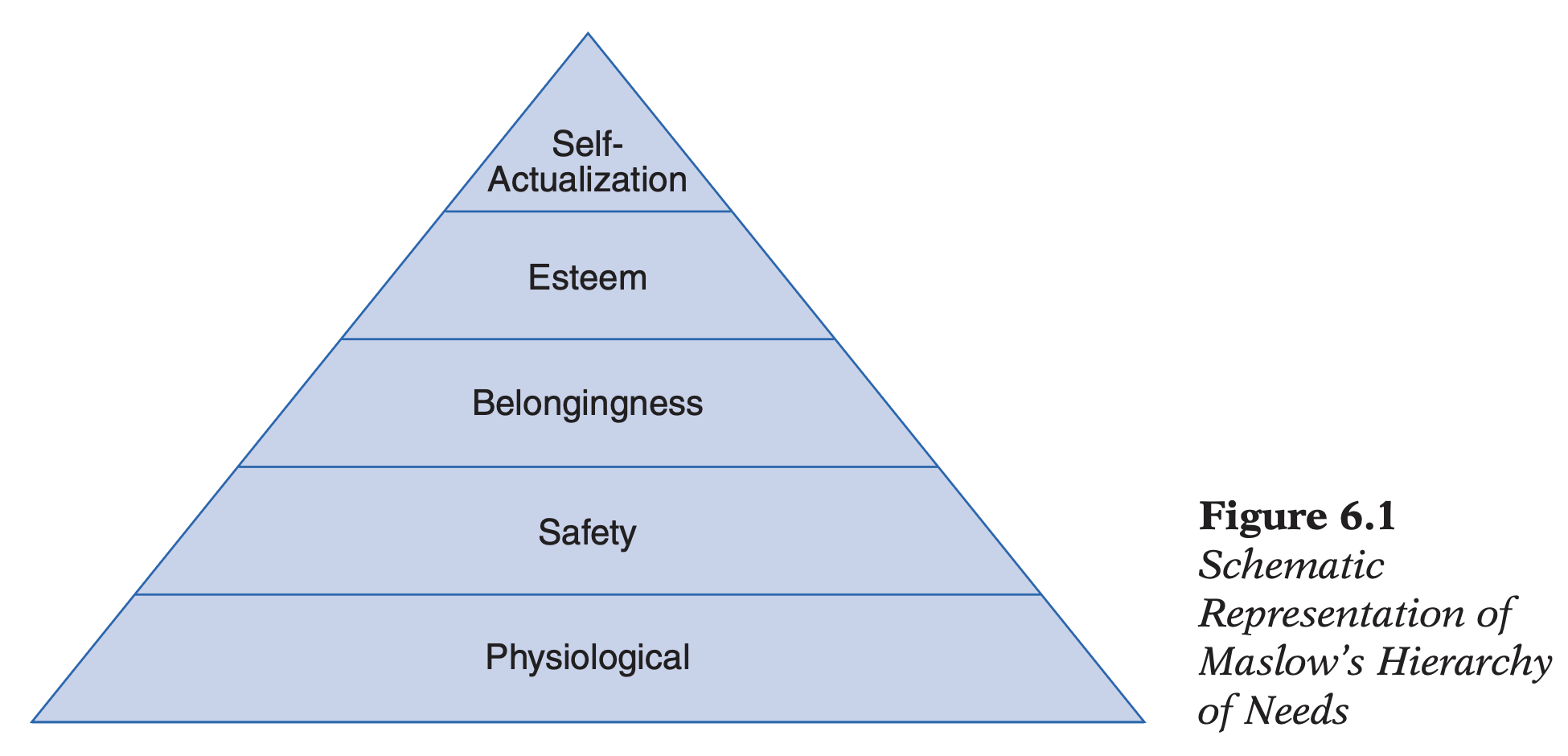
Contribution 1: Hierarchy of Needs; Physiological (food; water) → Safety → Belongingness → Esteem → Self-actualization (Psychology overemphasized biological deficit reduction ≠ higher psychological growth)
Contribution 2: Study of self-actualizers; Study exceptionally healthy individuals ≠ average/pathological populations
Characteristics: self-/other-acceptance; balance own + others’ needs; flexible (≠ stereotyped); intimate relationships; spontaneity; creativity; independence from conformity; realistic adaptation; authenticity.
Positive Psychology / Human Strengths Movement
Core claim: psychology historically overfocused on pathology (e.g., Freud’s clinical samples); study flourishing, strengths, virtues, optimal functioning.
Limitation: identifies strengths better than explaining how societies systematically develop them.
(2.1) Seligman
Human strengths: (a) enduring; (b) broadly beneficial; (c) socially encouraged; (d) cross-culturally valued → 6 virtues: Wisdom; Courage; Love; Justice; Temperance (forgiveness); Transcendence (appreciation of beauty).
Positive Psychotherapy (because early work on learned helplessness & depression): ↑ positive emotion + meaning (strength identification; three good things; gratitude letter); promising but further independent evidence needed (!)
(2.2) Fredrickson: Broaden-and-Build Theory
Positive emotions → broaden cognition/behavior (exploration; creativity; flexibility) → build enduring competencies/resources (e.g. interest → exploration; pride → further achievement)
Speech experiment: resilient individuals experiencing positive emotions → ↓ physiological stress (buffering effect).
(2.3) Csikszentmihalyi: Flow
Skill ≈ challenge; complete attentional absorption; intrinsic enjoyment; loss of self-consciousness; distorted time perception; distractions absent.
Demonstrates optimal functioning ≠ merely absence of pathology.
Existentialism
Focus: existence; human condition; lived (phenomenological) experience ≠ abstract theories/general law; individual; subjective experience; freedom; responsibility; authenticity; meaning; death; existential anguish.
(3.1) Rogers’ existential elements
Empathy; authenticity + Existential loneliness: deeply personal experiences rejected/not understood → relieved through empathic understanding.
(3.2) Frankl
Primary motive = search for meaning; Existential frustration/neurosis → failure to find meaning; escape from freedom/responsibility.
Logotherapy: discover personally meaningful purposes; realize human potential ≠ merely symptom reduction.
(3.3) Sartre
(a) Consciousness imagines possibilities (“nothingness”) → genuine free choice; Freedom → personal responsibility (even under extreme conditions).
(b) Rejects essentialism: existence precedes essence; people create themselves through choices/actions; Humans ≠ objects/animals (e.g., painting a brown horse white ≠ changes essence; humans create identity).
Criticism: Freud; behaviorists; automatic-process research → unconscious/automatic determinants limit freedom.
(3.4) Terror Management Theory (Experimental Existentialism)
Basis: (1) desire to live + (2) awareness of inevitable death → potential death anxiety (terror) // Culture/worldviews buffer anxiety by providing meaning (religion; collective identity).
Mortality salience manipulation: write about own death; death-anxiety scales; gory fatal-accident films; subliminal death primes → Effects: ↑ worldview defense; ↑ in-group favoritism (e.g., donations); ↑ hostility/physical aggression toward out-groups/opposing beliefs; ↑ anxiety toward blasphemous cultural/religious acts; ↓ interest in purely animalistic sex; ↑ interest in romantic/loving sex; high self-esteem buffers death anxiety → Existential concepts become experimentally testable.
Describe contemporary developments of Rogers’ theory.
(1) Self-Discrepancy Theory (Higgins):
Extends Rogers by distinguishing: (1) Ideal self: hopes; aspirations; desires; (2) Ought self: duties; obligations; responsibilities.
(a) Actual–ideal discrepancy → dejection emotions (disappointment; sadness; depression; supported!), (b) Actual–ought discrepancy → agitation emotions (fear; anxiety; threat; supported!).
Situational moderation: Greater self-awareness (e.g., mirror) → stronger discrepancy–emotion relationship.
(2) Fluctuations in Self-Esteem (Crocker)
(A) Rogers: self-esteem relatively stable vs (B) Crocker: self-esteem fluctuates according to contingencies of self-worth; Success → ↑ self-esteem; failure → ↓ self-esteem only if domain is central to self-worth.
Graduate-school study: Acceptances/rejections changed self-esteem only for students whose self-worth depended on academic success.
Extension of Rogers: (1) Explains both stable self-esteem and day-to-day fluctuations + (2) Objective events matter only when personally valued / Limitation of global self-esteem: Poor predictor of objective outcomes (grades; job performance; popularity) → self-esteem likely domain-specific rather than universally beneficial.
(3) Authenticity & Self-Determination Theory
Authenticity: behaving consistently with the true self ≠ false self-presentation → correlation w/ healthier functioning and greater extraversion, agreeableness, conscientiousness, opennesswithin that situation.
Self-Determination Theory
(1) Best functioning → autonomous, intrinsically meaningful, self-concordant goals; (a) Self-determined = freely chosen (≠ compelled) + (b) autonomous/self-initiated (≠ externally controlled) → ↑ persistence; well-being; relationship satisfaction; physical health.
(2) Three basic psychological needs: (A) Autonomy (self-directed action), (B) Competence (feeling effective), (C) Relatedness (connection with others).
Limitations: (1) Goal content ≠ motivation (same goal may be intrinsic or guilt-driven); (2) Cross-cultural variation (see below): Anglo-American children → greater intrinsic motivation after own choices VS Asian-American children → greater intrinsic motivation when trusted authority figures choose → Autonomy/self-determination may not operate universally; Rogers may fit Western cultures better.
(4) Cross-Cultural Research on the Self
(W) Western self: independent; separate // (E) Eastern self: interconnected; relational / (W) United States; Self-enhancement: downward comparisons, externalising blame; devaluing failures / (E) Japan; Less self-enhancement, More self-criticism (socially valued; promotes continual self-improvement rather than pathology) → Self-discrepancies predict depression less strongly than in North America.
Neuroscience evidence: (W) Western participants: (mPFC activation mainly when thinking about self), (E) Chinese participants (MPFC activation for self + mother) → Supports culturally interconnected self-concept.
Overall implication Positive self-regard and self-actualization are not equally universal; cultural context shapes self-processes and motivation.
Evaluate Rogers’ theory.
Major Contributions: Redirected personality psychology toward self, authenticity, subjective (phenomenological) experience, and personal growth when psychoanalysis and behaviorism largely ignored them + Integrated humanistic philosophy with rigorous empirical psychotherapy research; permanently established self-processes as central to personality psychology.
Scientific Database
Strengths: objective scientific observation ≫ Freud; standardized assessment (Q-sort); experimental evaluation of therapy; published recordings/transcripts → independent verification; objective outcome measurement.
Limitations: primarily explicit self-report measures; neglects implicit processes (only moderate explicit–implicit correspondence); conscious awareness emphasized; database largely Western → limited cross-cultural generalizability.
Theory: Systematic?
Strengths: formal 1959 theory = coherent propositions linking childhood experiences → self-concept → psychological well-being; concepts functionally integrated.
Limitations: relatively little formal theorizing; impressionistic writing style; relationships insufficiently specified/mathematically precise; Rogers acknowledged theoretical immaturity.
Theory: Testable?
Strengths: actual self; ideal self; congruence; therapeutic conditions operationalized (Q-sort etc.) → extensive empirical testing.
Limitations: self-actualization poorly operationalized; vague definition; no clear measurement; difficult falsification; unclear evidence that could disconfirm single self-actualizing motive.
Theory: Comprehensive?
Strengths: comprehensive regarding self-processes, conscious experience, psychotherapy, personality change.
Limitations: less comprehensive than Freud; limited treatment of biology, evolution, genetics, emotions, unconscious processes, and biology–environment interactions; emphasis on conscious self/growth → neglect of broader determinants of personality.
Applications
Greatest strength of the theory; therapeutic relationship central; empirically supported therapeutic conditions (congruence; unconditional positive regard; empathic understanding); objective psychotherapy evaluation; clients treated as capable, self-actualizing individuals ≠ passive patients; transformed modern clinical psychology.
Tree (PKP Kap. 6) 1/2
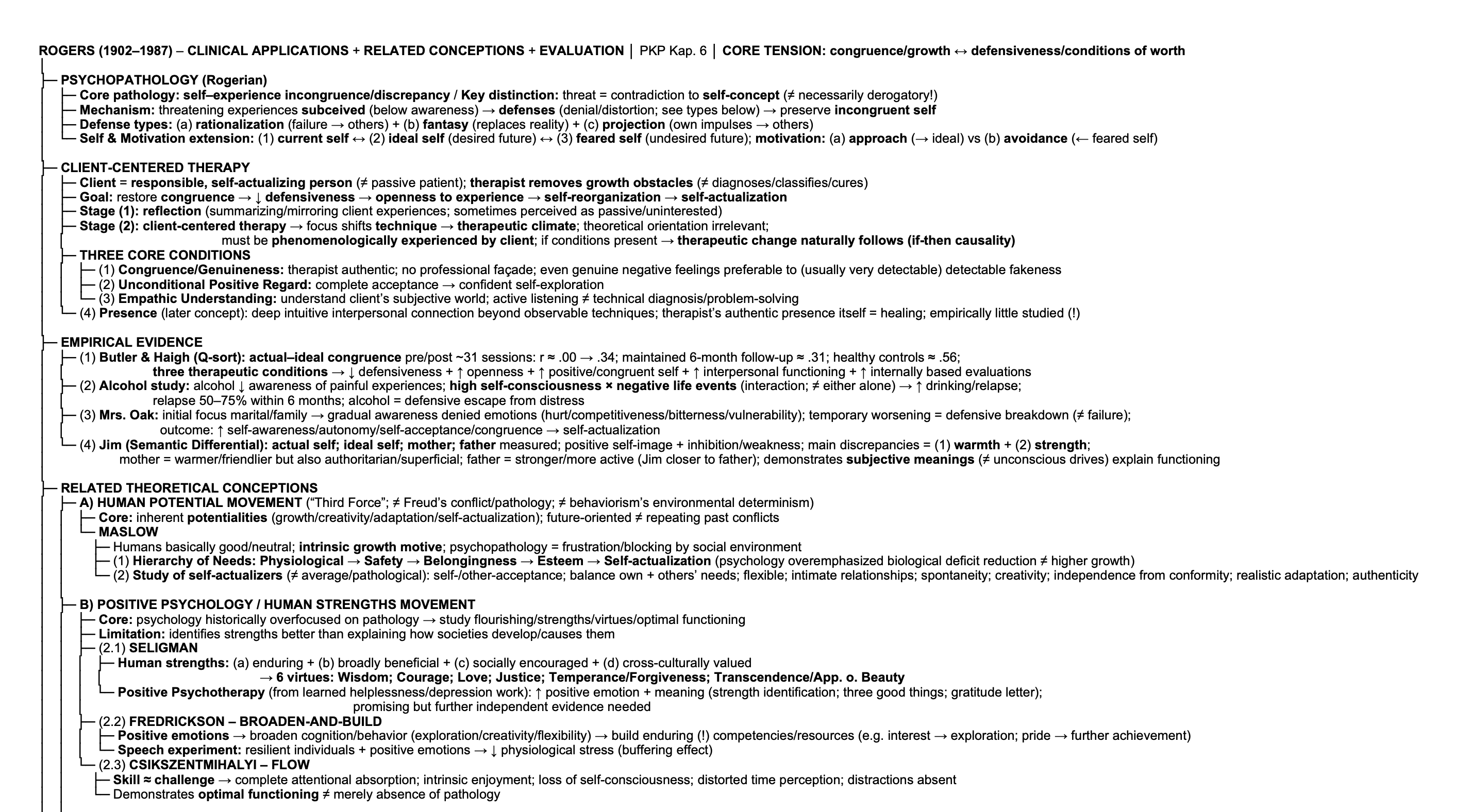
Tree (PKP Kap. 6) 2/2
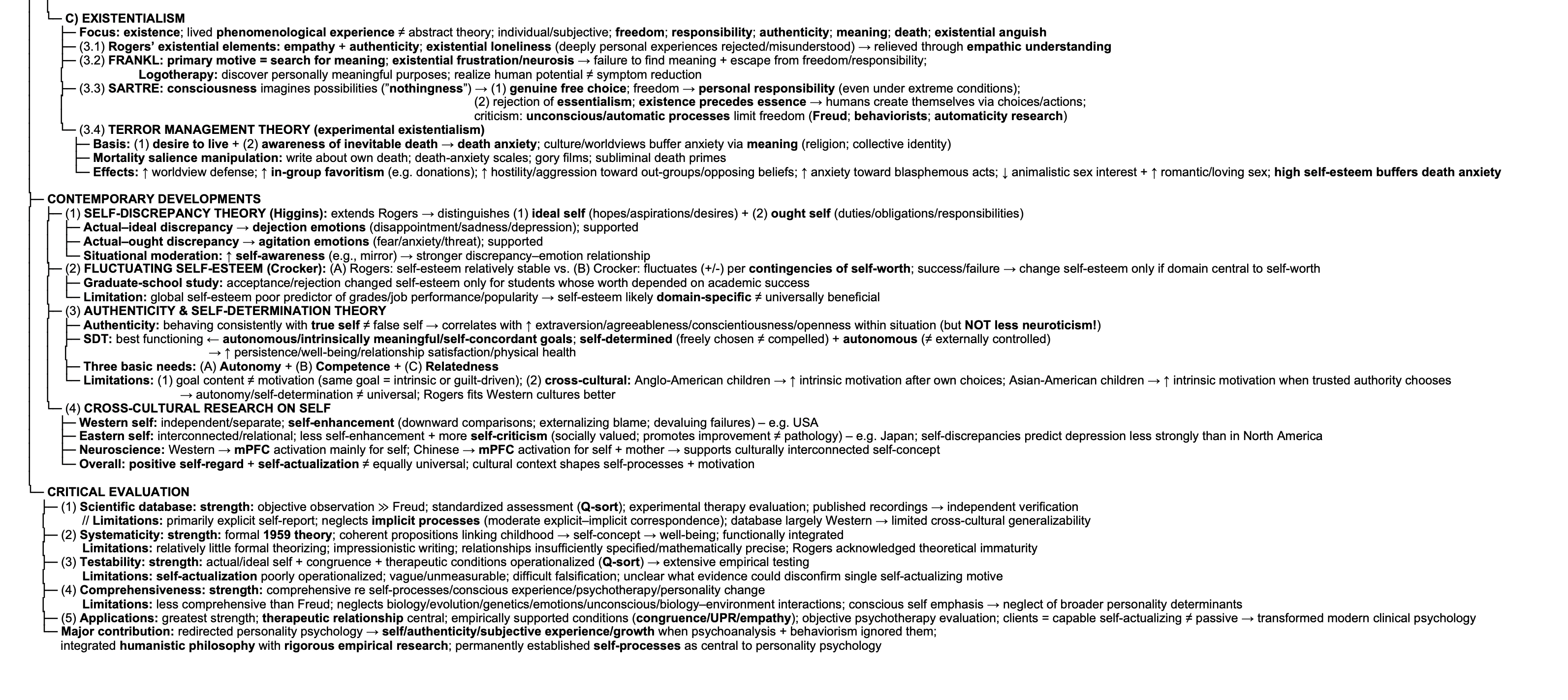
What are the defining characteristics of trait theories and what are they fundamentally based on?
Scientific basis; objective measurement > intuition; personality psychology ≈ physical sciences; construct reliable, quantifiable measures before theorizing; contrast Freud/Rogers (subjective interpretation; unconscious emphasis).
Trait theories; personality = traits (broad, stable dispositions);
(1) consistency (across appropriate (!) situations + time)
(2) distinctiveness (individual differences); explain behavioral stability despite changing roles/environments.
Scientific functions of traits;
(1) Description (universal taxonomy; classify all individuals within one framework);
(2) Prediction (forecast real-world behavior from measured traits);
(3) Explanation (some theories: identify underlying—primarily biological—causal mechanisms).
Core assumptions;
(1) people possess broad behavioral predispositions;
(2) overt behavior ↔ underlying traits (direct correspondence; ≠ psychodynamic view where reported calmness may reflect defensiveness/repression rather than true calmness);
(3) personality organized hierarchically;
(4) many traits assumed biologically influenced.
Methodological foundation;
Factor analysis (clusters correlated behaviors/items → underlying trait dimensions);
Secondary factor analysis (factor-analyzes correlations among the initial factors themselves → higher-order “superfactors”);
Strengths = objective, reduces hundreds of descriptors to a few fundamental traits;
Limitations = factors are mathematical patterns requiring psychological interpretation; analytic choices → different personality structures (partially subjective).
Describe two trait perspective personality psychologists.
Gordon W. Allport (Conceptual foundation);
Traits = real nervous-system structures; characterized by (1) frequency (how often expressed), (2) intensity (how strongly expressed), (3) range of situations (generalization across appropriate contexts);
Freud visit → emphasize manifest motives > unconscious interpretations;
Distinguish (1) traits (stable dispositions) vs (2) states (temporary emotions/moods) vs (3) activities (specific behaviors);
Hierarchy = (1) cardinal (dominant, pervasive) vs (2) central (major general characteristics) vs (3) secondary traits/dispositions (specific, less consistent tendencies);
Traits + situations jointly determine behavior (consistency + variability);
Functional autonomy (adult motives become independent of childhood drives; initially extrinsic → intrinsically valued);
Idiographic approach (study unique individuals via detailed case studies); later trait theorists adopted nomothetic population-based methods, arguably overlooking idiographic scientific value;
Evaluation = major conceptual influence; criticized for limited empirical validation (e.g., traits × situations, biological basis largely untested) + see above
Raymond B. Cattell (Scientific classification);
Goal = psychology’s “periodic table”: (1) surface traits (observable correlated behaviors) → factor analysis → 16 (2) source traits (latent dimensions); categories = (a) ability (skills; intelligence), (b) temperament (emotional/behavioral style), (c) dynamic (motivation/goals).
Empirical strategy = (A) L-data (life records; 15 source traits) → (B) Q-data (16PF; 12 replicated + 4 questionnaire-specific traits) → (C) OT-data (objective behavioral tests; >500 tests; 21 OT source traits; “real coin” due to less bias/self-deception);
No one-to-one correspondence across methods; BUT source traits supported by cross-method factor analyses, cross-cultural/age replication, predictive validity, genetic evidence.
Behavior determined by (1) traits + (2) states + (3) roles (situational influences).
Evaluation = comprehensive, empirically rigorous taxonomy; criticized for (1) high complexity (16 traits), (2) measurement-driven theorizing (as opposed to 1. theory, 2. measurement; issue →), and (3) inability to capture richer personality aspects (e.g., life narratives).
Application (Leadership);
Successful leaders = energetic, decisive, adaptive, assertive, sociable, achievement-oriented, stress-tolerant;
Top executives distinguished by integrity + understanding others // failure associated with insensitivity, untrustworthiness, arrogance, excessive ambition, moodiness, volatility under pressure, defensiveness.
Describe the third trait personality theorist.
Hans J. Eysenck (Biological trait theory)
Goal = (1) simplify Cattell’s 16-factor model into a parsimonious, (2) biologically grounded theory; biological explanation needed to (3) avoid circular explanations (trait inferred from behavior → same trait used to explain behavior).
Personality structure; secondary factor analysis (factor-analyzes correlations among first-order factors → higher-order factors) → 3 independent superfactors (highest-order dimensions):
(1) Extraversion (E) (sociability, activity, liveliness), (2) Neuroticism (N) (anxiety, moodiness, shyness), (3) Psychoticism (P) (aggressiveness, coldness, impulsivity);
Hierarchy = specific responses → habitual responses → traits → superfactors + Related Greek temperaments to combinations of E + N, suggesting long-standing, biologically based personality variation.
Measurement;
(1) Eysenck Personality Questionnaire (EPQ) (self-report of E, N, P),
(2) Lie Scale (detects socially desirable responding/faking),
(3) objective behavioral tests (e.g., lemon drop test measuring salivation differences / differences between I + E!) to support biological foundations.
Biological explanation; traits correspond to underlying biological systems rather than merely describing behavior (see research on E/I, N, P!)
Psychopathology; disorders = (a) biological predispositions × (b) learning experiences;
high N → neurotic disorders;
high P + N + E → criminal/antisocial behavior (weaker learning of social norms); despite genetic influences
BUT behavior therapy effective because learning can modify behavior!
Evaluation; strengths = scientific rigor, biological orientation, parsimonious model, major influence on modern personality psychology
Limitations = mixed support for biological mechanisms (especially N/P), better contemporary models, possible isolation of his research tradition, 3 superfactors may be insufficient to capture full personality complexity.
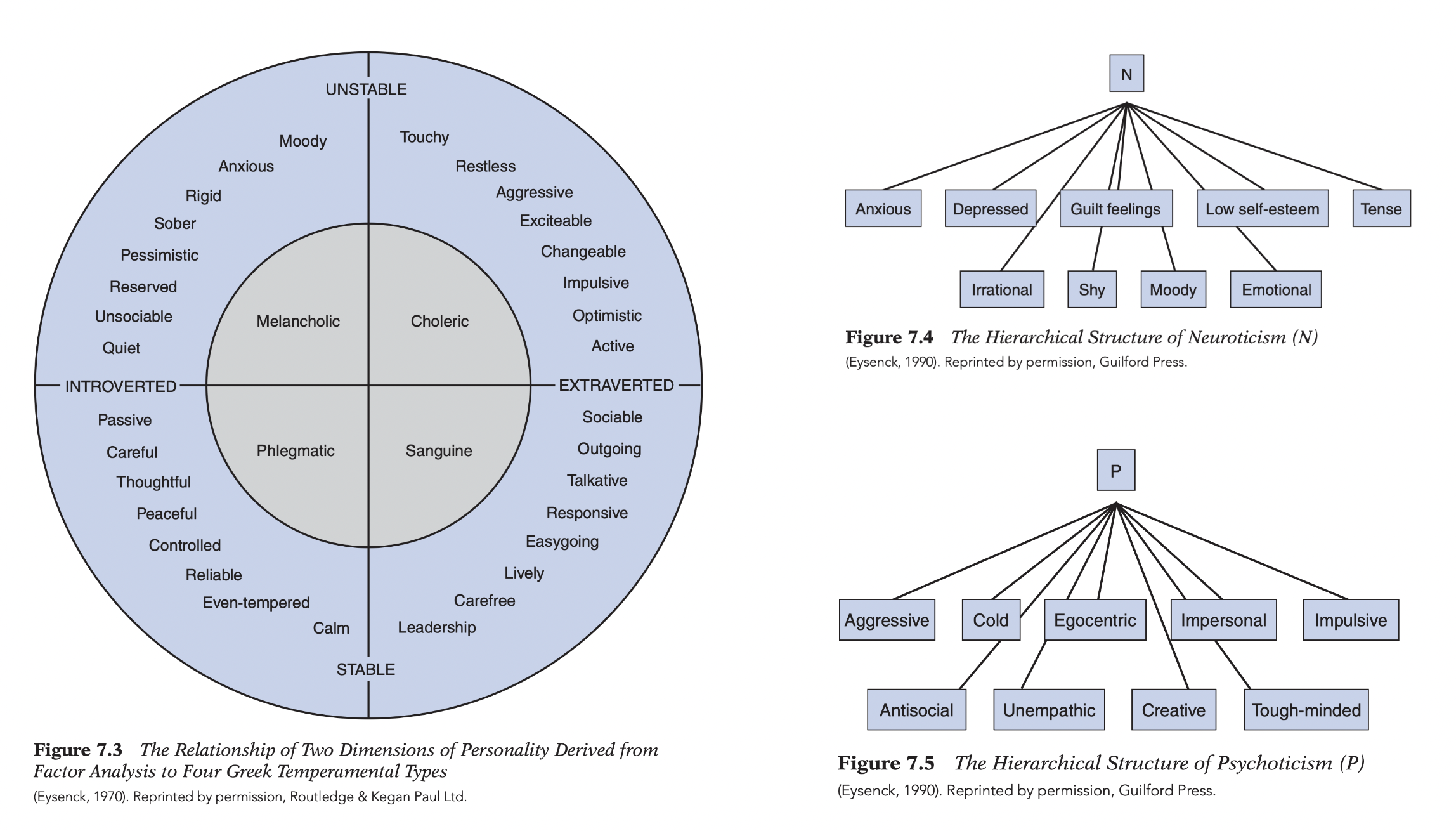
Are Eysenck’s hypotheses supported?
Overall; partially supported; strongest support = Extraversion; mixed/improving support = Neuroticism; weakest support = Psychoticism.
Extraversion (E);
Hypothesis = (E) lower cortical arousal → stimulation seeking (extraverts) vs (I) higher cortical arousal → stimulation avoidance (introverts)
Supported by (1) reward vs punishment learning (E → rewards; I → punishment), (2) twin studies (partial heritability), (3) cross-cultural universality, (4) stability over time, (5) correlations with biological markers (brain activity, heart rate, hormones, sweat glands).
Behavioral evidence;
Introverts = ↑pain sensitivity, ↑fatigue, ↓performance under high stimulation (↑ under low stimulation), ↑careful/slower, ↑academic performance (esp. in advanced), ↑psychiatric dropouts, prefer solitary careers, intellectual humor, quiet study (react more to noise);
Extraverts = ↑performance under stimulation, ↑academic dropouts, social careers, novelty seeking, explicit sexual/aggressive humor, ↑sexual activity, ↑suggestibility (hyperventilation epidemic: affected girls = ↑E + ↑N), stimulating/noisy study environments, more breaks/social interaction.
Both perform best at their own optimal stimulation level!
Neuroticism (N);
Hypothesis = hyperreactive limbic system + autonomic nervous system → stronger stress responses + slower recovery; original physiological evidence inconsistent
Recent fMRI findings provide stronger support (↑N → greater prefrontal cortex activation VS. ↑E → greater insula but less cerabellar activation during emotional processing); precise neural mechanisms remain incompletely understood.
Psychoticism (P);
Hypothesis = linked to genetic influences, testosterone, later dopamine activity (also implicated in schizophrenia); support comparatively limited.
Tree (PKP Kap. 7)
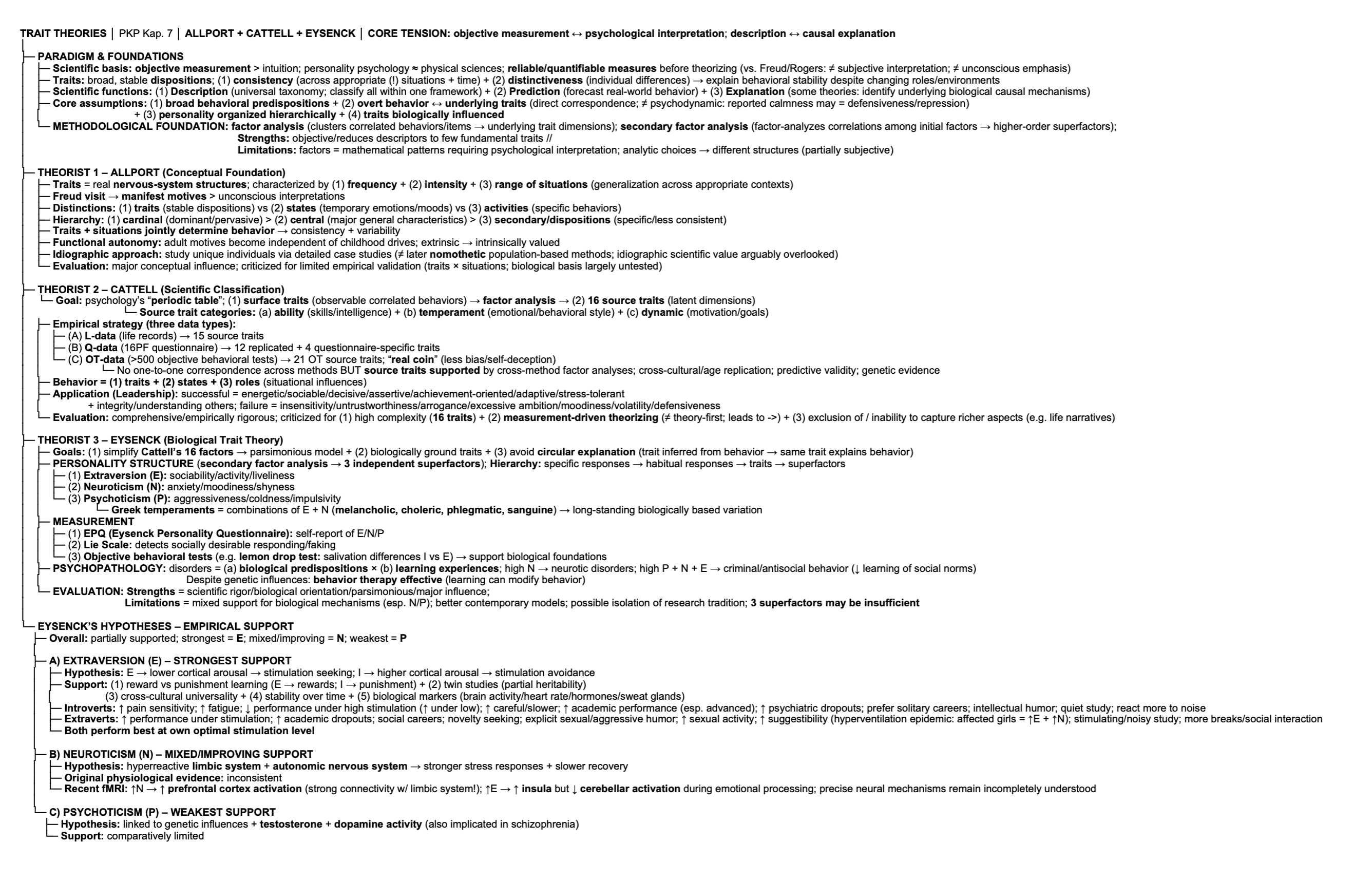
How was a scientific taxonomy of personality traits established, why is it required, and why is the Big Five considered the best-supported taxonomy?
Taxonomy: scientific classification system; organizes thousands of traits into few broad dimensions → common language; comparability; cumulative research; descriptive framework ≠ explanatory theory.
Why required: early trait theorists agreed on stable traits but disagreed on number/organization (Allport vs. Cattell vs. Eysenck) → incompatible systems; empirical consensus needed.
Empirical approach: (1) natural language (lexical approach) → collect personality adjectives → ratings → factor analysis → recurring higher-order dimensions. → Outcome: OCEAN (Neuroticism; Extraversion; Openness; Agreeableness; Conscientiousness); each factor summarizes many narrower traits; robust even with shorter questionnaires.
Evidence supporting the taxonomy:
Lexical evidence: five factors repeatedly emerge; lexical hypothesis → socially important individual differences become encoded in language (though not every important characteristic necessarily has a lexical label).
(1.1) Tentative brain associations: E→frontal reward regions; N→threat-processing regions; A→theory-of-mind/social cognition regions; C→frontal planning/rule-following regions; O→no consistent brain-volume association; correlational only (causality unresolved).
Cross-cultural evidence: translated questionnaires + indigenous lexical studies (translation may impose English categories); E, A, C replicate most consistently; N and especially O show greater variability; trait expression may differ despite shared/genetic bases; possible culture-specific additional factors (e.g., unconfirmed “Chinese factor”), same words different interpretation etc. → largely, not perfectly, universal.
(2.1) Cross-species evidence: E, N, A found across many animals (reliable measurement!); C mainly in chimpanzees (most similar to humans); O inconsistent (later developed structures?) → supports real biological individual differences, not merely human concepts.
Questionnaire evidence: NEO-PI-R (5 factors → 6 facets each → 8 items each; 240 items); high reliability; validity; convergence with other Big Five measures; facet placement (especially Openness) remains debated.
(3.1) Integration of previous theories: Eysenck (E≈E; N≈N; P≈low A + low C); Cattell’s 16 factors map onto Big Five; convergence with Q-sort, Murray’s motives, biological temperament → overarching taxonomy across theories/methods.
(3.2) Rating convergence: substantial S-data ↔ O-data agreement (self–spouse > self–peer / better knowledge or more verbalization?); observable traits show higher agreement; Neuroticism better captured by S-data; O-data may better predict outcomes (e.g., job performance); self-ratings influenced by self-enhancement/self-criticism (S- more N, less C).
What evidence supports and challenges the assumption that personality traits are causal psychological structures?
Support (McRea & Costa’s Five-Factor Theory):
Traits = real basic tendencies (like organs everyone has in varying size); biologically based; inherited; universal; present in everyone (degree differs) ≠ mere summaries.
Causal pathway: biology → basic traits → characteristic adaptations (goals; attitudes; habits) + self-concept + emotional reactions → objective biography; environment mainly influences adaptations, not basic traits.
Growth & Development / Lifespan evidence: substantial rank-order stability; cross-cultural age trends (↓N/E/O; ↑A/C); interpreted as intrinsic biological maturation (but initial assumption of no change after 30s revised!).
Challenges:
Mechanism problem: theory specifies that traits cause behavior, not how; dynamic psychological processes linking traits → moment-to-moment behavior largely unspecified.
Historical change (Twenge): ↑Neuroticism (likely societal stressors); ↑Extraversion (greater individualism/assertiveness) across generations → contradicts claim that basic traits are unaffected by environment.
Environmental change: Helson; Srivastava; defense mechanisms (more → greater N later); parenting (greater A/C, less E); work; psychotherapy; major life events → measurable personality change; environment influences traits throughout life.
Ecological/aggregation fallacy: factor analysis derives dimensions between individuals (nomothetic) ≠ proves identical psychological structures within individuals (idiographic); Big Five may summarize population differences rather than represent universal internal mechanisms.
Developmental evidence: children show 7-factor structure (E → Activity + Sociability; N → Fearfulness + Irritability) → adult Big Five emerge gradually (especially during adolescence); personality becomes increasingly stable with age (individual differences in stability); adulthood > childhood in stability; remains partly genetically influenced but also modified by environmental experiences → precise limits of biology vs. environment remain unresolved.
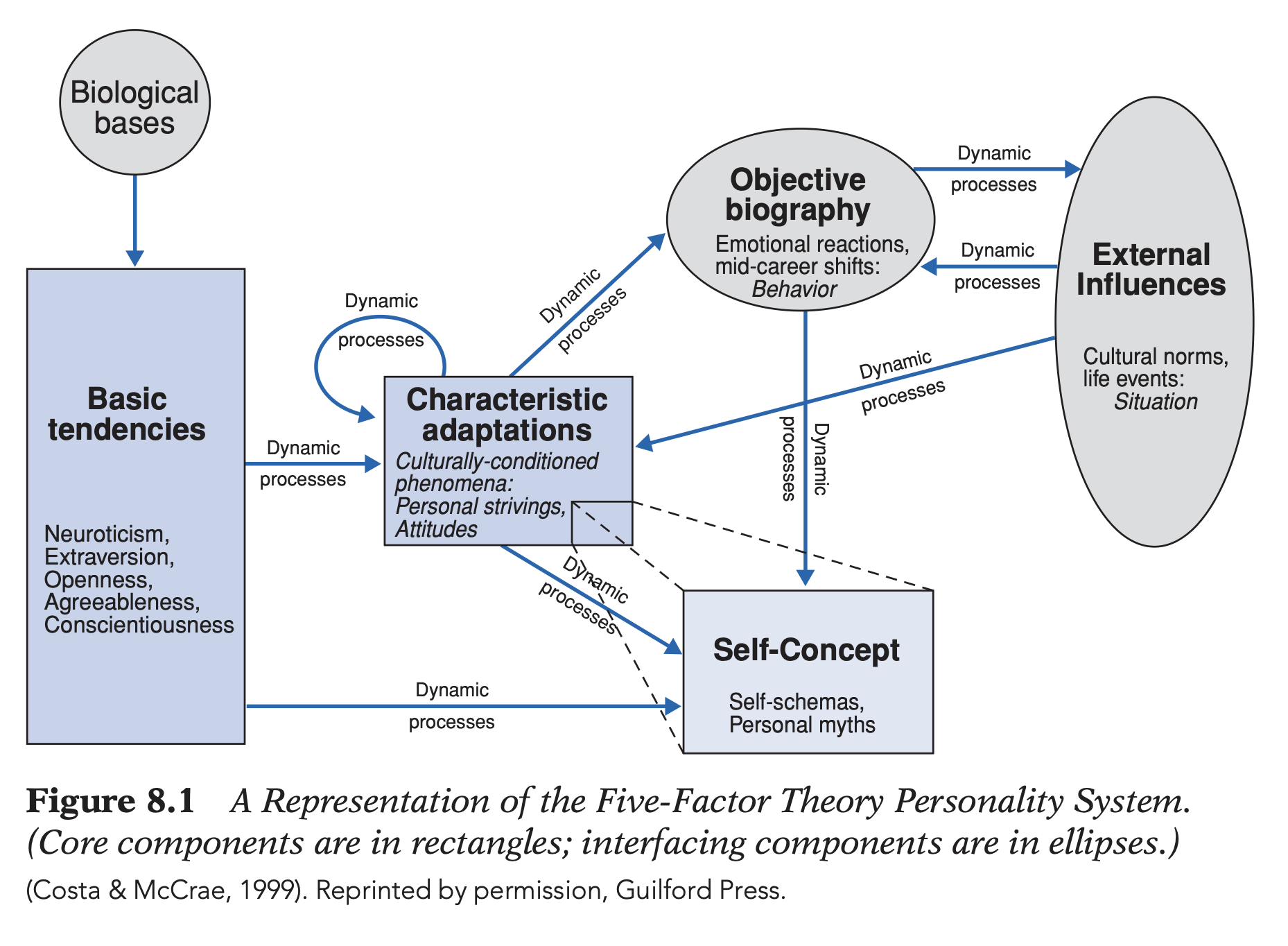
What are the major applications of the Big Five, and how does Jim’s case illustrate both its usefulness and its limitations?
Applications:
Vocational: predicts career preferences (E→social/enterprising; O→artistic/investigative); C = strongest general predictor of job performance; other traits improve domain-specific prediction; prediction imperfect!!
Well-being: high positive emotionality + low negative emotionality → greater life satisfaction; personality + life circumstances jointly contribute.
Physical health: high C → healthier behaviors (exercise; diet; adherence; ↓smoking/alcohol; checkups // -30% less mortality each year!) → longer lifespan; childhood (11 in study) personality predicts adult health habits; effects accumulate across life (E→↑activity but also ↑smoking).
Clinical: psychopathology viewed as extremes of normal traits (e.g., OCD-like ≈ high C + N; antisocial ≈ low A + C // Interactions more predictive?); aids diagnosis + treatment selection (high O→exploratory therapy; low O→structured/directive).
Limitation: strong descriptive/predictive framework ≠ explains underlying psychological mechanisms or provides distinctive methods for personality change.
Jim:
16PF: high intelligence; outgoing; anxious; emotionally sensitive; introspective; mood swings; psychosomatic complaints → accurate, normative description of stable traits but little explanation of motives/conflicts/dynamics.
Longitudinal course (~20 years): business → clinical psychology (despite parental opposition; business); relationships (poor experience, later “not as exciting“); communal self-growth; marriage; fatherhood; consulting psychologist → ↑self-awareness; maturity; acceptance of others; core traits remained stable (perfectionistic; compulsive; self-critical; anxious; authority concerns) → stability + gradual developmental change.
NEO-PI + wife ratings: agreement on high E; average O; very low A; minor C difference (Jim rates himself higher); largest discrepancy = N (Jim high; wife low) → internal experiences better captured by self-ratings or self-critical bias; multiple informants improve assessment.
Overall: Big Five reliably describes and predicts stable individual differences and real-world outcomes, but does not explain the psychological processes producing them.
What are further criticisms of trait theories, and how can they be evaluated overall?
Further criticisms:
Incomplete taxonomy: Big Five may omit important dimensions; HEXACO adds Honesty–Humility; further cross-cultural replicated studies suggest up to 8 factors (e.g., competence or based on verbs/nouns) → taxonomy remains provisional; personality classification is continuously refined as new empirical evidence accumulates rather than representing a final, fixed structure.
Person–situation controversy: strong (1) longitudinal stability but only modest, NOT ZERO, (2) cross-situational consistency (Mischel & Peake; Hartshorne & May); behavior varies across contexts ( = within-domain stability, across-domain instability!).
Within-person variability: Fleeson (Experience sampling study) → individuals fluctuate (variation) substantially across situations while maintaining stable average trait levels → traits = stable tendencies, not fixed behavior.
Trait rebuttals: consistency increases when behavior is aggregated across many situations (Epstein) or examined within similar contexts (Jackson & Paunonen).
Balanced conclusion: personality reflects stable average dispositions + situational modulation; trait and situation perspectives are complementary rather than mutually exclusive.
Evaluation:
Strengths: exceptionally strong scientific database; objective measurement; extensive cross-cultural evidence; highly testable hypotheses; comprehensive taxonomy; predicts important outcomes (work; health; well-being; psychopathology); integrates earlier trait theories; links naturally to biological research.
Weaknesses: primarily descriptive and predictive; weaker at explaining causality, dynamic psychological mechanisms/processes, personality development/change, and therapeutic intervention; nomothetic limitation: statistical factors derived between individuals may not represent psychological structures within each individual (i.e. structures like superego etc.; athleticism vs. CNS example).
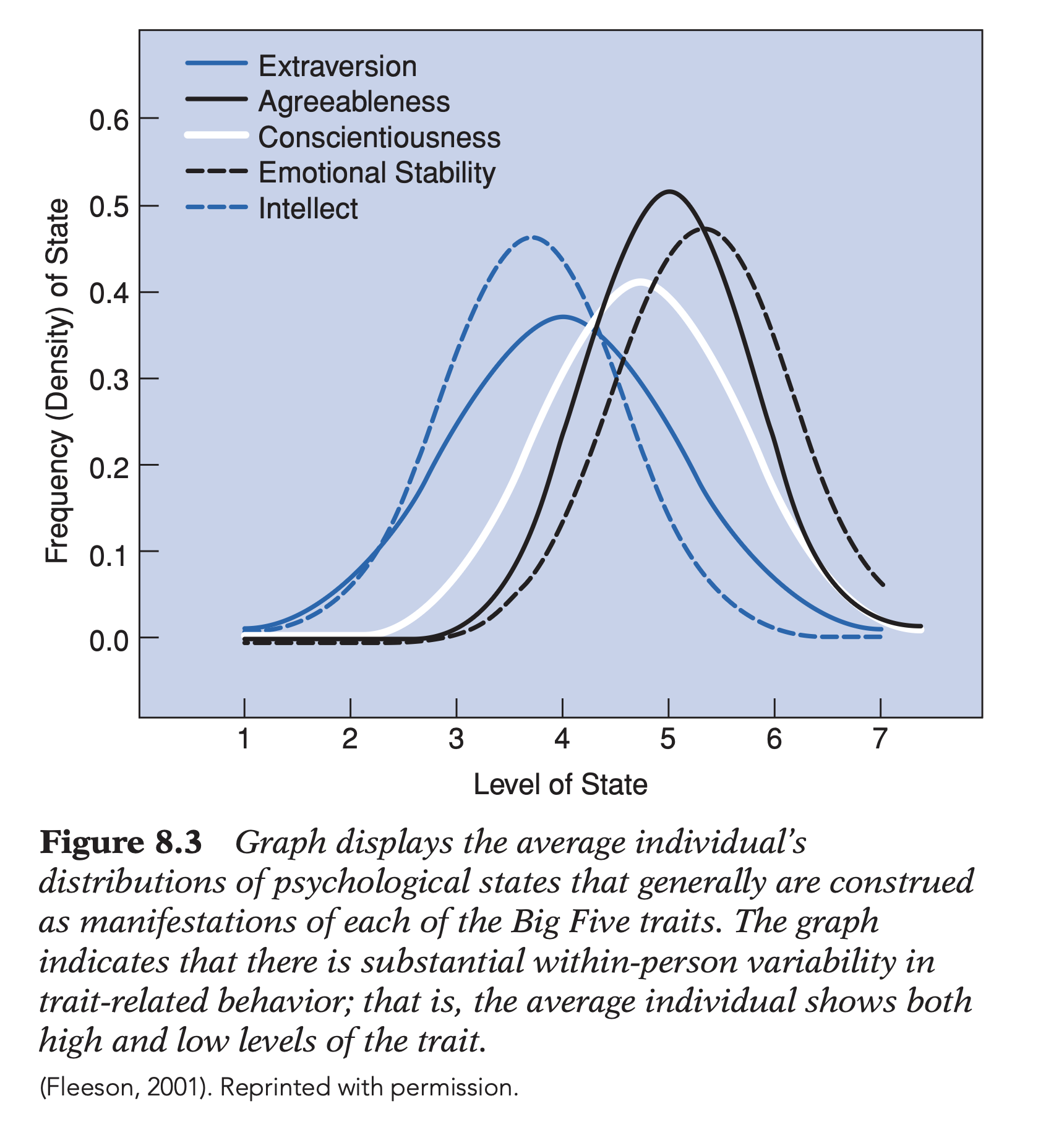
Tree (PKP Kap. 8) 1/2
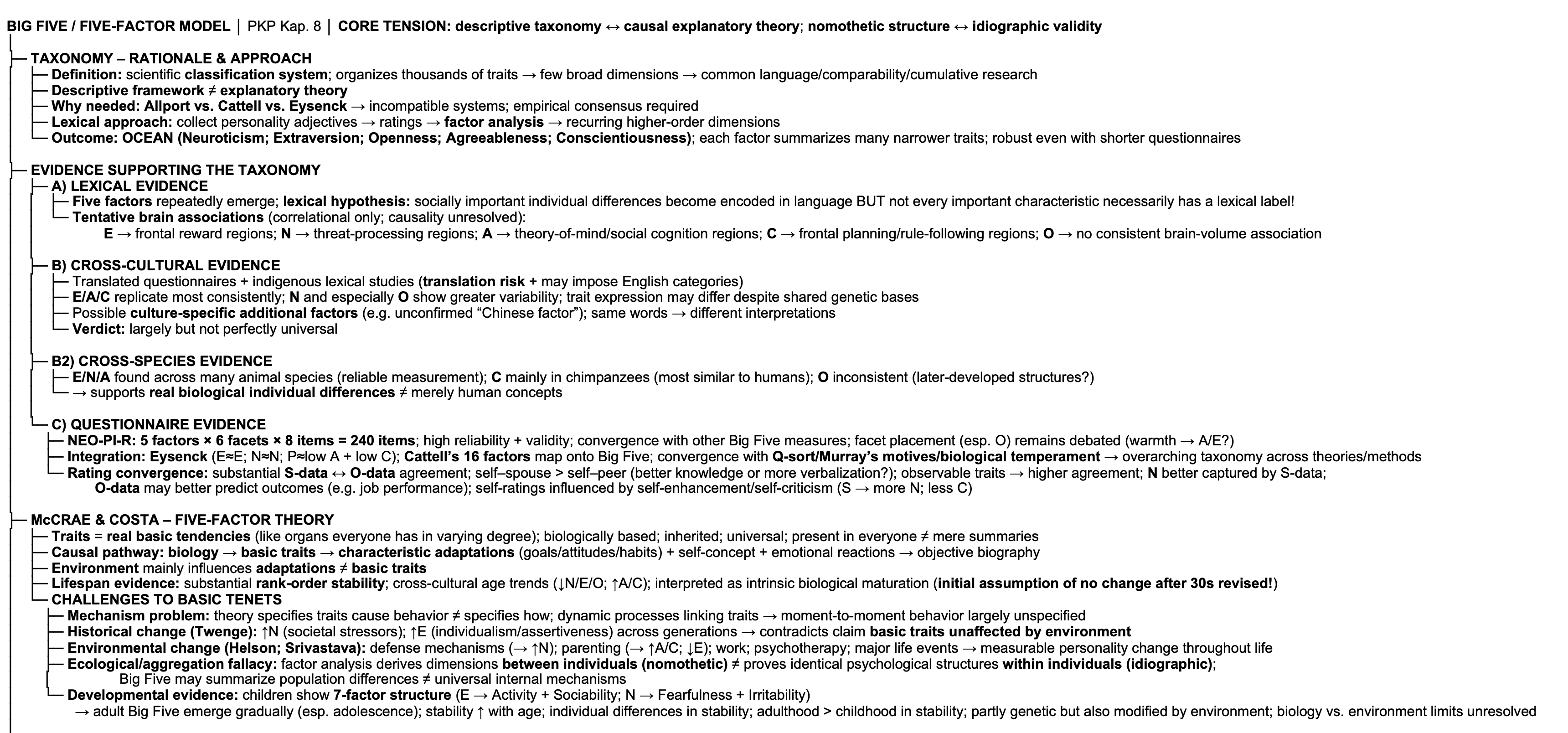
Tree (PKP Kap. 8) 2/2
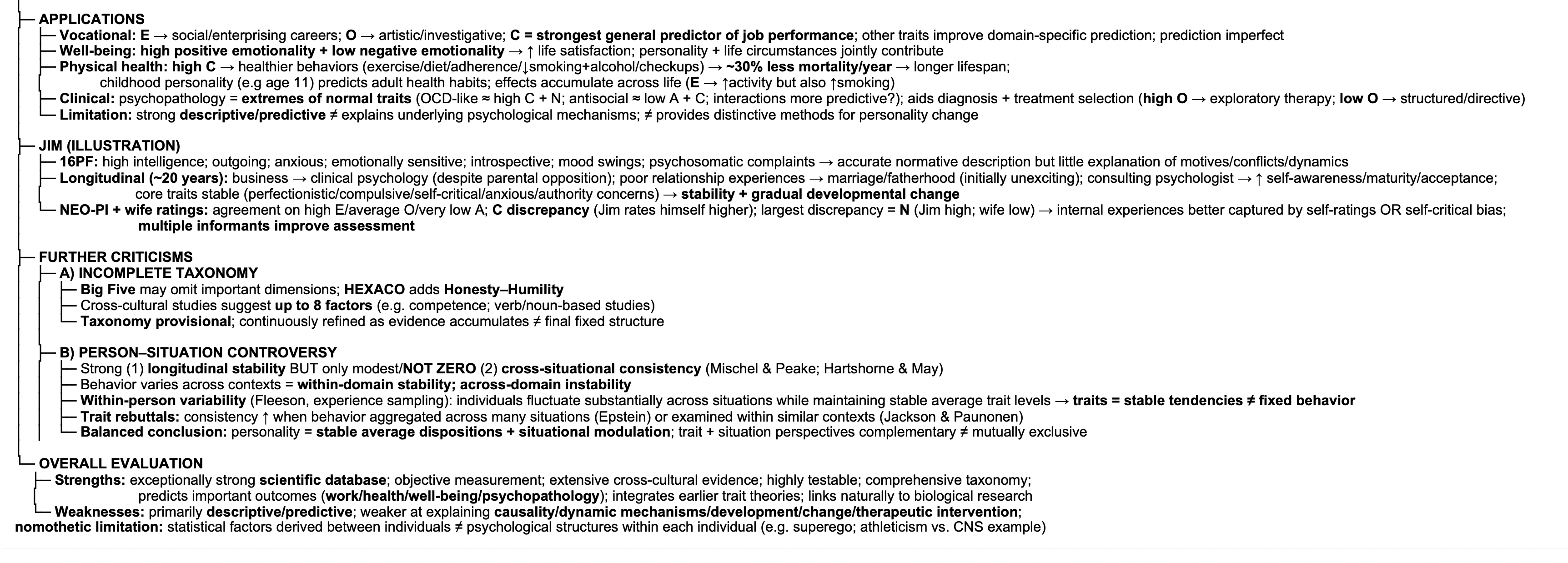
What role does biology play in personality psychology research?
Role: empirical foundation (≠ competing personality theory); provides scientific findings that every personality theory must explain; supports trait theories while expanding them through evolutionary psychology and neuroscience.
Core evidence: Phineas Gage → frontal cortex damage → intelligence/language/memory preserved; personality radically altered (responsible → impulsive, irresponsible) → specific brain systems contribute causally to personality.
Research focus: biological foundations of personality via: (1) Temperament, (2) Evolutionary psychology, (3) Behavioral genetics, (4) Mood, emotion & the brain, (5) Plasticity.
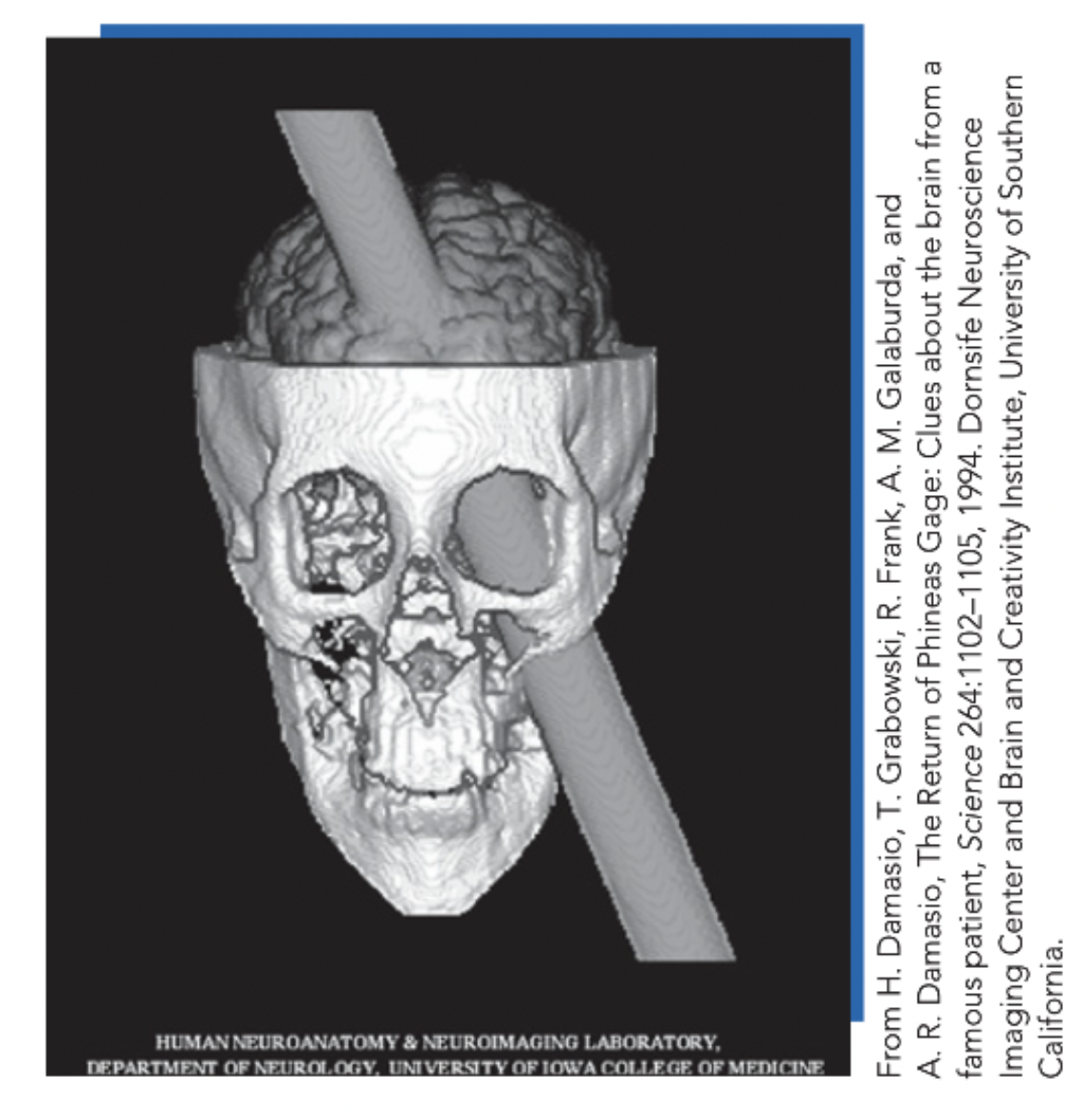
Describe temperament research.
Temperament: biologically based individual differences in emotional/motivational tendencies evident early in life (emotional reactivity; mood; arousal; self-soothing) → suggests biological origins before substantial social experience (but keep prenatal experience in mind for homosexual study!).
(A) Historical development: early taxonomy + causal explanations
Hippocrates/Kant: four temperaments explained by bodily fluids (rejected);
Gall: phrenology (correct: functional specialization; incorrect: isolated localization—brain functions via interconnected systems);
Darwin: evolution + emotional expression → foundation for evolutionary psychology;
Mendel: modern genetics;
Kretschmer/Sheldon: body type → temperament/personality (weak empirical support; methodological flaws);
Pavlov: nervous-system strength (maintaining functioning under high stimulation) + conditioned reflexes → precursor of biological stress reactivity.
(B) Modern longitudinal research:
Thomas & Chess (NYLS):
(1) easy (adaptable; positive); (2) difficult (negative; poorly adaptable); (3) slow-to-warm-up (low reactivity; cautious)
→ infant temperament predicts later adjustment (difficult → most problems; easy → fewest);
goodness-of-fit: optimal development depends on match between temperament and parenting (≠ universally optimal parenting).
Buss & Plomin:
inherited dimensions: (1) emotionality; (2) activity; (3) sociability → stable across development; substantial genetic influence (especially MZ twins);
limitation: parental-report bias (e.g., overestimating twin similarity). → Shift toward biologically grounded temperament dimensions; influenced later trait models (Big Five); lacked direct biological measures.
Kagan’s biological temperament model: objective laboratory observations (≠ parent reports);
(1) inhibited: fear; avoidance; restraint; physiological arousal to novelty vs. (2) uninhibited: curiosity; sociability; positive affect.
Hypothesis: high-reactive (!) infants → inhibited; low-reactive → uninhibited. 4-month testing: ~20% high-reactive; ~40% low-reactive; ~40% intermediate. Longitudinal follow-up (14 mo; 21 mo; 4.5 y; 8 y): substantial continuity (high-reactive → greater fear; HR/BP; less smiling/talking; low-reactive → confident/social).
Continuity ≠ determinism: (a) supportive, (b) non-overprotective parenting with (c) reasonable demands reduced fearful outcomes; BUT no high-reactive infant became consistently uninhibited; low-reactive → inhibited only rarely → inherited temperament biases developmental direction (predisposition ≠ destiny).
Biological mechanisms: high-reactive infants form distinct categorical group (~10% consistently inhibited; ≠ purely continuous dimension).
Amygdala: novelty/threat detection; frontal cortex: regulates amygdala/emotion. fMRI: inhibited at age 2 → greater amygdala activation to unfamiliar / novel (but not non-novel!) faces at ~20 y → long-term biological stability.
Animal knockout studies: stathmin gene influences amygdala functioning (gene present → greater fearfulness; absent → reduced fear). Limitations: amygdala ≠ fear center only (multiple functions); amygdala damage ≠ absence of emotion; novelty may activate amygdala more than fear; maternal social support moderates genetic prediction (high support weakens genetic risk) → biology provides predispositions expressed within developmental context; temperament retains built-in flexibility across life.
Effortful control & conscience:
Rothbart: effortful control = suppress dominant response to perform adaptive/subdominant response (delay gratification; inhibit impulses).
→ Kochanska: temperament × parenting → conscience (Freud’s superego analogue). Longitudinal behavioral measures (slow walking; whispering; delay candy) + observed parenting + later conscience tasks (cheating; obedient vs. naughty dolls).
Findings: authoritarian/high power assertion → ↓ effortful control; ↑ effortful control → ↑ later conscience; effortful control mediated parenting → conscience relation. → Moral development emerges from interaction of biologically based self-regulation and environmental experience (biology × parenting; mediation).
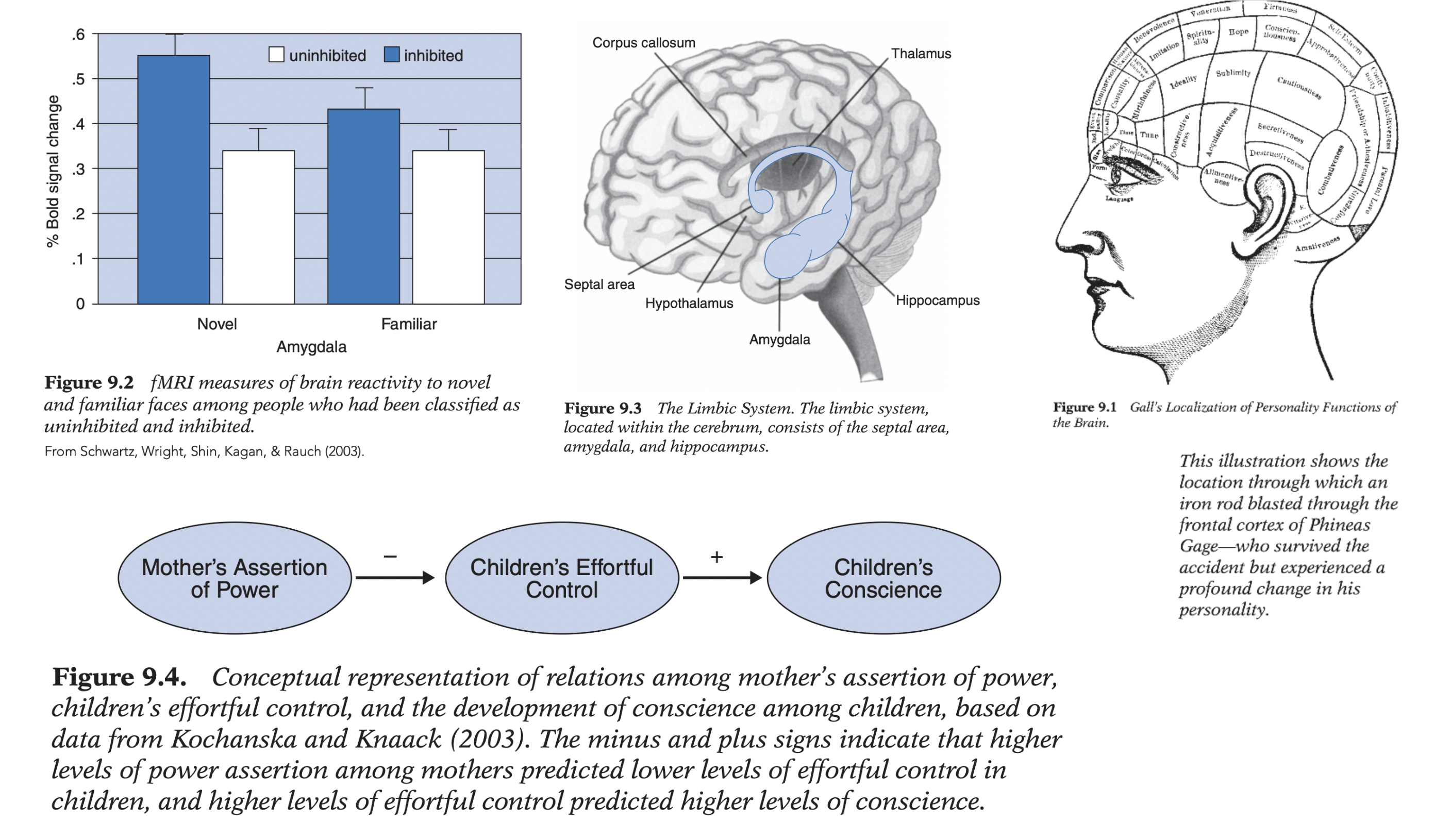
Describe the research in evolutionary psychology.
Evolutionary psychology: explains ultimate causes (why mechanisms evolved via natural selection for survival/reproductive success) ≠ proximate causes (current biological mechanisms producing behavior) // Main assumptions (Buss; Cosmides; Tooby; Pinker):
(1) Personality = evolved psychological mechanisms solving recurrent ancestral adaptive problems.
(2) Adaptations evolved in hunter-gatherer environments (modern mismatch possible; e.g., fat preference → obesity);
(3) Domain-specific mechanisms (specific problems ≠ general traits; e.g., jealousy ≠ childcare; fear of ancestral threats ≠ general fear)
(4) Mind = multiple specialized modules (social exchange; parenting; mating; exclusion…) ≠ single general processor. → Contrasts with trait theory (specialized adaptive mechanisms ≠ broad context-free traits).
Social exchange & cheating detection (Cosmides): reciprocal exchange repeatedly essential → cheating detection adaptive. Abstract logical reasoning (“if P then Q”) → poor performance; identical logic framed as social contract/cheating (e.g., taxes) → high accuracy. Replicated across literate/non-literate cultures → evidence for universal evolved module. Neuropsychology: frontal cortex/amygdala damage → normal general reasoning; impaired social-contract reasoning → specialized cognitive system for cooperative exchange.
Sex differences: Parental Investment Theory (Trivers): women invest more biologically (pregnancy; limited fertility; childcare); men face paternity uncertainty.
(1) Predictions: men prefer youth; physical attractiveness; chastity (reproductive value; paternity certainty); women prefer earning capacity; ambition; industriousness; protection/resources. Buss:>10,000 participants; 37 samples; 33 countries + islands;
→ broad support (men consistently valued youth/attractiveness; chastity only moderate support; women valued financial resources/ambition).
(2) Jealousy hypothesis: men → sexual infidelity (paternity threat); women → emotional infidelity (resource threat).
→ questionnaires supported predicted distress; physiological measures replicated; strongest effect for men with prior committed relationships (women: nonsignificant).
Evaluation/Criticism: universal evolutionary mechanisms predict cross-cultural consistency;
Eagly & Wood: sex differences smaller in gender-equal societies (women ↓ emphasis on earning capacity; men ↓ emphasis on domestic skills) → supports biosocial model (biology × social roles) ≠ biological determinism.
Miller et al.: men and women showed highly similar overall mate preferences.
DeSteno; Harris: jealousy effects largely disappeared when replacing forced-choice methods (MCQ) with separate ratings/real experiences; both sexes responded more strongly to sexual infidelity; men generally reacted more strongly to sexual content BUUT regardless of infidelity (!)
→ Evolution contributes to behavior, but evidence for universal, hardwired sex differences is mixed/inconsistent; biology and social context jointly shape behavior.
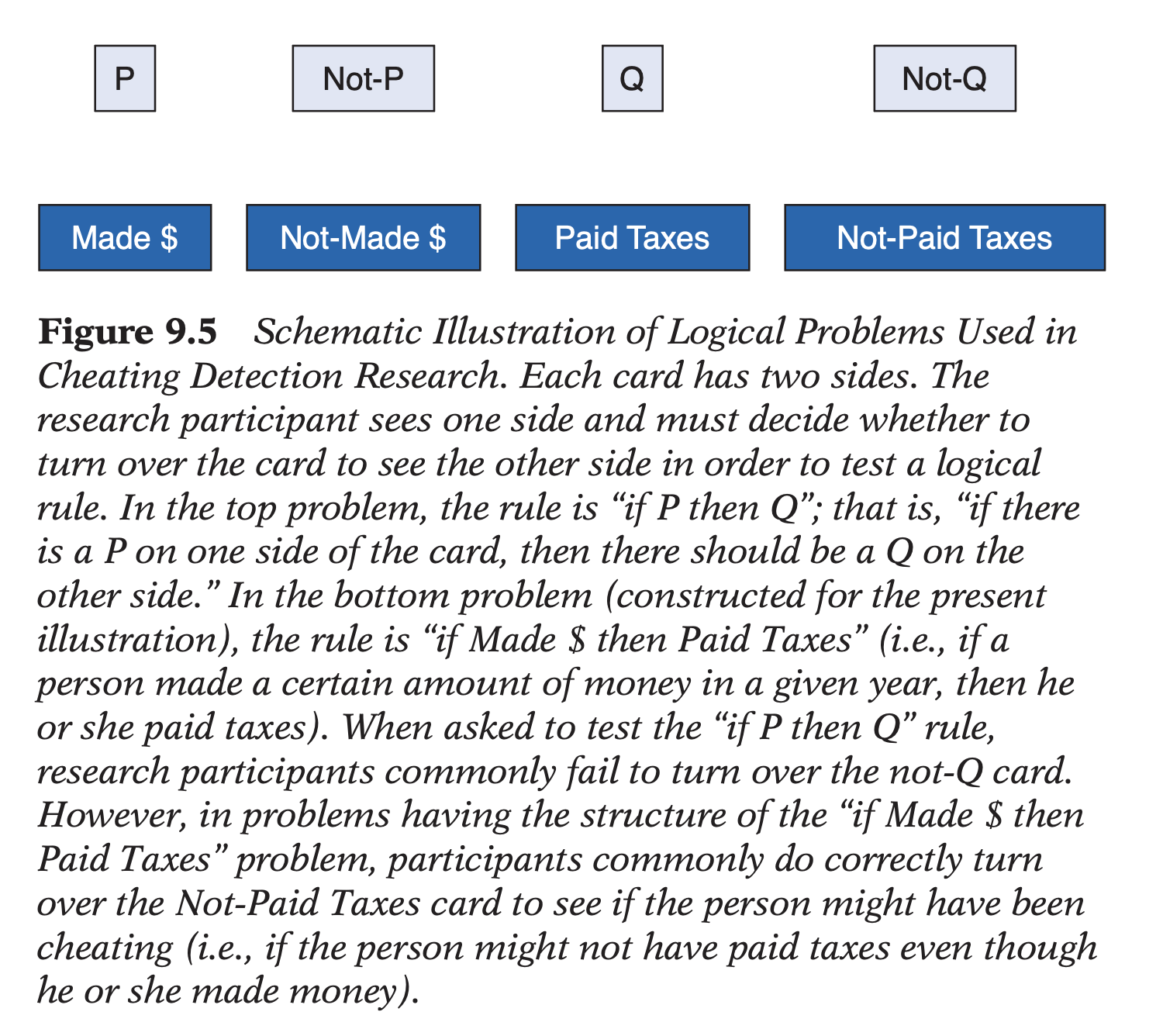
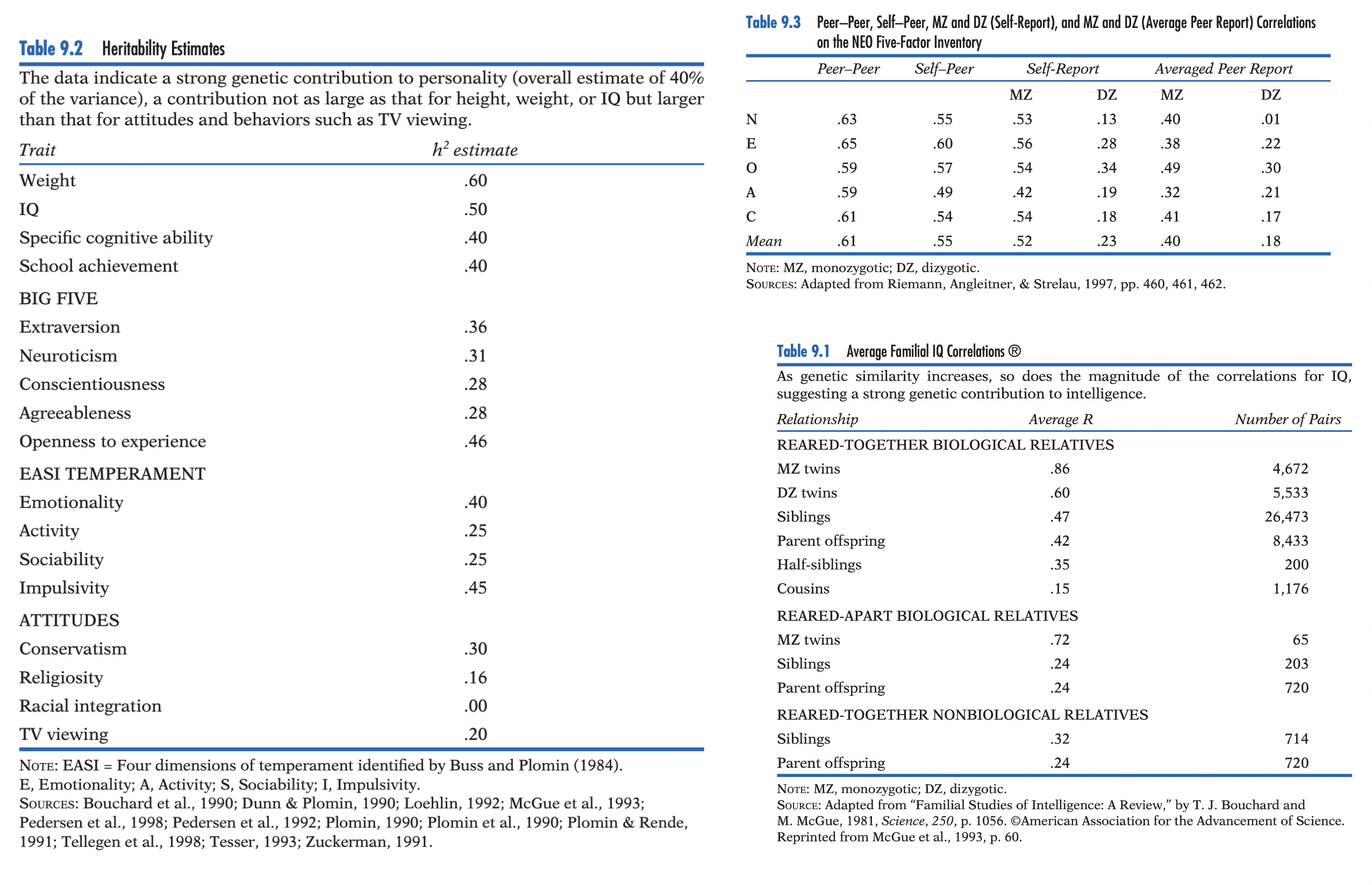
Describe behavioral genetics research.
Behavioral genetics: investigates genetic contributions to individual differences (genes influence personality INDIRECTLY via biological development; ≠ genes for Extraversion/Neuroticism) // Methods:
Selective breeding: experimentally breed animals for traits (e.g., fearfulness; alcohol responsiveness) → demonstrates genetic effects; manipulate environments experimentally (not possible in humans).
Twin studies: MZ (~100% shared genes) vs. DZ (~50%; ordinary siblings); MZ > DZ similarity → genetic influence; MZ reared apart → isolates environmental effects. MZ reared apart: r ≈ .45–.50; nearly identical to MZ reared together → substantial genetic contribution.
Adoption studies: compare adopted children with biological vs. adoptive relatives → biological resemblance = genetic effects; adoptive resemblance = environmental effects.
Heritability (h²): proportion of population variance attributable to genetic differences (remainder = environmental variance + residuals); population statistic (varies across traits/populations/environments; e.g., war ↓ h² by increasing environmental variation or different for different populations!); ≠ percentage of an individual’s trait caused by genes; h² = 0 possible despite genetic necessity (e.g., universal abilities with no person-to-person variation).
Findings: personality moderately heritable (~40–50%); genetic influences across virtually all traits (Big Five; IQ; emotionality; activity; sociability; impulsivity; attitudes such as conservatism). Self-report limitation addressed by peer ratings → independent peer reports replicated Big Five genetic findings (slightly lower genetic estimates) → greater validity/generalizability across measures.
(!) Caveats: (1) heritability ≠ immutability (environment can modify highly heritable traits); (2) heritability = nomothetic (population differences) ≠ idiographic (individual prediction); (3) genetics operate via gene × environment interactions, not genetic determinism; e.g. Molecular genetics: identifies specific genes underlying outcomes (≠ estimating overall h²).
MAOA study: high-activity allele buffered childhood maltreatment → lower antisocial behavior than low-activity allele.
Serotonin transporter study: low-serotonin variant + many stressful life events → higher depression risk; gene alone insufficient.
→ Both demonstrate gene × environment interaction.
Gene–environment interaction: genes and environment = inseparable partners (≠ nature vs. nurture).
Cooper & Zubek: maze-bright/maze-dull rats × enriched/impoverished environments → enrichment benefited genetically dull rats; deprivation mainly harmed genetically bright rats → same environment produces different outcomes depending on genotype.
Environmental influences: shared environment (makes siblings similar) vs. nonshared environment (makes siblings different).
Findings: shared family environment contributes little to personality; ~40% of variance reflects nonshared environment. Big Five: substantial heritability across all traits (Openness independent of IQ); multiple measures separated measurement error from nonshared environment; peer ratings largely replicated self-reports
Reiss: nonshared effects partly arise because genetically different children evoke different parental treatment.
Three gene–environment interactions:
Passive: same environment → different effects depending on genotype.
Evocative: genetically influenced traits evoke different responses from others.
Active: individuals increasingly select/create environments matching genetic predispositions.
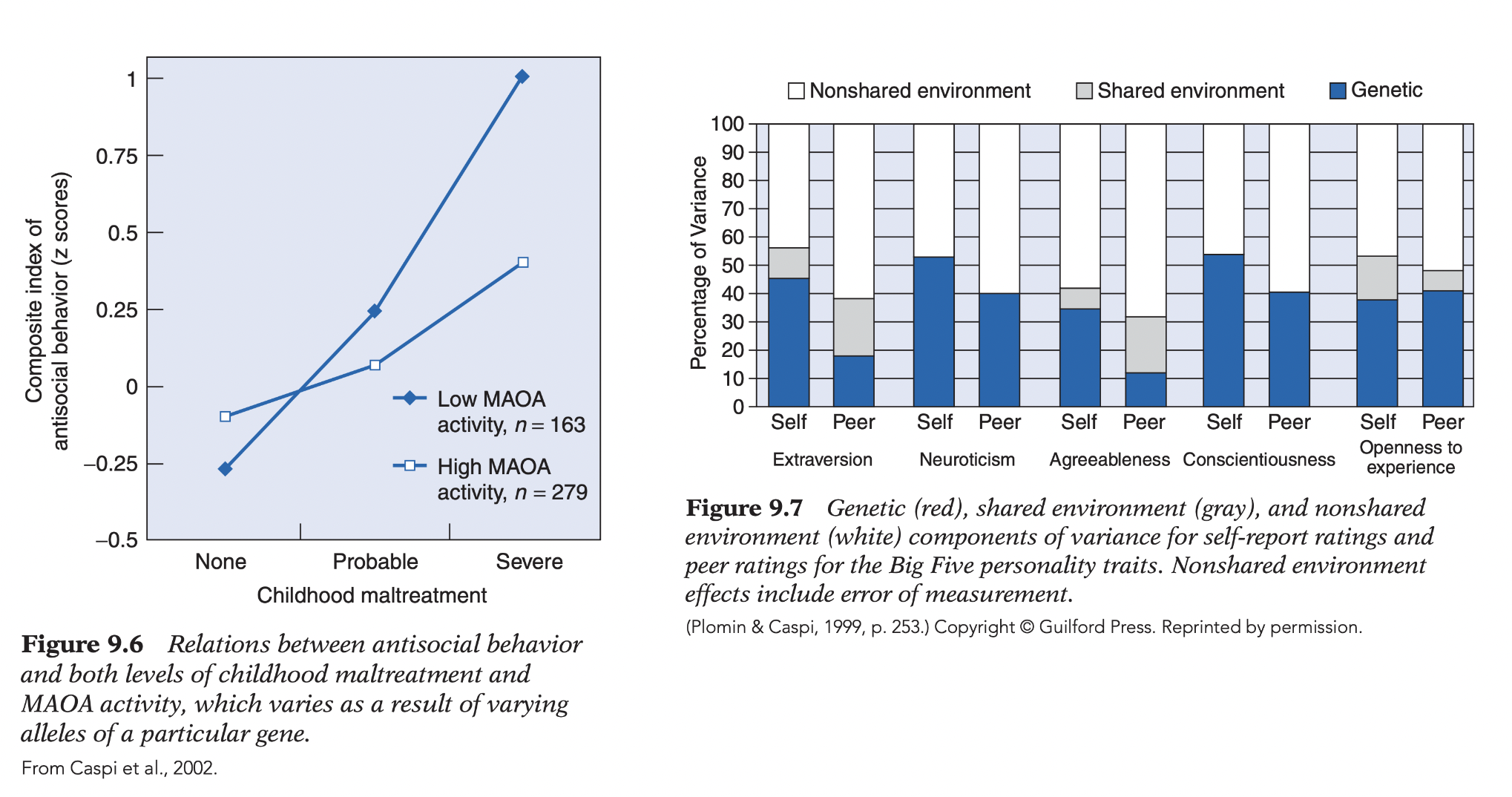
Describe the research on brain systems.
Focus: identifies neural/biochemical mechanisms underlying personality (emotion; temperament; self; morality); biology = dynamic system (≠ fixed cause only).
(!) Hemispheric asymmetry (Davidson): (L) left prefrontal → positive affect; enthusiasm; approach motivation; (R) right prefrontal → negative affect; distress; avoidance.
EEG: greater (L) left baseline activation → stronger positive emotions to pleasant films; greater (R) right activation → stronger negative emotions to unpleasant films.
Clinical evidence: depression → ↓ (L) left-anterior activity; left frontal damage → depression; (R) right frontal damage → mania;
distressed infants (maternal separation) → greater (R) right activation.
Worry ≠ anxious arousal: worry shows relatively greater (L) left-frontal activation → distinct neural mechanisms (≠ single Neuroticism factor).
Anger: despite negative valence → (L) left activation (approach/confrontation) → hemispheric asymmetry reflects approach vs. avoidance, not simply positive vs. negative emotion.
Neurotransmitters & temperament:
(1) Dopamine: reward/reinforcement; learning; pleasure; approach; positive affect; energy; impulsivity; incentive motivation; excess → schizophrenia; deficit → Parkinson’s disease.
(2) Serotonin: mood regulation; emotional stability; impulsivity; aggression. Low serotonin → depression; anxiety; OCD; alcoholism; impulsive aggression; pessimism. SSRIs prolong serotonin action.
(3) Cortisol: stress hormone; adaptive acutely; chronic elevation → depression; memory impairment; inhibited children (Kagan) ↑ cortisol at age 5 (effect absent age 7).
(4) Testosterone: dominance; competitiveness; aggression // high testosterone promotes competitive/aggressive behaviour, while winning competitions (even coin tosses) increases testosterone and losing decreases it → bidirectional cause–effect relationship.
Clark & Watson’s 3-factor temperament model → No one-to-one neurotransmitter–trait mapping; each transmitter influences multiple traits; personality reflects interacting biological systems. (A) Differentiation/localization: specialized brain regions vs.(B) organization/system: personality emerges from coordinated interaction of interconnected systems:
(A) PE (Positive Emotionality): Extraversion-like; energetic engagement; dopamine; left hemispheric activation.
(B) NE (Negative Emotionality): Neuroticism-like; threat sensitivity; emotional instability; low serotonin; right hemispheric activation; heightened amygdala responsiveness.
(C) DvC (Disinhibition vs. Constraint): self-regulation (≠ affective valence); high = impulsive; sensation-seeking; reward-driven; low = cautious; controlled; future-oriented; serotonin (primary) + dopamine + testosterone.
Plasticity: biology both cause and effect of experience.
Monkeys: dominance ↑ serotonin; loss ↓ serotonin.
Testosterone: promotes competition and increases after winning (even coin tosses), decreases after losing.
Juggling study: 3 months learning → ↑ gray matter in motion-processing regions → adult brain structurally plastic.
SES study: lower socioeconomic communities → reduced serotonergic responsiveness (serotonin agonist; prolactin measured), independent of IQ/Big Five → environment alters neurobiology.
Higher-level functions:
Self: fMRI; self-judgments (vs. Bush vs. perceptual judgments) → selective medial prefrontal cortex (mPFC; vgl. Rogers) activation → self-referential processing recruits specialized neural systems.
Morality: moral dilemmas activate emotion-related brain regions more than nonmoral reasoning → moral judgment integrates emotion + cognition (≠ purely rational).
2 Interesting studies:
Stress & telomeres (Epel): telomeres = chromosome end caps shortening with cell division (biological aging marker). Higher perceived + objective stress (especially mothers of chronically ill children vs. normal/healthy ones) → significantly shorter telomeres (~9–17 years greater biological age) → chronic stress modifies cellular biology; strong evidence for biological plasticity.
Prenatal environment: probability of male homosexuality ↑ with number of older biological brothers, independent of being raised together (!) → shared family environment excluded. Maternal immune hypothesis: successive male pregnancies trigger maternal immune response → altered prenatal environment → fetal brain development. → Prenatal biology contributes alongside genes and postnatal environment.
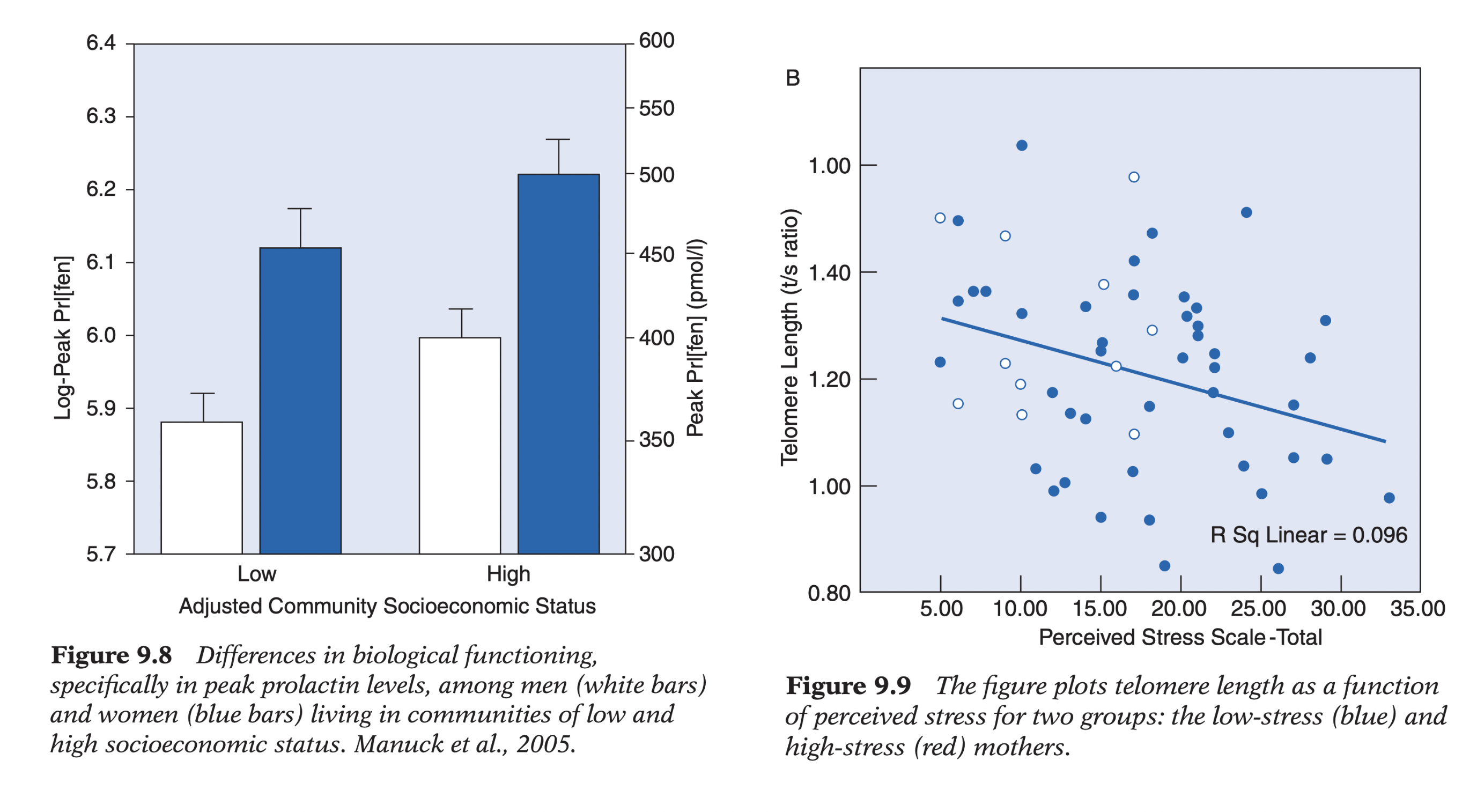
Tree (PKP Ch. 9) 1/2
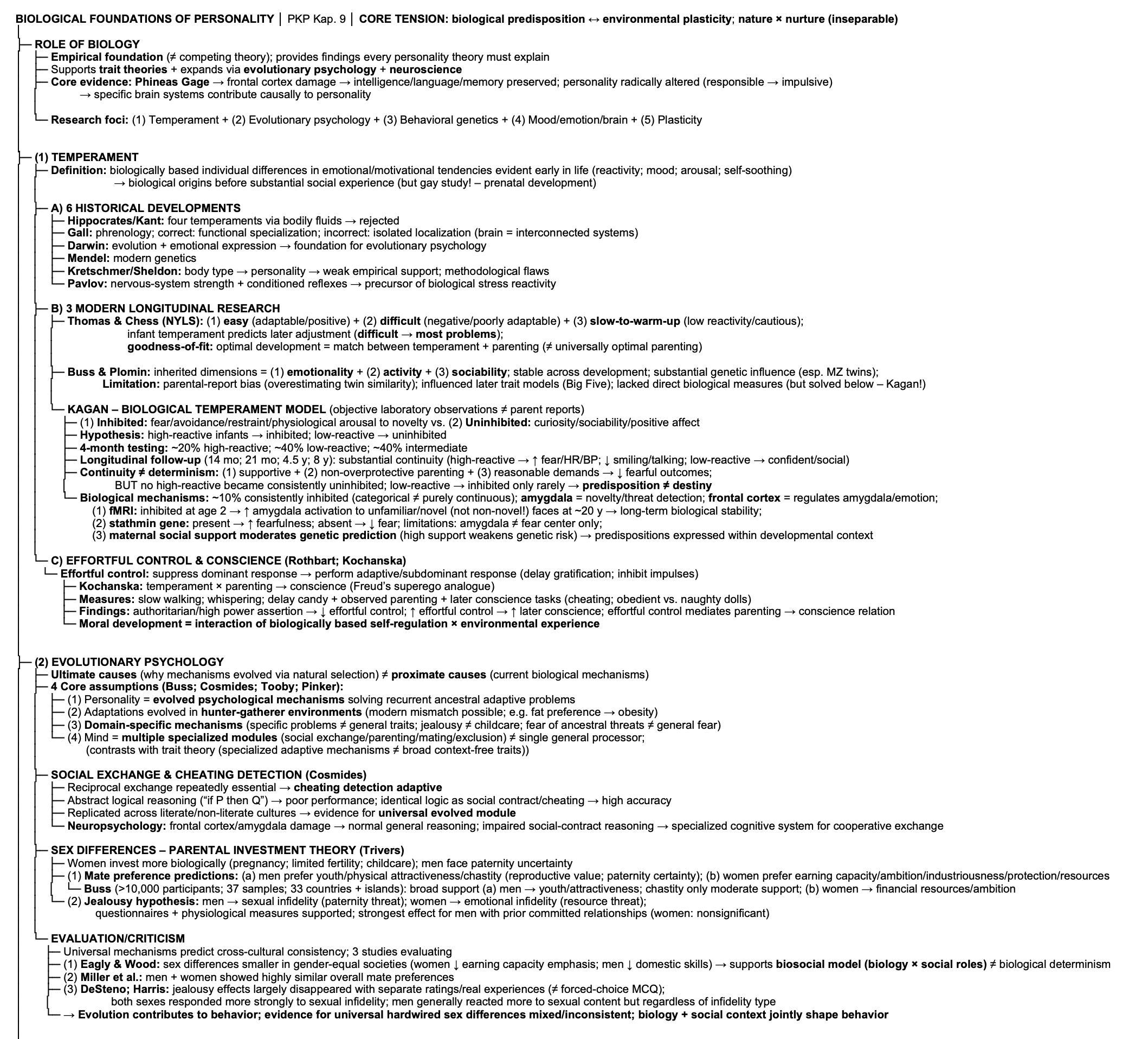
Tree (PKP Ch. 9) 2/2
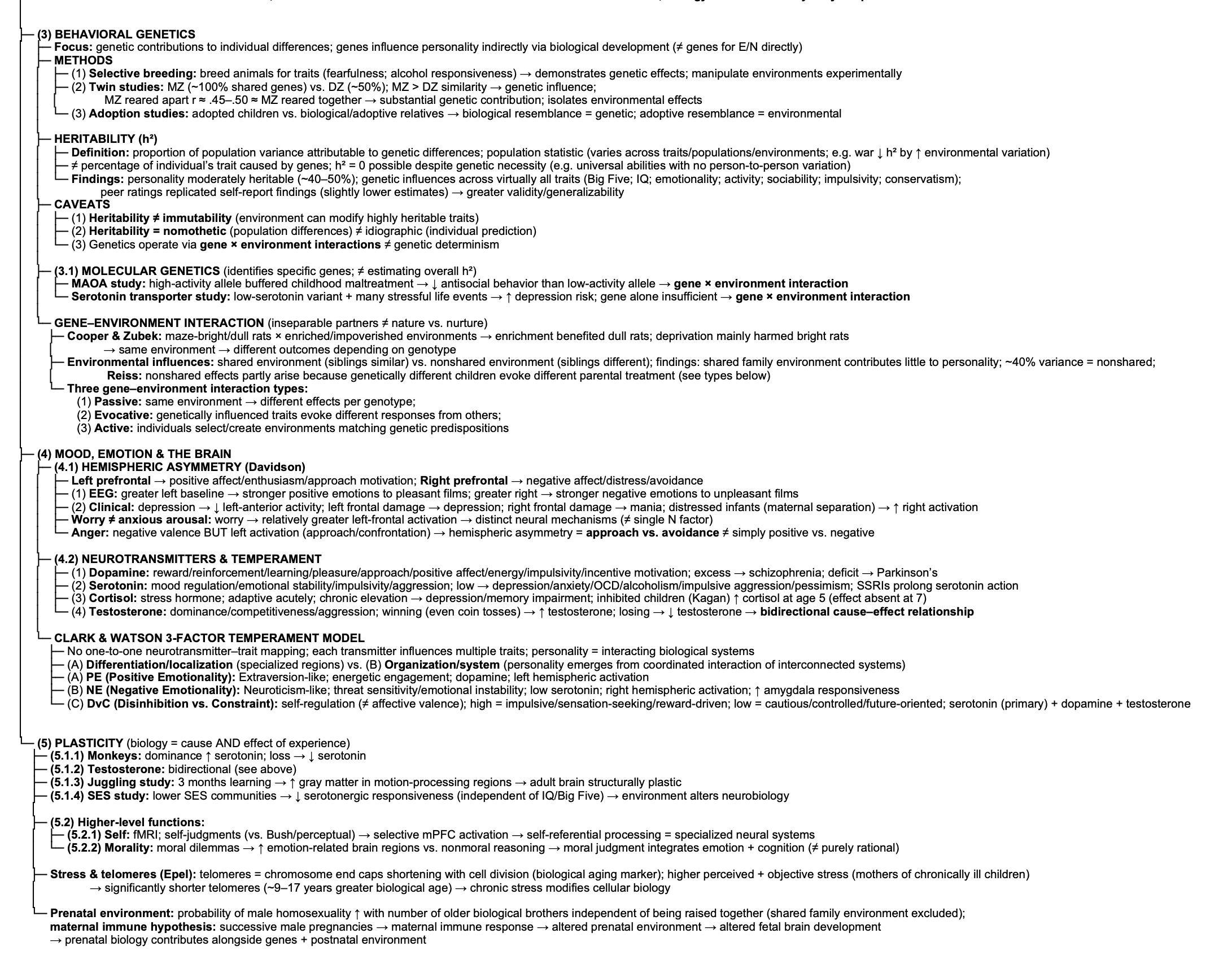
Tree (PKP Ch. 9) 3/3
Describe the foundations of behaviorism and evaluate the theory set.
Behaviorism (learning approach); personality = learned behavioral repertoire;
Internal constructs (traits; motives; unconscious) ≠ causes; environment + learning principles = causal explanation;
Pavlov (classical conditioning) + Skinner (operant conditioning) = complementary foundations;
Dominant paradigm (especially 1950s; decline in last third of 20th century);
Significance: model of theory construction; influential therapies; precursor of research on automatic environmental influences and positive psychology.
View of person:
Mechanistic organism; lawful environmental input → behavior; learning > internal structures;
Determinism (all behavior caused by prior environmental events); free will rejected; thoughts/feelings = behaviors requiring explanation (i.e. only descriptions), not causal explanations.
Scientific assumptions: environmental determinism;
psychology studies observable stimulus–response relations only; controlled laboratory experimentation; observable variables; rejection of speculative constructs (id; traits; self; motives);
Simple-systems strategy (animal research → general learning laws → human behavior);
Personality theories unnecessary/useless (personality constructs = descriptive labels for learned behavior, not causal entities);
Situational specificity > cross-situational consistency (contrast: trait theories);
Psychopathology = maladaptive learning; therapy = new learning experiences, not conflict resolution/personality restructuring.
4 Core assumptions/principles: (1) personality theory must rest on empirical research; (2) learning principles explain personality; (3) behavior primarily environmentally and situationally determined; (4) psychopathology understood and treated through learning rather than disease models.
Evaluation
Scientific database:
+ rigorous experimental methodology; objective, replicable evidence; strengthened psychology’s scientific credibility.
− evidence primarily from animals (dogs; rats; pigeons); limited representation of uniquely human capacities (language; abstract reasoning; autobiographical memory; future planning; subjective meaning!!); cognitive revolution exposed these limitations.
Systematicity & Testability:
+ highly systematic; same learning principles explain acquisition; maintenance; extinction; reinforcement; behavior change; internally coherent partly because few hypothetical constructs.
− limited real-world testability; laboratory predictions strong, but everyday environments contain numerous interacting stimuli; environmental causes often identifiable only retrospectively (e.g. through asking) → reduced predictive power.
Comprehensiveness:
+ exceptionally broad explanatory scope; applied learning principles to perception; language; motivation; emotion; self-concept; psychotherapy; education; economics; government; religion; culture; social organization.
− many explanations later challenged by cognitive theories.
Applications:
+ major practical contribution; behavior therapy; systematic desensitization; reinforcement-based interventions; token economies; strong clinical effectiveness; lasting influence on modern treatment; stimulated later theoretical developments.
− criticized for generalizing too readily from animal research to humans; oversimplifies personality; neglects subjective meaning and internal cognitive processes; environmental determinism too restrictive; lacks a fully unified personality theory; questions remain regarding long-term effectiveness/generalizability of some treatments.
Describe classical conditioning.
Classical conditioning (Pavlov); learning by association; foundation of behaviorism (Watson) and explanation of personality/emotional development.
Watson: founder of behaviorism; observable behavior > introspection; mentalistic explanations rejected; experimental science + learning principles replace speculative constructs.
Basic mechanism: NS + biologically meaningful US (naturally elicits UR) repeatedly paired → NS becomes CS; CS → CR (learned emotional/physiological response); responses learned, not chosen; e.g., food (US) → salivation (UR); bell (CS) → salivation (CR).
Learning principles: (1) Generalization (CR spreads to similar stimuli; fear of one dog → many dogs); (2) discrimination (learn only specific stimuli predict US); (3) extinction (CS repeatedly without US → association weakens/disappears) // explain acquisition; maintenance; modification; disappearance of emotional responses.
Applications:
(E.g.) Physiology: drug tolerance; drug-associated environmental cues = CS → conditioned compensatory physiological responses before drug intake → tolerance; BUT in unfamiliar environment → failure of tolerance → increased overdose risk.
(E.g.) Food preferences: likes; dislikes; disgust = conditioned emotional responses; generalization (contaminated milk → disgust toward all milk); explains cultural differences; modifiable through new conditioning.
(!) Psychopathology: experimental/acute neuroses (Pavlov); impossible discrimination (circle vs. ellipse) → behavioral disorganization; pathology = maladaptive learning, not internal disease.
Little Albert: conditioned emotional response; white rat (NS/CS) + loud noise (US) → fear (CR); generalization to white furry objects (e.g., Santa beard); supports learned fears vs. psychoanalytic conflict explanation.
Behavior therapy – Systematic desensitization (Wolpe): anxiety = learned response; counterconditioning (relaxation incompatible with anxiety); relaxation training → anxiety hierarchy (least → most feared) → gradual imagined exposure while relaxed → fear replaced by relaxation; transfers to real situations; challenges symptom substitution of psychoanalysts! (no new symptom if learned response removed).
(E.g.) Jones (Peter); rabbit phobia reduced by counterconditioning (rabbit + pleasant stimuli/food; observing fearless children also contributed); extinction/generalization of improvement to fur coat; feathers; cotton wool.
(E.g.) Little Hans reinterpretation: horse phobia = accumulated frightening horse experiences + horse collapse → conditioned fear; recovery = extinction/counterconditioning, not Oedipal conflict or insight; learning explanation > psychoanalytic explanation.
(!) Modern developments:
Implicit conditioning (subliminal pairings → attitudes/prejudice);
Self-esteem (self-relevant words + smiling faces → increased self-esteem vs. mixed-face control);
Kandel (Aplysia): repeated CS + tail shock (US; natural gill withdrawal = UR) → strengthened synapses (↑ neurotransmitter release from interneurons → motor neurons) → stronger CR; learning stored as strengthened neural connections.
Describe operant conditioning.
Operant conditioning (Skinner);
Skinner transformed behaviorism into comprehensive philosophy of human behavior; strict environmental control; laboratory experimentation; elementary laws of behavior; practical applications (teaching machines; Walden Two; behavior-change technologies); positive reinforcement > coercion.
Learning through consequences of behavior (≠ stimulus associations in classical conditioning); voluntary behavior acquired, maintained, modified by reinforcement/punishment;
Environmental consequences (≠ internal mental states) determine behavior → basis for personality, psychopathology, assessment, behavior change, free will.
Theory of personality: internal structures (traits; motives; unconscious) unnecessary;
(1) Response = basic structural unit; (1.1) elicited responses (triggered by known stimuli) vs. (1.2) operants (emitted spontaneously; future frequency determined by consequences); learning = selection/strengthening of emitted behaviors.
Basic mechanism: response → reinforcement → ↑ future response probability; reinforcer defined functionally (increases behavior; varies across individuals); generalized reinforcer (!) (e.g., money → access to many reinforcers); Skinner box demonstrates lawful effects of environmental consequences.
Schedules of reinforcement: (a) interval (time-based) vs. (b) ratio (response-based);
(1) fixed vs. (2) variable // ratio > interval (higher response rates) // variable ratio > all others (highest, most persistent responding; unpredictable reinforcement); e.g. slot machine (variable ratio) vs. soft-drink machine (fixed ratio).
Shaping (successive approximations): reinforce increasingly accurate approximations → complex behavior acquired stepwise; basis of animal training and complex human learning.
Negative reinforcement vs. punishment: negative reinforcement = removal of aversive stimulus → ↑ behavior (e.g., avoidance reduces anxiety); punishment = presentation of aversive stimulus → ↓ behavior; punishment often temporary; may produce resistance/rebellion; positive reinforcement more effective.
Growth/development: no stages; unconscious conflicts; or emerging structures; behavioral repertoire gradually expands through reinforcement history; parents should reinforce desirable behavior immediately rather than rely on punishment/lectures.
Psychopathology: maladaptive learned response patterns (≠ disease; sick personality); causes: (1) adaptive behavior not reinforced (behavioral deficits); (2) maladaptive behavior reinforced; (3) adaptive behavior punished; (4) reinforcement under inappropriate conditions
E.g. 1: depression = reduced responding following loss of positive reinforcement; E.g. 2: superstitious behavior = accidental response–reinforcement pairings maintained by chance.
Behavioral assessment: ABC assessment (Antecedents (causes) – (target) Behavior– Consequences (maintenance conditions)); functional analysis identifies environmental variables maintaining target behavior;
ABA design (baseline → intervention → baseline) demonstrates causal effects of reinforcement; (1) sample approach (behavior = sample of learned responses) ≠ (2) sign approach (behavior infers hidden traits).
Behavior change: token economies (tokens contingent on adaptive behavior → exchanged for rewards); effective in psychiatric hospitals; intellectual disability; schools; marital interventions; ↑ self-care; work performance; social interaction; ↓ aggression; environment redesigned to reinforce desired behaviors.
Free will: illusion; all behavior reflects cumulative reinforcement history; obvious environmental control recognized (e.g., police car → slow down), complex control mistaken for personal choice; rejecting free will enables behavioral technology and humane social engineering through positive reinforcement; criticized by phenomenological/cognitive theories for underestimating conscious agency and creativity.
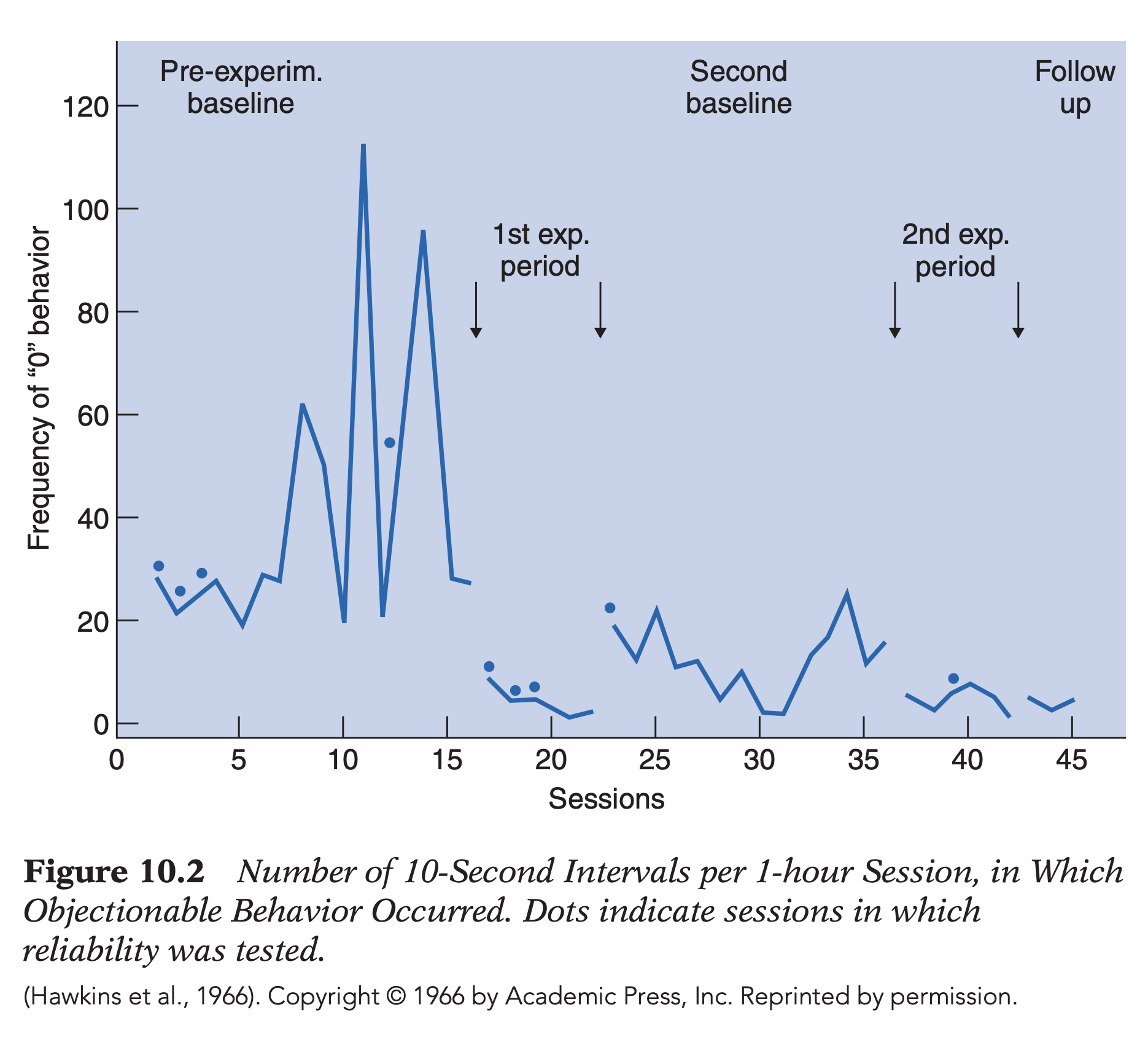
Tree (PKP Ch. 10) 1/2
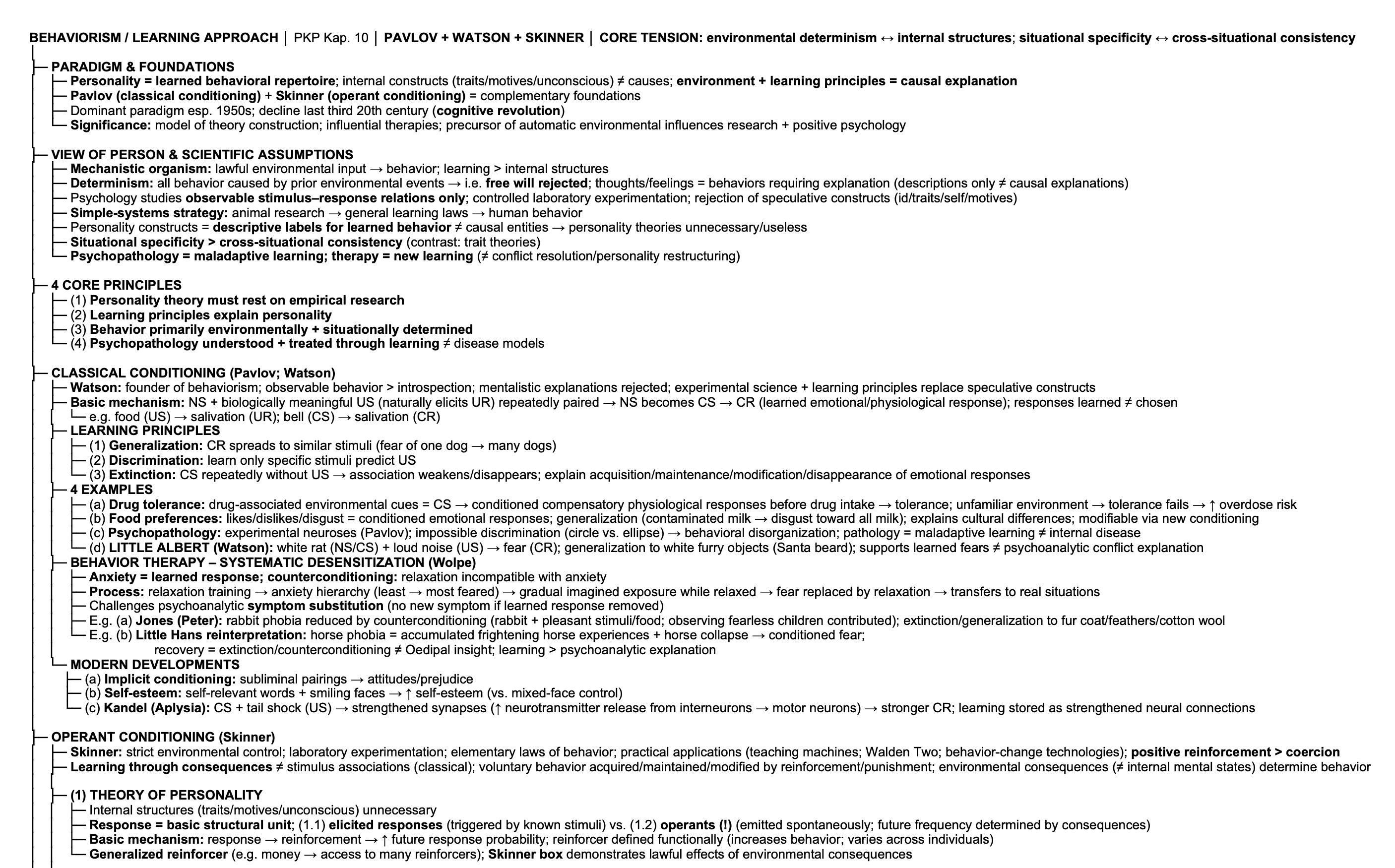
Tree (PKP Ch. 10) 2/2
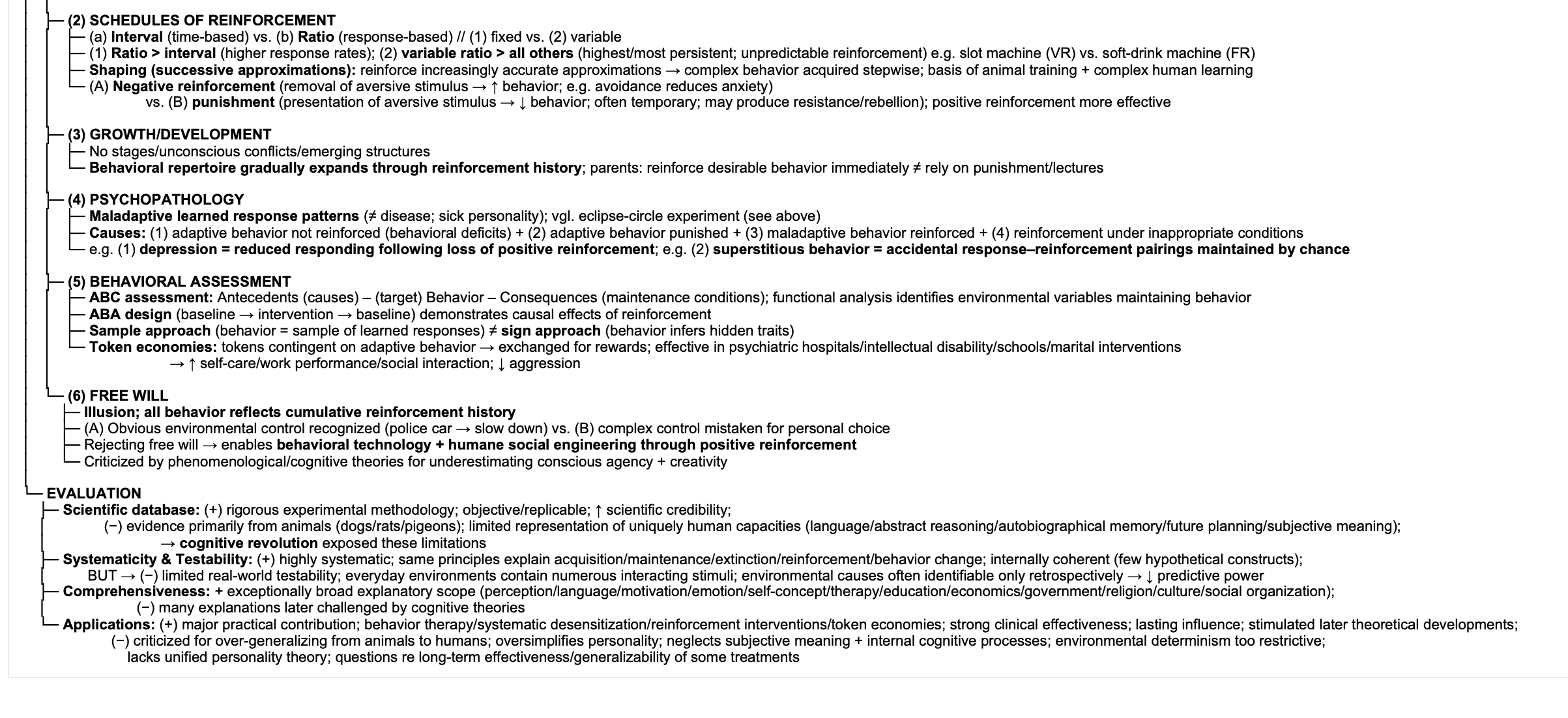
Describe and evaluate the theoretical foundations of George Kelly’s Personal Construct Theory.
Foundations → Cognitive personality theory (Kelly didn’t like the separation between emotion & cognition!); personality = subjective construction of reality (interpretation/categorization/meaning-making ≠ objective events); thoughts, emotions, goals, behavior derive from personal constructs (some well-known, others individual, e.g. tree vs. attentive/arrogant teacher) organized into a personal construct system; cognition, prediction, future orientation central; integrates personality theory + Rep Test + psychotherapy; anticipated cognitive revolution.
Origins → clinical observations (≠ Freud: unconscious drives → conscious interpretation; ≠ Rogers: general phenomenology → detailed cognitive meaning-making + teachers’ judgments reflected teachers’ constructions, not objective child traits) → meaning exists through interpretation; reject objective truth/black-or-white explanations; theories = provisional, revisable tools; pragmatism → usefulness > truth.
View of Science → goal ≠ discover objective reality; goal = maximize prediction + practical usefulness (pragmatism); constructive alternativism (multiple theories may each be useful / toolkit perspective! ≠ objective truth!); theories judged by predictive success → each has a range of convenience (where applicable) + focus of convenience (where most useful); modify/discard when predictions fail; anti-dogmatism (“invitational mood”); criticizes reification through excessive measurement; values clinical method (generates hypotheses; addresses important problems).
Criticized excessive measurement (reification of constructs into objective entities); valued clinical methods (generate hypotheses + important questions); prioritized practical understanding/problem-solving over merely appearing scientific.
View of the Person → person-as-scientist; everyday cognition parallels scientific inquiry (hypothesis → test → revise); fundamentally future-oriented (anticipate events); constructive alternativism at personal level → reconstrue reality via new constructs; free will ↔ determinism: constrained by existing construct system yet free to reconstruct it; personality = actively constructed, revisable predictive system.
Evaluation: among first major cognitive personality theories; shifted focus from drives/reinforcement (psychoanalysis / behaviouroism) → meaning-making, cognitive organization, future-oriented prediction; integrates universal principles with individual uniqueness; Rep Test = theory-consistent assessment; indirect legacy → conceptual foundation for later cognitive/social-cognitive personality theories.
Scientific database (+/−) → strong for its time (rich clinical observations + objective, theory-derived Rep Test); BUT limited today (primarily North American samples; lacks modern cognitive methods).
Systematicity (+) → highly coherent; explicit postulates/corollaries; tightly integrated concepts; entire theory presented simultaneously (no change of heart, not open to interpretation through many works) → exceptional internal consistency.
Testability (±) → precise concepts + Rep Test enable empirical testing (e.g., cognitive complexity; anxiety; therapy); BUT core assumptions (person-as-scientist; constructive alternativism; fundamental postulate) = philosophical premises (like other theories, but his are a major backbone!), not directly testable; limited evidence linking construct systems directly to overt behavior.
Comprehensiveness (±) → comprehensive if anticipation-through-constructs accepted; weaker for emotional, impulsive, irrational, biologically driven behavior; limited treatment of development, emotion → cognition, decision processes, genetics/evolution/neuroscience; embodied cognition (multiple interacting neural systems) extends beyond theory’s range of convenience.
Applications (+) → outstanding theory-practice integration; Rep Test + fixed-role therapy directly derived from theory; strong clinical utility.
Describe Kelly’s personality structure.
Structure → personality = organized personal construct system (≠ drives/traits); constructs interpret present events + anticipate future events.
Personal constructs → unit of knowledge; formed by observing regularities (similarities + contrasts); bipolar (similarity pole + contrast pole; ≥3 elements: 2 similar, 1 contrasting); meaning requires both poles; organize experience + predict future events.
Interpersonal implications → constructs reveal observer as well as target; personality inferred from habitual constructs; different construct systems → misunderstanding/conflict; identifying shared constructs → improved communication/cooperation (hospital clinician-manager study after construct system comparisons; SImpsons et al. (2004)).
Construct system
Types → (1) verbal (expressible); (2) preverbal (pre-language; unconscious-like); (2.1) submerged (one/both poles no longer verbalizable).
Application → (1) range of convenience (all applicable situations); (2) focus of convenience (where construct works best).
Importance → (1) core constructs (identity-defining; change → major system reorganization // e.g. (un)holy if religion central) vs (2) peripheral constructs (modifiable; minimal consequences // e.g. (un)holy if religion unimportant).
Organization → hierarchical (superordinate → subordinate // e.g. animals/dogs/labradors); interconnected (change in one construct → changes elsewhere); generally consistent, but conflicts → psychological strain/decision difficulty.
Current application (sensory constructs) → richer construct vocabulary + practice → improved perception, recognition, memory (odor labels transform vague sensations into identifiable percepts); language facilitates but does not determine perception (previously thought language absolutely forms reality).
Assessment: Role Construct Reperetory // Rep Test → idiographic; assumes people can report own construct system; (1) generate significant people → (2) compare triads (2 similar, 1 different) → elicit bipolar constructs; assesses individual’s construct system (≠ target people); reveals unique information beyond Big Five (~50% unique variance).
G&Development (Rep Test) → children: constructs dominated by Agreeableness/Extraversion; concrete (facts > habits/skills/preferences/behaviors > traits); adults: increasingly abstract, differentiated, psychological, trait-based (vgl. Piaget).
Cognitive complexity/simplicity → complexity = many differentiated, non-overlapping constructs; expertise, better behavioral prediction, perspective-taking, integration of contradictory information, higher Openness; (!) self-complexity (multiple roles → stress buffer; mixed evidence); (!) social identity complexity (integrating multiple group identities); higher complexity → better leadership/conflict resolution, lower war likelihood, more liberal/integrative thinking; lower complexity → categorical/conservative thinking, useful during revolutionary struggle but weaker for later governance.
Limitation (neuroscience) → Kelly assumed one construct system becoming more specialized; brain imaging shows experts recruit additional specialized neural systems (embodied cognition; e.g. hockey expert study with premotor cortex) → psychological predictions supported, biological mechanisms lie outside theory’s range of convenience.
Describe Kelly’s personality process, growth & development, and psychopathology.
Process → rejects motivation (push/drives; pull/goals); people inherently active; fundamental postulate: all psychological processes channelled by anticipation of events; construct system → predict future → choose behavior maximizing construct-system development/predictive accuracy; validation (even unpleasant events) → strengthen constructs; invalidation → revise/loosen/expand constructs; goal = improved anticipation (≠ reinforcement; ≠ pleasure; ≠ self-consistency).
Anxiety → events outside range of convenience; insufficient constructs; cope by broadening or narrowing constructs.
Fear → new construct about to enter construct system.
Threat → imminent comprehensive change in core construct system; accompanies major personal change/self-reconstruction.
2 Studies → (1) music students: larger self vs. “self-if-failed” discrepancy (Threat Index) → greater increase in pre-performance anxiety; (2) death: larger self–death discrepancy (Threat Index) → greater death threat; lower in hospice patients, emotionally open, self-actualizing individuals.
Integration → functioning = tension between expanding construct system vs protecting it; excessive anxiety/threat → rigidity/dogmatism; healthy functioning → “invitational mood” (tolerate uncertainty; continual reconstruction).
Growth & Development → least developed part of theory; constructs emerge through repeated experience; preverbal constructs develop in infancy; culture teaches shared ways of construing events;
Later research: construct systems become larger, more differentiated/complex, hierarchical, abstract, trait-based (vgl. Piaget); increasing perspective-taking/empathy (recognizing events not self-related); (1) diverse experiences + (2) autonomy-supportive parenting → greater cognitive complexity; authoritarian environments → rigid, constricted construct systems; limited lifespan explanation = theoretical weakness.
Psychopathology → maladaptive, rigid construct system; preserve invalid constructs despite repeated predictive failure (poor scientist analogy); driven by anxiety, fear, threat;
Defenses: (1) make constructs unavailable to awareness (repression-like), (2) submerge construct poles, (3) ignore contradictory information, (4) force others to confirm predictions; pathology = failure to reconstruct construct system.
Psychotherapy → reconstruct construct system; therapist helps client become better “scientist” (replace ineffective constructs; strengthen adaptive ones; flexible reinterpretation); fixed-role therapy: personality sketch → client lives ~2 weeks as alternative person; safe experimentation with new constructs; large role change > small adjustments (system-wide reconstruction); therapist encourages exploration, not prescription; goal = more accurate, flexible anticipation; effective across diverse psychological disorders.
Case of Jim → constricted construct system dominated by (1) warm–cold relationships + (2) secure–insecure people; self = insecure/lacking confidence; ideal = warm, intelligent, open-minded, confident, successful → explains restricted relationships, low creativity, rejection expectations
Father = successful/open-minded; Mother = warm but conservative;
Limitation → Rep Test/Kelly explain how reality is construed but capture little emotional richness, inner conflict, or subjective experience.
Tree (PKP Ch. 11) 1/2
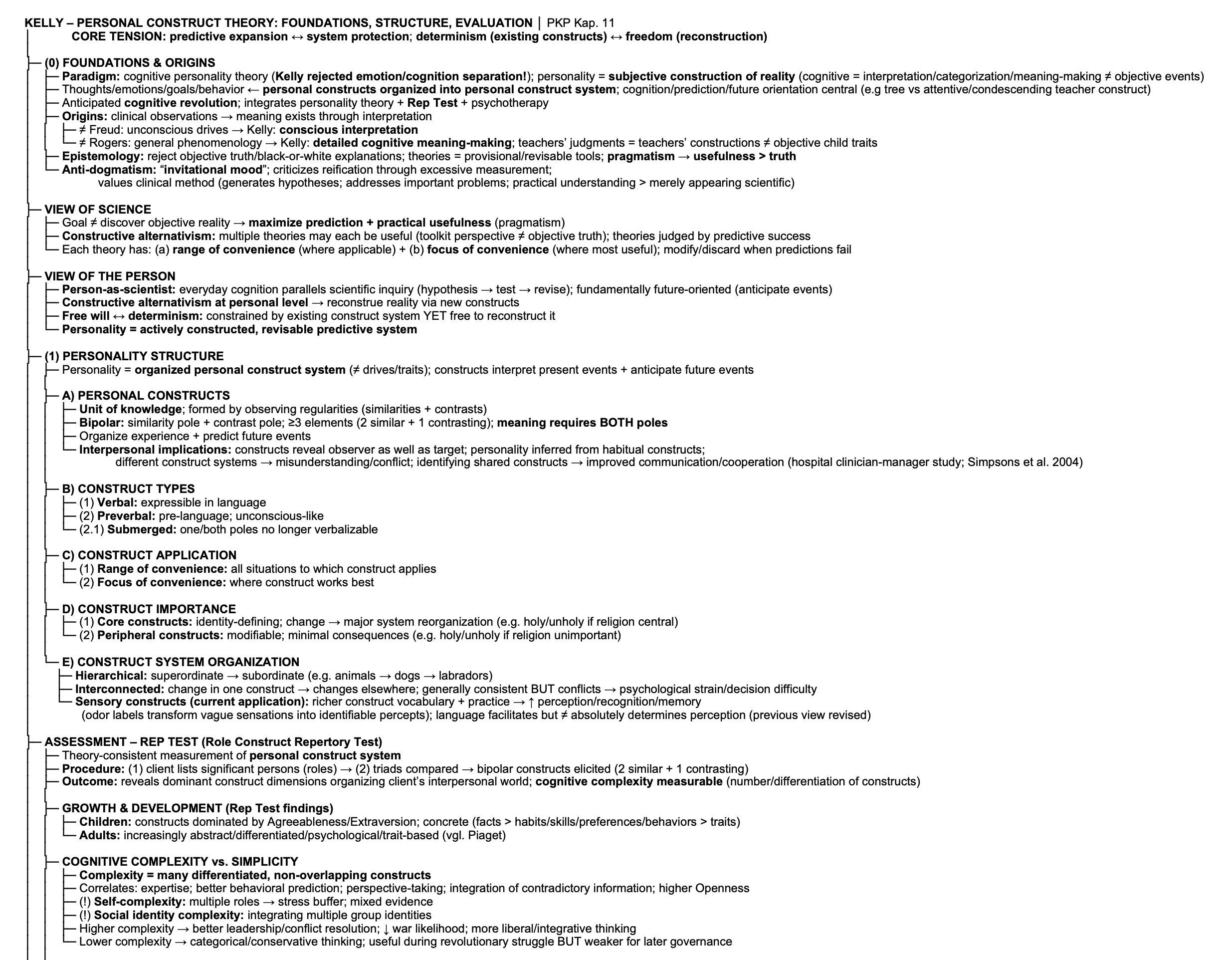
Tree (PKP Ch. 11) 2/2
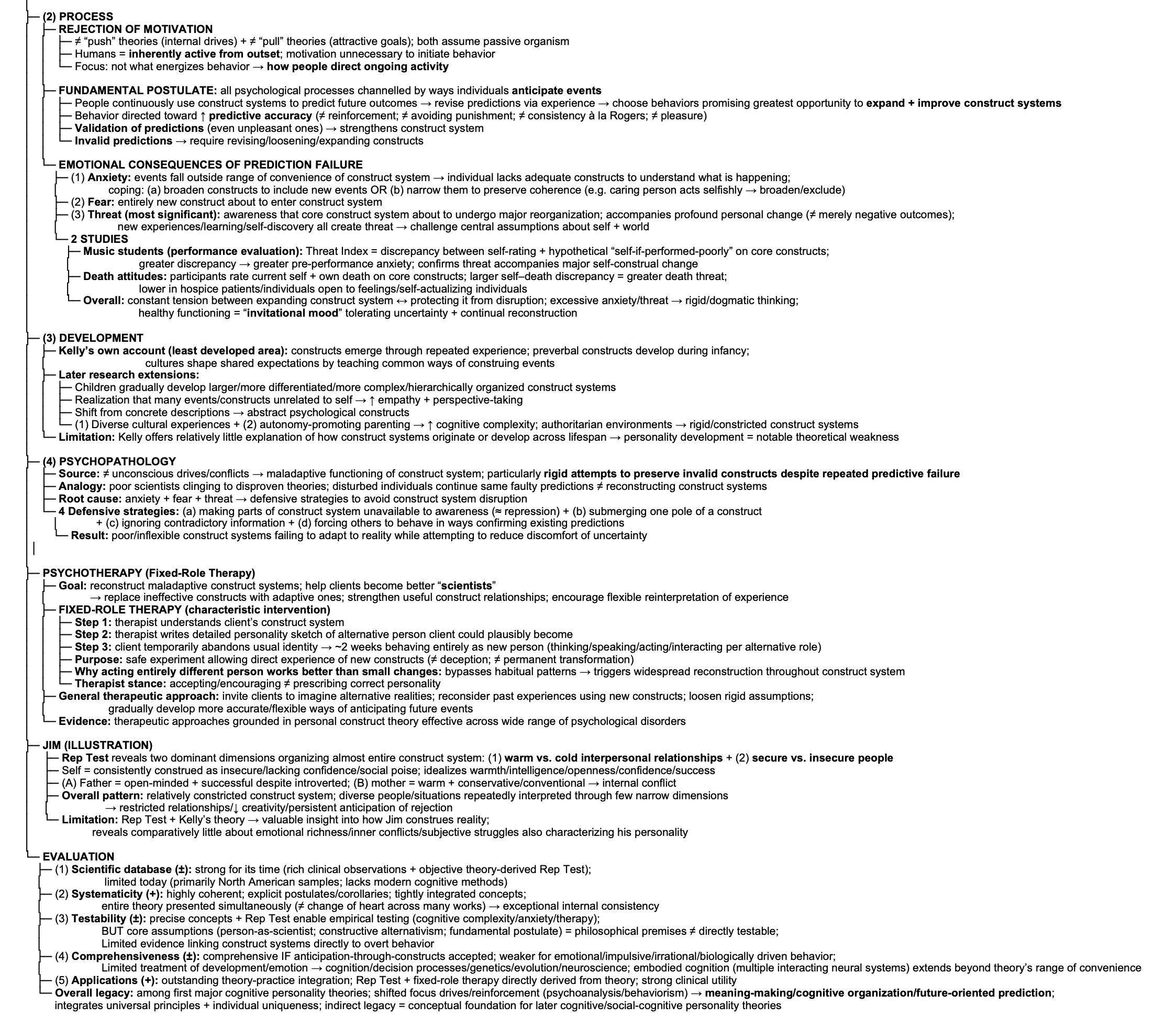
Describe the foundations of social-cognitive theories.
Definition/Theoretical Position: synthesis (behaviorism + cognitive psychology + Kelly); personality = Person × Environment (reciprocal interaction); behavior = interpretation + selection + influence of environment; person = active agent (≠ passive S-R organism).
Guiding Questions: (1) cognition → personality; (2) learning of complex social behavior without direct reinforcement; (3) scientific explanation of personal agency; (4) personality = behavioral consistency + systematic cross-situational variability.
Critique of Earlier Theories: (a) Psychoanalysis → overemphasis on unconscious/early childhood; (b) Trait theories → global average traits insufficient (variability informative); (c) Evolutionary psychology → limited explanation of rapid historical/cultural change; (d) Behaviorism → environmental determinism; underestimates self-control, cognitive interpretation, observational learning.
Complementarity: Bandura → agency; learning; self-regulation; Mischel → behavioral variability; stable cognitive-affective systems.
Bandura: transformed behaviorism → agentic theory; integrated cognition into learning/therapy; emphasis on self-processes (especially self-efficacy; also self-referent beliefs); individuals regulate own behavior/development (≠ products of environmental/social forces).
Mischel: global traits inadequate; behavior = systematically situation-dependent; personality = stable patterns of situation-specific responding; developed cognitive-social person variables → CAPS; focus: “How consistent is behavior?” → “Under which situations does this person reliably behave in particular ways?”
(A) View of the Person: uniquely human cognitive capacities → (1) symbolic reasoning (language); (2) mental representation(past; future; hypotheticals); (3) self-reflection; evaluation of own thinking; intentional action regulation; person = active problem-solver; constructs psychological meaning; personality = active cognitive system (self-reflection; planning; adaptation; agency).
(B) View of Personality Science: (1) integration of cognitive psychology, learning theory, neuroscience, related disciplines; (2) idiographic focus → unique cognitive organization (≠ only group averages); (3) pragmatic evaluation → theories should generate interventions improving human functioning/well-being.
Describe the social-cognitive personality structure.
Definition: personality = interacting cognitive structures (≠ unconscious drives; ≠ global stable traits); 4 structures: (1) competencies & skills; (2) beliefs/expectancies; (3) goals; (4) evaluative standards; explain what people know; expect; strive for; evaluate.
Competencies & Skills: acquired abilities (≠ motives/emotions);
(1) Declarative knowledge (verbally stated) vs (2) procedural knowledge (executed without explicit verbalization);
Domain-/context-specific (≠ general competence; opposite of trait theories); learned via observation + social interaction; continuously modifiable → basis for therapeutic skill development.
Beliefs & Expectancies: (A) Beliefs = what people think; (B) expectancies = anticipated future outcomes (behavioral consequences; others’ actions; rewards/punishments; coping ability);
Domain-specific; situations categorized idiosyncratically (e.g., school vs social; stressful vs relaxing) → unique expectancy patterns; behavior determined by expected reinforcement (≠ objective reinforcement).
Self-Efficacy (Bandura): belief about capability to perform specific behaviors in specific situations; influences task choice; persistence; emotional calm; analytical thinking; coping with setbacks; performance.
2 Distinctions: self-efficacy ≠ (A) self-esteem (task-specific capability / cognitive vs global self-worth / emotional); self-efficacy ≠ (B) outcome expectations (capability vs anticipated rewards).
Research: Self-efficacy predicts performance better than self-esteem; often outweighs attractive rewards when efficacy is low (e.g doctors earning a lot, but SEF low); microanalytic assessment (task-specific efficacy judgments ≠ global self-concept).
Experimental Evidence (see attachment): criticism: ability → efficacy (≠ efficacy → performance); anchoring manipulations (e.g. 600 million vs. 40 million Russian citizens steering estimations) changed efficacy while skill remained constant → altered persistence/performance → causal role of efficacy supported.
→ Effects of Self-Efficacy: (1) Goals: more challenging goal selection; (2) greater effort; persistence; performance; (3) Emotions: more positive emotional functioning; (4) Coping; better coping with stress/disappointment; self-belief alone insufficient, but persistent self-doubt ↑ failure likelihood (Bandura).
Goals: mental representations of desired future outcomes;
Organize long-term behavior; enable self-control despite immediate temptations;
Hierarchical: higher-order → lower-order goals (career → grades → today’s studying); flexibly adjusted according to opportunities + self-efficacy.
Goal Dimensions: (a) difficulty (easy vs challenging); (b) temporal distance (proximal vs distal / proximal goals generally motivate more strongly); (c) meaning (learning goals = competence development; performance goals = demonstrate competence/avoid embarrassment); .
(!) Goals ↔ Expectancies: self-efficacy → goal choice (high efficacy → more difficult goals; stronger commitment); goals → outcome interpretation (same performance → satisfaction/disappointment depends on goal); motivation = expectancies × goals × subjective meaning.
Evaluative Standards: internal criteria for judging self; behavior; events; goals direct action; standards evaluate action; continuous self-monitoring → behavioral adjustment until standards met.
Self-Reinforcement: standards met → pride; satisfaction; standards violated → dissatisfaction; guilt; shame; emotions function as internal reinforcement (≠ environmental reinforcement).
Moral Standards: internalized standards regulate morality; moral disengagement = cognitive justification temporarily suspending self-sanctions (e.g., “everyone cheats”); enables unethical behavior without guilt; E.G. prison-execution research → greater involvement associated with greater moral disengagement; behavior depends on cognitive interpretation of morality (≠ objective situation).
→ Integration: competencies; expectancies; goals; evaluative standards = interacting cognitive categories (≠ independent objects); different structures activated across situations; personality = complex interconnected cognitive network; activation situation-dependent; understanding personality requires analyzing structure × structure × environment interactions.
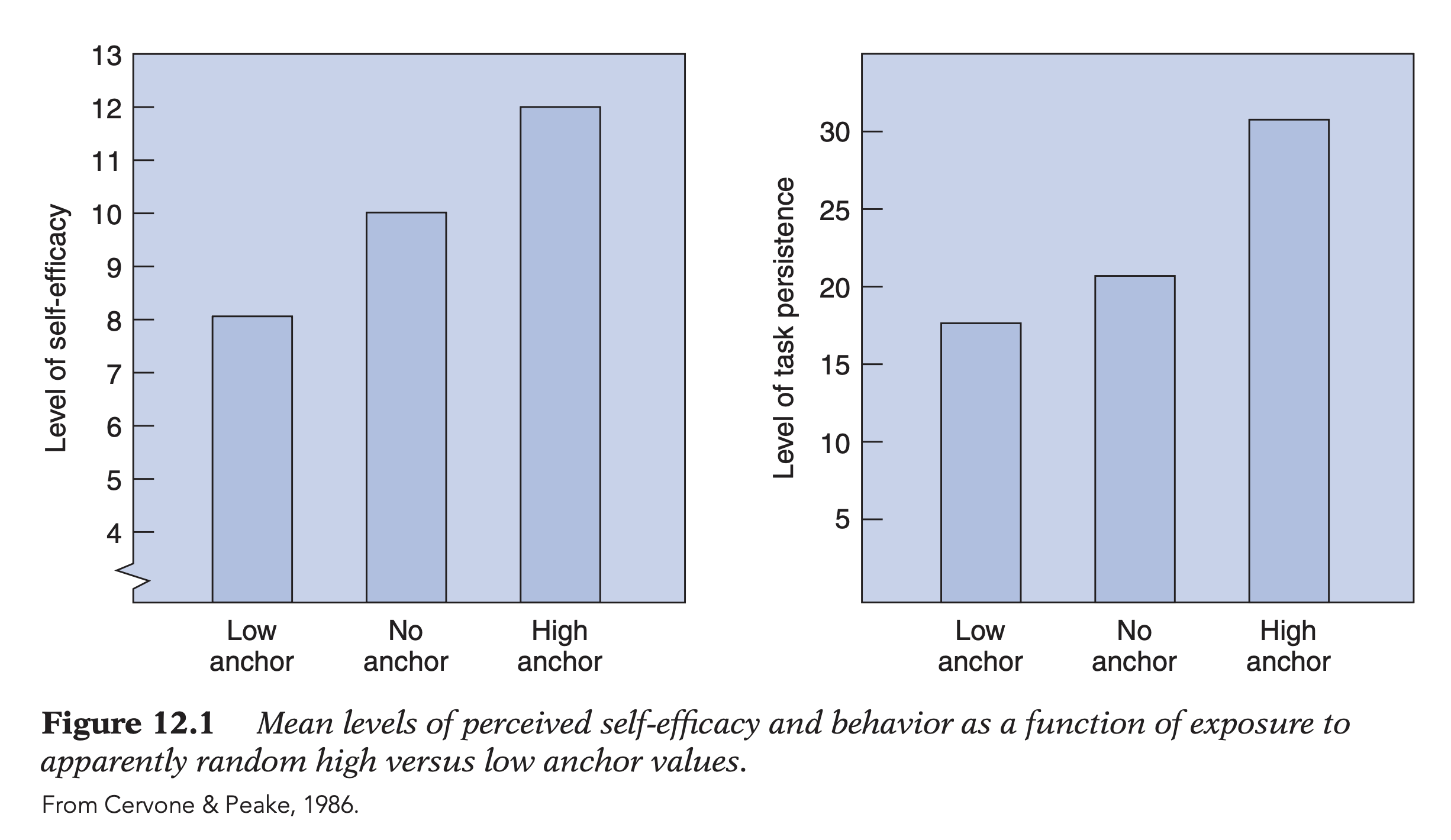
Describe the social-cognitive personality process.
Definition: personality process = dynamic interaction of established cognitive structures (competencies; expectancies; goals; evaluative standards) with behavior + environment; explained by (1) Reciprocal Determinism + (2) CAPS; foundation for G&D (observational learning; motivation; self-control).
Reciprocal Determinism (Bandura): behavior = reciprocal interaction among (1) personality (person); (2) behavior; (3) environment (≠ single cause); each component simultaneously influences + is influenced by the others.
Mechanism: environment → cognitively interpreted through beliefs; emotions; competencies (persona structure) → behavior → modifies environment → feedback → changes mood; self-beliefs; competencies (persona structure); future behavior; cause ↔ effect continuously reverse.
Implications: rejects (A) internal determinism (traits; motives; unconscious conflicts) and (B) environmental determinism (reinforcement);
Person = responsive + agentic; actively selects; constructs; modifies environments; situation selection (! i.e. choosing what will influence them) = key expression of agency; personality development = continuous reciprocal Person ↔ Behavior ↔ Environment interaction.
Cognitive-Affective Processing System (CAPS; Mischel & Shoda): personality = integrated network of cognitive + affective processes (≠ isolated variables/traits); competencies; expectancies; goals; standards; emotions continuously interact (e.g. neurons → brain).
2.1 Integrated Cognitive-Affective System: activation spreads throughout network; goal activation → competencies → self-efficacy → emotional reactions (confidence/anxiety); personality functions as organized cognitive-emotional system.
2.2 Situation-Specific Activation: situations selectively activate different cognitive-affective subsystems; different contexts → different beliefs; goals; emotions; competencies activated (e.g. dating vs academia); stable system ≠ identical behavior across situations; stability resides in organization, not behavioral uniformity.
2.3 Behavioral Signatures: behavioral variability = stable personality characteristic; personality expressed as if…then patterns (if situation X → behavior Y); average behavior alone obscures meaningful personality structure.
Evidence: summer-camp observations (~167 h/child); behaviors recorded across multiple psychological situations (peers; adults; praise; teasing; punishment); if…then profiles predicted behavior; children with identical average aggression displayed different behavioral signatures (e.g., aggression after punishment vs teasing); averaging erased psychologically meaningful patterns.
Everyday Cognition: people naturally expect cross-situational variability; explain behavior through underlying motives rather than inconsistency; personality = stable if…then contingencies (≠ fixed average behavior); e.g. someone anxious in academic but not in romantic contexts.
Self-Regulatory Cycle: goals + standards → expectancies + self-efficacy guide action → behavior → external feedback + self-evaluation → adjust goals; self-efficacy; effort → success → ↑ self-efficacy + more challenging goals; failure → ↓ effort or ↑ persistence (depends on goal value + efficacy beliefs) → continuous cognition–behavior–feedback–adaptation cycle.
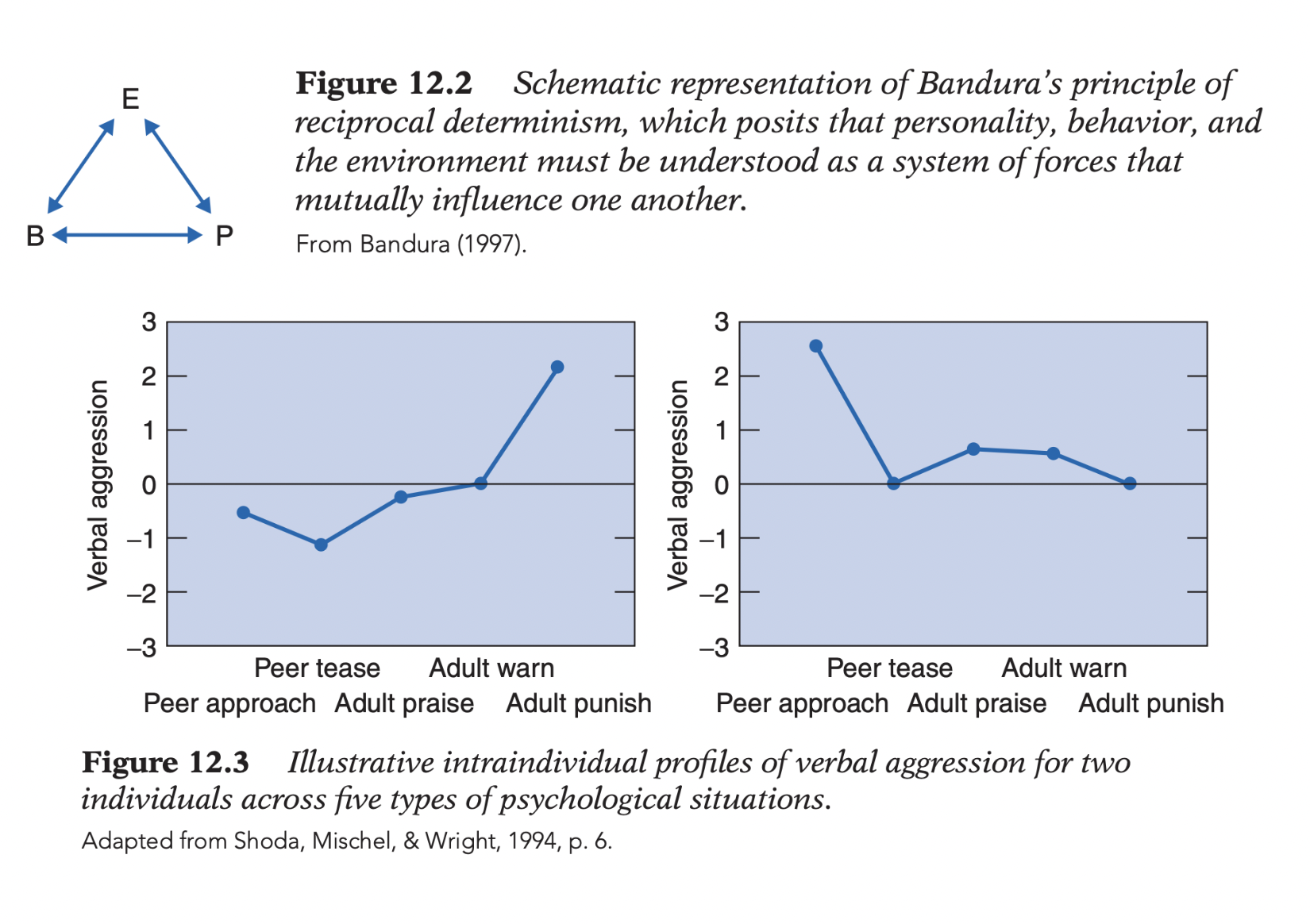
Describe the social-cognitive growth and development of personality.
Developmental View: development = continuous acquisition of competencies; expectancies; goals; evaluative standards; self-efficacy; self-regulatory abilities (≠ fixed stages; ≠ innate traits); core mechanisms = observational learning; vicarious conditioning; self-regulation.
Observational Learning (Modeling): acquisition through observing models (≠ trial-and-error shaping / successive approximations, e.g. while driving impossible); observe → mentally represent → later reproduce; no direct reinforcement required;
Learns general behavioral rules (≠ simple imitation); ≠ psychodynamic identification (information acquisition ≠ personality internalization); models need not be present (media);
Childhood media violence (ages 6–10) → ↑ adult aggression (controls incl. SES); see more below
(1.1) Acquisition vs. Performance: acquisition = learning behavior; performance = expressing behavior;
Bobo Doll: all children acquired aggression; model punishment ↓ spontaneous performance / in no incentive condition (no punishment + reward n.s. different!); BUT positives incentives ( = reinforcement) eliminated differences → reinforcement influences performance (≠ acquisition).
(1.2) Vicarious Conditioning: observation also acquires emotional responses; fear learned by observing fearful models (animals; humans; media; not necessarily present!); responses generalize; remain stable; BUT this learning non-deterministic (multiple models; increasing model choice with age).
Violent Media Research: 35 studies (exp. & corl.); >4,000 participants → violent video games associated with ↑ aggression; ↑ aggressive thoughts; ↓ prosocial behavior (r ≈ .20; one contributing factor); experiments → hostile attribution/expectation bias (ambiguous situations interpreted as hostile → ↑ aggression).
Self-Regulation & Motivation: motivation primarily self-regulated (≠ externally reinforced); future-oriented self-referent thinking; goal setting; planning; monitoring; resisting distraction; behavioral adjustment.
Integration of Personality Structures: goals → direction; evaluative standards → progress evaluation; expectancies/self-efficacy → persistence; competencies → effective action; development = increasingly sophisticated self-regulatory capacity.
Motivation Research (Bandura & Cervone): [2goals x 2feedback; 4 total conditions] → goals alone ≠ sufficient; feedback alone ≠ sufficient; strongest motivation = clear goals + accurate feedback + [2self-satisfaction x 2self-efficacy; 4 total] → greatest effort = low satisfaction + high self-efficacy (belief improvement possible); low satisfaction + low self-efficacy → low effort; neither sufficient alone!.
Intrinsic Motivation: challenging but attainable goals + high self-efficacy + consistent positive feedback; self-efficacy often outweighs objective rewards (= outcome exp.) // possible to strengthen by subgoals; progress monitoring; efficacy-enhancing feedback → positive self-evaluation sustains effort without external rewards (!).
Self-Control & Delay of Gratification:
Bandura & Mischel (1965): delay of gratification socially learned via modeling; (swap of high- & low-delay children into opposite conditions →) high-delay children exposed to immediate-reward models → ↓ willingness to delay (strongest with live models); low-delay children exposed to delay models → ↑ willingness to delay (largest effect with live models; symbolic weaker/n.s.); effects remained stable weeks later.
Observed rewards/punishment (environment) influence performance (whether learned behavior is expressed), not acquisition (“Monkey sees reward or is not punished, monkey does”).
Mischel’s Delay Paradigm: immediate small reward vs delayed larger reward; delay depends on cognitive representation≠ (!) (≠ objective reward); hide rewards (vs. directly displaying them) → ↑ waiting + cool strategies (clouds; photographs; distraction) ↓ hot emotional activation → ↑ self-control; mental processing > external environment.
Longitudinal Outcomes: preschool delay ability → ↑ emotional regulation; ↑ self-control; ↑ academic competence; ↑ SAT; ↓ overweight risk.
Neuroscience (same kids as original Mischel’s study!): self-control = frontal cortex/lobes (higher-order; planning; behavioral control; response selection, esp. 2) ↑ + striatum (lower-order; reward processing) ↓; delay reflects interaction of cognitive control × reward systems.
Integration: development via direct experience; observational learning; vicarious conditioning; self-regulation → gradual acquisition/refinement of competencies; expectancies; goals; standards; self-efficacy; agency; context-specific cognitive competencies (≠ universal stages).
![<p><strong>Developmental View:</strong> development = <strong>continuous acquisition</strong> of <strong>competencies; expectancies; goals; evaluative standards; self-efficacy; self-regulatory abilities</strong> (≠ fixed stages; ≠ innate traits); core mechanisms = <strong>observational learning; vicarious conditioning; self-regulation</strong>.</p><p class="p2"></p><ol><li><p class="p2"><strong>Observational Learning (Modeling):</strong> <strong>acquisition through observing models</strong> (≠ trial-and-error shaping / successive approximations, e.g. while driving impossible); <strong>observe → mentally represent → later reproduce</strong>; no direct reinforcement required;</p></li></ol><ul><li><p class="p2">Learns <strong>general behavioral rules</strong> (≠ simple imitation); ≠ psychodynamic <strong>identification</strong> (information acquisition ≠ personality internalization); models need not be present (media);</p><ul><li><p class="p2">Childhood media violence (ages <strong>6–10</strong>) → ↑ adult aggression (controls incl. SES); see more below</p></li></ul></li><li><p class="p1"><strong>(1.1) Acquisition vs. Performance:</strong> <strong>acquisition = learning behavior</strong>; <strong>performance = expressing behavior</strong>;</p><ul><li><p class="p1"><strong>Bobo Doll:</strong> all children acquired aggression; <strong>model punishment ↓ spontaneous performance / in no incentive condition</strong> (no punishment + reward n.s. different!); BUT positives incentives ( = reinforcement) eliminated differences → <strong>reinforcement influences performance (≠ acquisition)</strong>.</p></li></ul></li><li><p class="p2"><strong>(1.2) Vicarious Conditioning:</strong> observation also acquires <strong>emotional responses</strong>; fear learned by observing fearful models (animals; humans; media; not necessarily present!); responses generalize; remain stable; BUT this learning <strong>non-deterministic</strong> (multiple models; increasing model choice with age).</p><ul><li><p class="p2"><strong>Violent Media Research:</strong> <strong>35 studies</strong> (exp. & corl.)<strong>; >4,000 participants</strong> → violent video games associated with <strong>↑ aggression; ↑ aggressive thoughts; ↓ prosocial behavior</strong> (r ≈ <strong>.20</strong>; one contributing factor); experiments → <strong>hostile attribution/expectation bias</strong> (ambiguous situations interpreted as hostile → ↑ aggression).</p></li></ul></li></ul><p class="p1"></p><ol start="2"><li><p class="p1"><strong>Self-Regulation & Motivation:</strong> motivation primarily <strong>self-regulated</strong> (≠ externally reinforced); future-oriented <strong>self-referent thinking</strong>; <strong>goal setting; planning; monitoring; resisting distraction; behavioral adjustment</strong>.</p></li></ol><ul><li><p class="p1"><strong>Integration of Personality Structures:</strong> <strong>goals → direction</strong>; <strong>evaluative standards → progress evaluation</strong>; <strong>expectancies/self-efficacy → persistence</strong>; <strong>competencies → effective action</strong>; development = increasingly sophisticated <strong>self-regulatory capacity</strong>.</p><ul><li><p class="p1"><strong>Motivation Research (Bandura & Cervone):</strong> [2goals x 2feedback; 4 total conditions] → <strong>goals alone ≠ sufficient; feedback alone ≠ sufficient</strong>; strongest motivation = <strong>clear goals + accurate feedback</strong> + [2self-satisfaction x 2self-efficacy; 4 total] → greatest effort = <strong>low satisfaction + high self-efficacy</strong> (belief improvement possible); <strong>low satisfaction + low self-efficacy → low effort; </strong>neither sufficient alone!.</p></li><li><p class="p1"><strong>Intrinsic Motivation:</strong> <strong>challenging but attainable goals + high self-efficacy + consistent positive feedback</strong>; <strong>self-efficacy often outweighs objective rewards</strong> (= outcome exp.) // possible to strengthen by <strong>subgoals; progress monitoring; efficacy-enhancing feedback</strong> → positive self-evaluation sustains effort <strong>without external rewards (!)</strong>.</p></li></ul></li></ul><p class="p2"></p><ol start="3"><li><p class="p2"><strong>Self-Control & Delay of Gratification:</strong></p></li></ol><ul><li><p class="p2"><strong>Bandura & Mischel (1965):</strong> <strong>delay of gratification socially learned via modeling</strong>; (swap of high- & low-delay children into opposite conditions →) <strong>high-delay children</strong> exposed to <strong>immediate-reward models → ↓ willingness to delay</strong> (strongest with <strong>live</strong> models); <strong>low-delay children</strong> exposed to <strong>delay models → ↑ willingness to delay</strong> (largest effect with live models; symbolic weaker/n.s.); effects remained <strong>stable weeks later</strong>.</p></li><li><p class="p2"><strong>Observed rewards/punishment </strong>(environment) <strong>influence performance (whether learned behavior is expressed), not acquisition</strong> (“Monkey sees reward or is not punished, monkey does”).</p></li><li><p class="p2"><strong>Mischel’s Delay Paradigm:</strong> immediate small reward vs delayed larger reward; delay depends on <strong>cognitive representation≠ (!)</strong> (≠ objective reward); <strong>hide rewards</strong> (vs. directly displaying them)<strong> → ↑ waiting</strong> + <strong>cool strategies</strong> (clouds; photographs; distraction) ↓ hot emotional activation → ↑ self-control; mental processing > external environment.</p><ul><li><p class="p1"><strong>Longitudinal Outcomes:</strong> preschool delay ability → <strong>↑ emotional regulation; ↑ self-control; ↑ academic competence; ↑ SAT; ↓ overweight risk</strong>.</p></li><li><p class="p1"><strong>Neuroscience</strong> (same kids as original Mischel’s study!)<strong>:</strong> self-control = <strong>frontal cortex/lobes</strong> (higher-order; planning; behavioral control; response selection, esp. 2) <strong>↑</strong> + <strong>striatum </strong>(lower-order; reward processing) <strong>↓</strong>; delay reflects interaction of <strong>cognitive control × reward systems</strong>.</p></li></ul></li></ul><p class="p1"></p><p class="p1"><strong>Integration:</strong> development via <strong>direct experience; observational learning; vicarious conditioning; self-regulation</strong> → gradual acquisition/refinement of <strong>competencies; expectancies; goals; standards; self-efficacy; agency</strong>; <strong>context-specific cognitive competencies</strong> (≠ universal stages).</p>](https://assets.knowt.com/user-attachments/f8c35ebd-3227-4acb-ae59-594b0ffc2fa1.png)
Tree (PKP Ch. 12) 1/2
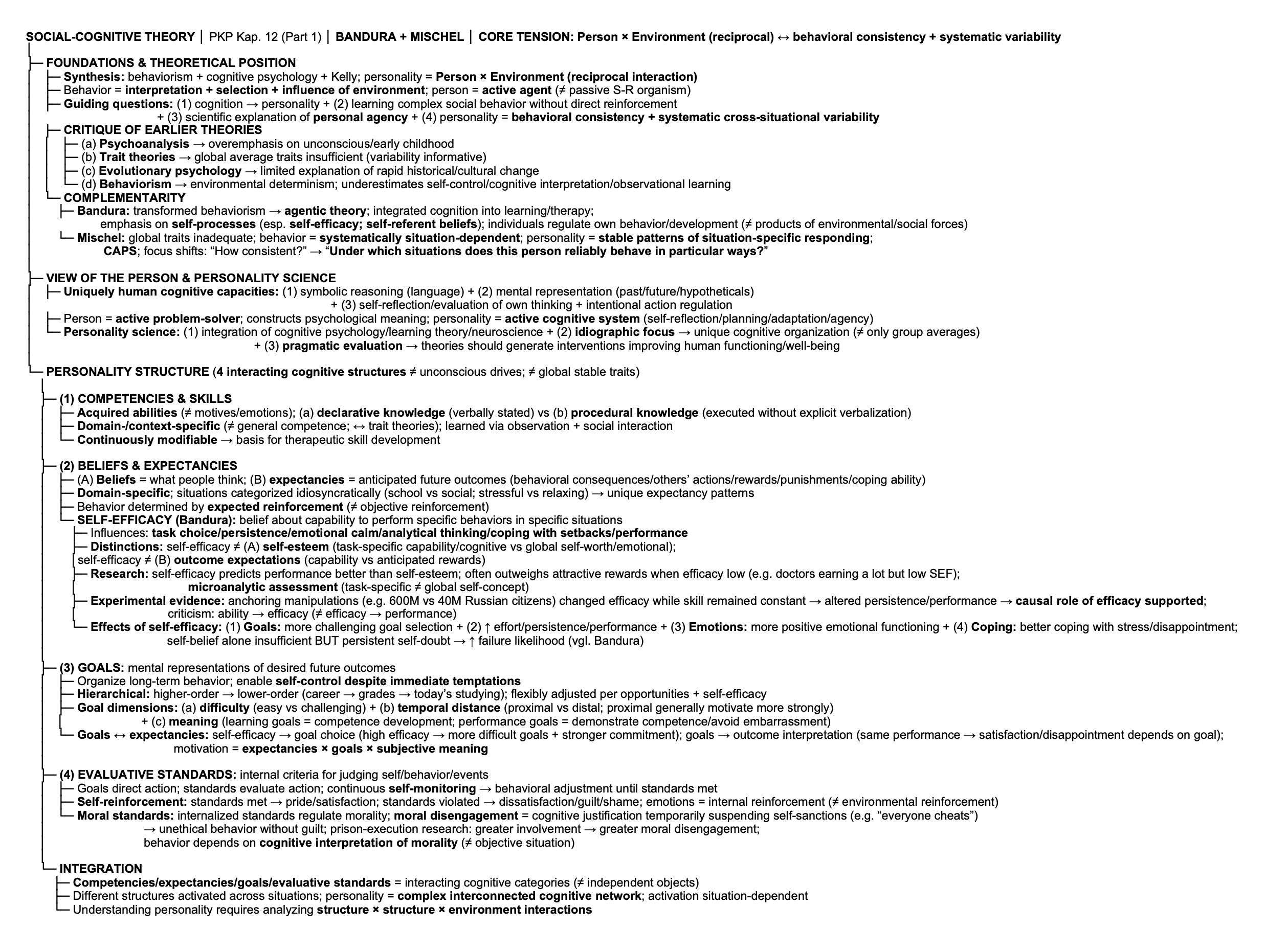
Tree (PKP Ch. 12) 2/2
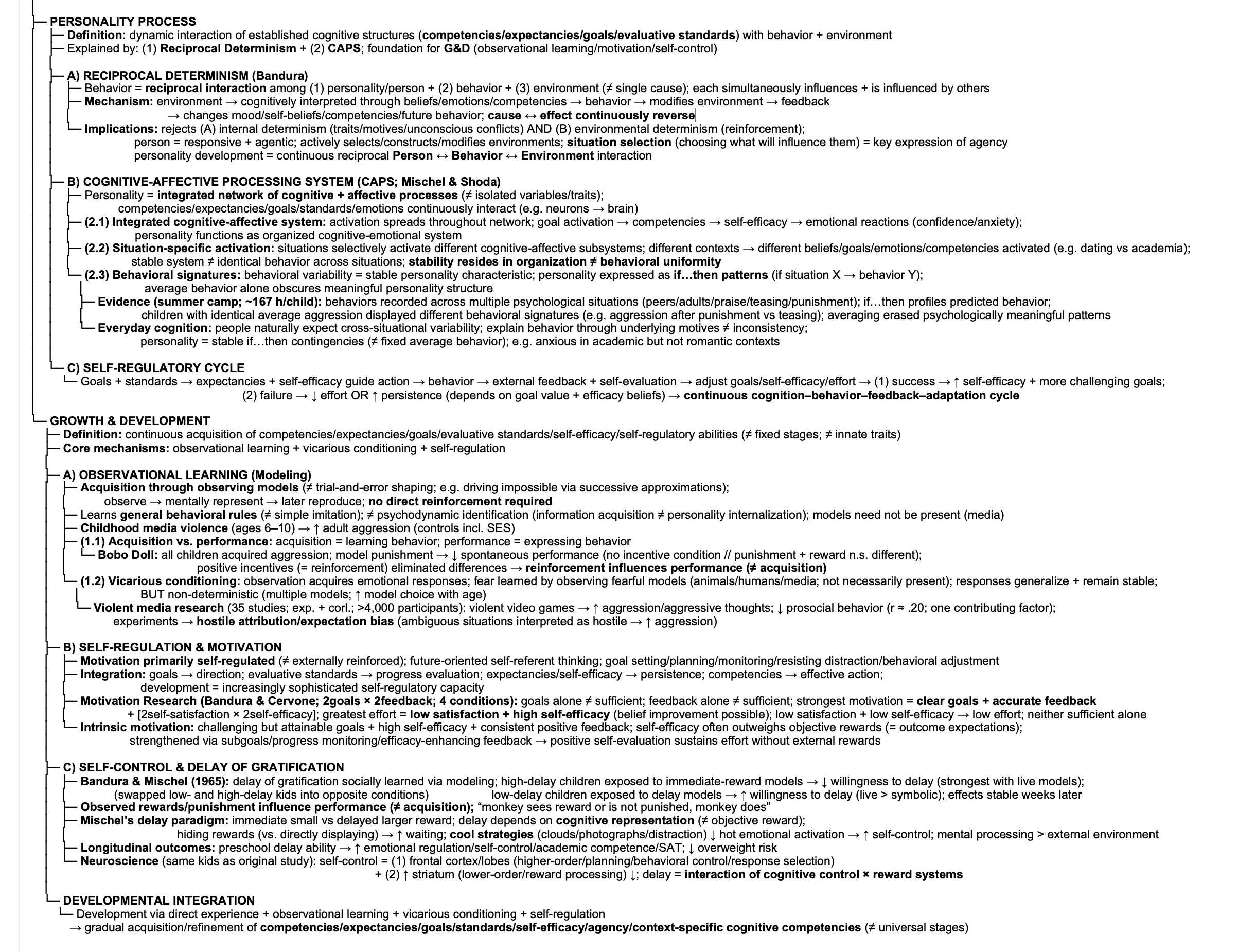
Describe the contextual perspective on personality and its consistency.
Contextual perspective: personality = person ↔ context (reciprocal interaction); inseparable from interpersonal/social/cultural/developmental contexts; extends social-cognitive approaches through broader contemporary research; complements (≠ replaces) traditional theories (analogous to Ch. 9 biological foundations); humans studied as meaning-makers (interpret/construct situations), not merely biological organisms; person + context dynamically co-construct each other (≠ independent causes).
Context: no fixed psychological meaning; meaning actively constructed through interpretation; personality both shapes contexts and is shaped by them; contexts consist largely of other people + socially constructed meanings.
Consistency: cross-situational consistency explained (≠ broad traits alone) by subjective meaning; objectively different situations become psychologically equivalent when they activate the same self-schemas/goals/beliefs (e.g., competitive person construes party, exam, sport, politics as competition) → similar appraisals/behavior across contexts.
KAPA (Knowledge-and-Appraisal Personality Architecture): (1) Knowledge (stable; self-schemas, goals, beliefs, world knowledge) + (2) Appraisals (dynamic evaluations of situation meaning + coping ability); stable knowledge → shapes appraisals → consistent self-efficacy/behavior across subjectively similar (≠ objectively similar) situations.
Evidence: participants identified self-schemas → linked situations to schemas → rated self-efficacy; (a) positive self-schemas → consistently higher self-efficacy; (b) negative self-schemas → consistently lower self-efficacy; (c) effects absent for nonschematic traits → stable self-knowledge organizes diverse situations into coherent psychological categories.
→ Person–situation relation: rejects person vs. situation dichotomy; situations possess no fixed meaning independent of the individual; personality helps construct what situations psychologically are → person and context dynamically interdependent, continuously shaping one another → explains behavior and consistency more accurately than separate person/situation effects.
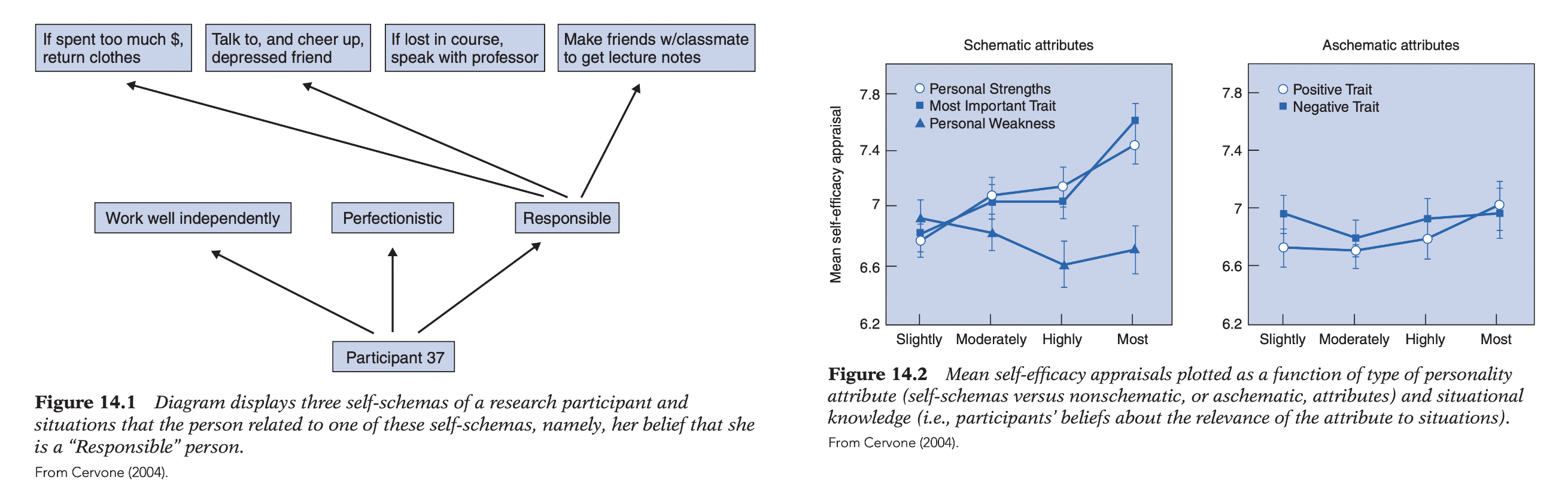
Describe personality in the context of interpersonal relationships.
Interpersonal relationships: closest social context; reciprocal system; personality influences both (a) behavior toward partner + (b) interpretation of partner’s behavior; subjective perceptions (≠ objective behavior alone) strongly determine relationship quality.
Rejection sensitivity (RS): contextualized personality variable; anxious expectation + anxiety about rejection in interpersonal relationships; expectations → biased hostile-intent attributions + maladaptive behavior → self-fulfilling prophecy → ↓ relationship satisfaction; ↑ breakup risk (both partners). RSQ: measures (1) expectation of rejection + (2) anxiety about rejection.
Evidence: longitudinal; RS measured before (≠ reaction to ongoing relationship) relationship onset → predicted later hostile-intent attributions; prediction after controlling Neuroticism, Introversion, self-esteem, attachment styles, interpersonal sensitivity (but n.s. without controls!) → contextualized personality variables predict relationship outcomes better than broad decontextualized traits.
Cognitive strategies (Hot vs. Cool focus; Mischel): attentional focus regulates emotional reactions → emotional responses depend on attentional focus (≠ situation itself):
(1) Hot focus (emotions/bodily sensations) → ↑ anger; ↑ hostile cognitions;
(2) Cool focus (neutral contextual features; e.g., physical surroundings) → ↓ anger; ↓ hostile narratives (text-writing) despite identical rejection memory
Transference (Andersen; social-cognitive reinterpretation of Freud): encountering person resembling significant past other → activates stored knowledge about past relationship → transferred to new person → biases memory, expectations, emotions, attraction, interpersonal behavior;
Measured via false-positive memories (remembering traits belonging only to past significant other); greater false positives → greater transference;
Behavior explained by context-specific cognitive links (present ↔ meaningful past), not global traits.
Oxytocin: initially viewed as increasing trust; BUT
Later research: effects context-dependent; ↑ trust mainly with familiar/trustworthy/ingroup partners; effects vary with social cues (e.g., facial expressions, competitive outcomes); improves emotion recognition primarily in low-social-competence individuals by enhancing attention to social cues (≠ directly increasing trust) → biological processes interact with personality + context.
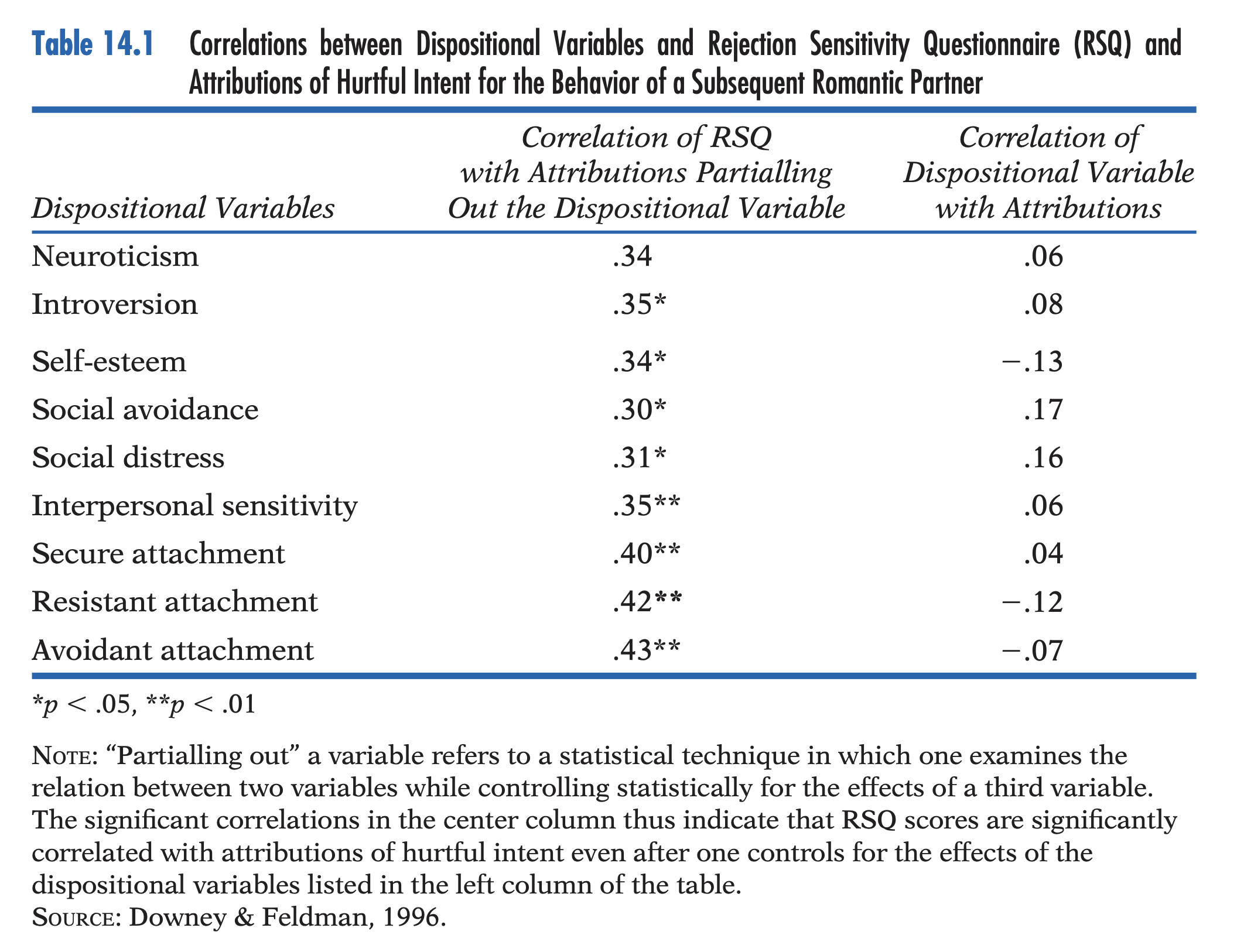
Describe personality in the context of academia and SES.
→ Academic performance and socioeconomic development arise from dynamic interactions between personality and context; identical traits can produce different outcomes depending on coping strategy, domain, and socioeconomic environment.
(A) Academic context: personality expressed through context-specific coping strategies (≠ global traits);
Strategic optimism = realistic positive expectations consistent with abilities;
Defensive pessimism = deliberate negative expectations despite adequate competence → pessimism functions as motivational strategy (preparation), not inability.
Evidence (HS → university transition; high uncertainty): optimists + defensive pessimists → similar GPA (equal outcomes; different mechanisms);
Optimists: (a) positive expectations + (b) small actual–ideal self-discrepancies → ↑ achievement;
Defensive pessimists: (a) expectations ≠ GPA predictor; (b) larger self-discrepancies → ↑ achievement because negative thinking → greater preparation.
(!) Context specificity: optimism/pessimism domain-specific (≠ stable personality disposition); academic defensive pessimists often optimistic when making friends; group differences disappeared in friendship context → personality organized around meaningful contexts, not uniform cross-domain traits.
(B) SES context: effects of personality depend on socioeconomic environment (≠ universal trait effects); personality × environment interaction determines developmental outcomes.
Impulsivity × neighborhood:
Disadvantaged neighborhoods (↑ delinquency opportunities; ↓ protective resources) → high impulsivity → ↑ delinquency;
Affluent neighborhoods (↑ family/school/community support) → little/no delinquency difference between high vs. low impulsivity because environment buffers impulsivity.
Personality ↔ SES causality (Dunedin longitudinal study): direction depends on personality characteristic (≠ single causal pathway);
Anxiety: low SES childhood + limited education → ↑ later anxiety; anxiety ≠ substantial effect on later SES;
Antisocial behavior: antisocial tendencies → academic failure → ↓ later SES.
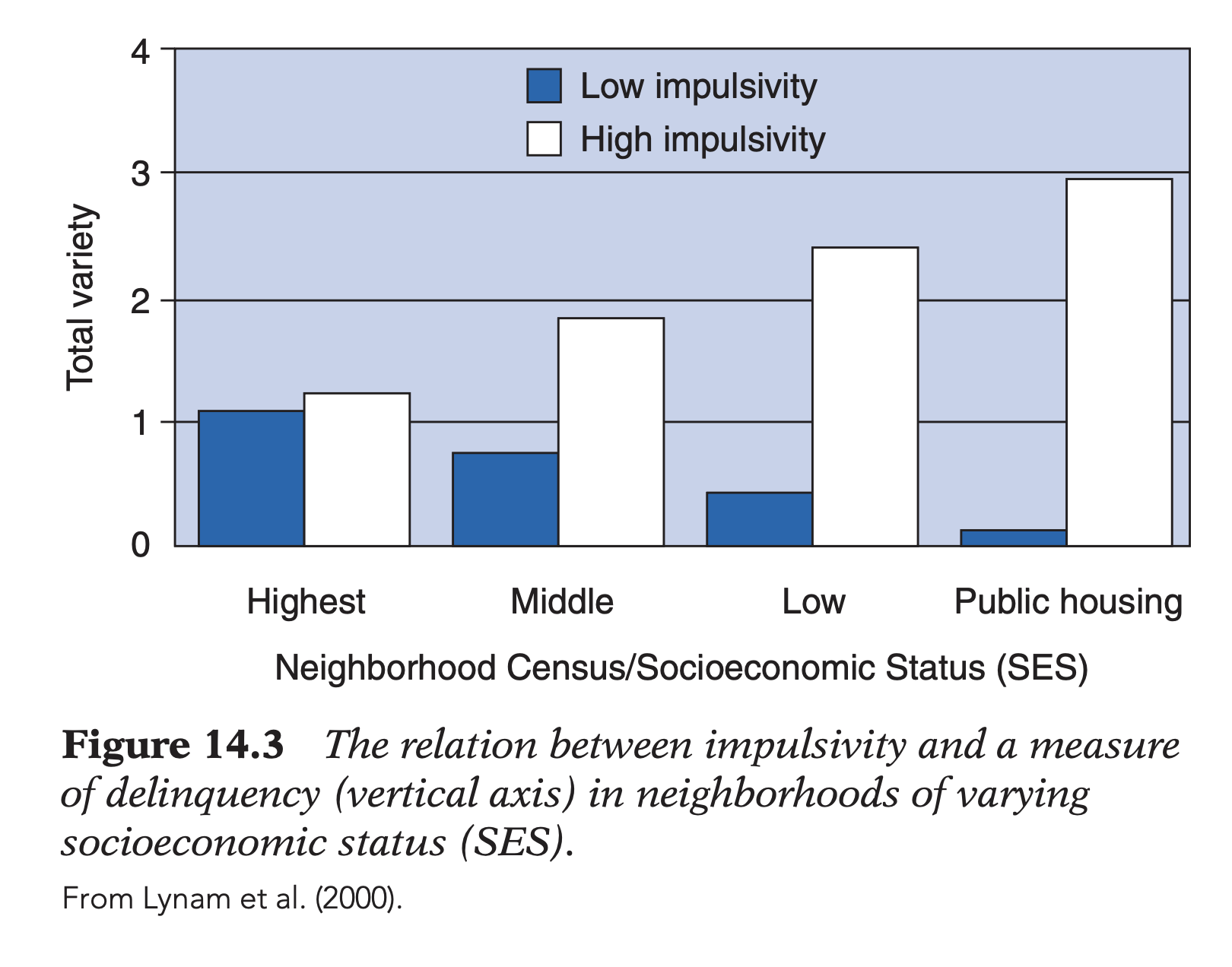
Describe the context of lifespan and culture on personality.
(A) Lifespan as context: age alters personality functioning via changing developmental contexts (≠ inevitable decline); older adults maintain self-esteem, perceived control, psychological well-being despite retirement, physical decline, loss → psychological resilience.
Baltes (Selection–Optimization–Compensation):
(1) development = trade-offs (losses + gains; e.g., ↓ cognitive speed, ↑ knowledge/wisdom); selective investment in fewer meaningful domains; optimize remaining resources; compensate for declines using knowledge/social resources;
(2) Berlin study: ↑ goal selection + optimization + family/social support → ↑ well-being; ↑ positive emotions (even controlling other personality variables).
Carstensen (Socioemotional Selectivity Theory): motivation determined by perceived future time horizon (≠ chronological age);
(1) Young: future-oriented goals (knowledge acquisition, career, identity, new relationships);
(2) Older: emotionally meaningful present-oriented goals; investment in close family/long-term friends; ↓ motivation for new information/social networks.
→ Evidence: older adults prioritize emotional quality of relationships over future opportunities; same pattern in younger HIV-positive men with shortened life expectancy → perceived remaining lifetime drives motivational change.
(B) Culture as context: culture fundamentally shapes personality via shared meaning systems, interpretation, and self-construal (≠ merely testing Western theories elsewhere).
(1) Strategy 1 – Personality and Culture: develop Western theory → test cross-cultural generalizability; useful for replication (e.g., Rogers; Big Five);
2 Limitations: (a) may miss culture-specific constructs (e.g., karma); (b) treats culture as secondary addition to personality theory.
(2) Strategy 2 – Culture and Personality (Cultural Psychology): culture central to personality; personality ↔ culture continuously construct each other; no culture-free personality or person-free culture; psychological functioning inherently cultural.
Bali example: personhood defined by family role, social status, community (≠ unique individual); personal names relatively unimportant (“military secrets”); kinship/status labels dominate; individuality downplayed → enduring social order emphasized.
Markus & Kitayama:
(1) Independent self (Western): autonomous individual; internal traits, personal goals, rights, personal happiness; behavior explained by internal traits.
(2) Interdependent self (East Asian): defined by family/social roles, obligations, relationships; behavior explained by social position/obligations (≠ internal traits).
Evidence:
East Asians → ↓ self-esteem maintenance; ↑ self-criticism for self-improvement; authority/trusted-other choices > personal choice for intrinsic motivation; ↓ dispositional attribution bias; subjective well-being less dependent on pleasant emotional experiences than in Western cultures.
Cultural flexibility: prolonged immersion (Chinese students in Canadian universities) → ↑ extraversion;
Bicultural individuals: cultural frame (!) switching; Chinese vs. American cultural primes → situational vs. dispositional explanations of behavior → culture shapes both what people think and how they think.
What are the practical applications of the contextual perspective of personality?
Application 1 – Clinical assessment/therapy: contextualized assessment (≠ global trait assessment); identifies 3 things (see below) → assessment directly guides intervention.
(1) personally important situations/contexts,
(2) personality structures (self-schemas, goals),
(3) mapping of personality structures onto specific contexts
Case (S.L.): severe depression + moderate anxiety; standard measures identified distress (≠ why/how it occurred); contextual assessment revealed 9 recurring contexts (positive + negative), self-schemas (Self-as-Ruined; Self-as-Inferior; Self-as-Competent-Worker), life goals (family, relationships, financial security).
Mapping: problematic contexts consistently activated Self-as-Ruined + Self-as-Inferior; work activated Self-as-Competent-Worker → therapy used positive schemas/resources from successful contexts to challenge negative schemas in threatening situations (e.g., grocery-store job) → ↑ self-efficacy; identifies vulnerabilities and strengths for treatment.
Application 2 – Social change/public health: personality principles applied at societal level; Bandura’s observational learning + self-efficacy embedded within culturally relevant contexts.
Tanzania HIV intervention (Twende na Wakati): educational radio soap opera;
Negative models → consequences of risky behavior (HIV);
Positive models → correct information + preventive behavior;
(!) Transitional models → gradual change from unsafe to safe behavior → strongest self-efficacy because listeners identify with struggles and observe successful change.
→ Evidence: natural experiment (broadcast vs. non-broadcast regions); ↑ HIV discussions; ↓ misconceptions; ↑ perceived personal risk; ↓ number of sexual partners; ↑ condom use; effects replicated after nationwide broadcasting.
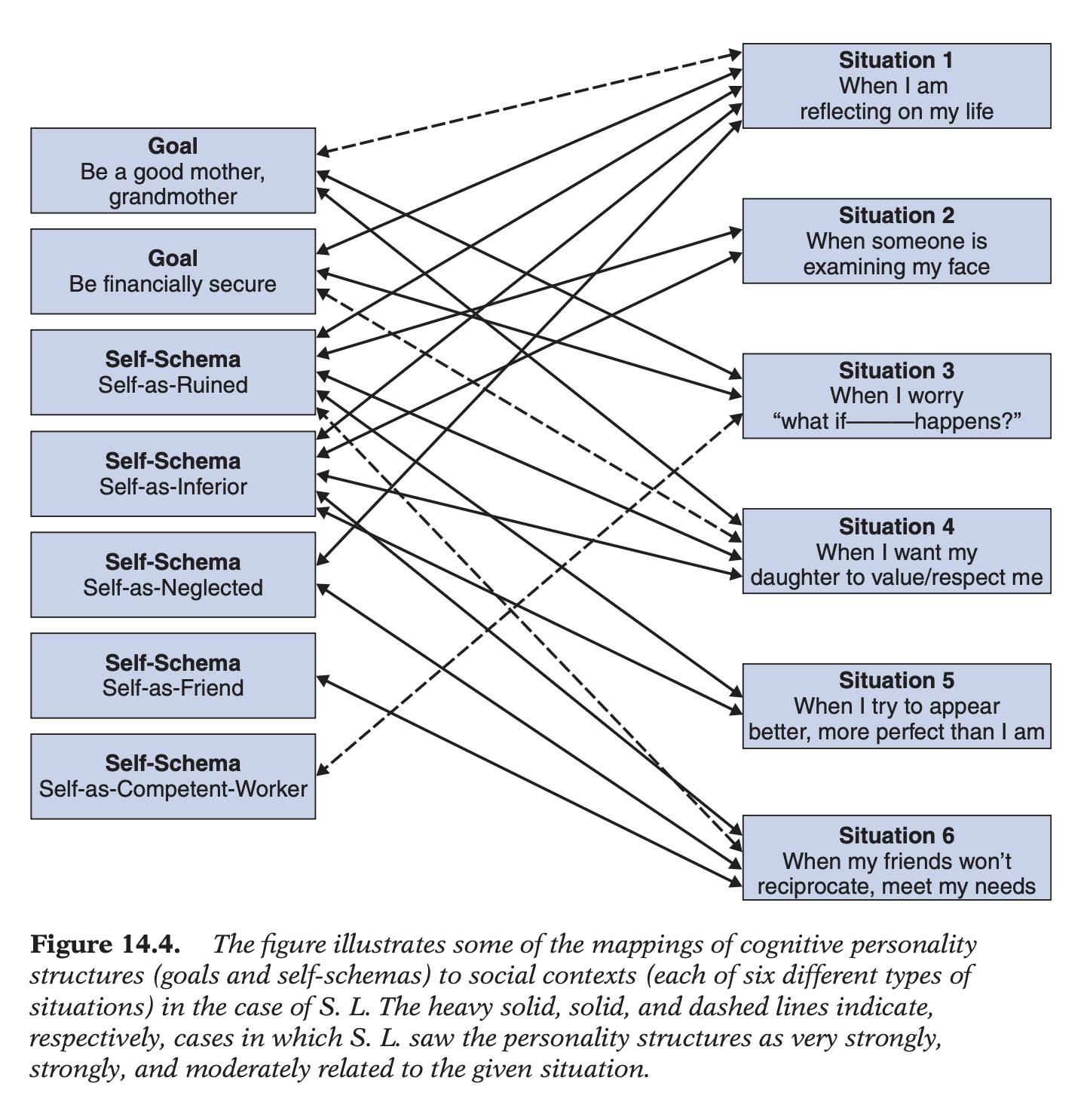
Tree (PKP Ch. 14) 1/2
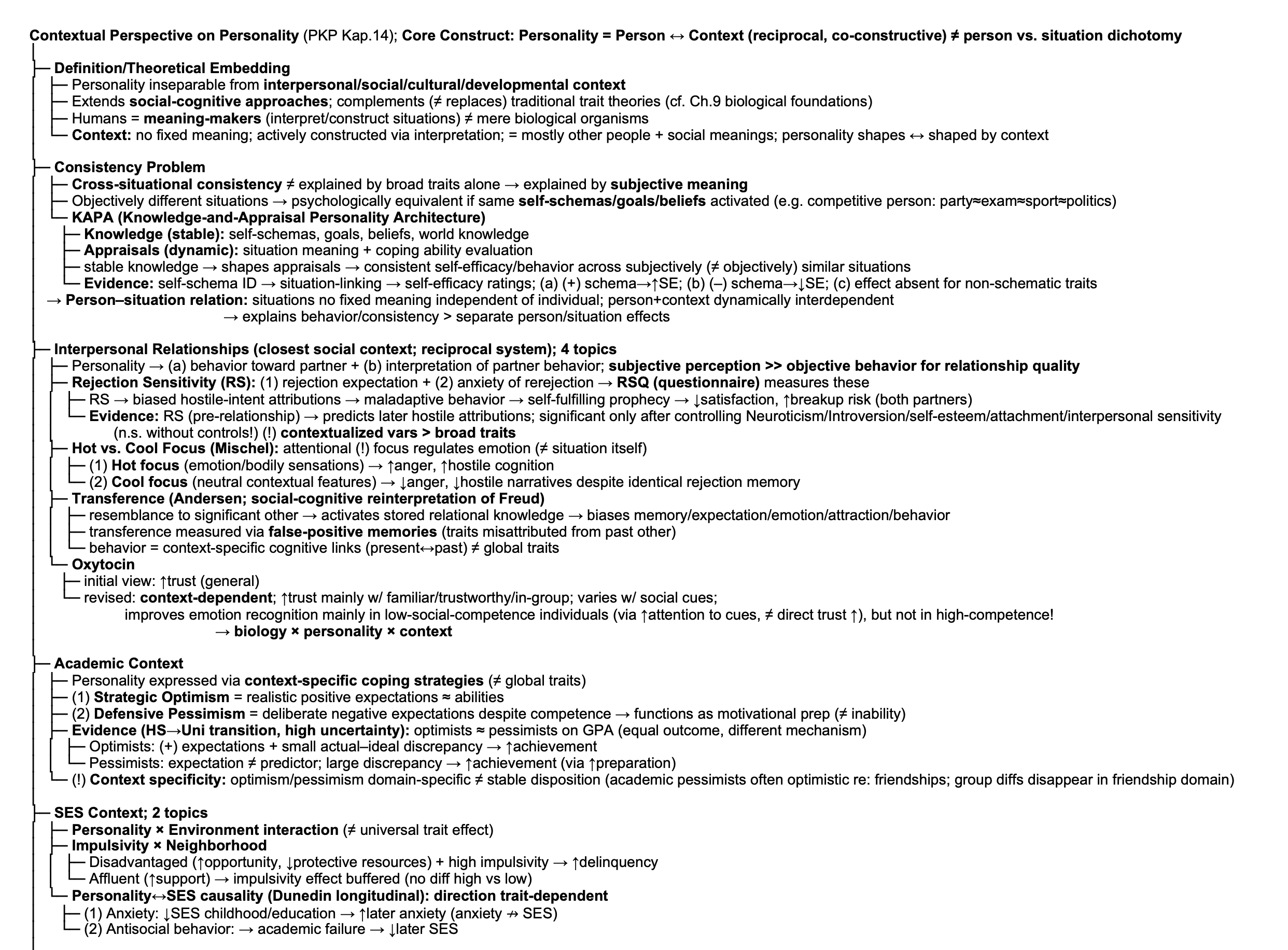
Tree (PKP Ch. 14) 2/2