Voltage gated Calcium Channels (hillie chapter 4)
 Studied by 0 people
 Call Kai
 Learn
Learn Practice Test
 Spaced Repetition
 Match
Match Flashcards
 Knowt Play
1/32

Earn XP
Description and Tags
Objectives: dynamics, ion channel properties, types of calcium channels, and activation and inactivation dependence.
Name | Mastery | Learn | Test | Matching | Spaced |
|---|
No study sessions yet.
33 Terms
what are the categories of Calcium channels?
They are Low Voltage Activated Channels (LVA) and High Voltage Activated Channels (HVA)
What are the Channels that are HVA?
There are 4 channels that are HVA
Cav 1.1-1.4 = L type
Cav 2.1 = P/Q type
Cav 2.2 = N type
Cav 2.3 = R type
What is the main function of L-type Channels and how are they blocked?
They are blocked by dihydropyridines, (nifedipine, nicardipine, nitrendipine), verapamil, diltiazem, calcicludine (green mamba toxin), calciseptine (black mamba toxin)
function: In muscle contraction, cardiac rhythm, hormone, secretion. ** used to maintain/regulate blood pressure
What is the function for P/Q types and how are they blocked?
they are blocked by w-Agatoxin IVA, TK (funnel web spider toxins)
function: cerebellar function and aid in synaptic transmission
What is the function of N-type channels and how are they blocked?
They are blocked by w-Conotoxin GVIA, MVIIA, SVIB (cone snail toxin)
function: aid in neurotransmitter release at the synapses
What is the function of R-type Channels and how are they blocked?
They are blocked by PLTX-II (spider toxin) and SNX-482 (tarantula toxin)
functions: are a little less known but they do contribute to dendritic signaling of calcium
What are the channels in Low Voltage Activated Channels?
They are T-Type Channels Cav 3.1-3.3
How are T-type channels blocked and how do they function?
These channels are blocked by Ni2+, ethosumaxide (Zarontin), kurtoxin (scorpion toxin)
function:
They initiate low threshold activity = endocrine cycles, cardiac pacing, and sleep-wake cycle
modulates excitability = influencing firing patterns in neurons and sensory cells
enables calcium dependent signaling = intracellular cascade for gene expression and secretion
What are the 9 properties of calcium channels?
voltage gated
found in every excitable cell
voltage dependent gates
delayed opening with depolarization
rapid close after repolarization
show inactivation during maintained depolarization
moderate ion selectivity
can be blocked by agents inside and outside the cell
translate electrical signals into chemical signals
Local increase in calcium results in:
hint: there are 6 outcomes!
contraction (actin and myosin)
secretion (release NT, enzymes)
gating (opening and closing)
cell migration
ciliary motion
calcium dependent release (release of NT)
What are the classifications of VG Ca2+ channels?
T = tiny transient current (LVA) — 3.1-3.3 channels*; get inactivated quickly
L = Large and long current (HVA) — remain open
N = neuronal (HVA)
R = resistant (HVA)
P/Q = splice variants of R
What are L-type currents?
they are large and long HVA channels and they keep the VG channels open for a long time.
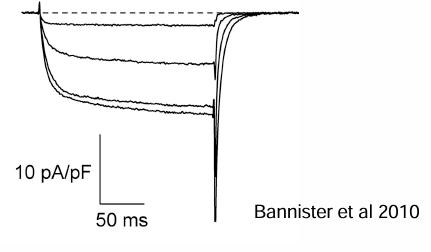
What kind of current is this image showing? How did you know?
L-Type; there is a long and large period of activation with a short period of inactivation
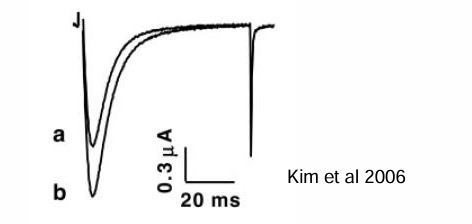
What kind of channel is this image showing? How did you know?
T-Type; there is a short period of activation and a rapid/sharp inactivation
What is the reversal potential (E Ca) for Ca2+ current and why is there little outward current?
The reversal potential of calcium is approx. +125 mV; There is minimal to no outward current because there is low driving force as a result of low intracellular [Ca2+]i .
what are the two mechanisms of calcium channel inactivation?
calcium dependent: intracellular Ca2+ binds calmodulin, promoting inactivation (blocked by EGTA
voltage dependent: higher depolarization —> increased Ca2+ influx —> increased inactivation
How do the subfamilies of VG Ca2+ channels differ in sensitivity?
Cav1 and 2 are HVA, meaning they require large changes in voltage ( > -30 mV) and they show slow and incomplete inactivation
Cav3 are LVA’s, meaning they require small changes in voltage ( > -70mV) and they show fast and complete inactivation
What experimental finding by Fatt and Katz demonstrated that action potentials can occur without Na⁺ influx?
Replacing extracellular Na⁺ with choline did not eliminate action potentials in crustacean neurons — showing APs can be driven by Ca²⁺ influx.
Name two divalent ions that can be permeate calcium channels and one that blocks them.
ca2+, sr2+, Ba2+ permeate; Mn2+ blocks excitibility
what is the main physiological role of voltage-gated calcium channels in excitable membranes?
convert electrical signals (APs) into chemical signals by allowing calcium entry that triggers process such as contraction or NT release.
Which subunit forms the Ca2+ channel pore, and which accessory subunit is the target of gabapentin?
α₁ subunit = ion-conducting pore; α₂δ subunit = target of gabapentin / pregabalin.
What are the Ca2+ subunits?
α1 subunit = ion conducting pore
α2δ, β, and γ subunits = accessory subunits, ion channel properties, targeting to membrane
How many domains are there and how many transmembrane subunits are there in each? which make the pore loop and the voltage sensor?
The voltage sensor = S4
Pore loop = S5 and S6
4 domains with 6 transmembrane subunits in each
Why do Ca2+ dependent AP last longer than Na+ dependent ones?
Ca2+ open more slowly and keep the membrane depolarized for longer, extending the AP duration (important in cardiac and neuronal plateau phases)
![<p>Neurotransmitter release is extremely sensitive to calcium levels. Roughly how does transmitter release scale with [Ca<sup>2+</sup>]</p>](https://knowt-user-attachments.s3.amazonaws.com/5d2c18e7-4475-4c1f-847b-7b2febd12b30.png)
Neurotransmitter release is extremely sensitive to calcium levels. Roughly how does transmitter release scale with [Ca2+]
the slope of the line is 3.9, meaning that the transmitter release is proportional to [Ca2+]3.9 and small changes in calcium can cause large effects
What causes most of the “synaptic delay” between an AP and neurotransmitter release?
the time required for calcium channels to open after the AP peak and some delay due to movement of NT across the synapse
What does BAY K 8644 do to L-type channels?
Acts as an agonist, increasing open probability and prolonging openings —> larger sustained currents
Why are vascular smooth-muscle Ca2+ channels especially sensitive to dihydropyridines?
They are frequently depolarized, keeping the channels in the inactivated state, which binds dihydropyridines more tightly.
they bind better at inactivated state of L-type; inactivation occurs with longer and larger depolarization, thus more susceptible to blocking
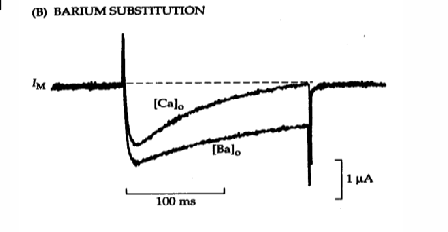
Why does Ba2+ produce less activation than Ca2+?
Ba2+ does not bind to calmodulin, so Ca2+ dependent inactivation is reduced
Calcium dependent Cl- and K+ currents are:
they are affected by the internal concentration of calcium, and it shows that calcium modulates ion channels as well aside from aiding in NT release.
How does the change in [Ca2+] affect membrane voltage?
calcium current increases with an increase in membrane potential (~10 mV), eventually decreasing because of a drop in driving force
thus, the internal concentration of calcium after channels opening is dependent on the external concentration of calcium
What was used to measure the changes of calcium in the hippocampus?
Fura-2 was used to measure calcium, causing fluorescence when Fura-2 binds to calcium
What is the overall process of chemical neurotransmission ?
AP arrive at pre-synaptic terminal —> depolarization opening ca2+ channels —> influx ca2+ —> ca2+ binding to snare proteins allowing fusion to pore —> NT release into synapse
if blockers present, calcium influx is inhibited, decreasing release of NT or its blocked completely