BIO WEEK 7: Metazoans (Rise of Animals 1)
 Call Kai
 Learn
Learn Practice Test
 Spaced Repetition
 Match
Match Flashcards
 Knowt Play
1/35

There's no tags or description
Looks like no tags are added yet.
Name | Mastery | Learn | Test | Matching | Spaced | Call with Kai |
|---|
No analytics yet
Send a link to your students to track their progress
36 Terms
What Defines an Animal?
multicellular organoheterotrophs (get energy by eating organic matter, don’t photosynthesize)
no cell walls to allow flexibility, movement, and tissue formation
neurons + muscle cells which are specialized cells for movements and response (exception for sponges that lack true nerves & muscles)
Additional Animal Traits
Diploid-dominant life cycle:
most of life is in 2n (diploid) form
Sexual reproduction (often asexual too)
Extracellular matrix (ECM)
proteins outside cells
important for cell adhesion + communication
critical for multicellularity
Motile (moving) at some life stage
Origins of Animals: animals are?
monophyletic: all descended from one common ancestor
likely ancestor: Choanoflagellate
Homology
the similarity in characteristics, such as anatomical structures, genes, or developmental processes, between different organisms due to their inheritance from a common ancestor
Evidence of Homology in Animals
Sponges have choanocytes
Choanocytes look almost identical to choanoflagellates
Both use suspension feeding (filter feeding)
First Animals Debate 1: Porifera (Sponges) - Most Supported
Appear in fossil record >800 mya
Share traits with choanoflagellates
No true tissues
No nerves or muscles
Adults = sessile (immobile)
Larvae = motile (cilia, help organism move)
Important:
have epithelium-like layers
several interdependent cell types
suspension feeders
some have mutualistic cyanobacteria
(ancient, photosynthetic bacteria that generate oxygen)
**sponges have low oxygen needs —> could survive in early Earth conditions
First Animals Debate 2: Ctenophora (Comb Jellies) - Alternative Hypothesis
some say they evolved first because:
they lack certain microRNAs found in sponges
RNA: single-stranded nucleic acid that is messenger between DNA & protein
BUT
traits can be lost
most molecular evidence supports sponges first
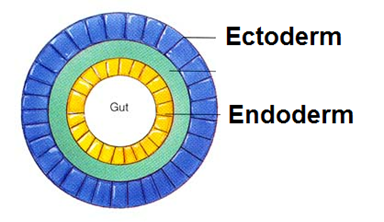
Evolution of True Tissues: Diploblasty
**two germ layers
Ectoderm
skin
nervous tissues
Endoderm
digestive tract lining
organs like liver
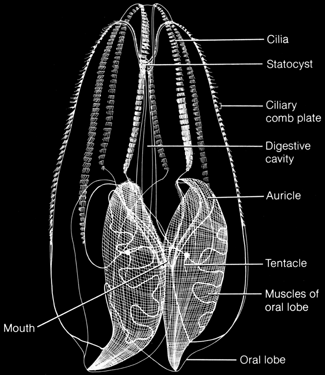
Phylum Ctenophora (comb jellies)
diploblastic
rows of comb-like cilia for movement
predators
stinky tentacles (not toxic)
some bioluminescent (emitting light living organism)
they actively hunt, thus more complex than sponges
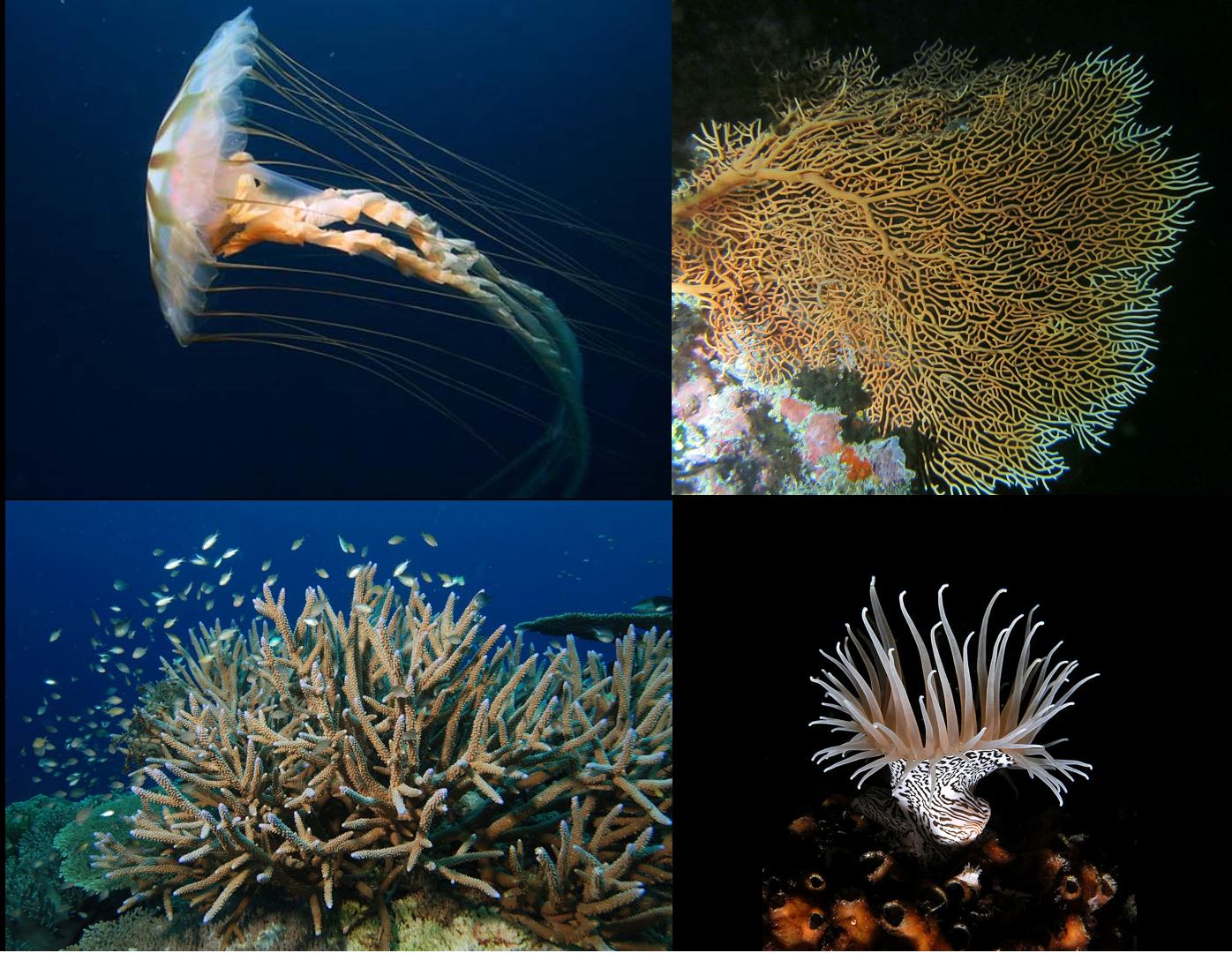
Phylum Cnidaria (Jellyfish, Corals, Anemones)
diploblastic
radial symmetry
true nerve net (no brain)
muscle-like tissue
Nervous System:
diffuse nerve net —> allows coordinated contracting for swimming + prey capture
Two Body Forms:
polyp (sessile, immobile)
medusa (free-swimming, jet propulsion)
Unique Feature: Cnidocytes
specialized singing cells
contains toxic
used for prey capture + defense
Coral & Symbiosis (living together of unlike species)
**most corals rely on dinoflagellates (photosynthetic protists)
Because of this
most live in shallow water (need sunlight)
Coral Bleaching; caused by:
warm water —> expulsion of dinoflagellates
pollution
over exploitation
destructive fishing
**without symbionts —> coral turns white & may due
96% of reefs threatened
Cambrian Explosion (541 mya)
geologically rapid appearance of most animal phyla in fossil record
BUT:
molecular data shows many phyla evolved earlier
So why no fossils before?
early animals were:
small
soft-bodied
not easily fossilized
During this time period:
suddenly —> larger, complex, skeletonized animals appear
What caused Cambrian Explosion?
increase in oxygen
due to cyanobacteria + algae
more oxygen = supports larger bodies + metabolism
new ecological niches
as animals got bigger
new interactions formed
mew lifestyles evolved (paraistes, predators)
Coevolutionary Arms Races
**Early animals didn’t hunt
then:
predators evolved
prey involved defenses
rapid evolutionary escalation
two major consequences:
increased body size
increased skeletalization
Hox genes & Body Plans
Homeotic genes = determine body layout
Hox Genes
specify structures along anterior-posterior axis (head-to-tail)
control where limbs, segments form
Small Genetic changes —> huge body plan differences
Sponges
no true Hox genes
gene duplication + divergence —> increased complexity
Deep Homology
when convergent traits evolve using homologous developmental genes
ex) tetrapod limbs & fish fins
correct logic: should have similar Hox genes with slightly modified activity
Homeotic Genes
master regulatory genes that determine the body plan of an embry
Homeosis
developmental phenomenon where one body part develops into the form of another body part due to changes in gene regulation.
Heterochrony
when something grows earlier, later, faster, or slower than it used to in evolution
Detritivore
An organism that feeds on dead organic matter, such as decaying plants and animals.
Examples: earthworms, millipedes.
They help recycle nutrients back into ecosystems.
Herbivore
An organism that eats plants only.
Example: deer, cows.
Carnivore
An organism that eats other animals.
Example: lions, hawks.
Omnivore
An organism that eats both plants and animals.
Example: humans, bears.
Parasite
An organism that lives in or on another organism (host) and benefits at the host’s expense.
Endoparasite
lives inside the host’s body (e.g., tapeworms).
Ectoparasite
lives on the outside of the host (e.g., ticks).
Suspension Feeder
An organism that filters small food particles from water.
Example: clams, baleen whales.
Deposit Feeder
An organism that consumes sediment and extracts organic material from it.
Example: earthworms, some marine worms.
Fluid Feeder
An organism that feeds by consuming liquid nutrients from plants or animals.
Example: mosquitoes, aphids.
Mass Feeder
An organism that eats large pieces of food (bulk feeding).
Example: lions, humans.
Parthenogenesis
A type of asexual reproduction where an embryo develops from an unfertilized egg.
Metamorphosis
A major change in body form during development from larva to adult.
Example: caterpillar → butterfly.
the whole process name
Larva (plural: larvae)
An immature form that looks very different from the adult and often has a different habitat or diet.
ex) caterpillar form when turning to butterfly
Viviparous
Offspring develop inside the parent and are born live.
Example: most mammals.
Oviparous
Organisms that lay eggs that develop outside the parent’s body.
Example: birds.
Ovoviviparous
Eggs develop inside the parent’s body, but offspring hatch internally and are born live.
The embryo is nourished by the egg yolk, not directly by the parent.
hatch eggs inside the mother's body, giving birth to live young without a placenta. This method combines egg-laying (oviparity) with live-bearing (viviparity)
***combination of both viviporous and oviparous
Example: some sharks and snakes.
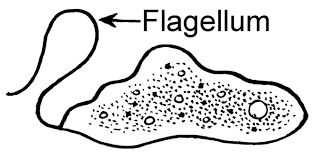
Opisthokont
major evolutionary group (clade) of eukaryotes characterized by having a single posterior flagellum at some stage in their life cycle.
“rear flagellum”

