Orthodontic Appliances
 Call Kai
 Learn
Learn Practice Test
 Spaced Repetition
 Match
Match Flashcards
 Knowt Play
1/56

There's no tags or description
Looks like no tags are added yet.
Name | Mastery | Learn | Test | Matching | Spaced | Call with Kai | Chat |
|---|
No analytics yet
Send a link to your students to track their progress
57 Terms
E-arch
what orthodontic appliance:
◦ Developed in 1900 by Edward Angle
◦ Angle's 1st appliance
◦ No brackets on teeth
◦ Bands on molars held a heavy steel base arch in place
◦ Steel ligature wires applied orthodontic pressure to teeth

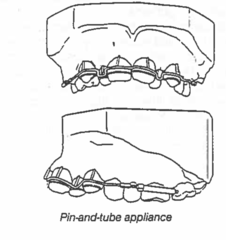
pin and tube
what orthodontic appliance:
◦ Developed in 1910 by Edward Angle
◦ Bands on all teeth
◦ Vertical slots
◦ Gold archwire has vertical pins soldered for each tooth which are inserted in the vertical slot tubes
◦ Tooth movement was directed by changing the placement of the pins
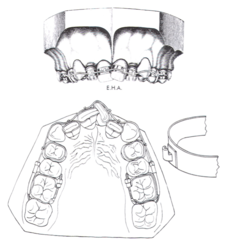
ribbon arch
what orthodontic appliance:
◦ Developed in 1910 by Edward Angle
◦ Bands on all teeth
◦ Vertical slot hook that holds horizontal wire
◦ Wire is made of a gold platinum alloy
◦ No more soldered pins
edgewise
what orthodontic appliance:
◦ Developed in 1925 by Edward Angle
◦ True horizontal rectangular slot
◦ Allows for control over the tooth in all planes of space
◦ All modern brackets stem from this design
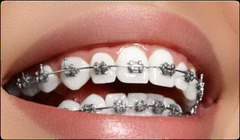
edgewise
all modern brackets stem from the design of the .... appliance
twin brackets
what orthodontic appliance:
◦ The modern version of the edgewise appliance
◦ An archwire is placed into the slot
◦ A ligature is wrapped around the wings to engage the archwire in the slot
◦ Archwire places pressure on this slot
◦ This pressure is transferred to the tooth, causing movement
Features:
◦ Wing
◦ x2, hence "twin"
◦ Slot
◦ Pad
◦ Hook (optional)

smaller
.... wires are less stiff, and therefore apply less force to the tooth
larger
.... wires are used later in treatment
NiTi
what type of orthodontic wire:
◦ are superelastic
◦They have a shape memory, so they can be easily deformed, but spring back to their original shape
◦Very difficult for the operator to change the shape
◦ Used for initial alignment of teeth
stainless steel
what type of orthodontic wire:
◦ Much more rigid than NiTi wires
◦ Bends and loops can be placed in the wire to make adjustments to teeth
◦ The operator can change the shape as desired
◦ Used later in treatment
NiTi
.... wires are used for the initial alignment of teeth
stainless steel
..... wires are used later in treatment
tighter
steel ligatures hold the wire in place .... than o-rings
rotated teeth
an example of when a steel ligature may be used rather than an O-ring is ..... requiring a higher level of force
decrease
Self ligating brackets ..... friction and chair time
do NOT
self ligating brackets .... decrease overall treatment length, the quality of the final treatment, root resorption, or the pain associated with orthodontic treatment
Brackets
..... only have chemical retention
bands
...... Have both mechanical and chemical retention
power chain
a ..... is an Elastic chain that is ligated to each bracket like an o-ring and used to close space
open coil spring
a ...... is a Spring that is compressed between two brackets and Used to open space
no
do temporary anchorage devices osteointegrate
yes
can temporary anchorage devices be immediately loaded
palatal expansion
most significant transverse problems usually require .....
midpalatal suture
By applying lateral pressure to opposite sides of the maxilla, the two palatal shelves expand along the .....
6
Expander should remain in place for at least .... months post expansion to allow for fusion to occur
14
palatal expanders work best in children under the age of ~.....
0.2-0.25
Every turn of a paltal expansion screw generates ..... mm of expansion
haas
which type of palatal expander:
◦ Tooth and tissue borne
◦ Can split the midpalatal suture
◦ True boney expansion
◦ Less dental tipping due to tissue support
◦ Difficulty with oral hygiene under palatal acrylic
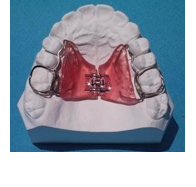
hyrax
which type of palatal expander:
◦ Tooth borne only
◦ Can split the midpalatal suture
◦ True boney expansion
◦ More dental tipping due to lack of tissue support
◦ Self-cleansing
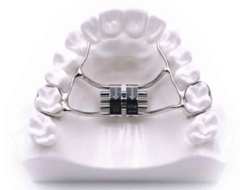
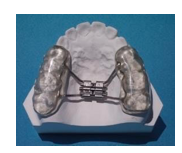
bonded
which type of palatal expander:
◦ Full acrylic coverage of posterior teeth
◦ Can split the midpalatal suture
◦ True boney expansion
◦ Less dental tipping due to full dental coverage
◦ Difficulty with oral hygiene
◦ Risk of extracting primary teeth on removal
◦ Good for open bite patients
schwartz
which type of palatal expander:
◦ Hawley retainer with an expansion screw
◦ Does not split the mid-palatal suture
◦ Dental expansion only
◦ 100% dental tipping due to lack of skeletal expansion
◦ Ease of oral hygiene

MARPE
which type of palatal expander:
◦ TAD supported expander
◦ Bone borne
◦ Can split the midpalatal suture
◦ True boney expansion
◦ No dental tipping due to skeletal support
◦ The preferred expander in adults

Schwartz
which palatal expander is the only that works soley by dental expansion
kloehn cervical headgear
what orthodontic appliance:
◦ Extraoral removable appliance
◦ Inserts into bands on the U6s
◦ Applies pressure to the maxilla restricting forward growth
◦ This allows the mandible to "catch up"
◦ Extrudes and distalizes U6s
◦ Good for deep bites
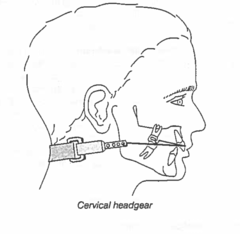
extrudes; distalizes
the kloehn cervical headgear ... and .... U6s and thus is good for deep bites
high pull headgear
what orthodontic appliance:
◦ Extraoral removable appliance
◦ Applies pressure to the maxilla restricting forward growth
◦ This allows the mandible to "catch up"
◦Intrudes and distalizes U6s
◦ Good for open bites

intrudes; distalizes
the high pull headgear ... and .... U6s and thus is good for open bites
functional
A ..... appliance is an appliance that postures the mandible forward
procline
All functional appliances ... lower incisors
no
do non-functional class II correctors procline lower incisors
pubertal growth spurt
the best time to treat class II is .....
herbst
what functional appliance:
◦ Rod and tube system
◦ The length of the rod forces the patient to bite forward in a more protrusive position
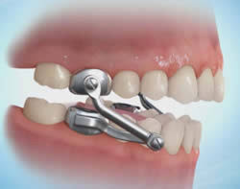
mandibular anterior repositioning appliance (MARA)
what functional appliance:
◦ Bite ramp system
◦ Bite block prevents patient from biting in Class II occlusion
◦ Bite ramp encourages patient to bite in a more protrusive position

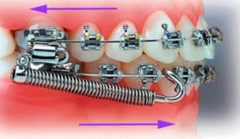
forsus
what functional appliance:
◦ Spring and rod system
◦ The compressed spring applies a mesial force on the lower teeth and a distal force on the upper teeth
◦ Functional appliance
◦ Stock item
◦ Requires brackets
class ii elsastics
what functional appliance:
◦ Intraoral removable rubber bands
◦ Stretched elastic applies a mesial force on the lower teeth and a distal force on the upper teeth
◦ Functional appliance
◦ Requires brackets
◦ Typically run from U3-L6
◦ The least expensive, most comfortable, and easiest to use Class II corrector
◦ And therefore the most popular
◦ Requires high level of patient compliance
U3-L6
class II elastics Typically run from ....
mixed dentition
The best time to treat a Class III is in the ....
growth cessation
the second best time to treat class 3 is after .....
facemask
what appliance for class III treatment:
◦ The facemask applies a protrusive force to the maxilla to encourage growth and correct a Class III malocclusion
◦ Combination intra and extraoral appliance

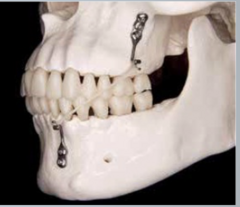
declerck plates
what appliance for class III treatment:
◦ Intraoral plates screwed into the bone with protruding hooks
◦ Plates and screws are inserted under general anesthesia
◦ Require raising a flap
◦ Class III elastics are worn from the hooks
◦ These bone anchored elastics apply a protraction force to the maxilla, encouraging forward growth of the maxilla
◦ Works better in adolescents than facemask alone
class III elastics
what appliance for class III treatment:
◦ Intraoral removable rubber bands
◦ Stretched elastic applies a mesial force on the upper teeth and a distal force on the lower teeth
◦ Class III elastics do not distalize lower teeth, but they do retrocline lower incisors
◦ Requires brackets
◦ Typically run from U6-L3
◦ Insufficient for moderate to severe Class IIIs
no
do class III elastics distalize lower teeth
retrocline
class III elastics ..... lower incisors
expansion; interproximal reduction; extraction
the 5 ways to relieve dental crowding include:
1. .....
2. proclination
3. .....
4. distilization
5. ....
Hawley
what type of retention appliance:
◦ Historically, the most commonly used retainer
◦ Labial bow wire and lingual acrylic help maintain alignment
◦ Can be made for the upper and lower arch
◦ Versatile
◦ Easy to adjust
◦ Very durable
◦ Unesthetic

essix
what type of retention appliance:
◦ Clear plastic retainer that fully covers all teeth to help maintain alignment
◦ Good for patients with esthetic concerns
◦ Can be made for the upper and lower arch
◦ Cannot be adjusted
◦ Hygiene concerns
◦ Patient cannot eat with essix in place
◦ Tend to break within 1 year
fixed lingual retainers
what type of retention appliance:
◦ A bonded retainer is permanently fixed in the patient's mouth to help prevent relapse even in the absence of patient compliance
◦ The bane of hygienists everywhere
◦ Excellent for holding alignment of anterior teeth
◦ Typically bonded to U2-2 and L3-3