Bone and Bone Marking Vocabulary
 View linked note
 Call Kai
 Learn
Learn Practice Test
 Spaced Repetition
 Match
Match Flashcards
 Knowt Play
1/94

There's no tags or description
Looks like no tags are added yet.
Name | Mastery | Learn | Test | Matching | Spaced | Call with Kai | Chat |
|---|
No analytics yet
Send a link to your students to track their progress
95 Terms
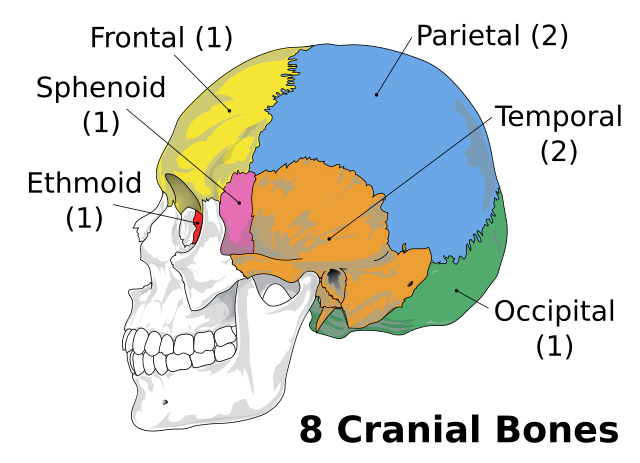
Cranial bones
The bones that make up the cranium of the skull.
Frontal bone
The bone that forms the forehead.
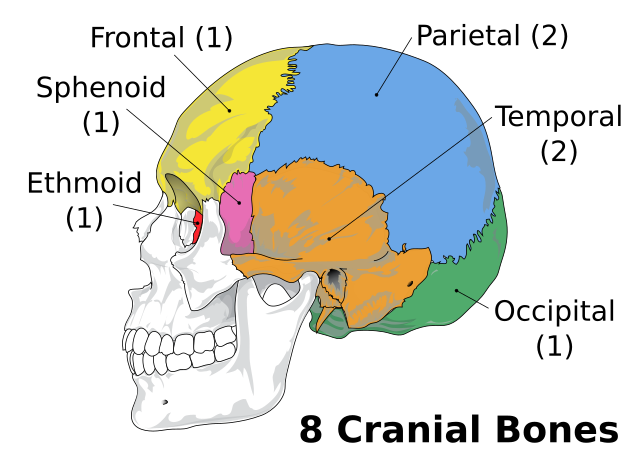
Parietal bone
The two bones that form the sides and roof of the skull.
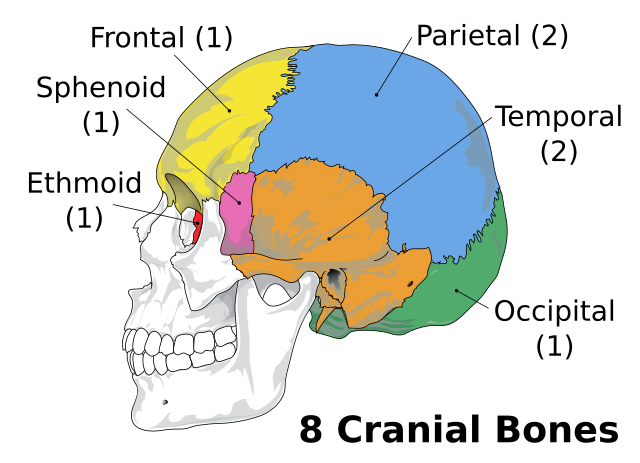
Occipital bone
The bone that forms the back and base of the skull.
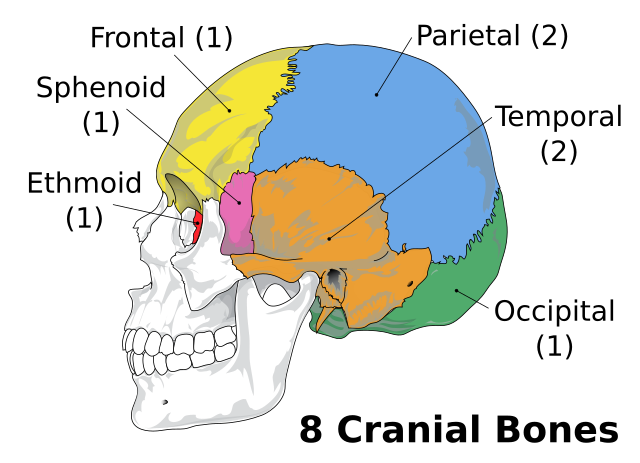
Temporal bone
The bone that forms the sides of the skull and contains the structures of the ears.
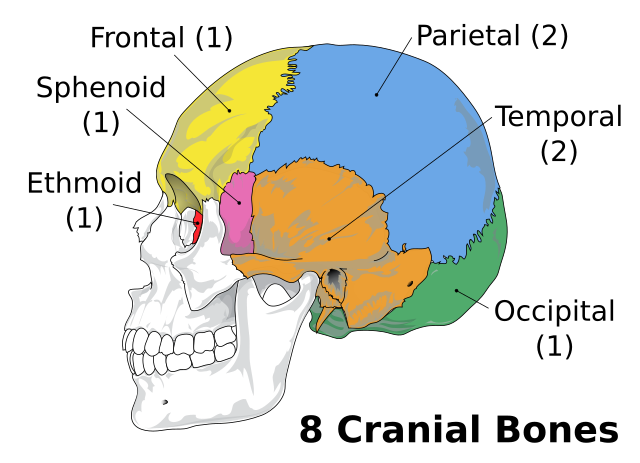
Ethmoid bone
A bone that contributes to the nasal cavity and orbits.
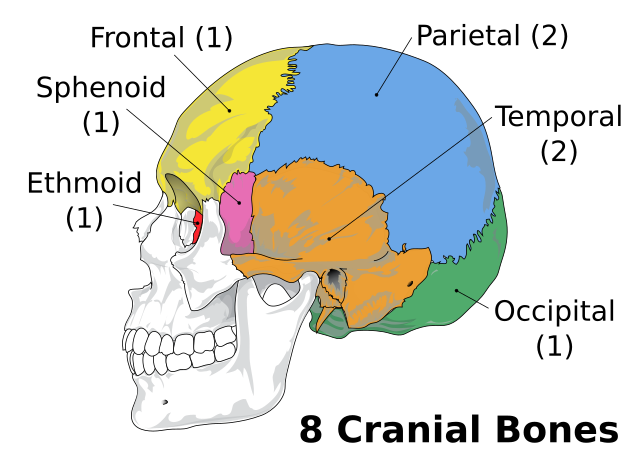
Sphenoid bone
A complex bone located at the base of the skull, articulating with all cranial bones.
Coronal suture
The suture that runs across the skull, separating the frontal bone from the parietal bones.
Sagittal suture
The suture that runs along the midline of the skull, separating the parietal bones.
Lambdoid suture
The suture that separates the occipital bone from the parietal bones.
Squamous suture
The suture that separates the temporal bone from the parietal bone.
Styloid process
A slender pointed piece of bone just below the ear.
Mastoid process
A bony prominence located behind the ear.
Occipital condyles
The rounded ends of the occipital bone that articulate with the atlas.
Foramen magnum
The large opening at the base of the skull where the spinal cord exits.
External acoustic meatus
The passage leading to the inner ear.
Zygomatic arch
The arch formed by the zygomatic bone and the temporal bone.
Mandibular fossa
The depression in the temporal bone where the mandible articulates.
Nasal bones
The two small bones that form the bridge of the nose.
Lacrimal bone
The small bones forming part of the eye socket.
Zygomatic bone
The bone that forms the cheekbone.
Vomer
The bone that forms part of the nasal septum.
Maxilla
The bone that forms the upper jaw.
Mandible
The lower jawbone.
Palatine bones
The bones that form the back part of the hard palate.
Lacrimal fossa
The groove for the lacrimal sac located in the lacrimal bone.
Mental foramen
An opening in the mandible for the mental nerve and vessels.
Condylar process
The projection at the end of the mandible that forms a joint with the skull.
Coronoid process
The anterior projection on the ramus of the mandible for muscle attachment.
Hyoid bone
A U-shaped bone in the neck that supports the tongue.
Atlas (C1)
The first cervical vertebra that supports the skull.
Axis (C2)
The second cervical vertebra that allows for head rotation.
Cervical vertebrae
The seven vertebrae in the neck region.
Thoracic vertebrae
The twelve vertebrae in the upper back region.
Lumbar vertebrae
The five vertebrae in the lower back region.
Sacrum
The triangular bone formed by the fusion of five sacral vertebrae.
Coccyx
The small bone at the base of the vertebral column, commonly called the tailbone.
Spinous process
The bony projection off the back of each vertebra.
Transverse process
The bony projections on the sides of each vertebra.
Superior articular process
The projections that connect vertebrae together at the top.
Inferior articular process
The projections that connect vertebrae together at the bottom.
Lamina
The flattened part of a vertebra that bridges the gap between the spinous and transverse processes.
Pedicle
The part of a vertebra that connects the body to the posterior elements.
Body of vertebrae
The thick, disc-shaped anterior portion of a vertebra.
Vertebral foramen
The opening in a vertebra that houses the spinal cord.
Rib
The curved bones that form the ribcage.
Sternum
The flat bone located in the middle of the chest.
Manubrium
The upper part of the sternum.
Body of sternum
The long central part of the sternum.
Xiphoid process
The small pointed portion at the inferior end of the sternum.
Clavicle
The collarbone that connects the arm to the body.
Scapula
The shoulder blade.
Glenoid cavity (fossa)
The cavity in the scapula that receives the head of the humerus.
Acromion process
The bony process on the scapula that forms the highest point of the shoulder.
Coracoid process
A small hook-like structure on the scapula.
Scapular spine
The ridge of bone on the posterior surface of the scapula.
Humerus
The bone of the upper arm.
Trochlea
The spool-shaped structure on the humerus that articulates with the ulna.
Medial epicondyle
The bony prominence on the inner side of the humerus.
Lateral epicondyle
The bony prominence on the outer side of the humerus.
Olecranon fossa
The space on the humerus that receives the olecranon of the ulna.
Coronoid fossa
The depression in the humerus that receives the coronoid process of the ulna.
Capitulum
The rounded surface on the humerus that articulates with the radius.
Radius
The lateral bone of the forearm.
Radial tuberosity
The bony prominence on the radius for muscle attachment.
Ulna
The medial bone of the forearm.
Olecranon process
The bony prominence of the ulna that forms the elbow.
Coronoid process (ulna)
The projection of the ulna that forms part of the elbow joint.
Trochlear notch
The curve of the olecranon that fits around the trochlea of the humerus.
Carpals
The eight small bones that make up the wrist.
Metacarpals
The five bones that form the middle part of the hand.
Phalanges (hand)
The bones of the fingers.
Ilium
The largest bone of the pelvis.
Iliac crest
The upper curved margin of the ilium.
Sciatic notch
The indentation on the posterior side of the ilium.
Pubis
The frontal bone of the pelvis.
Acetabulum
The socket in the pelvis for the hip joint.
Ischium
The lower and back part of the pelvis.
Obturator foramen
The large opening in the pelvis formed by the pubis and ischium.
Femur
The thigh bone, the longest bone in the body.
Greater trochanter
A large bony prominence on the femur, serving as a muscle attachment site.
Lesser trochanter
A smaller bony prominence on the femur, also for muscle attachment.
Medial condyle
The rounded end of the femur that articulates with the tibia on the inner side.
Lateral condyle
The rounded end of the femur that articulates with the tibia on the outer side.
Patella
The kneecap, a small bone that protects the knee joint.
Tibia
The larger, medial bone of the lower leg.
Tibial tuberosity
The bony prominence on the tibia below the kneecap.
Medial malleolus
The bony knob on the inner side of the ankle, at the end of the tibia.
Fibula
The smaller bone of the lower leg, located lateral to the tibia.
Lateral malleolus
The bony knob on the outer side of the ankle, at the end of the fibula.
Calcaneus
The heel bone, which forms the foundation of the rear part of the foot.
Talus
The ankle bone that articulates with the tibia and fibula.
Tarsals
The seven bones that make up the ankle.
Metatarsals
The five long bones in the foot between the tarsals and phalanges.
Phalanges (foot)
The bones of the toes.