Chemistry unit 3 vocab
 Call Kai
 Learn
Learn Practice Test
 Spaced Repetition
 Match
Match Flashcards
 Knowt Play
1/32

There's no tags or description
Looks like no tags are added yet.
Name | Mastery | Learn | Test | Matching | Spaced | Call with Kai | Chat |
|---|
No analytics yet
Send a link to your students to track their progress
33 Terms
Dmitri Mendeleev
a Russian chemist known for creating the Periodic Table of Elements, which organized elements based on their atomic mass and properties. He predicted the existence of undiscovered elements.

Moseley
was a British physicist who improved the Periodic Table by establishing atomic numbers as the organizing principle, replacing atomic mass. His work confirmed the arrangement of elements based on their positive charge.
Periodic Law
states that the properties of elements are a periodic function of their atomic numbers.
Period
a horizontal row in the Periodic Table where elements have the same number of electron shells.
Group
a vertical column in the Periodic Table where elements have similar chemical properties and the same number of valence electrons.
S Block
the group of elements in the periodic table that includes alkali metals and alkaline earth metals, characterized by having their outermost electrons in s orbitals.
P Block
the group of elements in the periodic table that includes nonmetals, metalloids, and some post-transition metals, characterized by having their outermost electrons in p orbitals.
D Block
the group of elements in the periodic table that includes transition metals, characterized by having their outermost electrons in d orbitals.
F Block
the group of elements in the periodic table that includes lanthanides and actinides, characterized by having their outermost electrons in f orbitals.
Alkalai Metals
the group of elements in the periodic table found in Group 1, known for their high reactivity and tendency to lose one electron.
Alkaline Earth Metals
a group of six chemical elements in group 2 of periodic table.
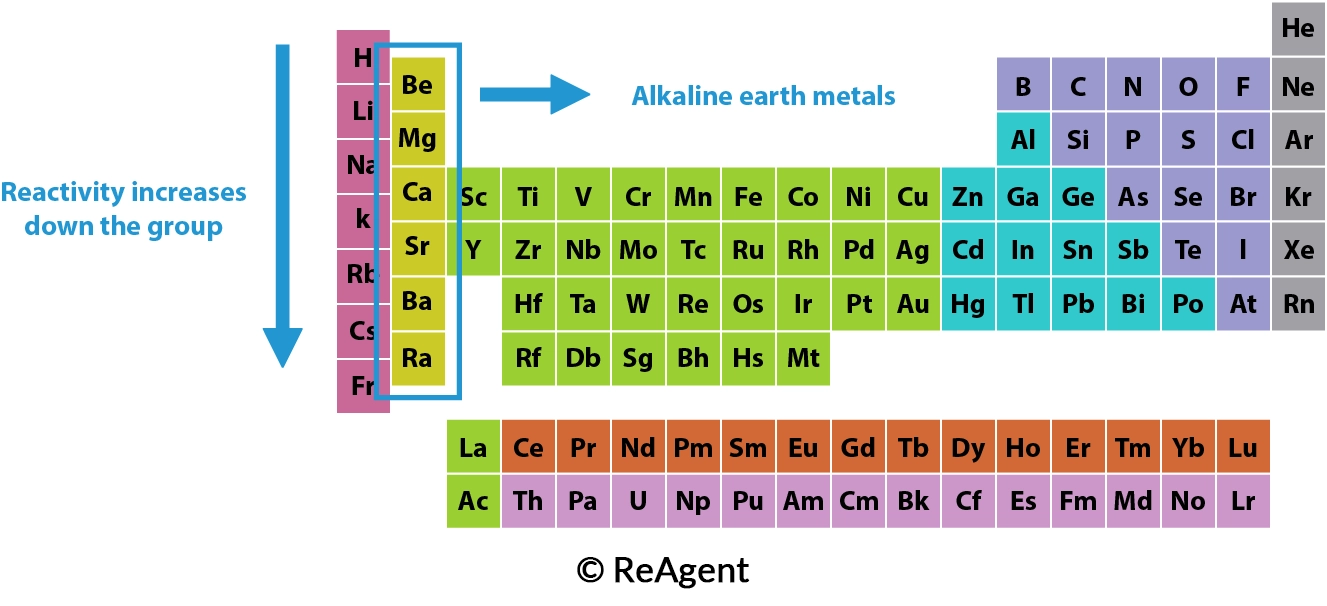
Transition Metals
a group of large metallic elements found in the d-block of the P.T, specifically spanning from groups 3-12.
Halogens
a group of 5/6 highly reactive nonmetallic elements located in group 17 of periodic table.
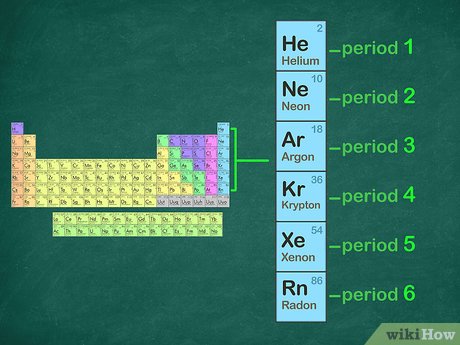
Noble Gases
a group of seven chemical elements located in group 18 on periodic table.
Metal
a class of chemical elements that make up 80% of P.T. Opposite of nonmetals.
Non-metals
a diverse group of chemical elements that occupy the upper right corner of P.T. Opposite of metals.
Metalliods
a unique class of elements that form diagonal border between nonmetals and metals. in between the staircase.
Electron Configuration
an arrangement of an atoms electrons within its energy levels, subshells and orbitals

Principal Energy Levels
the main electron shell or region around an atoms nucleus where electrons reside.
Sublevels
a smaller division of a main energy level in an atom where electrons are located.
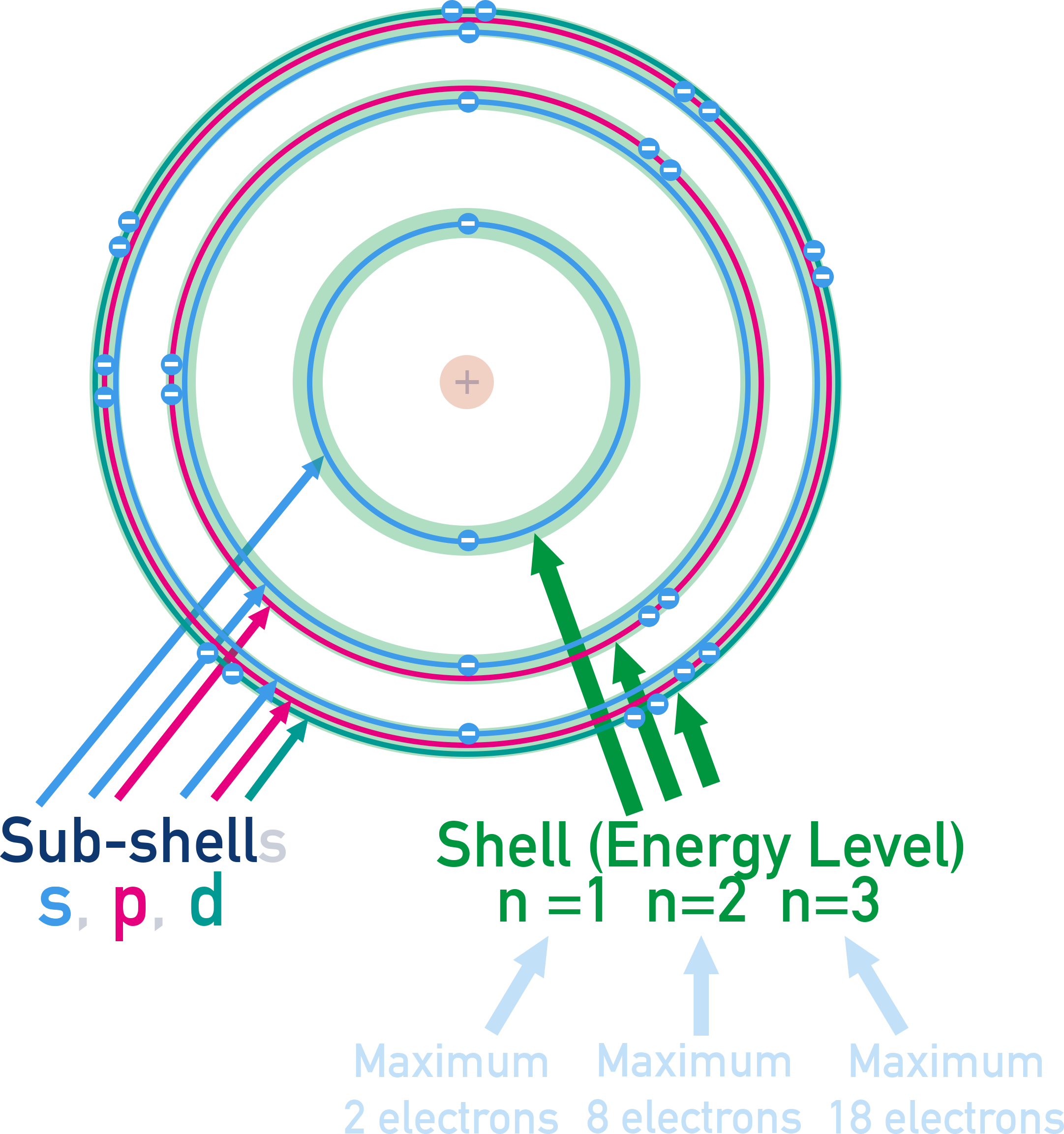
Atomic Orbitals
a three dimensional region around a atomic nucleus where there is a high probability of finding an electron.
Aufbau Principal
electrons fill an atoms atomic orbitals in order of increasing energy, starting with lowest available energy before moving up to higher ones.

Orbital Notation
a visual way to show how electrons are arranged inside an atom using boxes and arrows.
Pauli Principle
no two electrons in same atom can have an identical set of all four quantum numbers.
Hund’s rule
every orbital in a subshell is singly occupied with ne electron before any orbital is doubly occupied, and all singly occupied orbitals contain electrons with parallel spins.

Isoelectronic
two or more atoms,ions or molecules that have same number of electronic configuration despite having different nuclear charges.
Valence Electrons
the electrons located in the outermost electron shell of an atom.

Atomic Radius
a measure of the size of an atom.
Nuclear Charge
the total positive charge inside an atoms nucleus equal to # of protons.
Shielding effect
when inner core electrons repel outer electrons which reduces the positive pull from the nucleus.
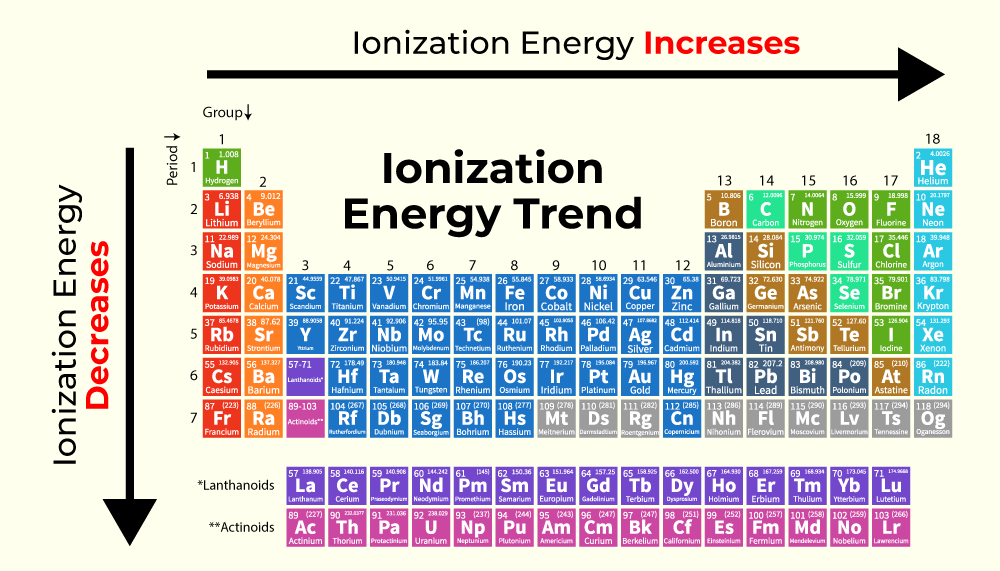
Ionization Energy
the minimum energy required to move an electron from an isolated, gaseous atom or ion.
Ionic size
the distance from the center of an ions atomic nucleus to the outer edge of its electron cloud.
Electronegativity
a measure of an atoms tendency to attract shared electrons towards itself when forming a chemical bond.
