Aldol Condensation + Michael Addition
 Call Kai
 Learn
Learn Practice Test
 Spaced Repetition
 Match
Match Flashcards
 Knowt Play
1/11

Earn XP
Description and Tags
OCHEM II Lab Final
Name | Mastery | Learn | Test | Matching | Spaced | Call with Kai | Chat |
|---|
No analytics yet
Send a link to your students to track their progress
12 Terms
What is the first step?
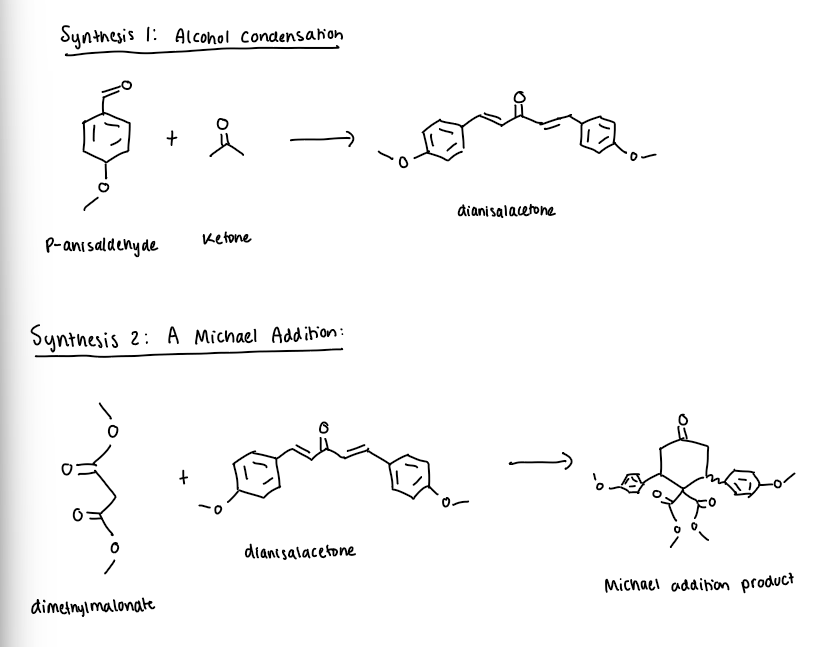
aldol condensation of acetone and p-anisaldehyde
Condensation reaction
combines two molecules while removing a small molecule such as water or an alcohol
First part:
removal of a proton from the a-carbon of one carbonyl compound molecules creates a nucleophile
nucleophile attacks the electrophilic carbon of a second molecule
Second part: dehydration
heat aldol with acid or base
can occur w/o heating under conditions
dianisalacetone (product) is very stable and relatively easy to produce because the double bonds formed by dehydration are conjugated with the carbonyl group and with the benzene rings
Second Step: Michael Addition
base catalyzed addition of a compound containing an active a-hydrogen to the b-carbon of an a,b - unsaturated carbonyl compound
dianisalacetone with dimethylmalonate under catalysis by methoxide ion
dimethyl-2,6-bis(p-methoxyphenyl)-4-oxo-cyclohexane-1,1-dicarboxylate
Ethylene ketal formation may also be used to temporarily block a carbonyl group while a reaction is conducted at another site on a molecule
after second site reaction is complete, the ethylene ketal-blocking group is removed by reaction with acid and water
Reactions
Precautions for ethyl ether?
keep away from flames
gloves + lab coat
Precautions for 25% sodium methoxide?
keep away from flames
wear gloves
Theoretical yield
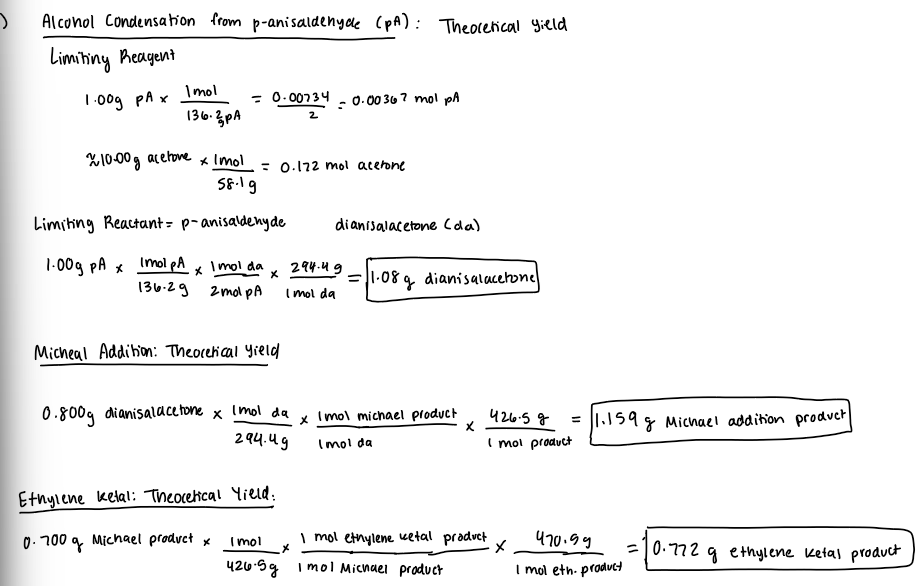
Overall Theoretical Yield

Compare the NMR spectra for each stage of the synthesis sequence. Explain how the spectra support the identity of your product in each case.
The NMR spectra for the aldol condensation sequence shows major peaks around 6.9-7 ppm which represent the aromatic protons that are two sets of doublets
Peaks around 3.8 ppm show the methoxy protons, and vinyl protons are shown around 6-7 ppm.
The NMR spectra for the Michael product shows major peaks that support the identity of the product.
The double peaks around 7.0 ppm represent the hydrogens right near the carbonyl in the top of the structure
The singlet peak at 3.755 ppm represents the hydrogens on the methoxy group
The singlet at 3.380 ppm showcases the hydrogens on the methyl ester groups.
What are the steps for this experiment?
p-anisaldehyde + acetone + ethanol in flaks A
10% NaOH in flask B
pour A into B and stir for 45 minutes
cool mixture in ice bath for 5 min and collect precipitate via vacuum filtration
rinse crystals with water and filter
wash crystals on funnel with acetic acid, stir gently, and filter
water rinse again and filter for 2 minutes
recrystallize the product with ethanol and dry for 10 minutes and record weight ( aldol product : dianisalacetone)
add aldol product + methanol + dimethyl malonate + 25% sodium methoxide to rbf with boiling chip
gently reflux for 15 min
cool flask to room temp + ice bath for 5 min
vacuum filter + wash with cold methanol + dry for 10 minutes , mp weight
Why do we add NaOH and stir the reaction for 45 minutes?
acts as base to deprotonate acetone to create nucleophile
allows enough time for double condensation to occur
acetic acid wash neutralizes any residual NaOH left on the crystals, preventing the base from interfering with the product during drying
Why do we use sodium methoxide for the Michael reaction?
deprotonate dimethyl malonate to create Michael donor
15 min reflux to do intramolecular claisen like condensation
methanol prevents transesterification side reactions that would happen if used a different alcohol