Chapter 3 - Structure and Geometry
 Call Kai
 Learn
Learn Practice Test
 Spaced Repetition
 Match
Match Flashcards
 Knowt Play
1/20

There's no tags or description
Looks like no tags are added yet.
Name | Mastery | Learn | Test | Matching | Spaced | Call with Kai | Chat |
|---|
No analytics yet
Send a link to your students to track their progress
21 Terms
What are the characteristics of ionic compounds?
Brittle and hard, and they have high melting and boiling points
What are the characteristics of molecular compounds?
Low melting points and do not conduct electricity
What is a polar covalent bond?
When two bonded atoms have different electronegativities and they share electrons unevenly
What are nonpolar covalent bonds?
Atoms with similar electronegativities that pull evenly on electrons
What are network covalent compounds?
Covalently bonded nonmetals similar to molecular compounds, but they do not form small discrete molecules. Instead, a large number of atoms are continuously bonded in a vast, repeating, covalent network
What are the characteristics of molecular compounds?
Generally hard, do not conduct electricity (except for graphite), and have high melting and boiling points
Describe metallic compounds.
When two or more metals bond together, creating a lattice of closely packed atoms. In this lattice, valence electrons are not tied to individual atoms, but instead, they form a “sea of electrons” that move freely about the structure
What are the properties of metallic compounds?
Variable hardness and melting points
Conduct electricity and heat
Malleable
Ductile
Lustrous (shiny) appearance
What is the equation for lattice energy?
Cation and anion charge subtracted by bond distance

What’s another way to calculate lattice energy?
Ion charge / ion size
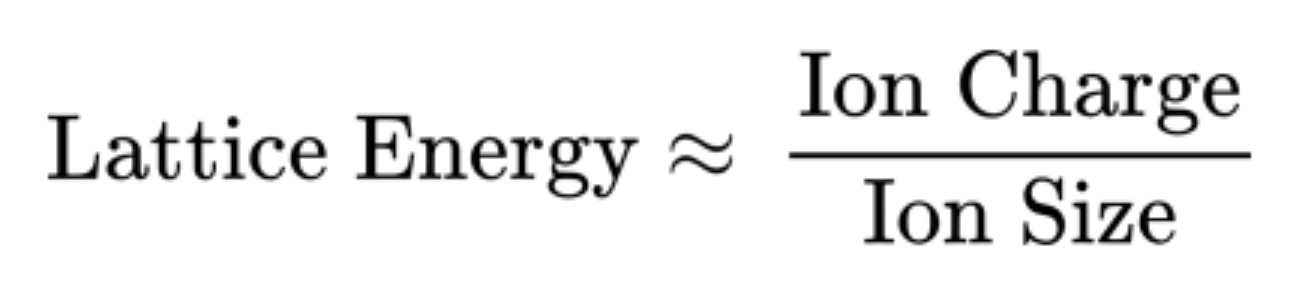
What does lattice energy represent?
Energy required to break an ionic compound apart into its cations and anionsWh
What is bond radii equivalent to?
ions’ combined atomic radii
________ ions will be further apart and _______ ions will be closer together
Larger; smaller
The strongest ionic compounds will be formed by the ions with the ______ charges and the ______ sizes
Largest; smallest
Ion’s size generally increases moving _____ and to the ______ on the periodic table.
Down; left
Formal charge equation is?
√

Lewis structure with the ______ formal charge values is most stable.
Lowest
What do you look at when the lewis structures have the same formal charge?
Which atoms carry the charge. The most electronegative should have the negative charge and the least electronegative atoms carry positive charges
Which resonance contributor will contribute most to the resonance hybrid of a molecule?
A. The structure with the greatest number of bonds, regardless of charges
B. The structure with minimized formal charges across all atoms
C. The structure with positive charges on electronegative atoms
D. The structure with negative charges on the least electronegative atoms
E. The structure with the most atoms carrying nonzero formal charges
D. The structure with negative charges on the least electronegative atoms
What is bond order about?
When multiple resonance forms for a molecule exist, bond order can be thought of as the average number of bonds between these resonance forms
Which of the following bonds is the shortest and
strongest?
A. C–C
B. C=C
C. C≡C
D. C–H
E. C–O
C. C≡C