7 - Domains of Exercise
 Studied by 0 people
 Call Kai
 Learn
Learn Practice Test
 Spaced Repetition
 Match
Match Flashcards
 Knowt Play
1/20

There's no tags or description
Looks like no tags are added yet.
Name | Mastery | Learn | Test | Matching | Spaced |
|---|
No study sessions yet.
21 Terms
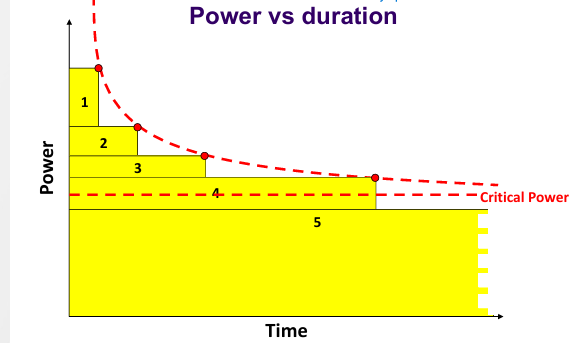
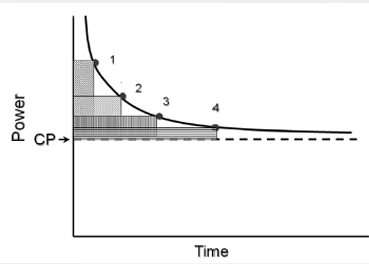
Power vs Duration
Opposite to MLSS (low to high intensity)
Higher to lower power output
Reach power where athlete can go on indefinitely
Asymptote curve
Critical Power
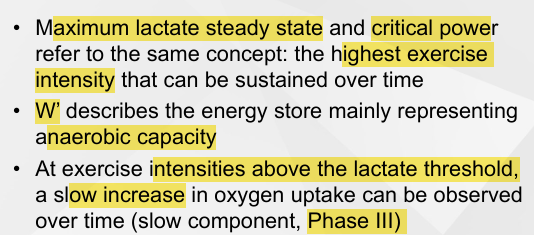
Highest power output that can be maintained over time
Homeostasis - Steady state in:
VO2
BLa concentration
HR
Muscle cell physiology
Fatigue products
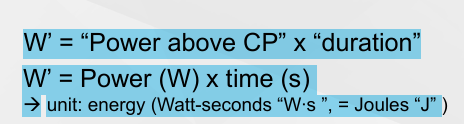
W’ (W’ Prime)
W’ can be increased if supplemented with creatine
Fuels anaerobic battery with more glycogen as creatine breaks down more PCr
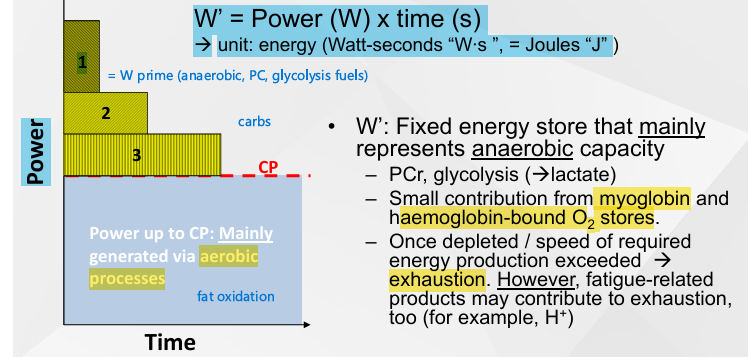
W’ and CP
100m sprinters - anaerobic metabolism (W’)
Cycling - maintain effort over time (CP)
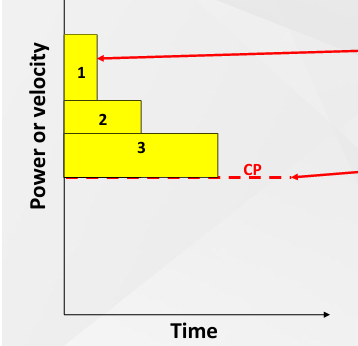
CP: Practical Applications
Characterisation of Athletes - highest sustainable power, fittest athlete?
Power Zones - training prescription, steady state training level
Athlete tracking over season/training cycle
Domains of Exercise
Low intensity domain
Moderate domain
Severe domain (Interval)
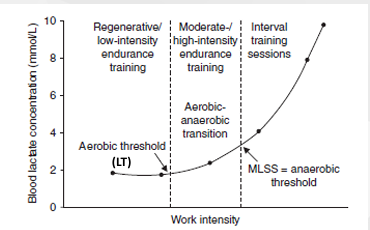
Low Intensity Domain
Below the LT
BLa < ~2 mmol/L;
< 70% VO2max
Steady state in < 3min
Moderate domain
Between the LT and MLSS/CP
BLa elevated but stable at 2-8 mmol/L
70-90& VO2max
Steady state delayed
Severe Domain (Interval)
Above the MLSS/CP
BLa > 2-8 mmol/L
70-90% VO2max
Steady state not attainable
Exercising at/above CP
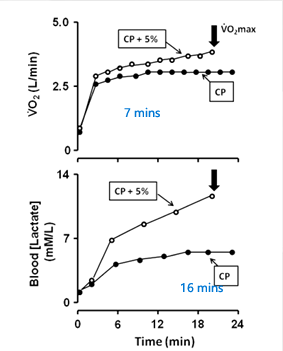
O2 Uptake Kinetics
How much o2 per breath
Breath by breath analysis of o2 uptake
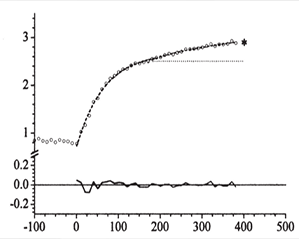
Oxygen uptake kinetics differ across the exercise intensity range and can help to define domains of exercise
O2 Uptake Kinetics: 3 Distinct Phases
Procedure
track o2 uptake
Findings
O2 uptake goes up
Steep increase before levelling off
Slight increase of o2 uptake
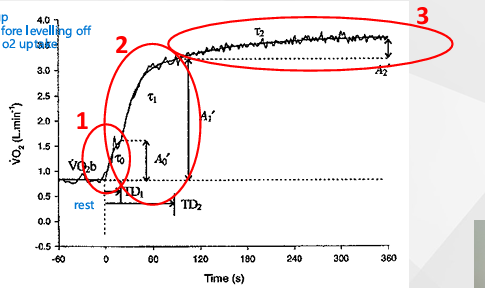
o2 Uptake Kinetics Continued
high demand for o2 in muscles when starting exercise but bit of a lag
smooth rise, quick o2 rise to meet demands
Phase 1 - cardiodynamic component
Phase 2 - Primary component
Phase 3 - Slow component
Phase 1: cardiodynamic component (20s)
Transmit time of blood between the exercising muscle and lungs
Phase 2: Primary Component (2-3 min)
Pulmonary V O2 rises in a mono-exponential fashion to meet the muscle oxygen demand
Phase 3: Slow Component (>3 min)
Slow rise in VO2
Only observed at high power outputs, as a growing number of fast motor units (Type II fibres) have to be recruited
More force can be generated
Not as efficient and fatigue resistant as Type I fibres - more o2 needed per unit of force
Reached strenuous watts so activate T2 - not efficient, fatigue, require more o2 than T2
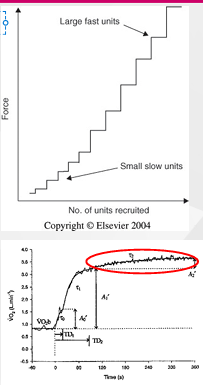
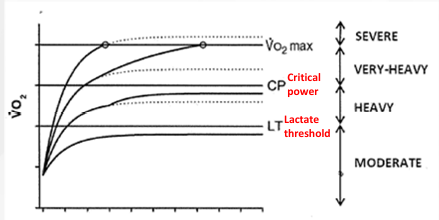
Moderate Exercise (Below LT)
Mainly T1
Below/At CP = Steady state
Phase 2 - mono-exponential increase in VO2
Phase 3 - none
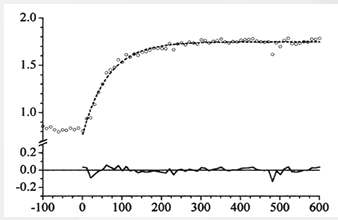
Heavy Exercise (between LT and CP)
Delayed steady state due to T2
Phase 2 - mono-exponential increase in VO2
Phase 3 - slow component
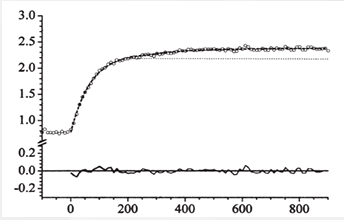
Severe Exercise (Above CP)
Doesn’t stabilise - reach VO2 max
Phase II - mono-exponential increase in VO2
Phase III - “slow component” never stabilises and continues until exercise has to be terminated or V is attained
Practical Implications in the Lab
Steady state exercise above LT (slow component)
Check douglas bag over time
Summary