M13: Monetary policy
 Call Kai
 Learn
Learn Practice Test
 Spaced Repetition
 Match
Match Flashcards
 Knowt Play
1/10

There's no tags or description
Looks like no tags are added yet.
Name | Mastery | Learn | Test | Matching | Spaced | Call with Kai | Chat |
|---|
No analytics yet
Send a link to your students to track their progress
11 Terms
Why does the Bank of England control monetary policy?
Expertise
Operational independence since 1997 to prevent govts from creating short term growth for political support
What are the main functions of the central bank?
Price stability (Target 2% ±1% CPI)
Support govt. objectives of growth and employment
‘lender of last resort’
Readiness to loan to banks that are solvent but have short term liquidity problems to prevent another GFC
Monitoring and regulating the financial system
What are other side functions of the central bank?
Controlling note issue
Acting as the bankers’/government’s bank
Influencing exchange rate via buying and selling currency
What component of the macroeconomy do interest rates influence?
What is considered by the BoE when implementing?
C, I and (X-M) components of AD
Inflationary/deflationary pressures, consumer and business confidence, growth rate, employment levels
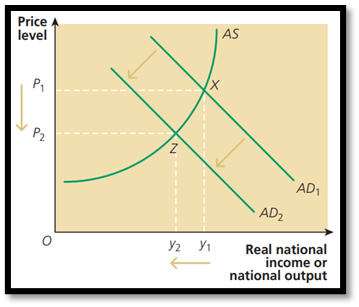
What is contractionary MP?
Eval?
Diagram?
Increase IR to decrease AD, lowering price levels
Extent of deflation (more realistically, disinflation) depends on the initial position of the AD curve on the LRAS
Might trigger recession if the CMP triggers a large multiplier that shifts AD further to the left
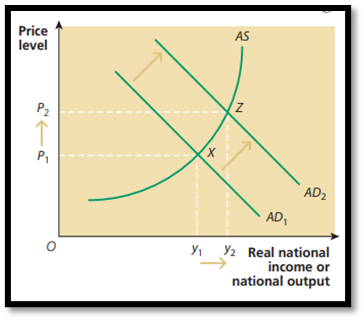
What is expansionary MP?
Eval?
Diagram?
Decrease IR to increase AD (shift right), growing national output
Extent of real output increase to inflation depends on the initial position of the AD curve on the LRAS
Might trigger hyperinflation if the CMP triggers a large multiplier that shifts AD further to the right
What is the transmission mechanism of MP?
What are the approximate time lags?
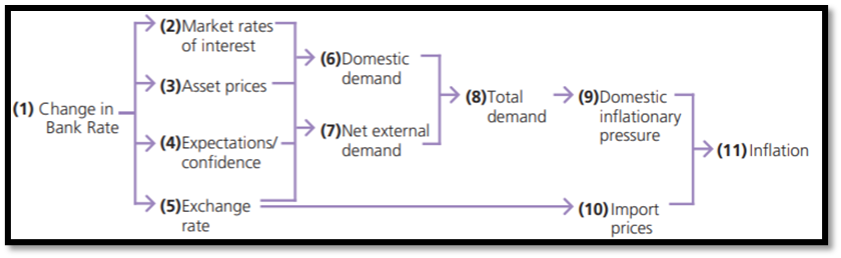
2 years for a change in IR to affect inflation
1% change in IR → 0.2-0.4% change in inflation after 2 years
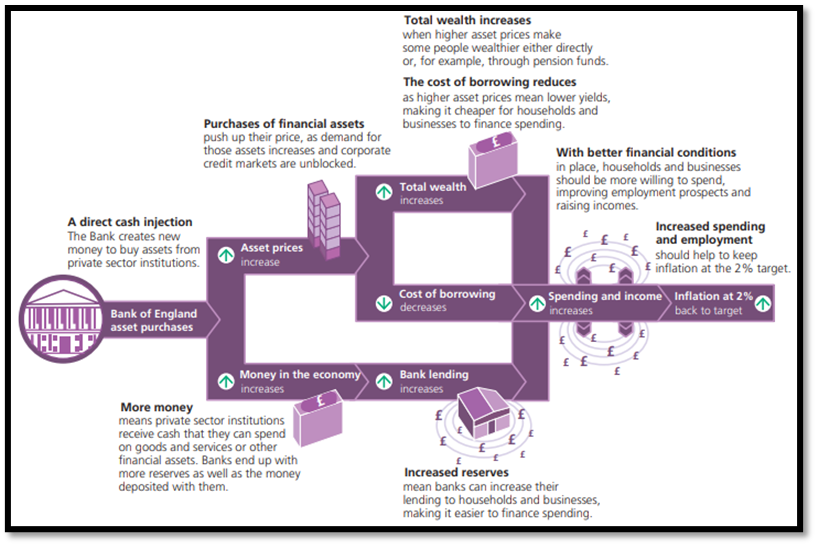
What is Quantitative Easing?
When is it used?
BoE buys assets (govt. bonds) with newly created money, increasing liquidity of banks
Banks more likely to lend loans, increasing investment, increasing AD
When inflation is low and IR fails
QE eval?
Inflation, potentially stagflation
Money supply increases, exchange rate weakens, raw materials cost more, price levels rise but output does not.
Widens wealth inequality
Benefits asset owners only
What is forward guidance?
BoE sending signals about future IR policy
Increases credibility, greater effects
How do IR rates affect the exchange rate and thus inflation?
Fall in IR, Financial capital outflow, reduces demand of £ and increases supply of £, reducing exchange rate
Increases import prices, cost-push inflation
Reduces export prices, demand-pull inflation for domestic goods