1 - Protein & Enzymes
 Call Kai
 Learn
Learn Practice Test
 Spaced Repetition
 Match
Match Flashcards
 Knowt Play
1/165

Earn XP
Description and Tags
Proverbs 16:3
Name | Mastery | Learn | Test | Matching | Spaced | Call with Kai | Chat |
|---|
No analytics yet
Send a link to your students to track their progress
166 Terms
c. Biochemistry
[OVERVIEW]
_________ discusses the structure, function, and metabolism of biomolecules.
a. Physiology
b. Pharmacology
c. Biochemistry
d. Microbiology
Protein
Carbohydrates
Lipids
Nucleic acids
[OVERVIEW]
Four Biomolecule [4]
a. True
[OVERVIEW]
Except for lipids , BIOMOLECULES such as protein , carbohydrates, nucleic acid can exist as polymers
a. True
b. False
a. Protein
[BIOMOLECULE]
Amino acid
a. Protein
b. Carbohydrate
c. Lipid
d. Nucleic acid
b. Carbohydrate
[BIOMOLECULE]
Monosaccharide
a. Protein
b. Carbohydrate
c. Lipid
d. Nucleic acid
c. Lipid
[BIOMOLECULE]
No universal monomer, but major components include fatty acids and isoprene
a. Protein
b. Carbohydrate
c. Lipid
d. Nucleic acid
Isoprene
Fatty acids
[BIOMOLECULE]
Lipid have no universal monomer. but major components include ______ [2]
a. Amino acids and nucleotides
b. Monosaccharides and amino acids
c. Isoprene and Fatty acids
d. Glycerol and nucleotides
d. Nucleic acid
[BIOMOLECULE]
Nucleotide
a. Protein
b. Carbohydrate
c. Lipid
d. Nucleic acid
a.True
[PROTEINS AND ENZYMES]
All biomolecules (including proteins) are rarely defined by their function since they all have multiple important functions.
a.True
b. False
b. Proteins
[PROTEINS AND ENZYMES]
_______ are polymers ("polypeptide chains") built up by amino acids that are joined together.
a. Lipids
b. Proteins
c. Carbohydrates
d. Nucleic acids
b. Peptide
[PROTEINS AND ENZYMES]
<50 amino acids
a. Protein
b. Peptide
a. Protein
[PROTEINS AND ENZYMES]
> 50 amino acids
a. Protein
b. Peptide
a. True
[PROTEINS AND ENZYMES]
Though proteins are often functional as polymers, even solo amino acids are important in their own right. Some are notable for being neurotransmitters (e.g.glycine and glutamate), while many serve as precursors for other important things(e.g. alkaloids, porphyrins, etc.).
a. True
b. False
b. Proteins
[PROTEINS AND ENZYMES]
Building block of life
Most flexible in 4 biomolecules
a. Lipids
b. Proteins
c. Carbohydrates
d. Nucleic acids
c. Amino acids
[AMINO ACIDS - GENERALITIES]
Amino-containing carboxylic acids.
a. Nucleotides
b. Fatty acids
c. Amino acids
d. Carbohydrates
b. Amino Acids
[AMINO ACIDS - GENERALITIES]
Have two FG such as: NH2 and COOH
This is "basic"
a. Carbohydrates
b. Amino Acids
c. Lipids
d. Nucleic acids
a. Primary
[AMINO ACIDS - GENERALITIES]
Most amino groups in amino acids are:
a. Primary
b. Secondary
c. Tertiary
d. Quaternary
a. True
[AMINO ACIDS - GENERALITIES]
In amino acids, only one alpha carbon is present for both functionalities.
a. True
b. False
c. Alpha carbon
[AMINO ACIDS - GENERALITIES]
_________ the first carbon atom that attaches to a functional group in an organic molecule
a. Beta carbon
b. Gamma carbon
c. Alpha carbon
d. Omega carbon
a. True
[AMINO ACIDS - GENERALITIES]
Most amino acids are chiral.
a. True
b. False
b. Chiral
[AMINO ACIDS - GENERALITIES]
A molecule that has four different functional groups and is not superimposable on its mirror image.
a. Achiral
b. Chiral
c. Meso
d. Racemic
b. Glycine
📌NOTE: Glycine is the only ACHIRAL amino acid
[AMINO ACIDS - GENERALITIES]
Most amino acids are chiral except:
a. Proline
b. Glycine
c. Alanine
d. Valine
c. Proline
[AMINO ACIDS - GENERALITIES]
Most amino acids have a primary amino group except:
a. Glycine
b. Lysine
c. Proline
d. Arginine
b. An aromatic ring
[AMINO ACIDS - GENERALITIES]
Benzene is:
a. An aliphatic ring
b. An aromatic ring
c. A heterocyclic ring
d. A saturated ring
b. Isomers
[AMINO ACIDS - GENERALITIES]
Compounds with the same molecular formula but different structural arrangements or spatial orientations.
a. Polymers
b. Isomers
c. Homologs
d. Isotopes
b. Same formula, different structure
[AMINO ACIDS - GENERALITIES]
Isomer refers to compounds with:
a. Different formula, same structure
b. Same formula, different structure
c. Same formula, same structure
d. Different formula, different structure
a. Both acid and base
[AMINO ACIDS - GENERALITIES]
Amino acids are amphoteric, meaning they can act as:
a. Both acid and base
b. Only acid
c. Only base
d. Neither acid nor base
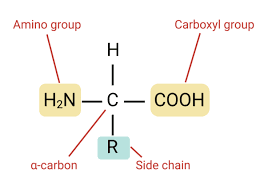
[AMINO ACIDS - GENERALITIES]
General structure of an amino acid:
b. L-amino acid
[AMINO ACIDS - GENERALITIES]
_______ is the most common type of amino acid.
a. D-amino acid
b. L-amino acid
c. DL-amino acid
d. Racemic amino acid
a. True
[AMINO ACIDS - GENERALITIES]
In living organisms there are only 20 standard proteinogenic amino acids , each having their 3 and 1 letter abbreviations (e.g. glycine, gly, G)
a. True
b. False
c. 20
[AMINO ACIDS - GENERALITIES]
In living organisms there are only_______ standard proteinogenic amino acids
a. 10
b. 15
c. 20
d. 25
Glycine (Gly, G)
Alanine (Ala, A)
Phenylalanine (Phe, F)
Tryptophan (Trp, W)
Proline (P)
Valine (V)
Leucine (L)
Isoleucine (Ile, I)
Methionine (Met, M)
📌Mnemonic: “GAP” “TPV” “LIM”
[20 STANDARD AMINO ACID]
Nonpolar Amino acids [9]
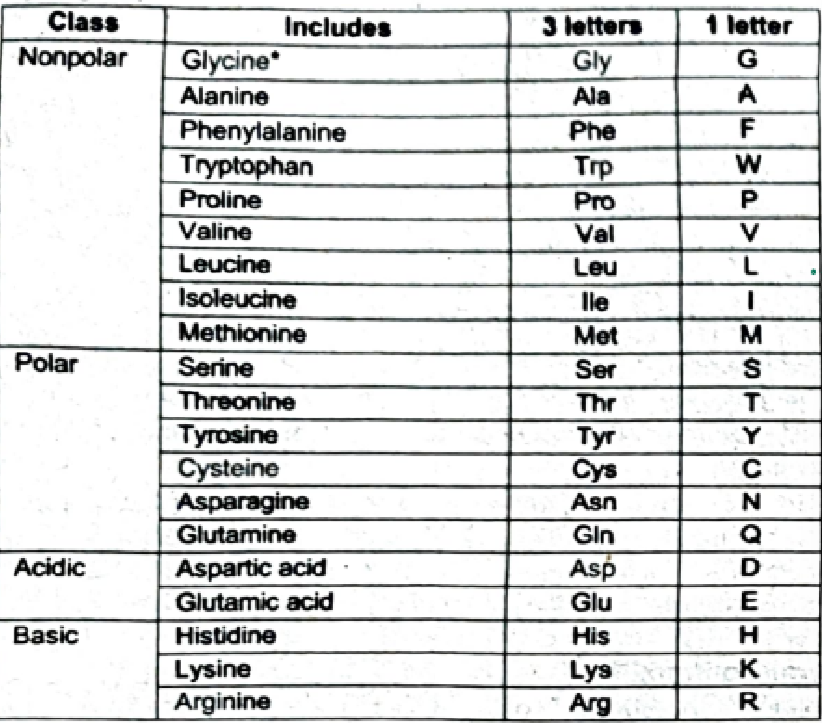
[AMINO ACIDS - CLASSIFICATION BY “R” GROUP]
The 20 standard amino acids group by R group polarity : [for reference only bwahah]
Cysteine (Cys, C)
Asparagine (Asn, N)
Tyrosine (Tyr, Y)
Threonine (Thr, T)
Serine (Ser, S)
Glutamine (Gln, Q)
📌Mnemonic: “CATTS” G
[20 STANDARD AMINO ACID]
Polar Amino acids [5]
Aspartic acid (Asp, D)
Glutamic acid (Glu, E)
📌Mnemonic: “AG”
[20 STANDARD AMINO ACID]
Acidic amino acids [2]
Lysine (Lys, K)
Arginine (Arg, R)
Histidine (His, H)
📌Mnemonic: “LAH” — isipin mo lang ang CEU
[20 STANDARD AMINO ACID]
Basic amino acid [3]
Tryptophan (W)
Phenylalanine (F)
Tyrosine (Y)
'📌Mnemonic: “TPT”
[20 STANDARD AMINO ACID]
Aromatic amino acids [3]
Cysteine (C)
Methionine (M)
[20 STANDARD AMINO ACID]
Sulfur containing amino acids [2]
Leucine (L)
Isoleucine (I)
Valine (V)
📌Mnemonic: “LIV”
[20 STANDARD AMINO ACID]
Branched -chain amino acids [3]
Asparagine (N)
Glutamine (Q)
📌Mnemonic: “AG” — same lng sa acidic amino acid dinagdagan lang acid
[20 STANDARD AMINO ACID]
Amide containing amino acids [2]
PVT
P - Phenylalanine
V - Valine
T - Tryptophan
TIM
T - Threonine
I - Isoleucine
M - Methionine
HALL
H - Histidine
A - Arginine
L - Leucine
L - Lysine
📌Mnemonic: “PVT” “TIM” haLL
Essential Amino acids include ____ [10]
c. Essential amino acids
[AMINO ACIDS - CLASSIFICATION BY DIETARY REQUIREMENT]
Amino acids that are not produced by the body and must be obtained from the diet.
a. Non-essential amino acids
b. Conditionally essential amino acids
c. Essential amino acids
d. Glucogenic amino acids
c. Non-essential amino acids
[AMINO ACIDS - CLASSIFICATION BY DIETARY REQUIREMENT]
Amino acids that are not in the essential list are classified as:
a. Essential amino acids
b. Conditionally essential amino acids
c. Non-essential amino acids
d. Ketogenic amino acids
b. Conditionally essential amino acids
[AMINO ACIDS - CLASSIFICATION BY DIETARY REQUIREMENT]
Histidine and Arginine are essential only in children and are referred to as:
a. Non-essential amino acids
b. Conditionally essential amino acids
c. Essential amino acids
d. Ketogenic amino acids
b. Exclusively ketogenic amino acids
[AMINO ACIDS - CLASSIFICATION BY METABOLITE FATE - DURING FASTING]
Amino acids that can lead to ketone bodies during fasting are called:
a. Glucogenic amino acids
b. Exclusively ketogenic amino acids
c. Both glucogenic and ketogenic
d. Non-essential amino acids
L – Leucine (Leu / L)
L – Lysine (Lys / K)
📌Mnemonic: “LL”
[AMINO ACIDS - CLASSIFICATION BY METABOLITE FATE - DURING FASTING]
Example of Exclusively ketogenic amino acids , that can lead to ketone bodies during fasting:
a. Leucine and Lysine
b. Leucine and Isoleucine
c. Lysine and Valine
d. Leucine and Arginine
c. Both glucogenic and ketogenic
[AMINO ACIDS - CLASSIFICATION BY METABOLITE FATE - DURING FASTING]
Amino acids that can lead to either glucose or ketone bodies during fasting are called:
a. Exclusively glucogenic
b. Exclusively ketogenic
c. Both glucogenic and ketogenic
d. Non-essential
F - Phenylalanine (Phe)
I - Isoleucine (Ile)
T - Threonine (Thr)
T - Tryptophan (Trp)
T - Tyrosine (Tyr)
📌Mnemonic: “FITTT”
[AMINO ACIDS - CLASSIFICATION BY METABOLITE FATE - DURING FASTING]
Example of amino acid that are Both glucogenic and ketogenic include [4]
c. Exclusively glucogenic
[AMINO ACIDS - CLASSIFICATION BY METABOLITE FATE - DURING FASTING]
Amino acids that can lead to glucose during fasting are called:
a. Exclusively ketogenic
b. Both glucogenic and ketogenic
c. Exclusively glucogenic
d. Essential amino acids
b. Neutral (COOH)
[Effects of Adjusting pH for Amino Acid Functional groups]
When pH < pKa, the acidic group (-COOH) is:
a. Ionized as negative (COO⁻)
b. Neutral (COOH)
c. Ionized as positive
d. Neutral (NH₂)
c. Ionized as positive (NH₃⁺)
[AMINO ACIDS - IONIZATION]
When pH < pKa, the basic group (-NH₂) is:
a. Neutral (NH₂)
b. Ionized as negative
c. Ionized as positive (NH₃⁺)
d. Neutral (COOH)
b. Ionized as negative (COO⁻)
[AMINO ACIDS - IONIZATION]
When pH > pKa, the acidic group (-COOH) is:
a. Neutral (COOH)
b. Ionized as negative (COO⁻)
c. Ionized as positive
d. Neutral (NH₂)
b. Neutral (NH₂)
[AMINO ACIDS - IONIZATION]
When pH > pKa, the basic group (-NH₂) is:
a. Ionized as positive (NH₃⁺)
b. Neutral (NH₂)
c. Ionized as negative
d. Neutral (COOH)
b. Acidic environment
[AMINO ACIDS - IONIZATION]
Low pH corresponds to:
a. Basic environment
b. Acidic environment
c. Neutral environment
d. Alkaline environment
b. Basic environment
[AMINO ACIDS - IONIZATION]
High pH corresponds to:
a. Acidic environment
b. Basic environment
c. Neutral environment
d. Isoelectric environment
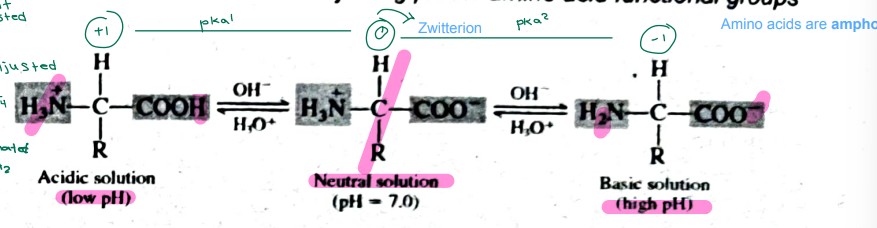
[AMINO ACIDS - IONIZATION]
Figure 2: Same amino acids in different ionization states
b. Not constant; can be adjusted
[AMINO ACIDS - IONIZATION]
pH is:
a. Constant; cannot be adjusted
b. Not constant; can be adjusted
a. Constant; cannot be adjusted
[AMINO ACIDS - IONIZATION]
pKa is:
a. Constant; cannot be adjusted
b. Not constant; can be adjusted
b. Acidic
[AMINO ACIDS - IONIZATION]
When pH < pKa, the environment is:
a. Basic
b. Acidic
c. Neutral
d. Alkaline
b. Protonated
[AMINO ACIDS - IONIZATION]
When pH < pKa, the molecule is:
a. Deprotonated
b. Protonated
c. Neutral
d. Ionized as negative
d. -NH₂ (neutral) and -COO⁻ (negative)
[AMINO ACIDS - IONIZATION]
When pH < pKa, the amino group (-NH₂) and Carboxyl group (-COOH) exists as:
a. -NH₃⁺ (positive) and -COO⁻ (negative)
b. -NH₂ (neutral) and -COOH (neutral)
c. -NH₃⁺ (positive) and -COOH (neutral)
d. -NH₂ (neutral) and -COO⁻ (negative)
a. Basic
[AMINO ACIDS - IONIZATION]
When pH > pKa, the environment is:
a. Basic
b. Acidic
c. Neutral
d. Alkaline
a. Deprotonated
[AMINO ACIDS - IONIZATION]
When pH > pKa, the molecule is:
a. Deprotonated
b. Protonated
c. Neutral
d. Ionized as negative
d. -NH₂ (neutral) and -COO⁻ (negative)
[AMINO ACIDS - IONIZATION]
When pH > pKa, the amino group (-NH₂) and carboxyl group (-COOH) exist as:
a. -NH₃⁺ (positive) and -COO⁻ (negative)
b. -NH₂ (neutral) and -COOH (neutral)
c. -NH₃⁺ (positive) and -COOH (neutral)
d. -NH₂ (neutral) and -COO⁻ (negative)
c. Zwitterion
[AMINO ACIDS - IONIZATION]
The species with zero net charge, having one positive and one negative charge canceling each other out.
a. Anion
b. Cation
c. Zwitterion
d. Isomer
b. Double ion (one positive and one negative canceling out)
[AMINO ACIDS - IONIZATION]
Zwitterion means:
a. Single ion
b. Double ion (one positive and one negative canceling out)
c. Triple ion
d. Neutral molecule without charge
a. Isoelectric pH (iPH or pI)
[AMINO ACIDS - IONIZATION]
The pH at which all amino acids or peptides have the same (iso) electric charge of zero
a. Isoelectric pH (iPH or pI)
b. Neutral pH
c. Acidic pH
d. Basic pH
a. Isoelectric pH (iPH or pI)
[AMINO ACIDS - IONIZATION]
Also known as the zwitterion form
a. Isoelectric pH (iPH or pI)
b. Neutral pH
c. Acidic pH
d. Basic pH
c. Zwitterion
[AMINO ACIDS - IONIZATION]
The isoelectric pH is the pH where the amino acid exists as a:
a. Positive ion
b. Negative ion
c. Zwitterion
d. Neutral molecule without charge
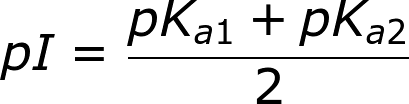
[AMINO ACIDS - IONIZATION]
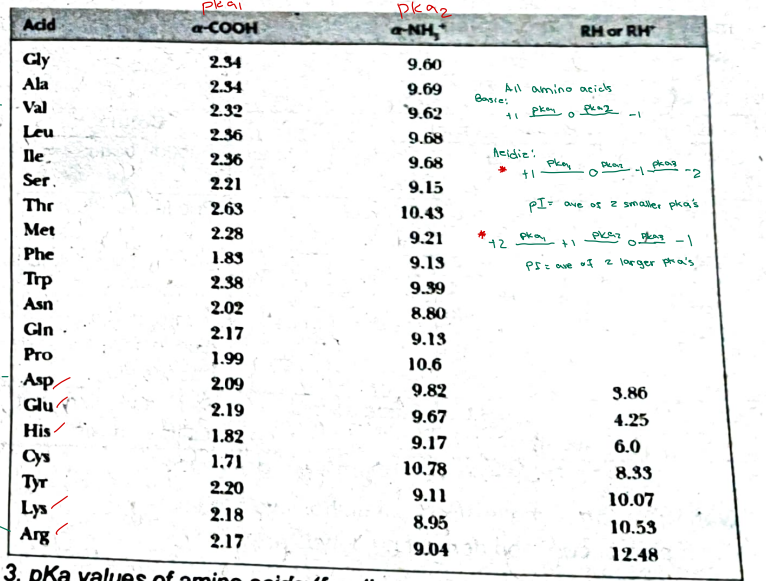
Formula for Isoelectric pH (iPH or pI):
[AMINO ACIDS - IONIZATION]
Figure 3: pKa values of amino acids (for discussion purposes only;PLEASE do not memorize)
a. Glycine
[NON POLAR AMINO ACIDS]
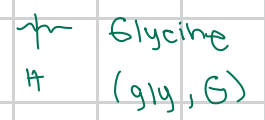
Smallest ACHIRAL amino acid on Earth
a. Glycine
b. Alanine
c. Valine
d. Leucine
a. Glycine
[NON POLAR AMINO ACIDS]
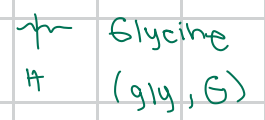
The only ACHIRAL amino acid
a. Glycine
b. Alanine
c. Valine
d. Leucine
b. Alanine
[NON POLAR AMINO ACIDS]
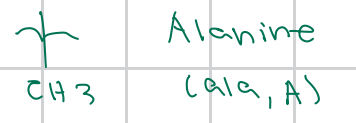
Amino acid with METHYL GROUP
a. Glycine
b. Alanine
c. Valine
d. Leucine
b. Alanine
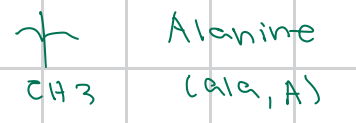
[NON POLAR AMINO ACIDS]
✨BEQ: Smallest CHIRAL amino acid
a. Glycine
b. Alanine
c. Valine
d. Leucine
b. Proline
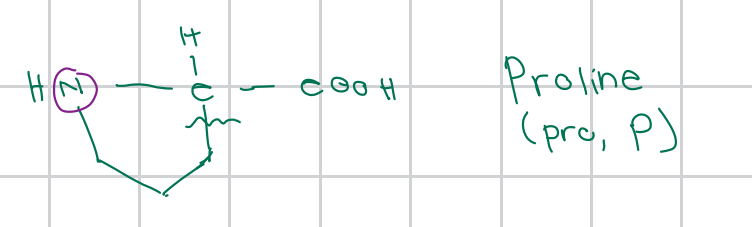
[NON POLAR AMINO ACIDS]
The only SECONDARY amino acid
a. Glycine
b. Proline
c. Alanine
d. Lysine
b. Proline
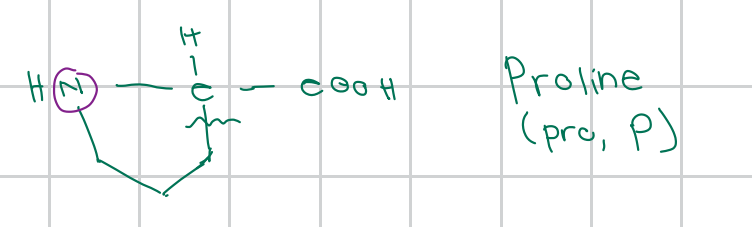
[NON POLAR AMINO ACIDS]
In the past , this is called as IMINO ACID
a. Glycine
b. Proline
c. Alanine
d. Lysine
a. Imino acid
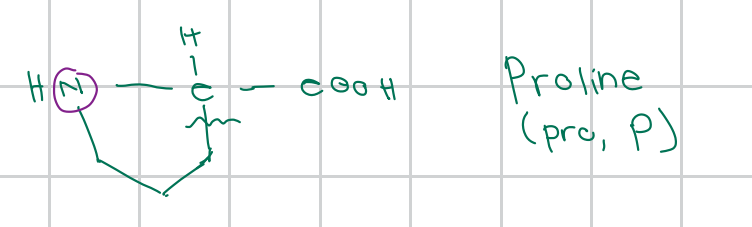
[NON POLAR AMINO ACIDS]
Proline is also known as:
a. Imino acid
b. Alpha amino acid
c. Beta amino acid
d. Essential amino acid
b. Ninhydrin test
[NON POLAR AMINO ACIDS]
A general test for amino acids
a. Biuret test
b. Ninhydrin test
c. Xanthoproteic test
d. Sakaguchi test
b. Ninhydrin test
[NON POLAR AMINO ACIDS]
The general test that gives a positive result with proline is:
a. Biuret test
b. Ninhydrin test
c. Xanthoproteic test
d. Sakaguchi test
b. Yellow
[NON POLAR AMINO ACIDS]
The positive result of ninhydrin test with proline is:
a. Violet
b. Yellow
c. Blue
d. Red
b. Yellow
[NON POLAR AMINO ACIDS]
Most amino acids give a violet color with ninhydrin, but proline gives:
a. Violet
b. Yellow
c. Blue
d. Green
b. Aromatic amino acid
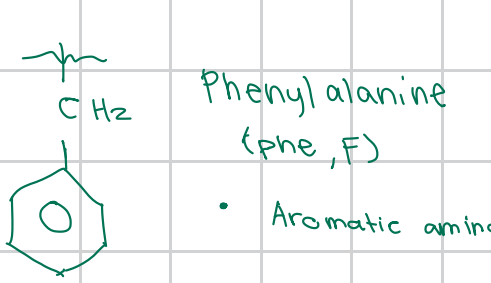
[NON POLAR AMINO ACIDS]
Phenylalanine (Phe, F) is classified as:
a. Aliphatic amino acid
b. Aromatic amino acid
c. Sulfur-containing amino acid
d. Basic amino acid
c. Xanthoproteic test
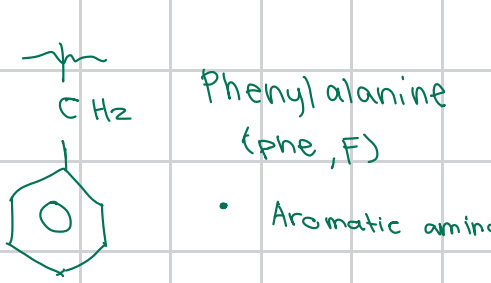
[NON POLAR AMINO ACIDS]
Phenylalanine gives a positive result with which test?
a. Biuret test
b. Ninhydrin test
c. Xanthoproteic test
d. Millon's test
c. Yellow
[NON POLAR AMINO ACIDS]
The positive result of the xanthoproteic test for phenylalanine is:
a. Violet
b. Blue
c. Yellow
d. Red
b. Aromatic amino acids
[NON POLAR AMINO ACIDS]
The xanthoproteic test is positive for:
a. Aliphatic amino acids
b. Aromatic amino acids
c. Sulfur-containing amino acids
d. Basic amino acids
b. Sulfur-containing amino acid
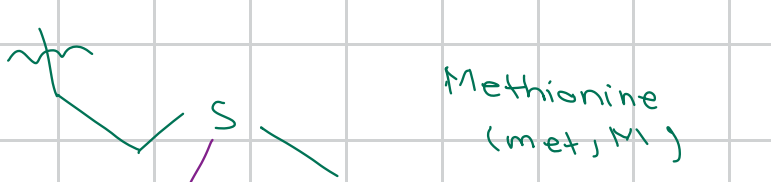
[NON POLAR AMINO ACIDS]
Methionine (Met, M) is classified as:
a. Aromatic amino acid
b. Sulfur-containing amino acid
c. Basic amino acid
d. Aliphatic amino acid
b. Thioether (R-S-R)
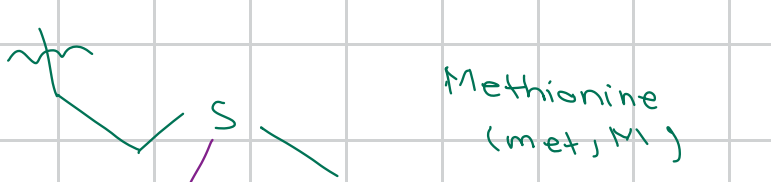
[NON POLAR AMINO ACIDS]
Methionine contains which functional group?
a. Disulfide
b. Thioether (R-S-R)
c. Thiol
d. Sulfoxide
c. Fohl's / Pb acetate test
[NON POLAR AMINO ACIDS]
The test used for methionine is:
a. Xanthoproteic test
b. Ninhydrin test
c. Fohl's / Pb acetate test
d. Biuret test
b. Aromatic amino acid
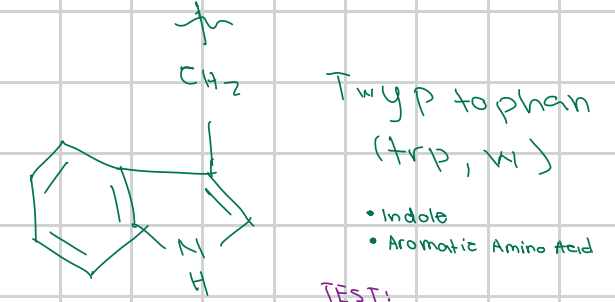
[NON POLAR AMINO ACIDS]
Tryptophan (Trp, W) is classified as:
a. Aliphatic amino acid
b. Aromatic amino acid
c. Sulfur-containing amino acid
d. Basic amino acid
b. Indole
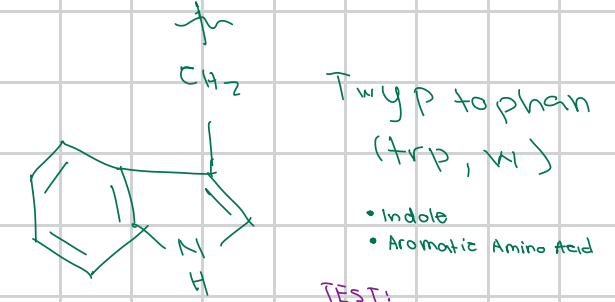
[NON POLAR AMINO ACIDS]
Tryptophan contains which ring structure?
a. Benzene
b. Indole
c. Imidazole
d. Pyrrole
c. Hopkins-Cole test
[NON POLAR AMINO ACIDS]
The test used for tryptophan is:
a. Xanthoproteic test
b. Fohl's test
c. Hopkins-Cole test
d. Biuret test
b. Thiol (-SH)
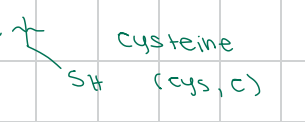
[POLAR AMINO ACIDS]
Cysteine (Cys, C) contains which functional group?
a. Thioether
b. Thiol (-SH)
c. Disulfide
d. Indole
c. Nitroprusside test
[POLAR AMINO ACIDS]
The test used for cysteine, which is the test for “thiols”
a. Hopkins-Cole test
b. Xanthoproteic test
c. Nitroprusside test
d. Fohl's test
b. Thiols (-SH)
[POLAR AMINO ACIDS]
Nitroprusside test is used to detect:
a. Aromatic rings
b. Thiols (-SH)
c. Indole rings
d. Thioethers
c. Disulfide bond
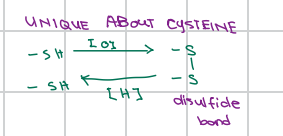
[POLAR AMINO ACIDS]
Cysteine is unique because it can form:
a. Thioether group
b. Thiol group (-SH)
c. Disulfide bond
d. Indole ring
b. Aromatic amino acid
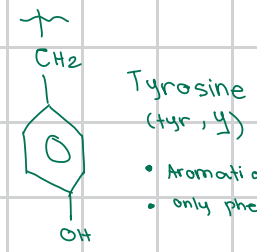
[POLAR AMINO ACIDS]
Tyrosine (Tyr, Y) is classified as:
a. Aliphatic amino acid
b. Aromatic amino acid
c. Sulfur-containing amino acid
d. Basic amino acid
c. Tyrosine
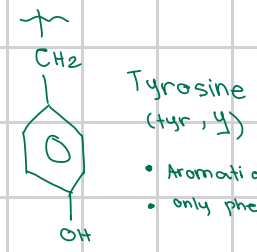
[POLAR AMINO ACIDS]
The only PHENOLIC amino acid
a. Phenylalanine
b. Tryptophan
c. Tyrosine
d. Proline
c. Millon's test
[POLAR AMINO ACIDS]
The test used for tyrosine is:
a. Xanthoproteic test
b. Hopkins-Cole test
c. Millon's test
d. Fohl's test
c. Imidazole ring
[BASIC AMINO ACIDS]
Histidine (His, H) contains which ring structure?
a. Indole ring
b. Phenolic ring
c. Imidazole ring
d. Thioether group