Family Relations Exam 1 Study Guide
 Call Kai
 Learn
Learn Practice Test
 Spaced Repetition
 Match
Match Flashcards
 Knowt Play
1/96

There's no tags or description
Looks like no tags are added yet.
Name | Mastery | Learn | Test | Matching | Spaced | Call with Kai | Chat |
|---|
No analytics yet
Send a link to your students to track their progress
97 Terms
Cherlin’s definition of the public family
One or more adults caring for dependents, plus the dependents themselves.
which of these is NOT an example of Cherlin’s definition of the public family.
A. A single parent and her children
B. A cohabiting couple caring for his ill mother
C. A married couple, no dependents
A married couple, no dependents
Cherlin’s definition of the private family
Two or more people in a close emotional relationship with a durable commitment to each other.
what does the private-family definition require and not require?
has to be two or more people (they do not have to be a couple or a household and can be a group of any size)
Close and emotional (intimate, but not necessarily sexual/romantic)
durable (lasting but not permanent but not a fling)
committed (an obligation to show up when someone needs you)
**does not require marriage, blood, children, or shared address
what is a public good?
A public good is something you get to enjoy whether or not you helped produce it.
what is the free-rider problem?
If you can have the benefit without paying the cost, why pay the cost? Someone who never raises a child still draws Social Security funded by other people’s children
Voluntary kinship versus assigned kinship
Assigned kinship = You got it automatically — by being born, or by someone marrying in. You did not choose it and you cannot resign from it
ex: cousins, your in-laws
Voluntary Kinship = You built it. Ties with people not related to you by blood or marriage who function as family anyway.
ex: the aunt who is not your aunt, godparents
what are Survey studies
Ask a large, randomly selected sample the same fixed questions. Longitudinal surveys go back to the
same people repeatedly, which lets you watch change happen rather than infer it.
what are observational studies
Spend extended time with a small number of families, watching what they actually do rather than what
they report doing. Also called field research
what are strengths and weaknesses of survey studies?
strengths: you can say what is true of a population
weaknesses: you only learn what you thought to ask, and only what people are willing to report, lomited knowledge can be obtained
what are strengths and weaknesses of observational studies?
strengths: you see how things actually work, including what people would never say out loud, detailed knowledge is obtained
weaknesses: you cannot claim the families you watched are like anyone else’s, not representative
Survey vs. observational survey lake analogy
If each type of study could be stored in a lake, a survey-based lake would be wide (because of the large number of people reach) but shallow (because of the limited time spent with each family). An observationally based lake would be narrow but deep.
Challenges for establishing causality: random assignment, confounding factors, and the
teenage-childbearing example.
what is symbolic interaction
people’s interpretations of symbolic behavior
people act on the meanings they attach to things, and those meanings are learned from others.
Meanings and categories are constructed through interaction itself (e.g., “doing gender,” “moming,” or “adulting”). Nouns become verbs because rather than take these categories for granted, SI reveals the actions and efforts behind creating and maintaining them.
what is the door holding example of symbolic interaction?
when a man holds open a door for a woman, both people may see this as merely a display of courtesy. Yet, a woman is much less likely to hold a door open for a man. Does this mean that women are less courteous than men? of course not. the symbol of a man holding a door open has an additional meaning: it reinforces the cultural message that men are physically stronger than women and should take care for them
The feminist perspective’s critique of the breadwinner–homemaker family as an equal exchange
they argue that there are social and cultural differences between men and women constructed in ways that maintain the power of men over women
their critique is that women’s direct access to money through paid employment was restricted which maintained the women’s dependence on men
they also aruge that the kinds of work that women tend to do are less valued than the kinds of work that men do
what is individualism
a style of life in which individuals pursue their own interests and place great importance on developing a personally rewarding life
what is expressive individualism
a style of life that emphasizes developing one’s feelings and emotional satisfaction
what is utilitarian individualism
a style of life that emphasizes self-reliance and personal achievement, especially in one’s work life
Ben Franklin example of individualism
he was the quintessential utilitarian individualist
in his Poor Richard’s Alamack, he advised “early to bed and early to rise, makes a man healthy, wealthy, and wise” and “God helps them that help themselves”.
this is the style of the person determined to succeed on their own to get to the top of the ladder
From lecture: “a finding is not an explanation.” Using the housework-and-satisfaction
example, distinguish reverse causation from confounding and from a causal mechanism.
Data: couples who split household labor report higher marital satisfaction.
Explanations from different view points:
Exhange theorist: Because the exchange is fairer, and unfair exchanges breed resentmen
Symbolic interaction: Because of what the division signals — doing dishes means "I see your time as equal to mine."
Feminist: Because unequal household labor is one expression of a broader structure of gender inequality.
none: Because happier couples are simply more willing to share — the arrow may run the other way
Same data. 4 theories, theory is how you argue about which one is right
what are negative externalities and give an example
A cost that lands on people who had nothing to do with producing it.
A factory’s pollution. The neighbor’s 2 a.m. party.
what are positive externalities and give an example
A benefit that spills over to people who did not pay for it and cannot be billed.
A neighbor vaccinating their child. Someone else raising a competent adult
what is the largest externality that a person will ever produce and why?
raising a child
p arents pay for it in money, in time, and in career. The benefit goes to everyone — the employers who hire that person, the retirees whose Social Security that person funds, the patients that person treats if they become a nurse. None of those beneficiaries compensate the parents.
what is boundary ambiguity
a state in which family members are uncertain about who is in or out of the family
what is an example of boundary ambiguity
in a survey about household members, a single mom usually will include her boyfriend as a member of a household
when children are asked the same question, they will exclude their mom’s boyfriend from the household and answer as if they live in a single parent household
family members are uncertain of who is in or out of the family
what is the exchange theory?
views people as rational beings who decide whether to exchange goods or services by considering the benefits they will receive, the costs they will incur, and the benefits they might receive if they were to choose an alternative course of action
explain alternatives and dependence and power within the exchange theory according to Emerson
if Mary values goods or services that that Susan has to offer, and if Mary has few alternative sources of obtaining these good or services, then Mary is dependent on Susan. The more dependent Mary is on Susan, the greater Susan’s power over Mary.
What Cherlin means by treating the family as a social institution.
families still perform work society depends on, and that justifies both studying them as an institution and supporting them publicly
Cherlin wants us to understand that families aren't just private relationships—they are also influenced by culture, laws, economics, and social expectations.
What “the primacy of the public family” meant for European colonists in early america .
For European colonists, the family was considered a public institution that was important to the whole community, not just a private relationship between family members.
In Plymouth Colony, selected families functioned as hospitals, houses of
correction, orphanages, nursing homes, and poorhouses.
The economic change that produced the separation of women’s and men’s spheres in the 1800s.
switching from farming to wage labor
instead of growing crops and tending animals, more husbands took paying job
This created the idea of separate spheres:
👨 Men → public sphere: work, politics, earning money
👩 Women → private/domestic sphere: home, children, caregiving
How enslaved African Americans maintained family and kinship ties despite slavery.
it had been believed that many African American families were disorganized and dispersed before the Civil War, but this was not actually the case. Ensalved people had married and lived a life together for life and they knew and kept track of uncles, aunts, cousins, and other kin
Why were nineteenth-century Chinese immigrant communities were so heavily male.
Many Chinese men came to the U.S. for economic opportunities, especially during the California Gold Rush and railroad construction.
U.S. immigration laws(Page Act of 1875 stopped women’s entry into americ)) and anti-Chinese discrimination made it difficult for Chinese women to immigrate and reunite with their husbands.
Companionate marriage: what changed in the ideal of marriage in the early twentieth century.
marriage became more focused on love, friendship, companionship, and emotional satisfaction rather than mainly economic security, family duty, or having children.
Elder’s research on children of the Great Depression and what determined how hardship affected them.
Glen Elder studied people who grew up during the Great Depression and found that hardship did not affect every child in the same way.
What mattered was how the hardship affected the family and the child’s circumstances:
Economic hardship could create stress and problems for families.
But some families adapted well and became more resilient.
Children’s experiences depended on factors such as family relationships, parents’ responses to hardship, and the child’s age when the Depression occurred.
Some children who experienced hardship developed greater responsibility, independence, and resilience later in life.
Why the 1950s were unusual in U.S. family history.
The 1950s were unusual because the “traditional” nuclear family was especially common and stable compared with other periods.
👨👩👧👦 Marriage rates were high and people generally married younger.
👶 Birth rates were high — this was the Baby Boom.
💍 Divorce rates were relatively low compared with later decades.
👩 Many women were expected to focus on homemaking and childrearing.
👨 Men were generally expected to be the primary breadwinners.
🏠 The male breadwinner + female homemaker family became a strong cultural ideal.
The main family trends of the 1960s through the 1990s
From the 1960s through the 1990s, U.S. families became more diverse and less centered on the traditional married-couple household.
💍 Marriage rates declined and people began marrying later.
💔 Divorce rates increased, especially from the 1960s through the 1970s and 1980s.
👶 Birth rates declined, and people increasingly had fewer children.
👩💼 More married women entered the workforce, changing traditional gender roles.
🏠 Cohabitation increased—more couples lived together without being married.
👨👩👧 Single-parent families increased, particularly households headed by unmarried mothers.
👨👩👧👦 Family structures became more diverse, including blended families and unmarried couples.
🌎 Immigration increased, contributing to greater cultural diversity in American families.
explain the new term: “Emerging adulthood”
a new stage of life
a term coined by Jeffrey Arnett in 2000: mid-teens to about 30, when people finish education, enter the labor force,
and start their own familiesIn the mid-twentieth century most young people made this transition fast, marrying at historically young ages and having children
soon after. It now takes over a decade. The main reason is education — employment prospects have improved far more for the
college-educated than for everyone else
The life-course perspective
what are cohorts?
a group of people who experience an important historical event or period around the same stage of life.
Example: People who were children during the Great Depression form a cohort with shared historical experiences.
what is the life-course perspective
the study in changes in individual’s lives over time, and how those changes are related to historical events
“The primacy of the tribe” in American Indian families before 1776
Before 1776, many American Indian societies placed greater importance on the tribe/community than on the individual nuclear family.
Kinship relationships could extend broadly throughout the community.
The doctrine of separate spheres itself (not only its cause).
The doctrine of separate spheres held that men and women had different proper roles.
Men: public life, work, politics, earning money
Women: home, morality, childcare, domestic responsibilities
It was associated with the industrial-era separation between work and home
The historical emergence of sexual identities as categories.
Sexual identities such as “heterosexual” and “homosexual” became increasingly established as social categories in the modern period.
The important point is that sexual behavior has existed throughout history, but the way society classified and understood people's sexual identities changed over time.
define sex (as the textbook defines it)
the biological characteristics through which one can classify a person as male or female
define gender (as the textbook defines it)
the social and cultural characteristics that place people on a continuum from women to men
why estimates of the share of intersex births range from about 1.7% to about 0.02%, and what the disagreement is actually about.
Two things drive the spread
Which conditions count
how consistently they get reported. Hypospadias — the urethral opening sits along the underside of the penis rather than at the tip — is excluded from the 1.7 percent, and is reported ten times more often in North America and Europe than
in much of Asia and South America.
The disagreement is largely about what researchers count as “intersex.”
The higher estimate includes a broader range of variations in sex characteristics.
The lower estimate uses a much narrower definition, often focusing on conditions that are more clearly associated with ambiguous genitalia or sex development.
Main point: The disagreement is primarily about definition and measurement, not simply different counts of the exact same thing.
what is intersex
Congenital variations in which chromosomes, hormones, gonads, and genitals do not line up in either typical pattern
(think Jamie Lee Curtis)
what is the biosocial approach
the theory that both biological and social factors influence gender differences in family-related behaviors
what are the qualifications that Cherlin attaches to the biosocial approach?
it is important to consider there is a wide range of behavior and substantial overlap
you can say to 2 large random groups that “aggression is high among men” but you could not say that about 2 individual people in front of you
predisposition becoming a behavior depends on the environment
neglectful parents may lead to aggressive child, but supportive parents may lead to well behaved temperament in the same child
social influences can counteract biological predispositions
From lecture: Kane’s (2006) study of parents’ responses to gender nonconformity in sons and daughters.
Forty-two interviews with parents of preschoolers, ages three to five
for daughters, Nonconformity generally welcomed. Sometimes with pride
for sons, Some acceptance, balanced by effort to keep them near a
masculine ideal.
“Doing gender” (West and Zimmerman): what it means to say gender is accomplished in interaction and that people are held accountable for it
Gender identification and behavior are based on day-to-day behavior that reinforces gender distinctions
gender becomes a verb - usually in a passive voice
housework is gendered, paid work is gendered, childcare is gendered, etc.
People are expected to behave in ways considered appropriate for their gender and may be judged when they don't.
Example: A man may feel pressure to act masculine around other men because he expects others to evaluate his behavior.
Gender as a social structure: the levels at which gender operates and how each shapes opportunities and constraints.
The fundamental set of positions that organize society as a whole
material level: The distribution of wealth, education, and earnings across
groupscultural level: Mental models — cultural frames — of what women and
men are like.
what is the socialization approach to gender differences
the theory that gender identification and behavior are based on children’s learning that they will be rewarded for the set of behaviors considered appropriate to their sex but not for those appropriate to the other sex
From lecture: Correll, Benard, and Paik (2007) on the motherhood penalty, including what the study found for mothers versus fathers.
Their audit/experimental research examined how having children affected employment evaluations.
The study found that mothers were evaluated less favorably in employment-related outcomes, while fathers did not experience the same penalty and could sometimes receive advantages.
This is called the motherhood penalty.
Main idea: Parenthood can affect men's and women's careers differently.
Why an audit (correspondence) study is a strong design for detecting discrimination
An audit/correspondence study can hold qualifications constant while changing something like gender or parenthood.
Researchers can then see whether employers respond differently.
This is powerful because researchers are testing actual behavior, not simply asking people whether they discriminate.
the “Man Box” study and what it found about rigid masculine norms, violence, and mental health.
The Man Box refers to rigid expectations about how men are supposed to behave.
Examples:
Don't show vulnerability.
Be tough.
Be dominant.
Don't ask for help.
Be sexually aggressive.
The study linked stronger adherence to rigid masculine norms with outcomes including greater acceptance of violence and poorer mental-health-related outcomes.
Main point: Rigid gender norms can have consequences for men and others
The asymmetry of gender change: what it is, and the chapter’s explanation for why the masculine side of it “holds.”
Asymmetry of gender change means gender roles have changed more quickly for women than for men.
Women have increasingly entered traditionally male areas such as Paid employment, Higher education, Professional careers
But men have generally made slower movement into traditionally female roles, particularly unpaid domestic work and caregiving.
Why does the masculine side “hold”?
Cherlin discusses how traditional masculinity can remain protected by:
Social expectations
Gender norms
Institutional structures
The lower social/economic rewards associated with traditionally feminine work
How Chapter 3 discusses intersectionality.
the principle that inequalities related to one social identity often overlap with inequalities in other identities
example: poor women and women from no-white racial and ethnic groups experience the social inequalities differently from middle-class white women
why early gender research had little to say about men (the “unmarked case”).
Historically, researchers often treated men as the default human experience.
Women were viewed as the group that was “different,” so researchers studied women as a special category while men remained the unmarked case.
This meant early gender research often examined women but failed to recognize men's gender as something that also needed to be studied.
an interactionist’s approach tp gender differences
the theory that gender identifcation and behavior are based on day-to-day behavior that reinforces gender distinctions
Hegemonic masculinity (Connell).
A generally accepted style of masculinity that maintains men's power over women.
it is a style, not a description of men - most men do not embody it. it still sets the standard they are measured against
Why different surveys (e.g., BRFSS and Pew) give different estimates of the transgender
population
Different surveys can produce different estimates because they use different Definitions, Questions, Samples, Age groups, Methods of collecting information, etc.
For example, asking whether someone currently identifies as transgender can produce a different estimate than asking about broader gender identity experiences
The dispute over sex differences in the brain (average differences versus the “mosaic”
view).
Some research finds average differences between male and female brains in certain characteristics.
However, there is substantial overlap.
The mosaic view argues that individual brains contain a mixture of characteristics that may be statistically more common in males or females.
Peer groups in the childhood construction of gender
researchers suspect that much of the dev of gender-specific behavior occurs from an early age in children’s peer groups.
3-year-olds are more likely to offer a to to children of the same gender than to children of the opposite gender
Bertrand, Kamenica, and Pan (2015) on couples where the wife earns more, and the
critique of that finding
They studied heterosexual couples and found a relationship between wives earning more than husbands and relationship outcomes such as marriage patterns/divorce.
The important critique is that this type of finding does not automatically prove that the wife's higher income causes divorce or relationship problems.
Other factors could influence both income and relationship outcomes.
The pace of change in gender roles since the 1960s and the current women-to-men
earnings ratio (Census P60-286)
Since the 1960s, women's participation in education and paid employment has increased substantially, and gender roles have become less traditional.
However, differences in earnings remain.
men’s median full time earnings: $71,090
women’s median full time earnings: $57,520
Table 3.1’s four approaches to gender and the contributions of gender studies to family sociology.

Cherlin’s definition of a sexual identity
the formation in people’s minds of an identity such as heterosexual, gay, lesbian, bi, queer based on romantic and sexual attraction
The three ways surveys measure sexual orientation and why they do not identify the same people.
1. Attraction — Who are you sexually/romantically attracted to?
2. Behavior — Who have you had sexual experiences with?
3. Self-identification — What label do you use for your sexuality?
why? Someone may have had a same-sex experience but identify as heterosexual.
what is the social constructionist perspective on sexuality
the belief that human sexuality is entirely socially constructed
what is queer theory
Challenges the assumption that sexual identity is fixed, natural, and universally the same. Social, cultural, institutional, and power dynamics
shape it
sexuality and gender are artificially organized into categories that reflect the power of heterosexual norms
what does queer theory challenge
the assumption that sexual identity is fixed, natural, and universally the same
what is queer theory’s stance toward institutions such as marriage
Queer theory questions and challenges traditional institutions like marriage, rather than simply accepting them as natural or necessary.
queer theorists may criticize marriage as an institution that reinforces traditional norms, while also recognizing that marriage can be meaningful and beneficial to people who choose it.
What research on children raised by same-sex parents generally finds, and the
limitations of some of that research
Research generally finds that children raised by same-sex parents do not show broad disadvantages simply because their parents are same-sex couples.
Important limitations:
Some studies have small or nonrepresentative samples.
Older research sometimes had methodological problems.
Family outcomes can be affected by many factors beyond parents' sexual orientation.
how does a queer theorist feel about same-sex marriage being legal
Most queer theorists consider that an advance, and are still ambivalent about it
Winning the right to marry reinforces the idea that marriage is the
central form of family life — the premise queer theory rejects.
Some argued against pursuing it for that reason
How sexual frequency differs by relationship status (single, cohabiting, married) and
why
Single people: May have fewer consistent opportunities for sex because they don't have a regular sexual partner.
Cohabiting couples: Live together, so they have frequent access to a partner and may have more sex than singles.
Married couples: Also live together and have an ongoing sexual relationship, so they tend to have frequent sex.
However, relationship status itself doesn't necessarily cause the differences. Other factors—such as age, relationship length, having children, health, and how satisfied people are with their relationships—can also affect sexual frequency.
Trends in adolescent sexual activity and teen births since the early 1990s
Since the early 1990s, adolescent sexual activity and teen birth rates have generally declined.
The decline in teen births has been especially substantial.
Ganna et al. (Science, 2019) — the design, the central finding about
genetics and same-sex sexual behavior, and what the results cannot do.
Researchers used a very large genetic dataset to study genetic influences on same-sex sexual behavior.
They found that genetics plays a role, but there is no single “gay gene.”
Many genetic variants contribute small amounts, along with environmental and other factors.
What it cannot show:
It cannot predict an individual's sexual orientation.
It cannot identify one gene responsible for same-sex sexual behavior.
It does not establish that genetics completely determines sexuality.
the General Social Survey trend (1972–2021) in attitudes toward premarital sex compared with extramarital sex (sexual activity between a married person and someone who is not their legal spouse)
From 1972–2021, Americans became substantially more accepting of premarital sex.
Attitudes toward extramarital sex remained much more negative.
Raifman et al. (JAMA Pediatrics, 2017) — what the study compared and
what it found for adolescents, especially sexual-minority students.
The historical emergence of sexual identities; what twin studies do and do not show
about biological influences
Twin studies compare:
Identical twins → share almost all genes
Fraternal twins → share about half their genes
If identical twins are more similar on a trait, this can provide evidence for genetic influence.
But twin studies cannot show that genes completely determine a trait.
Obergefell v. Hodges (2015).
Obergefell v. Hodges was a U.S. Supreme Court decision establishing that same-sex couples have a constitutional right to marry throughout the United States.
The selection problem in research on teenage childbearing (sister-comparison studies)
and, from lecture, Diaz and Fiel (2016).
The selection problem means that teenagers who become parents may already differ from teenagers who don't.
For example, they may differ in: Poverty, Family background, Education, Neighborhood,Academic performance, etc.
Therefore, later differences between their children and other children cannot automatically be attributed to teenage parenthood itself.
Sister-comparison studies: Compare children of teenage mothers with children of their mothers' sisters to help control for some family background factors.
Diaz and Fiel (2016)
This research addresses the difficulty of determining whether teenage childbearing itself causes later disadvantages or whether preexisting family/social characteristics explain some of the association.
“Catch-up marriage” among four-year college graduates.
Catch-up marriage refers to the tendency for college-educated people who delay marriage while establishing careers to marry later, sometimes after reaching greater economic stability.
The marriage occurs after they have established themselves economically.
Edin and Kefalas’s study of low-income women in Philadelphia: why many had children
before marrying
Edin and Kefalas studied low-income women and found that many women did not view marriage as a necessary first step before having children.
Reasons included:
Marriage was viewed as a major commitment.
Women wanted economic and relationship stability first.
They wanted a partner who met certain standards.
Having a baby could be seen as more attainable than having a “successful” marriage.
Important: This research shows how people understand marriage within their social and economic circumstances.
Assortative marriage, and how the relative importance of religion and education in who
marries whom has changed since the 1930s
assortative marriage is the tendency of people to marry others similar to themselves
in the 1930s, religion was a more important determinant for who marries whom than education. protestants with protestants and catholics with catholics
in the last half century, college grads became increasingly likely to marry each other
How the risk of divorce has changed since about 1980, and for whom it has changed
most.
since the 1980s, divorce rates have decreased
the drop has been greatest for college graduates than those less educated
Weber’s concepts: life chances and status group (and how each differs from social
class)
life chances: the resources and opportunities that people have to prove themselves with material goods and favorable conditions
status group: a group of people who share a common style of life and often identify with each other
differences in life chances and styles of living suggest that 3 status groups, people with college degree, people with hs diplomas, and people without hs diplomas may be as useful as the 4 broad social classes (upper, middle, working, and lower class)
Lareau’s two childrearing styles: concerted cultivation and the accomplishment of
natural growth
concerted cultivation: middle class families tend to actively enhance children’s talents, opinions, and skills; as if parents were cultivating a gaarden so its plants would grow as well as possible
accomplishment of natural growth: working-class and poor parents emphasized providing a safe environment and love and letting children grow on their own
Reference group theory and how Cherlin uses it to explain “deaths of despair” (more death) among
less-educated whites but not less-educated Blacks or Hispanics.
reference group theory: the idea that to understand how people behave, one needs to know who are what they are comparing themselves
when less educated white people make mental comparisons, they remember the prosperity of their white fathers and become depressed they are not as prosperous\
when less educated black people make mental comparisons, they remember their oppressed forefathers and become proud of how far they have come since then
Polarization of the labor market and the “hourglass” image; family inequality.
The labor market has increasingly divided into:
High-skill/high-paying jobs
⬆
Low-skill/low-paying jobs
⬇
while many middle-skill/middle-paying jobs have declined.
This produces an “hourglass” shape.
Why families care: Different jobs provide very different levels of income and stability, contributing to family inequality
Figure 5.1 (family income by education, 1950–2000)
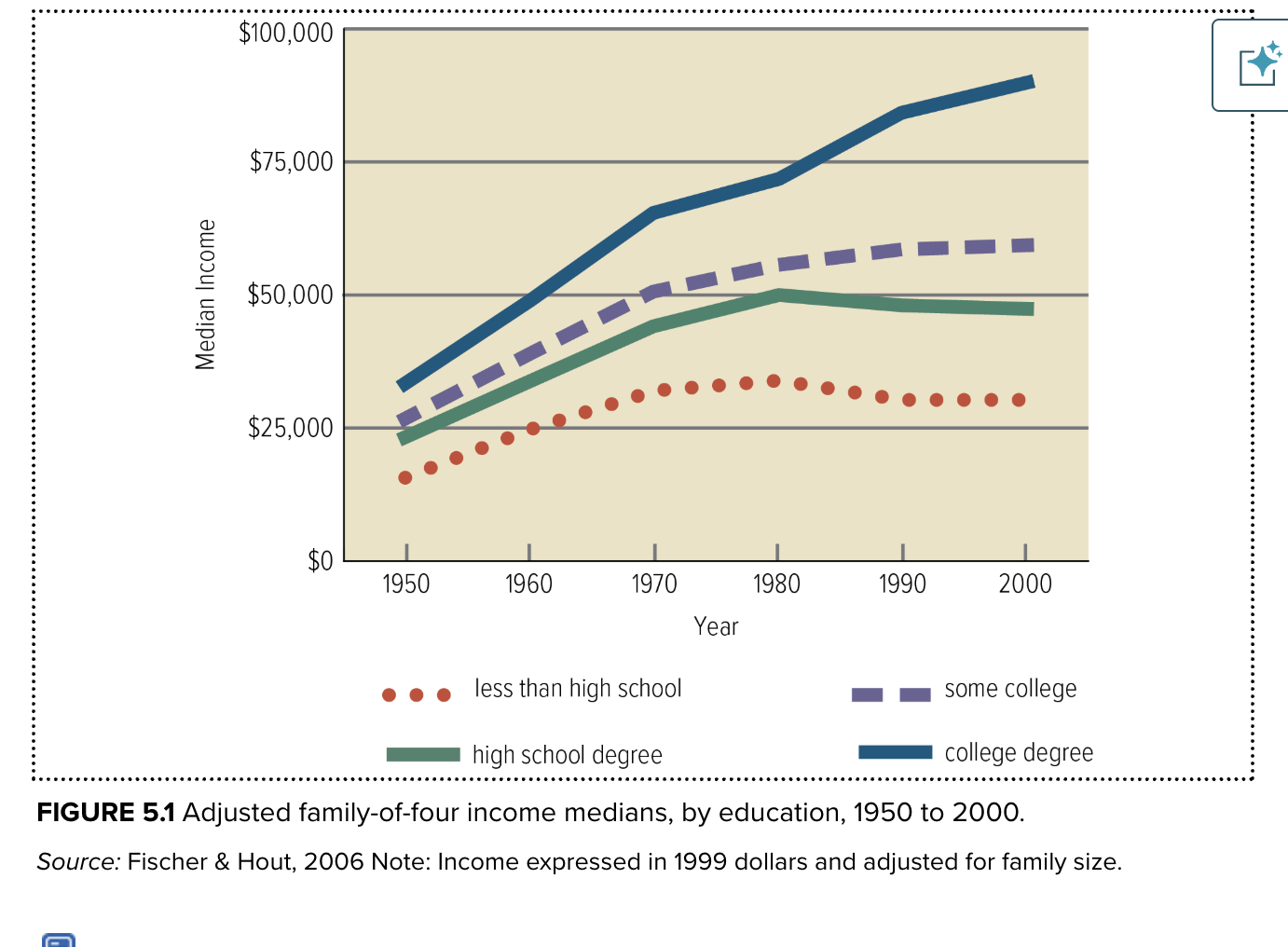
Figure 5.2 (share of women
married at the time of a birth, by education)

The three educational “submarkets” in the marriage market
people with bachelor’s degrees
people who graduated from high school and may have attended some college
people who did not gradute highschool
The four-class model as an ideal type
An ideal type is a simplified model used by sociologists to understand reality.
The four-class model divides society into broad categories based on economic/social position.
It is not saying that every real person fits perfectly into one category.
upper, middle, working, lower