lecture 1 stats
 Call Kai
 Learn
Learn Practice Test
 Spaced Repetition
 Match
Match Flashcards
 Knowt Play
1/54

There's no tags or description
Looks like no tags are added yet.
Name | Mastery | Learn | Test | Matching | Spaced | Call with Kai | Chat |
|---|
No analytics yet
Send a link to your students to track their progress
55 Terms
What is Statistics?
Statistics is a way of reasoning, along with a collection of tools and methods, designed to help us better
understand the world
Descriptive statistics:
Methods for organizing and summarizing data
inferential statistics:
Drawing conclusions about populations based on sample data
Experimental units:
Also referred to as individuals, subjects, or elements under study. These
are the people or objects we gather information about.
Variables:
Characteristics of the individuals that you measure and they have units. They can
differ from one individual to the next. We have two different types:
Categorical Variables:
places an individual into one of several groups or categories. If
there is an order to the categories, these are called Ordinal Variables.
Quantitative Variables:
takes numerical values for which arithmetic operations such as
adding and averaging make sense.
POPULATION:
(size N) Entire collection of individuals/elements you wish to study
SAMPLE:
(size n) Representative subset of the population
It mirrors the key traits, age, size, and diversity of the whole group.
STATISTICS (reg letters)
Measurements made on sample data
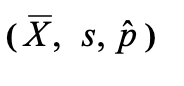
PARAMETERS (greek letters)
Measurements made on population data
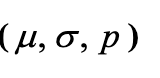
BIAS:
Systematically favoring a particular group or groups in sampling
(the sample is not representative of the population)
1) Of all the students enrolled in a certain college, 80% are full time. (population)
80/100 + 0.8 (answer is p=0.8)
Average height for 15 male SDSU students was 72 in. (sample)
statistic x̄=72
sample Survey:
A subgroup of a larger population is questioned on a set of topics
the sample size is essential not the……..
…..population size
What would help us minimize sampling bias?
randomness - dont leave room for bias to come in
A census makes an attempt to sample everyone in the population. What are some of the drawbacks?
- Some residents get left out.
• Populations are not static.
• Some people do not complete all of the information asked for.
• The costs and resources are incredibly high
Simple Random Sample (SRS):
Each member of the population and every sample of size n has an Equally Likely Chance of being selected for the sample. (example: drawing names from a hat)
Sampling Frame:
The list of items or subjects you wish to sample from.
Sampling Variability:
Each sample will select different people, and therefore, different
values for the measured variables (no two samples will be identical)
Stratified Random Sample: non over lapping groups (some from all)
In a stratified sample the sampling frame is divided into non-overlapping groups or strata, e.g. geographical areas, age groups, genders that have similar characteristics. A random sample is taken from each stratum and then these smaller samples are
combined to form the entire sample.
Cluster Sampling: overlapping groups (all from some)
The population is divided into groups called (heterogeneous) clusters. We then randomly select clusters and measure all of the individuals within the clusters that have been selected.
Multistage random sampling selects a sample in several steps, moving from larger groups to smaller ones.
Example: Randomly choose some states, then counties within those states, and finally neighborhoods within those counties. Continue until the groups are small enough for the study.
Sampling Methods to Avoid:
• Voluntary Response Sampling: Individuals are asked to provide information, and all who
respond are counted.
• Convenience Sampling: Selects individuals that are easiest to reach.
Systematic Random Sample
Systematic sampling is possible when the population of interest can be viewed as a list. Divide the list into as many consecutive segments as you need, randomly choose a starting point in the first segment, then sample at that same point in each segment. This method is often used in industry for quality control.
A survey is to be taken to ascertain student opinions about the quality of teaching at a high school
what kind of sampling strategy is used. if
an official school roster of the 2000 students, pick every 20th name.
Systematic Random Sample
A survey is to be taken to ascertain student opinions about the quality of teaching at a high school
what would the sampling strat be if
Separate the students by class (freshman, sophomore, junior, senior). Pick a simple random sample of size 25 from each of the four groups, and then combine these students into one sampleof size 100.
Stratified Random Sample ( b/c they are non overlapping groups)
A survey is to be taken to ascertain student opinions about the quality of teaching at a high school
what would the sampling start be if Using a random number table, 100 names are chosen from the list of 2000 students registered at
the high school.
simple randome samplings
a survey is to be taken to ascertain student opinions about the quality of teaching at a high school
what would the sampling strat be if Using a random number table, 100 names are chosen from the list of 2000 students registered at
the high school.
cluster
A State group is interested in whether voters would support lowering the legal drinking age to 18. A simple random sample of 25 voters is selected from each county in the state and asked whether they approve of lowering the drinking age. This is an example of
a) Systematic sampling
b) Multistage sampling
c) A simple random sample
d) Stratified sampling
d) Stratified sampling
Undercoverage:
When some groups in the population are left out of the process of choosing the
sample.
Nonresponse Bias:
When an individual chosen for the sample can’t be contacted or refuses to
cooperate.
Response Bias:
The behavior of the respondent or of the interviewer influences the outcome of
the survey or questionnaire.
A business magazine mailed a questionnaire to the human resource directors of all the Fortune
500 companies, and received responses from 23% of them. Those responding reported that they
did not find that such surveys intruded significantly on their workday.
nonresponse bias
Suppose you are conducting a survey regarding illicit drug use among sophomores in the Baltimore School District. You obtain a random sample of 12 schools within the district and have teachers verbally administer the surveys to all sophomores.
response bias
Researchers want to estimate how many college students work while attending school. They survey students on campus between 10 a.m. and 2 p.m.
undercover bias
You are trying to determine the average age of students at SDSU. The average age of 50 randomly selected SDSU students is 20. 20 is best described as:
A. Population B. Sample C. Parameter D. Statistic
D - statistic
The general manager of a luxury hotel decides to check the quality of housekeeping by inspecting 15 rooms. Consider that the hotel offers economy and business-class rooms as well as suites. Select the best method of sampling 15 rooms from the choices below:
A) Take a simple random sample of 15 rooms from all rooms at the hotel.
B) Randomly select one floor from the hotel and check the first 15 rooms.
C) Stratify according to type of room and randomly select 5 rooms from each to inspect.
D) There are 15 suites, so select those and inspect each.
C) Stratify according to type of room and randomly select 5 rooms from each to inspect.
All twenty-three birdwatchers at a randomly selected national park were asked if they saw any bluebirds. What sampling method was used?
A. Simple Random Sample
B. Stratified Sample
C. Cluster Sample
D. Convenience Sample
C. Cluster Sample
A State University group is interested in whether voters would support lowering the legal drinking age to 18. They have chapters on each of California’s major universities. Each of these chapters randomly selected 25 students and asked whether they approve of lowering the drinking age. The most significant bias introduced here is
A. Response Bias
B. Non Response Bias
C. Undercoverage
D. Convenience Sampling
C. Undercoverage
An Observational Study
observes individuals and measures variables of interest but does not
attempt to influence the responses.
type of observational study
Retrospective study
is a study that looks backwards in time. A typical retrospective design is used
when studying a disease that takes a long time to appear. The biggest problem in a retrospective study isthat some of the information that we need may be hard to get.
Retrospective observational study ex
Example: Smoking and Lung Cancer
Selecting patients who have lung cancer and asking how much they smoked. Are there any biases with
this type of design
Prospective study
(type of observatonal study)
is a study that looks forward in time. The study usually involves taking a group of
subjects (cohort) and following them over a long period of time. The outcome of interest should be
common and retaining participants in the study is important to avoid bias. These studies usually have less
chance of bias than retrospective studie
A comparative experiment
compares the effects of different treatments, one of which may be
really no treatment, or the control group.
Example #2: A researcher is studying the conditions under which commercially raised shrimp reach maximum weight gain. Two water temperatures (25 degrees, 35 degrees) and four water salinity levels (10%, 20%, 30%, 40%) are selected for study. Shrimp are raised in containers with specified water temperatures and salinity levels. The weight gain of the shrimp in each container is recorded after a six-week study period.
a) Identify the response variable. - weight gain
b) Identify the explanatory variable(s) in this experiment. - water temp, sanitary levels
c) List the treatments for the experiment. - 8 treatments (8 tanks)
Control Groups:
Using control groups helps to ensure that we account for known factors that could affect a study’s results. Researchers, however, may be unaware of important factors and not account for them in the experiment.
Randomization:
To ensure that we do not impose personal bias in the selection process, and use enough subjects in each group to reduce chance variation i
Blocking:
Grouping together subjects with similar characteristics. All experimental conditions are then administered to each block.
Example #1: Does music make plants grow faster? You divide 100 plants into two groups: shade plants and sun plants. Within each group, you randomly assign plants to one of three types of music: classical, rock, or reggae The selected type of music is played to each plant for 30 min a day over a period of 6 weeks. a. What type of experimental design is being employed? _________________
Blocking
A golf club manufacturer has designed a new style of golf club that it claims will help golfers hit the ball farther. Fifty golfers are randomly selected, and the hitting distance is determined for each with several types of golf clubs. The golfers are then each given a set of the new clubs, and are asked to practice with them. After the practice period, their hitting distances are again determined. A comparison is made for each golfer between their hitting distance before receiving the new clubs and after practicing with them. What type of experimental design is this?
A. Completely randomized design
B. Randomized block design
C. Matched Pairs design
D. This is not an experiment.
matched pairs
1. Completely Randomized:
randomly assigning subjects into treatment groups and measuring an outcome.
Matched Pairs:
Choose pairs of subjects that are as closely matched as possible in characteristics that may have an effect on the outcome. Then randomly assign them into treatment groups.
Lurking variables:
It is a variable that is not among the explanatory or response variables, but influences the interpretation of the relationship