Billing and coding
 Call Kai
 Learn
Learn Practice Test
 Spaced Repetition
 Match
Match Flashcards
 Knowt Play
1/37

There's no tags or description
Looks like no tags are added yet.
Name | Mastery | Learn | Test | Matching | Spaced | Call with Kai | Chat |
|---|
No analytics yet
Send a link to your students to track their progress
38 Terms
Advanced Practice Registered Nurses are
Revenue Visible - now we bill for services provided
Medicare
Centers for Medicare and Medicaid Services
A federal program mainly for adults age 65 or older, or younger people with certain disabilities. It does not have income limits. It is the same across the whole country. It uses parts like Part A for hospitals and Part B for doctor visits
Medicaid
A joint federal and state program for people of any age who have low income and limited resources. Rules and benefits can change depending on the state. It covers more long-term care and dental services than Medicare
Private Insurers
United Healthcare
Blue Cross and Blue Shield
fill out packet and insurance company decides if provider is approved then they come up with amount they cover for services
What drives reimbursement?
DOCUMENTATION
CPT codes (E/M)
used to drive statistics (like how many people die of heart attack that year)
ICD codes
NPI number
individuals “social security number” for medical services
Process for Billing/Coding
Determine
Site of service
outpatient
Type of patient
new
established
Choose
Medical Decision Making (MDM)
Total time spent on provision of services
Document
Document a medically appropriate history and/or examination to support MDM or time spent
New or Established patient
You transfer to a new practice and assume the care of patient within the practice?
Established
New or Established Patient
You transfer to a new practice. A patient that you have seen within the last 3 years schedules an appointment with you?
New
New or Established Patient
A patient presents to you for primary care. This is your first encounter, but the patient has been seen by cardiology in your group practice?
New
You work for a hospital organization in the outpatient clinical setting. A patient has been seen at location A and now presents to be seen at location B?
Established
You are an FNP on call for a group primary care practice and receive a call from an established patient with another provider, but is new to you?
Established
You are an FNP on call for the cardiology group you work for. You receive a call from an established patient with another provider, but is new to you?
Established
Medical decision making guidelines
Extensive clarifications provided in the guidelines to define the elements of MDM
4 levels:
straightforward
low
moderate
high
Time
Total time spent with the patient on the date of the encounter
Including non-face-to-face services
Clear time ranges for each code
3 elements to guide level of MDM
number and complexity of problems addressed
amount and/or complexity of data reviewed and analyzed
risk of complications and/or morbidity or mortality of patient management
Summary chart for codes and MDM and Time
New vs Established patient
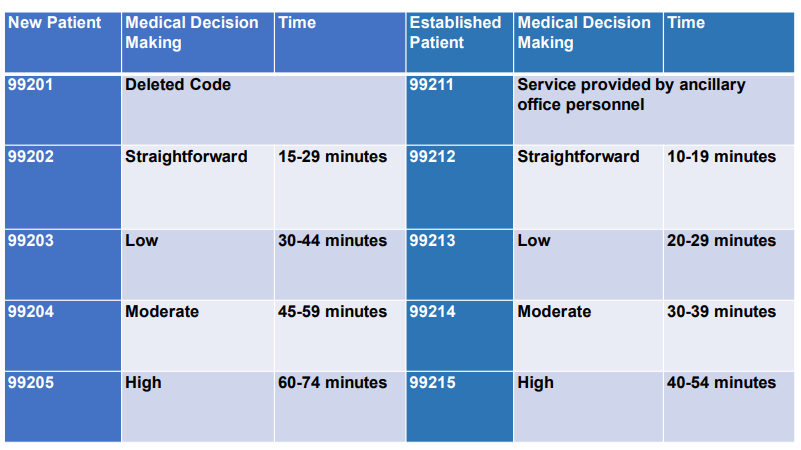
1ST ELEMENT - Number and Complexity of Problems
Chart summary for straightforward, low, moderate, high
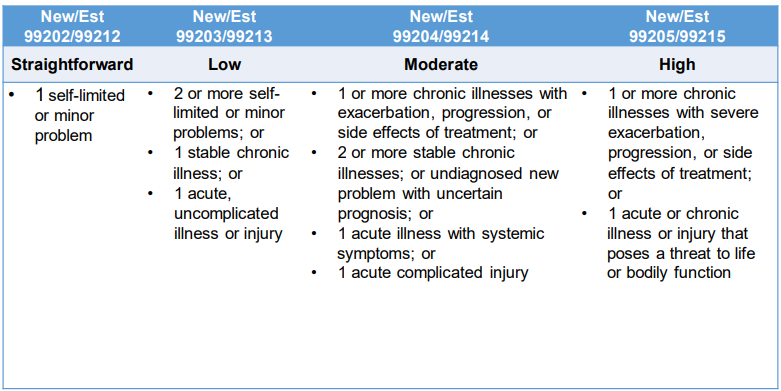
Definitions for
minor/self-limited problem
Stable, chronic illness
Acute, uncomplicated illness/injury
Acute Complicated injury
insect bite
BPH
urinary tract infection
pyelonephritis
Must have sufficient evidence in your documentation to support you reviewed medical issues (ex T2DM: reviewed average BG, diet, exercise, foot care, etc)
Must reflect that problems were sufficiently evaluated and/or treated
Simple notation of another professional managing a problem without additional assessment or care coordination does not qualify
Referral without evaluation or consideration of treatment does not qualify as being addressed or managed
2ND ELEMENT - Amount and/or complexity of data to be reviewed
Data are divided into three categories:
Tests, documents, orders, or independent historian(s). (Each unique test, order or document is counted to meet a threshold number)
Independent interpretation of tests (not separately reported)
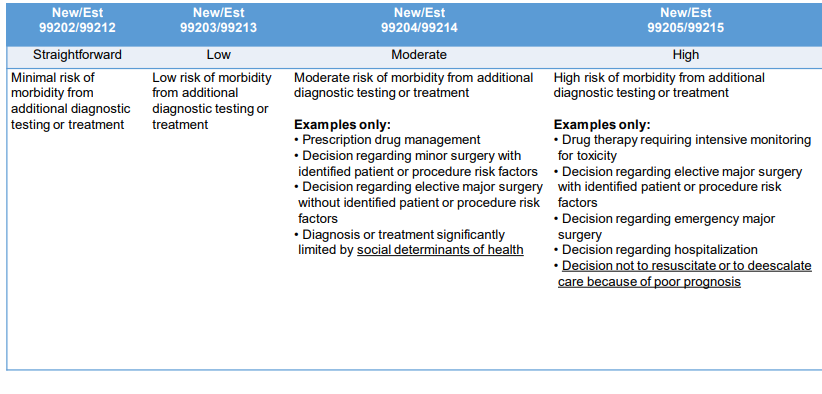
Discussion of management or test interpretation with external physician or other qualified healthcare professional or appropriate source
Chart summary for 2ND ELEMENT - Amount and/or complexity of data to be reviewed
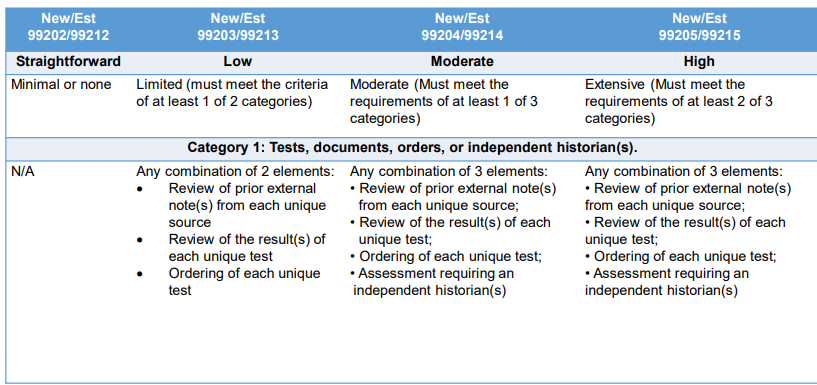
Chart summary for 2ND ELEMENT - Amount and/or complexity of data to be reviewed = continued 2
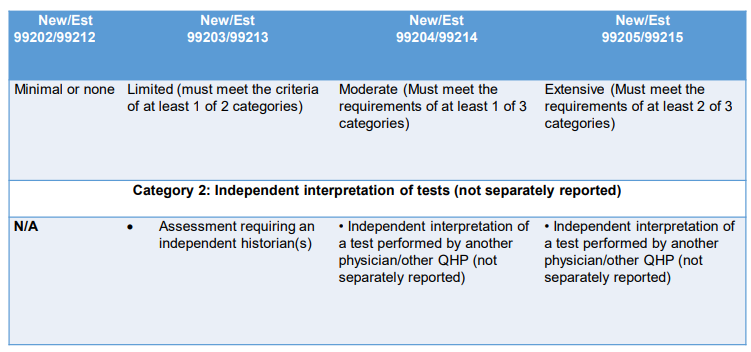
Chart summary for 2ND ELEMENT - Amount and/or complexity of data to be reviewed = continued 3
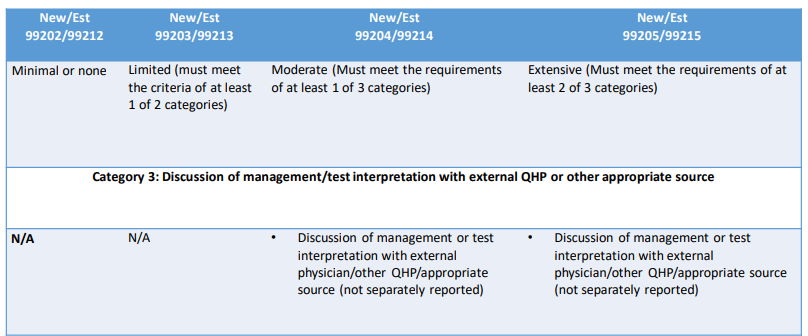
3RD ELEMENT - Risk of complications and/or morbidity or mortality of patient
new under moderate = social determinants of health
new under high = decision not to resuscitate or deescalate care d/t poor prognosis
Time requirements and things NOT included
Requirements:
A face-to-face encounter
Time spent on date of the encounter
Non-face-to-face activities performed the same calendar day
Do NOT include:
Time spent by office staff
Time spent on any other calendar day
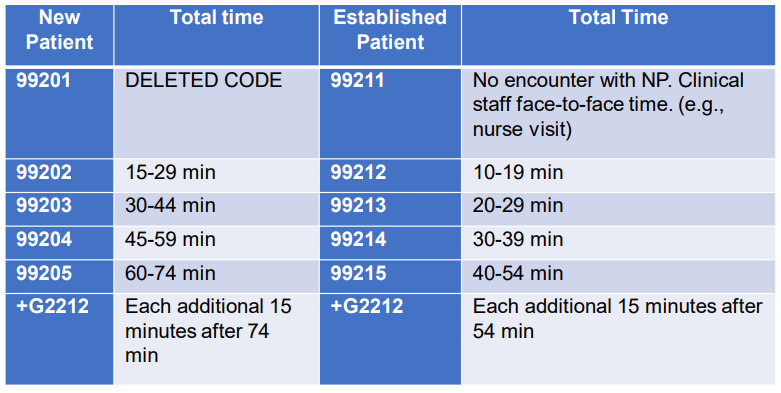
Chart summary of EM codes according to time
Time components
Preparing to see the patient (e.g., review of tests) •
Obtaining and/or reviewing separately obtained history •
Performing a medically appropriate examination and/or evaluation •
Counseling and educating the patient/family/caregiver • Ordering medications, tests, or procedures •
Referring and communicating with other healthcare professionals (when not separately reported) •
Documenting clinical information in the electronic or other health record •
Independently interpreting results (not separately reported) and communicating results to the patient/family/caregiver o
Example: Interpreting results of an ECG. •
Care coordination (not separately reported)
Prolonged Servies codes
CMS code G2212
With or without direct patient contact.
Do not report for any time unit less than 15 minutes
CMS code 99358
Non-face-to-face
30-60 minutes in a single day
Date other than the date of the encounter
Justifiable documentation of time
Itemization NOT required
Documentation must accurately reflect services rendered
Avoid overstating the actual time spent
How to describe time documentation
Documentation of time should describe what was done and time spent
Example: “I spent a total of 25 minutes reviewing the patient’s diagnostic tests, seeing the patient, talking with the nurse, and documenting in the record.” This justifies a 99202 visit for a new patient or a 99213 visit for an established patient. It is NOT necessary to denote time spent in each activity
How to Determine whether or not to use MDM or time?
Consider
Time: if considerable time is spent collecting the history or performing the exam, or considerable time is spent on patient education
MDM: if several tests are ordered, consult with other providers are consulted, complex data are reviewed
Time: if the patient is medically complex (e.g., a level 5 E/M), but time spent is excessive
Documentation that must be included on patient encounter?
1.Reason for the encounter and relevant history, physical examination findings, and prior diagnostic test results
2. Assessment, clinical impression, or diagnosis
3. Medical plan of care
4. Date and legible identity of the observer
Why do we document?
• to evaluate and plan the patient’s immediate treatment
• to monitor his/her healthcare over time
• communication and continuity of care
• timely claims review and payment
• appropriate utilization review and quality of care evaluations
• collection of data that may be useful for research and education
LEGAL COMPLAINTS!!
If the rationale for ordering diagnostic and other ancillary services is not documented, it should be easily inferred
• Past and present diagnoses should be accessible to the treating and/or consulting physician
• Appropriate health risk factors should be identified
• The patient’s progress, response to and changes in treatment, and revision of diagnosis should be documented
• The CPT and ICD codes reported on the health insurance claim form or billing statement should be supported by documentation in the medical record
Tips for documentation
An “abnormal” without elaboration is not sufficient
• Note normal/negative findings by a brief statement related to unaffected area(s) or asymptomatic organ systems(s)
• Ancillary staff may document the HPI, PFMS history and review of systems
Provider should verify the information, update if applicable, and indicate verification
The physical exam and medical decision-making activities must be performed by the QHP
Legible • Acronyms • Consistent
Ex: Diagnosis listed as right hemiparesis, but neurological assessment is documented as normal
• Avoid generic documentation: For example, list specific documents reviewed and the results or how the documents relate to the patient, rather than just stating “external documents reviewed”
ICD Code
make them as specific as possible
Ex: E11 vs E11.21 (more specific)
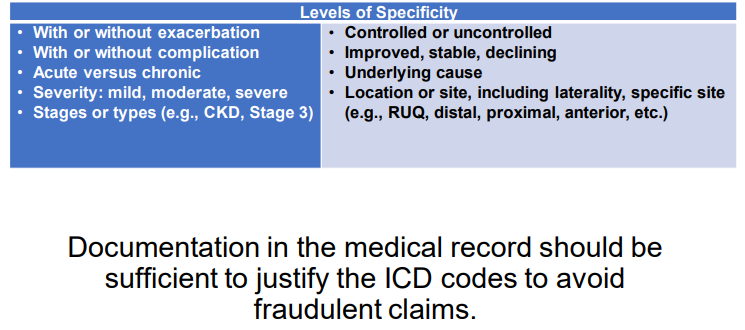
Rules to get Highest level of specificity of ICD
1.Helps assure appropriate reimbursement
2. Avoid unbillable & codes that are not reimbursable.
Ex: asthma, unspecified
3. Document signs and symptoms in the absence of a confirmed diagnosis
4. Align CPT code with the ICD code to avoid a rejected claim
Ex of unaligned codes: coding the performance of a skin biopsy under a diagnosis code of diabetic nephropathy
5. Diagnosis management requires a link of each diagnosis to an action (e.g., a prescription, test, etc.). Simply stating that the condition is managed by another provider is not sufficient
6. Capture all important details of the patient management
Ex: Homelessness code (Z59.0) or extreme poverty (Z59.5) addresses social determinates of health and helps support a higher level of medical decision making
Responsibilities of provider
Every provider is legally responsible for assigning the appropriate codes according to the services provided and knowing how their provider number (NPI) is being utilized
It is your professional obligation to be vigilant in avoiding unethical and fraudulent billing practices
You are responsible for submitting accurate claims
E/M coding is for services that you provided
Services provided must fall within your scope of practice