Naplex: Calculations III: Parenteral & Enteral Nutrition
 Studied by 0 people
 Call Kai
 Learn
Learn Practice Test
 Spaced Repetition
 Match
Match Flashcards
 Knowt Play
1/112

There's no tags or description
Looks like no tags are added yet.
Name | Mastery | Learn | Test | Matching | Spaced |
|---|
No study sessions yet.
113 Terms
Enteral Nutrition (EN) uses the ______ to deliver caloric needs
GI tract
Parenteral Nutrition (PN) uses the _____ to deliver caloric needs
vein
what are the 3 main components of calories?
carbohydrates
fat
protein
"calories" is used to refer to
kilocalories or kcals
when is PN indicated
when the patient is not able to absorb adequate nutrition via the GI tract for > 5 days.
what is 2-in-1 PN formulation?
contains 2 macronutrients (dextrose and amino acids) in 1 container. Lipids are infused separately, if needed.
what is 3-in-1 PN formulation?
contains 3 macronutrients (dextrose, amino acids and lipids) in 1 container.
3-in-1 formulations are also called TNA (total nutrition admixture) OR TPN (total parenteral nutrition)
what is Clinimix
3-in-1 three chamber formulation where each macro is separated by a seal that is broken before administration to mix the solutions together.
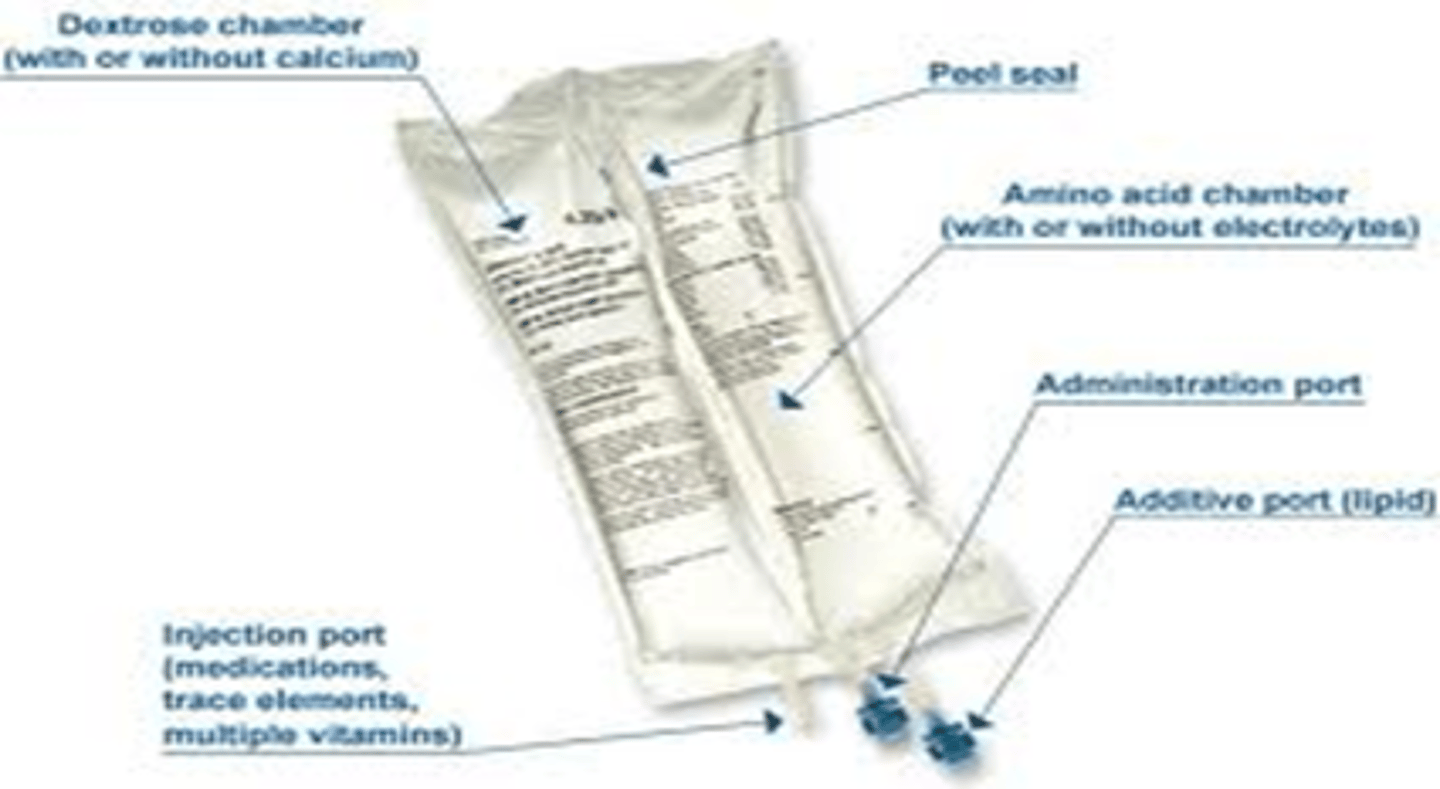
what extra does Clinimix-E contain
electrolytes
PN: which IV access?
short term (<1 week): peripheral is possible, but high risk of phlebitis
central line is preferred (PICC)
PN requires what when administrering? why?
filter
risk of precipitate
what is the formula for calculating daily fluid needs for TPN patient
when weight > 20 kg: 1,500 mL + (20 mL)(weight in kg - 20)

which weight is used for PN daily fluid needs?
total body weight
GG is a 57-year-old female admitted to the hospital with bowel obstruction. She will be NPO for the next 5-7 days. The decision was made to start PN therapy. She weighs 65 kg. Her SCr is 1.3 mg/dL. Calculate GG's daily fluid requirements.
1500 + 20ml(65-20) =
2,400 mL/day
a 76-year-old, 154 lb patient is NPO and needs hydration. she is afebrile and does not have HF, renal disease or ascites. what volume of fluid should the patient receive per day?
1500 + (20ml)(70-20) =
2,500 mL/day
what does BEE and BMR mean?
Basal Energy Expenditure
and
Basal Metabolic Rate
both are the same thing
what is BEE and BMR?
the energy expenditure in the resting state, exclusive of eating and activity
what is the BEE formula
BEE (males): 66.47 + 13.75(weight in kg) + 5(height in cm) - 6.76(age in years)
BEE (females): 655.1 + 9.6(weight in kg) + 1.85(height in cm) - 4.68(age in years)
provided on exam
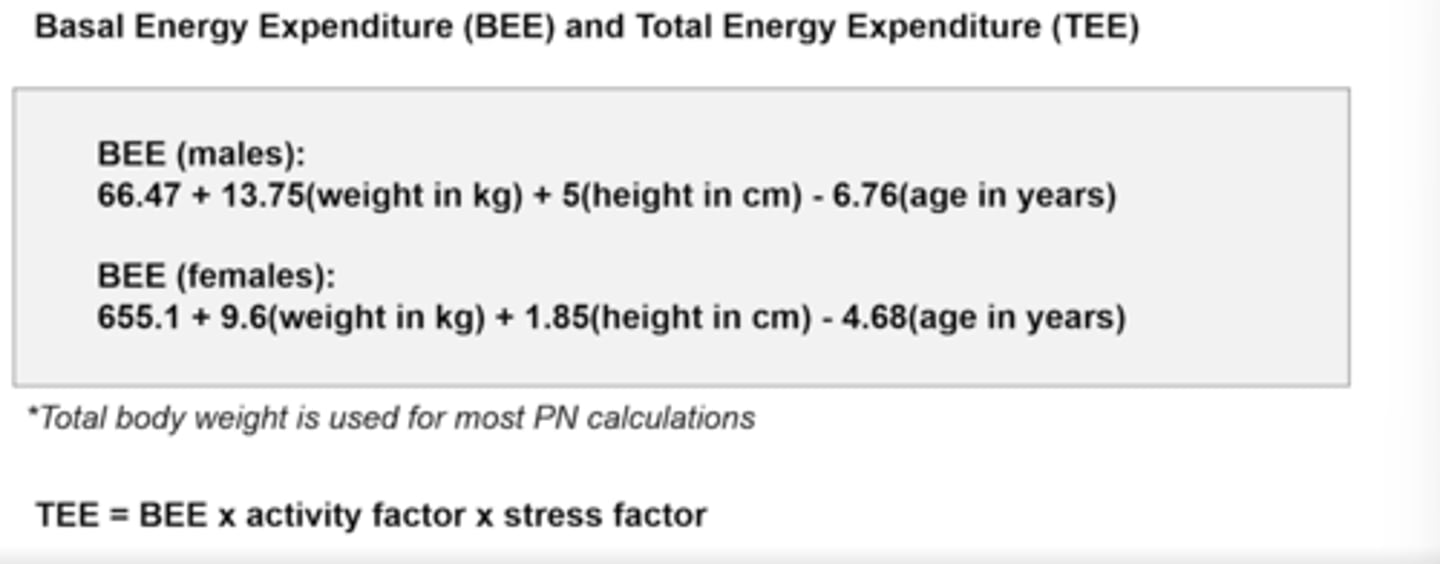
which wt is used most PN calculations?
total body weight unless stated otherwise in the question
what does TEE stand for?
total energy expenditure - A measure of Basal energy expenditure plus excess metabolic demands as a result of stress thermal effects in energy from activity
what is the TEE formula
TEE = BEE x activity factor x stress factor
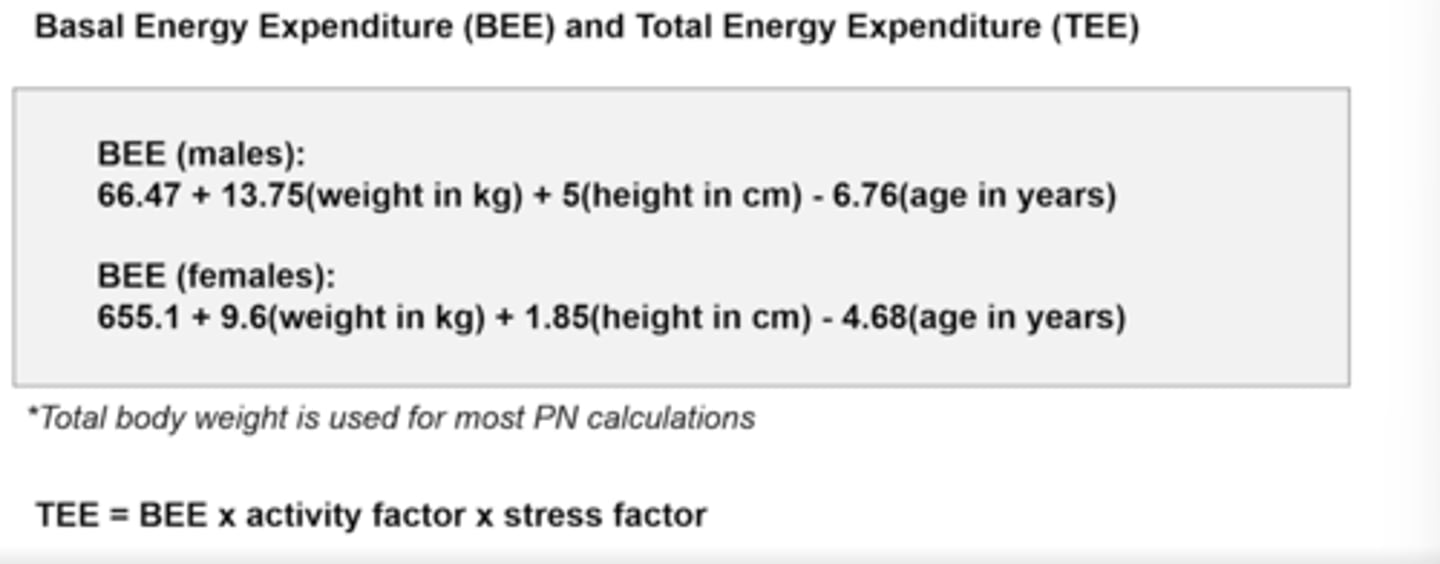
using the harris-benedict equation, calculate the basal energy expenditure for a 66-year old male with major trauma (stress factor 1.5). he weighs 174 pounds and is 5'10". activity factor is 1.2. Round answer to the nearest whole number.
BEE: 66.47 + 13.75(weight in kg) + 5(height in cm) - 6.76(age in years)
1,597 kcal/day

Calculate the total energy expenditure for a major trauma patient (stress factor 1.5, activity factor 1.2) who is a 66-year old male, weighing 174 lb. and measuring 5'10" in height. (use BEE as 1,597 kcal/day) round to the nearest whole number.
2,875 kcal/day
A 25-year-old female major trauma patient survives surgery and is recovering in the surgical ICU. the medical team wants to start PN therapy. she is 122 lb, 5'7" with some mild renal impairment . calculate her BEE using the harris-benedict equation and her TEE (stress factor 1.7 and activity factor 1.2). round each to the nearest whole number.
BEE: 66.47 + 13.75(weight in kg) + 5(height in cm) - 6.76(age in years) * 0.85
BEE = 1,385 kcal/day
TEE = 2,825 kcal/day
EN:
kcal/g
carb
fat
protein
carb: 4kcal/g
fat: 9kcal/g
protein 4kcal/g
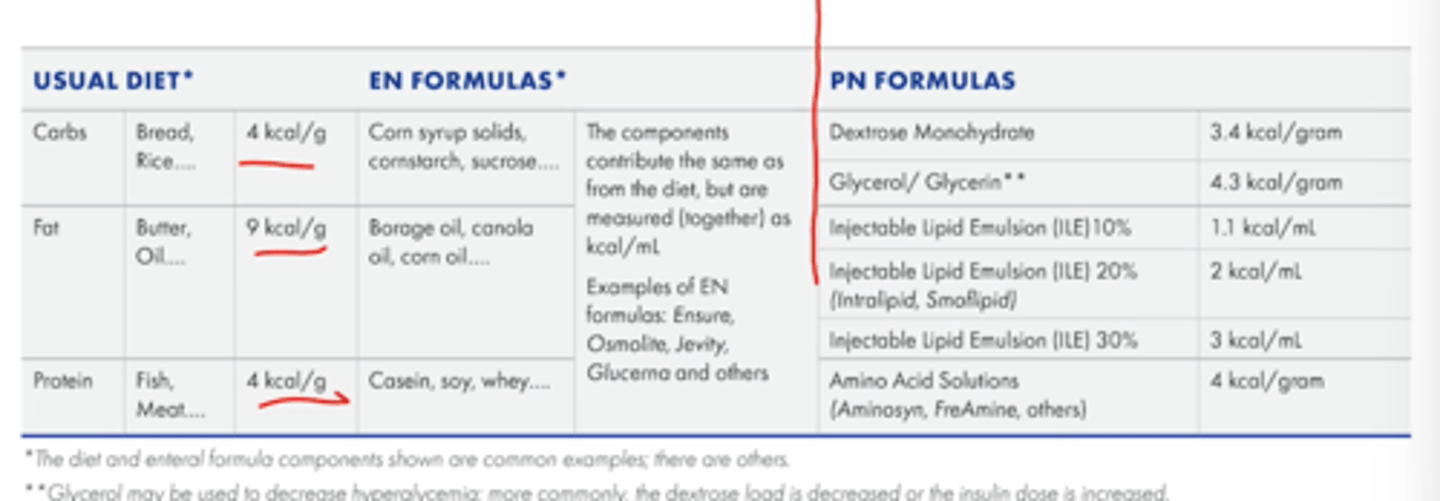
PN: carb kcal/g
(dextrose & glycerin)
fat kcal/ml
-lipids 10%
-20%
30%
protein kcal/g
dextrose: 3.4kcal/g
glycerol/glycerin: 4.3 kcal/g (dont have to mem this one)
uworlds lipids:
10: 1.1kcal/ml
20: 2 kcal/ml
30: 3kcal/ml
musop lipids:
10% = 11 kcal/g, 20-30 = 10kcal/g
amino acids: 4 kcal/g

other names for carb, fat, and protein
dextrose/glycerin
lipids
amino acids
what are the protein requirements for an ambulatory, non-hospitalized (non-stressed) patient
0.8-1 g/kg/day
usually given
what are the protein requirements for a hospitalized or malnourished patient
1.2-2 g/kg/day
usually given
MK is a 62-year-old female who has been admitted with enteritis and pneumonia. She has a history of Crohn's disease and COPD. Her IBW is 54.7 kg. The staff gastroenterologist has ordered PN therapy with 1.5 g/kg IBW/day of protein. How many grams of protein will MK receive per day? Round to the nearest whole number.
82 g protein/day
make sure you decide which wt to use!!

PP is a 46-year-old male who weighs 207 pounds. He is admitted for bowel resection surgery. Post surgery, he is to be started on PN therapy. The physician wants the patient to receive 1.3 g/kg/day of protein. Calculate his protein requirement. Round to the nearest whole number.
122 g protein/day
grams of nitrogen is used as an expression of the amount of what received by the patient
amount of PROTEIN received by the patient
1 gram of nitrogen (N) = how many g of protein
1 g nitrogen = 6.25 g protein
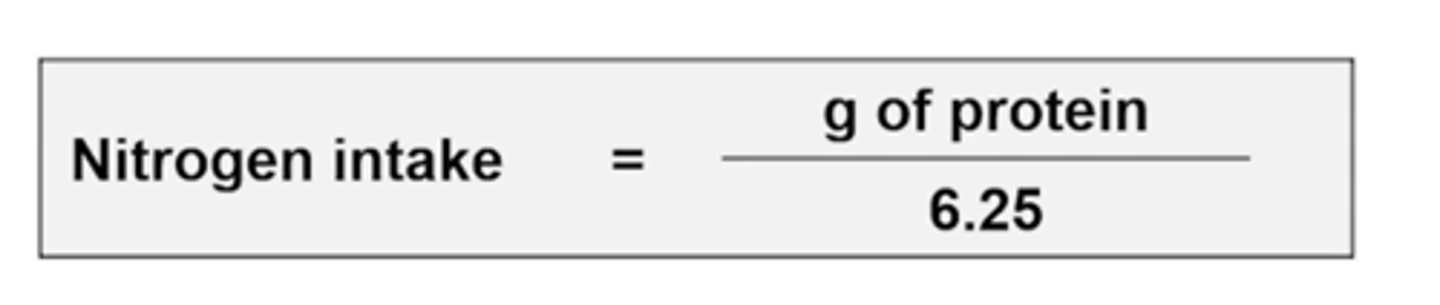
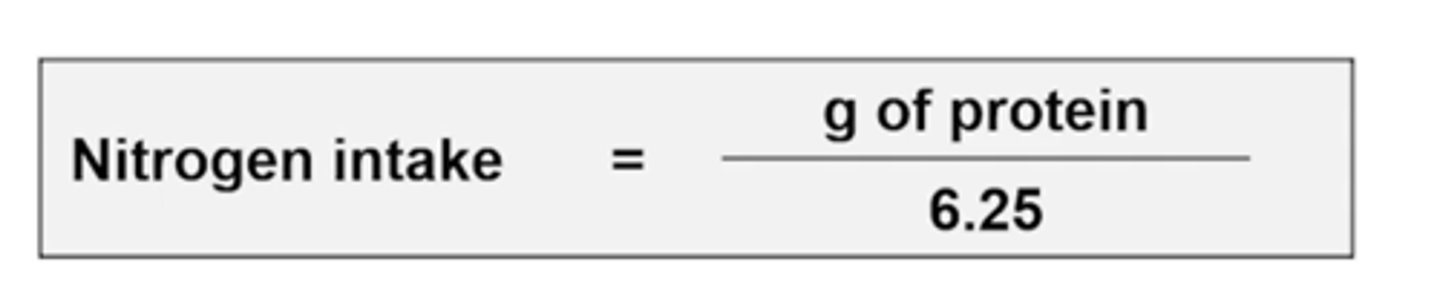
what is the equation for calculating nitrogen intake?
Nitrogen Intake = grams of protein intake/6.25
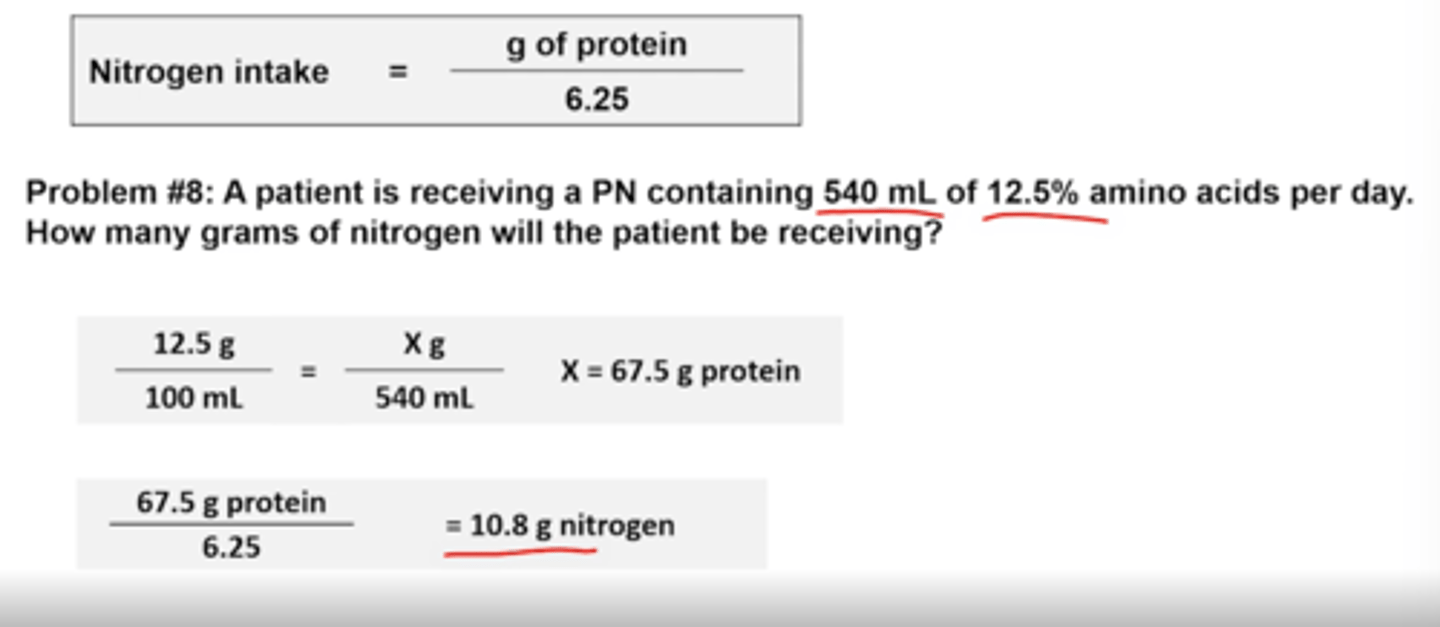
a patient is receiving PN containing 540 mL of 12.5% amino acids per day. how many grams of nitrogen is the patient receiving? round to the nearest tenth.
10.8 g nitrogen
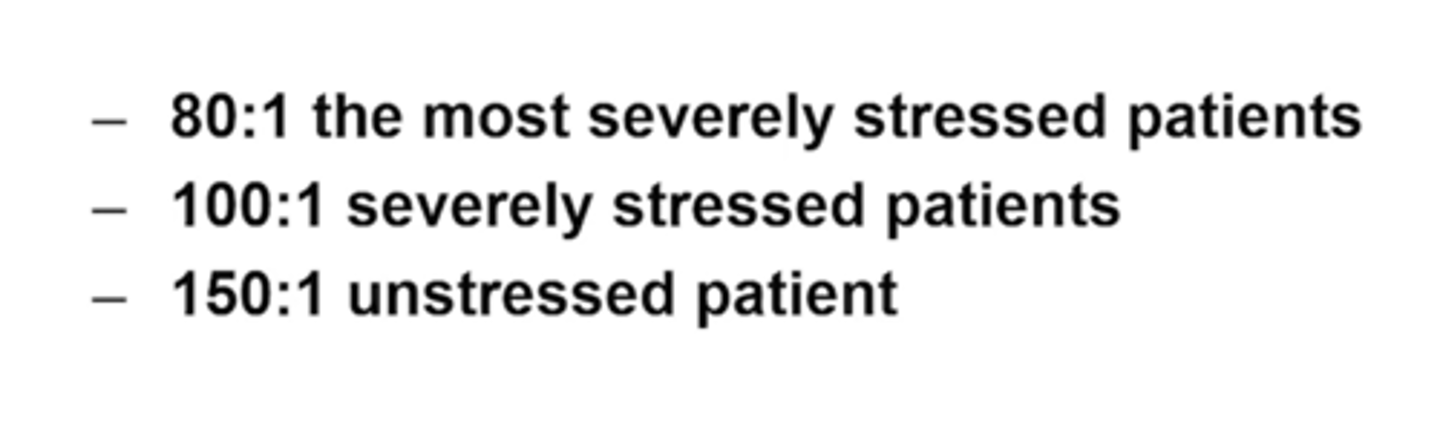
how to calculate non-protein calorie to nitrogen ratio (NPC:N)
what are desirable in most severely stressed, severely stressed, and unstressed
grams of nitrogen/non-protein calories
NPC:N desirable ratios are:
80:1 for most severely stressed patients
100:1 for severely stressed patients
150:1 for unstressed patients
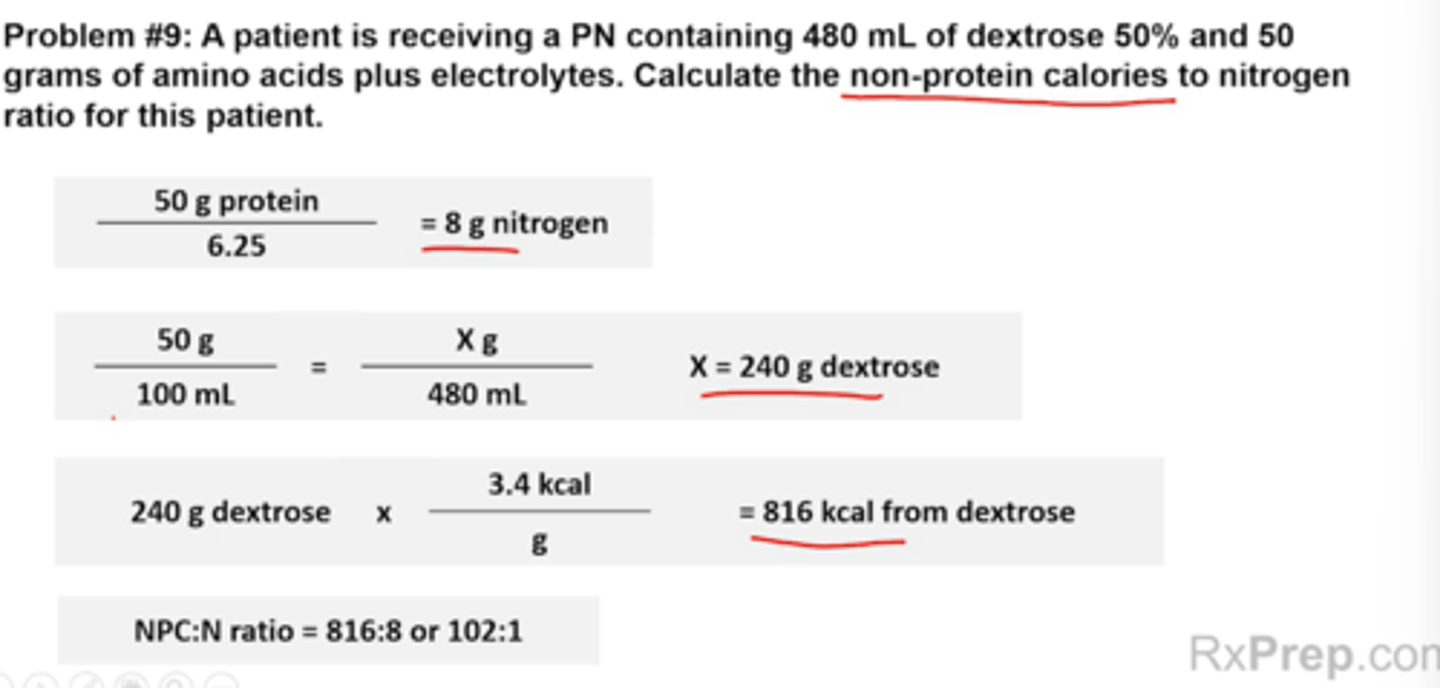
a patient is receiving PN containing 480 mL of dextrose 50% and 50 grams of amino acids plus electrolytes. calculate the non-protein calories to nitrogen ratio for this patient.
816/8 = 102/1 =
102:1
what are the brand names commonly used for amino acids
Aminosyn
FreAmine
Travasol
TrophAmine
Clinisol
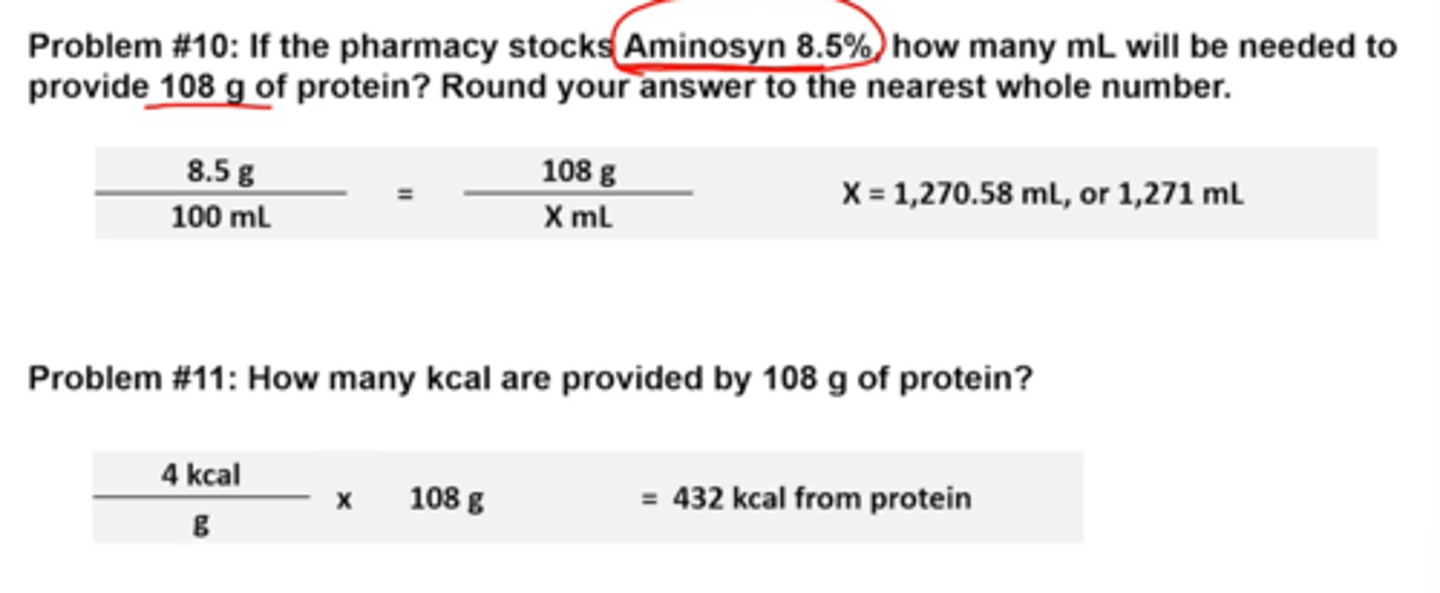
if the pharmacy stocks Aminosyn 8.5%, how many mL will be needed to provide 108 grams of protein. round to the nearest whole number
1,271 mL

how many calories are provided by 108 grams of protein?
432 kcal of protein
the pharmacy stocks FreAmine 10%. a patient requires 122 grams of protein per day. how many mL of FreAmine will the patient need?
1,220 mL
JR is a 55-year-old male (weight 189 pounds) who is confined to bed (activity factor 1.2) due to his current infection (stress factor 1.5). JR requires 1.4 g/kg/day of protein and the pharmacy stocks Aminosyn 8.5%. Calculate the amount of Aminosyn, in milliliters, JR should receive. Round to the nearest whole number.
1,415 mL
JR is receiving 97 grams of protein in an Aminosyn 8.5% solution on day 8 of his hospitalization. How many calories are provided by this amount of protein?
388 kcal protein
A PN order is written to include 800 mL of 10% amino acid solution. the pharmacy only has 15% amino acid solution in stock. using the 15%, how many mL should be added to the PN bag? Round to nearest whole number
533 mL
Using 50% dextrose in water, how many mL are required to fulfill a PN order for 405 grams of dextrose?
810 mL

DF, a 44-year-old male, is receiving 1,235 mL of D30W, 1,010 mL of FreAmine 8.5%, 200 mL of Intralipid 20% and 50 mL of electrolytes/minerals in his PN. HOw many calories from dextrose is DF receiving from the PN? Round to the nearest whole number.
1,260 kcal/day

A pharmacist mixed 200 mL D20% with 100 mL D5%. what is the percentage strength of dextrose in the final bag?
15%
40g + 5g = 45 g of dextrose
45g/ 300mL x100 = 15%
If a 50% dextrose injection provides 170 kcal in each 100 mL, how many milliliters of a 70% dextrose injection would provide the same caloric value? Round to the nearest tenth.
71.4 mL
AH is receiving 640 mL of D50W in her PN. How many calories does this provide?
1088 kcal
A PN order is written for 500 mL of 50% dextrose. the pharmacy only has D70W in stock. how many mL of D70W should be added to the PN bag? Round to the nearest whole number.
357 mL of D70W
If lipids are given once weekly how do you determine the daily amount of fat the patient receives?
Divide the total calories by 7
What filter is used for lipids?
1.2 micron
Some medications are formulated in a lipid emulsion these must be considered when calculating parental nutrition what are two examples that provide fat calories?
propofol
clevidipine
T/F Lipids must be given every day in parental nutrition
f, Do not need to be given daily
if the patient has high triglycerides lipid administration may be reduced to three times per week or once weekly
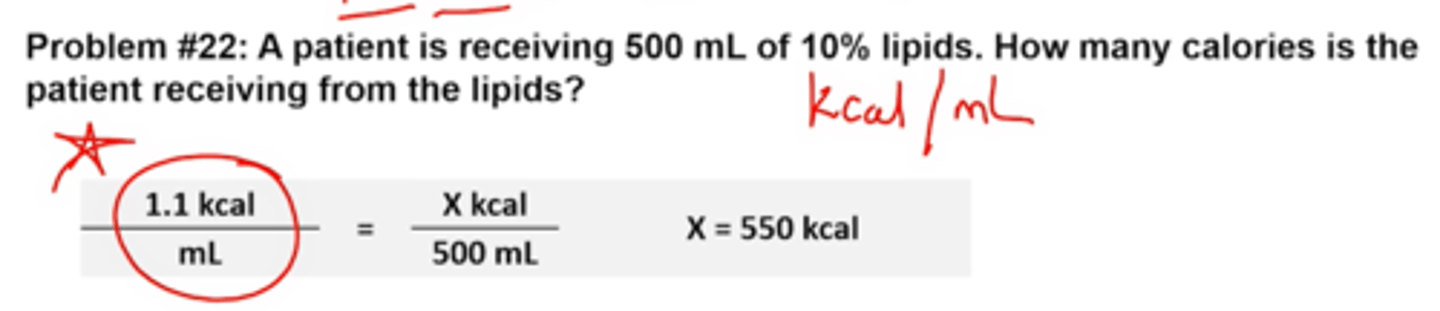
a patient receiving 500 mL of 10% lipids. how many calories is the patient receiving from the lipids? Round to the nearest whole number
550 kcal
the total energy expenditure (TEE) for a critically ill patient is 2,435 kcal/day. the patient is receiving 1,446 kcal from dextrose, 810 kcal from protein. in this CCU, clinicians do not include protein calories in the TEE. how many kcal should be provided by the lipids?
2435 kca; (Total non protein) - 1446 (dextrose) = 989 kcal remaining from lipids
Using 20% Smoflipid. how many mL are required to meet 989 calories? Round to the nearest whole number.
495 mL
a patient is receiving 660 mL of 10% Intralipid on saturdays along with his normal daily PN therapy of 1,420 mL of D20W, 450 mL Aminosyn 15%, and 30 mL of electrolytes. what is the daily amount of calories provided by the lipids? round to whole number
1.1kcal/1ml = x kcal/660ml =
726 kcal/week / 7 =
104 kcal/day
What is the principal extracellular cation?
sodium
Sodium can be added to PN as either what combinations? If acidosis is present what should be used? why?
Sodium chloride
sodium acetate
sodium phosphate
If acidosis, use sodium acetate d/t it being converted to sodium bicarb which may help correct acidosis
a patient is receiving 180 mL of 30% lipids. how many calories is the patient receiving from the lipids?
540 kcal
A PN order calls for 475 calories to be provided by lipids. The pharmacy has 10% lipid emulsion in stock. How many mL should be administered to the patient? Round to the nearest whole number.
432 mL
if acidosis is present in patient, which type of sodium should be used in TPN?
sodium acetate
it turns into sodium bicarb which will help correct acidosis by brining it to a more basic state
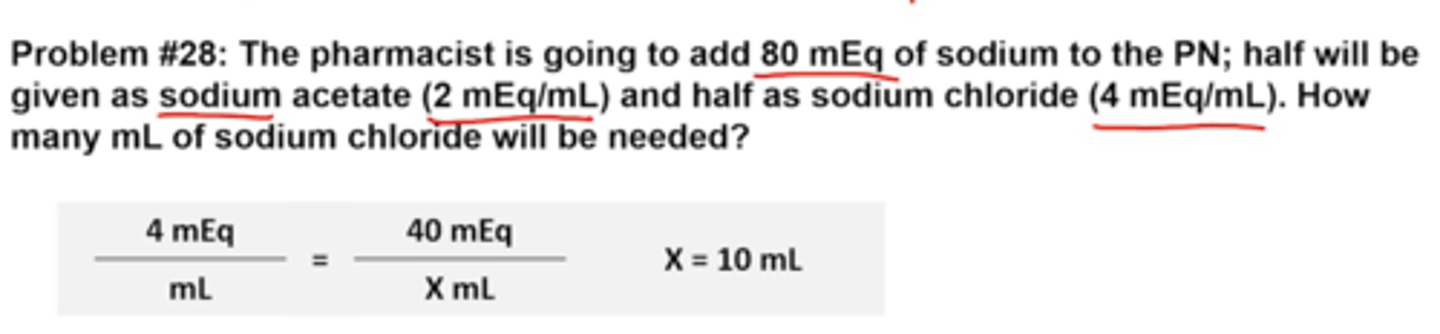
the pharmacist is going to add 80 mEq of sodium to the PN, half will be given as sodium acetate (2 mEq/mL) and half as sodium chloride (4 mEq/mL). how many mL of sodium chloride will be needed?
half of 80 = 40 thats why we us eit
10 mL
the pharmacist is making PN that needs to contain 80 mEq of sodium and 45 mEq of acetate. the available pharmacy stock solutions include sodium chloride (4 mEq/mL of sodium) and sodium acetate (2 mEq/ml of sodium) the final volume will be 2.5 liters to be infused at 100 mL/hr. what quantity, in mL of each stock should be added to the PN to meet the requirements? round to the nearest hundredth
1. calculate Volume of sodium acetate needed
2meq/1ml = 45meq/xml = 22.5 ml NAacetate
2. Determine how many MEQ of sodium are supplied by 22.5 ML sodium acetate
2meq/1ml (22.5mL naAcetate) = 45 meq of NA
3. So 45 MEQ (22.5 ML) of sodium acetate supplies 45 MEQ of acetate and 45 MEQ of sodium. how many MEQ of sodium are left to be provided by the sodium chloride?
80 meq Na total - 45 meq NA from NaAcetate = 35 meq Na needed from NaCl
4. Calculate the volume of sodium chloride that will supply the remaining sodium 35 meqs
4 meq/1ml = 35 meq/x ml = 8.75 ml of NaCl needed to provide 35 meq of Na
22.5 mL sodium acetate
8.75 mL sodium chloride
a 2 liter PN solution is to contain 60 mEq of sodium and 30 mEq of acetate. the pharmacy has in stock sodium chloride (4 mEq/mL) and sodium acetate (2 mEq/mL) how many mL of each solution should be added to the PN round to the nearest tenth
1. First calculate the amount of sodium acetate needed
2meq/1ml = 30 meq/x ml = 15 ml NaAcetate
2. The additional amount of sodium required is 30 meq from nacl (60meq-30meq).
3. Now calculate the amount of sodium chloride needed for the remaining
4meq/1ml = 30meq/x ml = 7.5 ml of nacl needeed
15 mL sodium acetate
7.5 mL sodium chloride
What is the principal intracellular cation in parental nutrition?
Potassium
Imperial nutrition potassium can be provided by what forms? What is the normal range for serum potassium?
Potassium chloride potassium phosphate potassium acetate
3.5-5
In parental nutrition phosphate can be provided by what forms? What are their differences?
Sodium phosphate potassium phosphate
do not provide equivalent amounts of phosphate!!
What is the principal intracellular cation in parental nutrition?
Potassium
What will cause serum calcium concentrations to be falsely low?
low albumin (ca is highly albumin bound)
Imperial nutrition potassium can be provided by what forms? What is the normal range for serum potassium?
Potassium chloride potassium phosphate potassium acetate
3.5-5
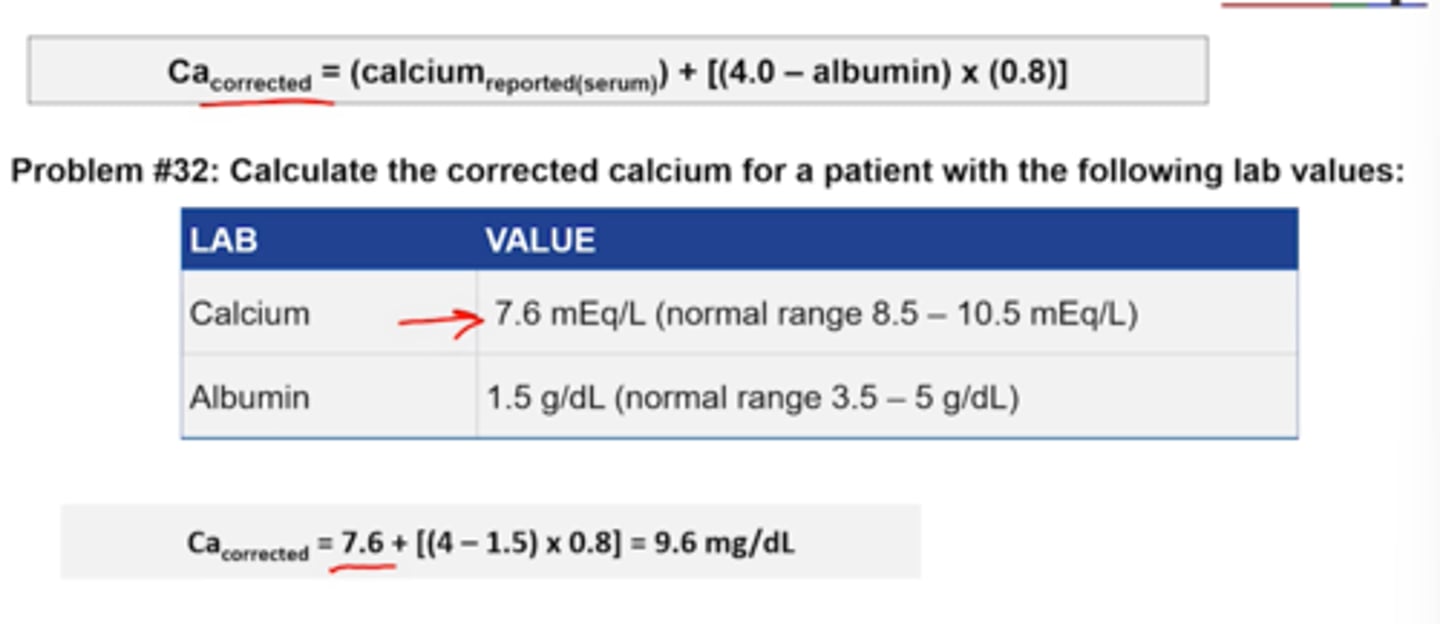
calculate corrected calcium for patient with following labs:
calcium reported 7.6 (8.5-10.5)
albumin reported 1.5 (3.5-5)
is it within range?
9.6 mg/dL
within range, falsely low d/t low albumin
Calcium phosphate solubility: What are some ways to decrease the risk of calcium phosphate precipitate in parental nutrition?
1. use calcium gluconate (over caCl)
2. add phosphates first (after Dextrose and amino acids followed by other pn components, mix, then add Ca near the end)
3. Calcium in Phosphate added together should not exceed 45 MEQ/L (If using solubility curve, lines should meet below the curve)
4. Lower ph = less risk of precipitation
5. Refrigerate once prepared (Increase temperature = increase precipitate)
What is the principal intracellular cation in parental nutrition?
Potassium
Imperial nutrition potassium can be provided by what forms? What is the normal range for serum potassium?
all trace elements except ____ are added to PN?
iron! dont add iron!!
zinc, copper chromium, manganese okay
what are other additives to PN?
MVI
trace elements (zinc, copper, chromium, manganese)
insulin (optional)
what type of insulin may be added to PNs?
insulin regular (no long acting!!!)
What is the principal intracellular cation in parental nutrition?
Potassium
What is the principal intracellular cation in parental nutrition?
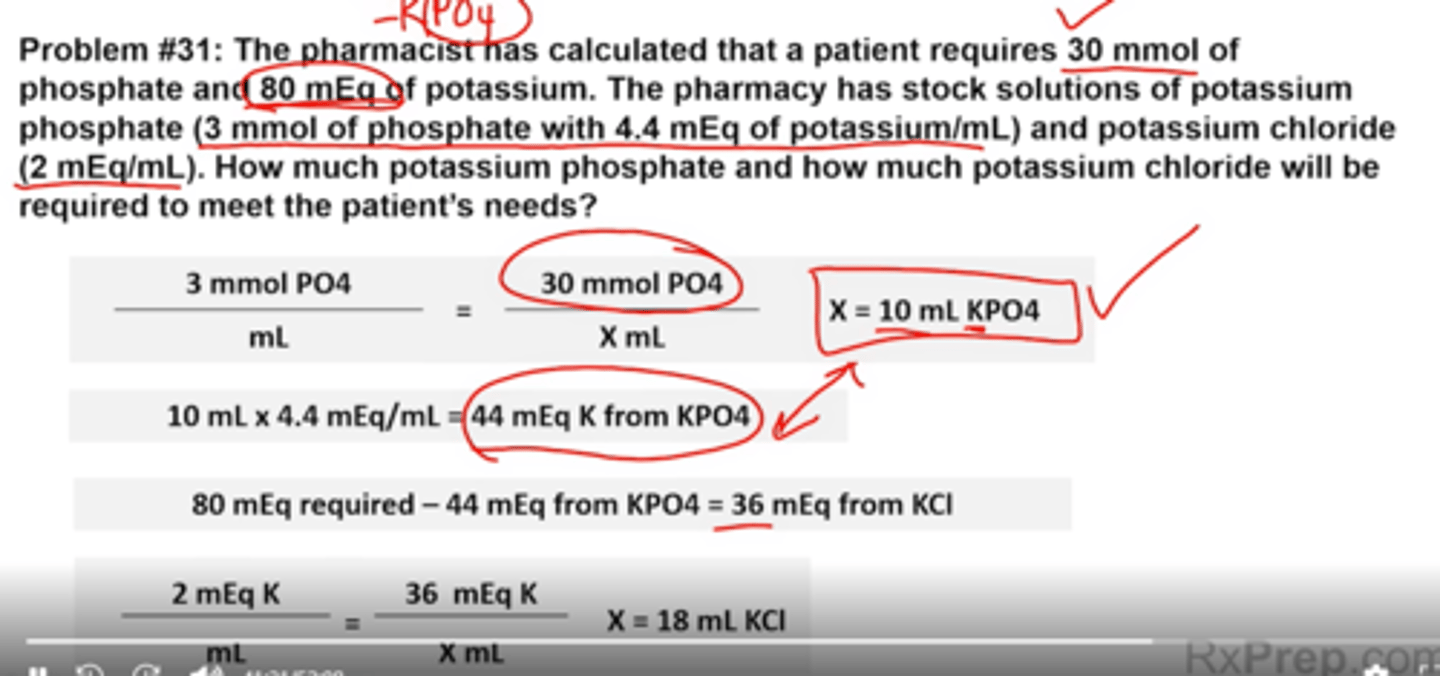
the pharmacist has calculated that a patient requires 30 mmol of phosphate and 80 mEq of potassium. the pharmacy has potassium phosphate (3 mmol of phosphate with 4.4 mEq potassium/mL) and potassium chloride (2 mEq K/mL). how many mL of each are required to meet the patient's needs?
1. First calculate the volume of potassium phosphate required:
3mmol po4/1ml = 30mmol po4/x ml = 10 ml kpo4
2. Calculate the amount of potassium the patient will receive from the 10 ML of KPO4
10ml x 4.4 meq/ml = 44 meq k from kpo4
3. How much meq of K are still needed from KCl?
80 mew K total - 44 meq k from kpo4 = 36 meq needed from kcl
4. Determine how many ML's are needed to obtain 36 MEQ of KCL
2meq k/1ml = 36meq k/xml = 18 ml needed from kcl
10 mL potassium phosphate
18 mL potassium chloride
what is the corrected calcium equation
Corrected Ca = Ca(reported) + [(4 - albumin) x 0.8]
a patient is to receive 8 mEq of calcium. the pharmacy has calcium gluconate 10% in stock with provides 0.465 mEq/mL how many mL of calcium gluconate should be added to the PN? round to nearest whole number
8meq Ca (1ml/0.465 meq ca) = 17.2 or 17 ml CaGluc
17 mL
a patient is receiving 30 mmol of phosphate and 8 mEq of calcium. the volume of the PN is 2,000 mL. there are 2 mEq PO4/mmol. confirm that the sum of the calcium and phosphorus do NOT exceed 45 mEq/L
1. First calculate the M E Q of phosphate
2 meq po4/1mmol x 30 mmol PO4 = 60 meq PO4
2. Add phosphate and calcium MEQ together
60 meq po4 + 8 meq Ca = 68 meq total
3. Calculate MEQ Per liter
68meq/2L = 34 meq/L
so less than 45 meq/l OK!
68 mEq total for 2 Liters does NOT exceed 90 mEq/2 L (or 45 mEq/L)
what percent of calories will WT receive from 19.6 g protein? round to whole number
356 total kcal
22 %
how many calories will WT receive from 17.8 g fat? round to whole number
17.8g x (9kcal/1g) = 160.2 =
160 kcal

what percent of calories are derived from the fat component? round to whole number
17.8 g fat
356 kcal total
45%
how many calories will JB receive if he consumed 4 oz? round to whole number
serving size: 8 oz
285 kcal total
37.4 g carbs
75 kcal
what percent of calories will JB receive if he has 8 oz? round to whole number
serving size: 8 oz
285 kcal total
37.4 g carbs
52%
The nurse was administering 1 can (8 fl oz.) of Osmolite to JB when she accidentally spilled 2 fl oz. onto the floor. The remaining amount in the can was accurately delivered to the patient. How many calories did he actually receive? Do not round the answer
Nutrition facts (serving size 8 fl oz; 237 mL):
- Calories: 285 kcal
- Total Fat: 9.2 g
- Protein: 13.2 g
- Total carbohydrate: 37.4 g
- L Carnitine: 36 mg
- Taurine: 36 mg
- Vitamin A
- Vitamin C
- Iron
213.75 kcal
DO THE ADDITION PRACTICE AT THE END OF TPN CHAPTER (starts on page 158)
Clinimix (4.5/10) with electrolytes is ordered
4.5% amino acids 10% dextrose
rate: 75 mL/hr
how many calories will the PN provide from protein each day? round to nearest whole number
306 kcal/day from protein
Clinimix (4.5/10) with electrolytes is ordered
4.5% amino acids 10% dextrose
rate: 75 mL/hr
how many calories will the PN provide from carbohydrates each day? round to nearest whole number
612 kcal/day from carbohydrates
Clinimix (5/15) with electrolytes is ordered
5% amino acids 15% dextrose
daily infusion
how many Liters of this PN should be ordered to provide 1,420 kcal/day? round to nearest whole number
2 L
Clinimix (5/20) is ordered
5% amino acids 20% dextrose
infuse daily
total volume: 1.5 liters/day
how many calories will this PN provide per day? round to nearest whole number
1,320 kcal/day
TE is a 35-year-old female who is receiving 325 grams of dextrose. 85 grams of amino acids, and 300 mL of 10% lipids via her PN therapy. What percentage of total calories is provided by the protein content? Round to the nearest whole number
19%
how many mL of dextrose 70% should be added to the PN? round to nearest whole number
PN Rx:
dextrose 70% 250g
amino acids 50g
sodium chloride (MW 58.5) 44 mEq
sodium acetate (MW 82) 20 mEq
potassium 40 mEq
mag sulfate 12 mEq
phosphate 18 mmol
calcium 12 mEq
MVI-12 5 mL
trace elements - 5 1 mL
vitamin K-1 0.5 mg
famotidine 10 mg
regular insulin 20 units
sterile water qa ad 960 mL
357 mL of dextrose 70%
using potassium phosphate (3 mmol of phosphate and 4.4 mEq of potassium/mL) vials in stock, calculate the amount of potassium phosphate that should be added to the PN to meet the phosphate requirement
PN Rx:
dextrose 70% 250g
amino acids 50g
sodium chloride (MW 58.5) 44 mEq
sodium acetate (MW 82) 20 mEq
potassium 40 mEq
mag sulfate 12 mEq
phosphate 18 mmol
calcium 12 mEq
MVI-12 5 mL
trace elements - 5 1 mL
vitamin K-1 0.5 mg
famotidine 10 mg
regular insulin 20 units
sterile water qa ad 960 mL
6 mL potassium phosphate
if the pharmacist adds 6 mL of potassium phosphate (3 mmol phosphate/mL and 4.4 mEq potassium/mL) to the 2-in-1 product, how much potassium chloride (2 mEq/mL) in milliliters should be added to fulfill the order?
PN Rx:
dextrose 70% 250g
amino acids 50g
sodium chloride (MW 58.5) 44 mEq
sodium acetate (MW 82) 20 mEq
potassium 40 mEq
mag sulfate 12 mEq
phosphate 18 mmol
calcium 12 mEq
MVI-12 5 mL
trace elements - 5 1 mL
vitamin K-1 0.5 mg
famotidine 10 mg
regular insulin 20 units
sterile water qa ad 960 mL
6.8 mL of KCl