Business classification and legal
 Call Kai
 Learn
Learn Practice Test
 Spaced Repetition
 Match
Match Flashcards
 Knowt Play
1/79

There's no tags or description
Looks like no tags are added yet.
Name | Mastery | Learn | Test | Matching | Spaced | Call with Kai | Chat |
|---|
No analytics yet
Send a link to your students to track their progress
80 Terms
Business Definition
Organisation that produces goods and/or services with the goal of making a profit
Wealth Definition
The total value of assets owned by a person, business or country
Income Definition
Businesses create an income for people to pay for goods and services
Employment Definition
Refers to a business providing jobs and paying wages to individuals in return for their labour and skills
Producing Goods and Services Definition
A business will provide products which allow people to satisfy their wants and needs- consumers drive demand for products
Goods vs Services
Intangible, some perishable, contains ownership, limited customisation
Intangible, exist when performed, generally customised towards customer preference.
Innovation Definition
The development of new ideas or the improvement of already exisiting ones- Competitive advantage
Choice Definition
Consumers having options availability when spending their money = variety to satisfy preference.
Entrepreneurship & Risk
When a business identifies a gap in the market and takes the risk of innovating to create or EXPAND their business. -Pursuit of profit
Quality of life Definition
The overal wellbeing improving due to an outcome of the business
Incorporated Definition
When the company is a seperate entity from the owners.
Unincorporated Definition
When the business entity and the owner are regarded as one and the same
What is an advantage of perpetual succession
The company’s continuity – it keeps existing despite death, exit, or insolvency of owners or directors.
What is a disadvantage of perpetual succession
The risk of long‑term liabilities – debts and obligations can persist indefinitely and burden future owners.
What are two extra disadvantages of choosing a incorporated legal structure
Must lodge a financial report and directors report annually, increasing administrative costs.
Higher startup costs
What is a advantage of limited liability
Owners’ personal assets are generally protected from business debts.
What is a disadvantage of paying company tax
The same money can be taxed at the company level and then again on dividends-no tax‑free threshold for the company
What is a advantage of paying company tax
Company tax is often lower than higher personal rates, so keeping profits in the company can save tax due to the flat rate 26-30%
List one extra disadvantage and advantage for unincorporated
ad: less management stress and costs are shared therefore affective for businesses starting, shared responsibility
dis: possibility of disputes damaging business culture
What is a disadvantage of unlimited liability
If the business fails, your personal assets (house, savings, car, etc.) can be taken to cover its debts.
What is a advantage of paying income tax
If your income is low enough, you may not have to pay income tax at all (you just fall under the tax‑free threshold).
What is a disadvantage of paying income tax
If you have a very high‑income year, you pay at the top personal tax rate, which is usually much higher than the flat company tax rate you’d pay if the money stayed in a company.
What is a advantage of limited succession
Small and short-term businesses usually have easier tax and reporting rules than bigger, long-lasting companies.
What is a disadvantage of limited succession
If the business has limited succession, it can end or collapse quickly when the owner or key person leaves, retires, or dies, disrupting operations and jobs.
What is another classification
Government Enterprises (public sector business)- Function as a regular business however are owned and managed by the government. such as aus post
What are the three markets(MCPIGSLEFT)
Consumer, labour and finance
What are the competitive situations(MCPIGSLEFT)
Monopoly: Usually only one main company in the industry
Monopolisitic comp: most common in australia, there are lots of similar businesses with slight differenciation
Oligopoly: A small number of large businesses dominating the markets
Perfect comp: Many businesses selling a product that cant be differenciated
What are the political influences (MCPIGSLEFT)
Changes to policy
There are two types of political influences taxation and environmental
What is an example of a political: taxation(MCPIGSLEFT)
Goods and services tax or company tax
What are institutional influences(MCPIGSLEFT)
Organisations that are not businesses but have an impact on them, most often regulatory bodies and trade unions.
What are geographical influences(MCPIGSLEFT)
the impact of the features of a population
demographics: needs and demands (gender, ethnicity, age, socioeconomic)
Locational: Effect of climate change, natural resource, physical infrastructure.
What is special about australias geographical location?(MCPIGSLEFT)
We are next to Asia Pacific region impacting the activity of imports and business in aus
What are Social Influences (MCPIGSLEFT)
The factors in society which alter consumer trends and spending habits, businesses must respond to consumer wants
Social media is an amplification= FOR EXAMPLE OWALA ECO FRIENDLY SOCIAL MEDIA TREND
What are legal influences? (MCPIGSLEFT)
When a change to law occurs it impacts a business
laws can be made my parliament or state/federal courts
EXAMPLE: Legally gov banned social media affecting target marketing to teens and possibly pay fines to gov.
What are economic influences (MCPIGSLEFT)
Refers to the change in overall economic conditions. Economic cycles influence a businesses capacity to compete and customers willingness/ability to spend. (Businesses must respond to this)
What are the factors influencing a boom or bust economic (MCPIGSLEFT)
Employment
Incomes (pay rises)
customer attitude (optimistic or pessimistic- increase customer spending)
What are the three policies the government implements to influence economic activity to keep it stable(MCPIGSLEFT)
Monetary policy (RBA changing interest rates influencing money supply and inflation)
Fiscal Policy (Government altering taxation to influence money supply and inflation)
Microeconomic Reform (Government focusing in on a specific industry)
What are financial Influences (MCPIGSLEFT)
How easily a business can access capitol to finance project. There are 2 types: Debt finance and Equity
What is DEBT FINANCE- financial influence (MCPIGSLEFT)
Owner doesn’t have to sell any ownership of the business
Most popular source finance- however not everyone has access due to a low credit score.
What is EQUITY- financial influence (MCPIGSLEFT)
Raised from sale of shares and doesn’t have to be repaid unless owner leaves the business
Disadvantageous as owners/shareholders may expect a return on the investment.
What are technological influences (MCPIGSLEFT)
The growing use of tools, techniques or systems by businesses to solve a problem or serve a purpose in operations. (competitive advantage)
EXAMPLE: Self serve checkout may alienate a demographic but improves efficency.
What is the internal influence: for PRODUCT (PLMBR)
Product refers to the choice of tangible good a business sells, focusing on quality and product differentiation.
Involves when businesses compete to have product differentiation: Making a service or product distinct from competitors features of a unique product.
EXAMPLE: coke, coke zero, vanilla coke.
What is the internal influence: for LOCATION (PLMBR)
Location refers to the factors a business should consider to favour customer convenience and visibility.
What is the internal influence: for MANAGEMENT (PLMBR)
Refers to how a company’s management is structured, there are two types: Centralised (autocratic) and Decentralised.
What is the internal influence: for BUSINESS CULTURE (PLMBR)
Business culture refers to the values, expectations, beliefs and rituals shared by management and staff inside a business.
What is the internal influence: for RESOURCES (PLMBR)
The inputs used by the business to create their product which the business can choose which resources they use falling under the categories: HR, Information resources, Physical resources and financial resources.
Define Human Resources
These are the employees of the business, its most important asset
Define Information Resources
Knowledge and data required by a business
Define Physical Resources
Tangible resources, raw material, tech, machinery, buildings
Define Financial Resources
The funds a business uses
What is a stakeholder
A person/group that can affect or be affected by the actions of a business
for example: CUSTOMERS, GOVERMNEMT EMPLOYEES
Acquisation
When one business takes control of another by purchasing and controlling interest in it
What is insolvency
When a business is unable to pay its debts as they fall due
What is involuntary and voluntary administration
When an incorporated business is either volunteers to find an administrator to help recover the business or decide to liquidate the business. Or a creditor/ASIC might take them to court and this causes court ordered liquidation
Whats the difference between bankrupcy and liquidation
When a business is bankrupt they just shut down whereas for a company, all company shareholders must agree.
What is voluntary and involuntary bankruptcy
Bankruptcy is a legal process for individuals who cannot pay their debts when they are due (insolvency)
What are the three ASIC nominated causes for business failure
Inadequate cash flow or higher cash use
Poor strategic managment
Trading losses
What is the business life cycle
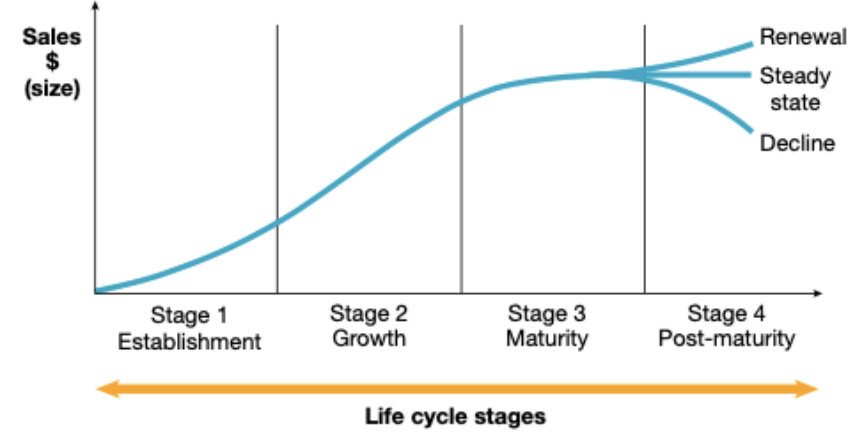
What are the three options after post maturity in the BLC
Renewal, steady state, decline
What is establishment (BLC)
An entrepreneur idea turns into an actual business and begins to operate and make sales.
What are the challenges of establishment (BLC)
Low level of sales due to no customer base
High up front costs
Failure rate high 33% in first year
What are the stratergies of establishment (BLC)
Advertising (costly but helpful)
Detailed business planning and budgeting
take out a loan
What is growth? (BLC)
As businesses grow, they sell more products and jhave a repetitive customer base, helps with profit but still presents challenges such as economies of scale
What are the challenges of growth (BLC)
Need to hire new staff (length and costly process)
Ensuring quality of product is maintained
Increasing market competition
what are the stratergies of growth (BLC)
Greater rewards for staff to motivate moral or promotion
Effecient accounting systems (such as computerised systems to manage cash flow)
What is maturity (BLC)
Businesses may struggle to grow continiously, with loyal repeat customers help sales remain consistent
Most desirable stage of BLC
What are the challenges of maturity (BLC)
Competition is at it highest as other businesses will see profit and stability and aim to replicate
Low morale: as business stabilise tasks become repitiie and remove passion from working
What are strategies of maturity (BLC)
Monitor external environment to adjust and change the internal environment in response (competive advantage)
offer rewards to greaten business culture
What is post-maturity? (BLC)
This is the final stage, there are three ways a business will respond during this stage= the long term survival of the business.
What are the challenges of post-maturity? (BLC)
changing business environment(taste and preferance- social)
Changing workforce (staff might leave)
What are the stratergies that can be used for post maturity?(BLC)
market research to see what changes could be made towards renewal (find new ideas/products or phase out old ones)
training current staff to take on the role of staff who may potentially leave
Establish a HR process to help a business fine the most suitable applicant if other staff leave the business
What is renewal- PM (BLC)
the business may go into a new period of growth this could include
the launch of a new product
taking over a competitor
effective marketing campaigns
Owala introducing new lid
What is steady state- PM (BLC)
Occurs when a business is able to maintain a consistant loong term sales
requires building brand loyalty and repeat customer base
EG: david jones/woolies
What is decline- PM (BLC)
The sales of the business may fall
this is due to competitors or a change in competitors
Such as CD sales going out due to spotify
Consider factors that may be challenging in (BLC)
Sales
resource costs
managment
profit
quality of profit
staff
volume of tasks
customer loyalty
business culture
competition
How do you answer a JUSTIFY question?
Meaning:
Give reasons to support an idea or choice.
Words/Phrases:
Beneficial
Effective
Positive
Detrimental
Tips:
Take a clear stance
Support with reasons
How do you answer a DISTINGUISH question?
Meaning:
Show how two things are different.
Words/Phrases:
Whereas
Conversely
However
On the other hand
Tips:
Compare both terms
How do you answer a DISCUSS question?
Meaning:
Provide points for and against.
Words/Phrases:
Advantageous
Beneficial
However
Conversely
Disadvantageous
Tips:
Include at least one advantage and one disadvantage
Separate ideas into sentences
How do you answer a ASSESS question?
Meaning:
Make a judgement of value based on evidence.
Words/Phrases:
Effective
Beneficial
Ineffective
Disadvantageous
Tips:
Start with a definition
Make a clear judgement early
Support with evidence
Don’t sit on the fence
How do you answer a RECOMEND question?
Meaning:
Provide reasons in favour of a strategy.
Words/Phrases:
Recommended
Beneficial
Effective
Assists
Advantageous
Tips:
First sentence = recommendation
Then justify why it’s good