Acid/Base titration
 Call Kai
 Learn
Learn Practice Test
 Spaced Repetition
 Match
Match Flashcards
 Knowt Play
1/42

Earn XP
Description and Tags
Theoretical knowledge, needed for performing an acid/base titration in the lab
Name | Mastery | Learn | Test | Matching | Spaced | Call with Kai | Chat |
|---|
No analytics yet
Send a link to your students to track their progress
43 Terms
What is autoproteolysis of water?
Process, by which water molecules can donate and accept protons, resulting in the formation of hydronium (H30+) and hydroxide ions (OH-).
What is pH?
A measure of the acidity of the soultion, defined as a negative logarithmus of hydrogen ions concentration

What is pOH?
Measure of baseity of the solution, defined as a negative logarithm of hydroxide ion concentration

If the pH of a substance is lower, it indicates that the substance is __________.
more acidic
The lower the pOH of the substance, the __________ is the substance
more basic
What is pH and pOH for pure water?
pH=pOH=7
What is the interplay between pH and pOH?
pH+pOH=14
Which acid and base definitions are used for titration?
The Brønsted-Lowry definitions
What is an acid according to Brønsted-Lowry?
A substance that donates protons H+ in a chemical reaction
What is a base according to Brønsted-Lowry?
A substance that accepts protons H+ in a chemical reaction
What is a feature of strong acids and bases?
They dissociate in water completely
What is a feature of weak bases and acids?
They dissociate in water only partially
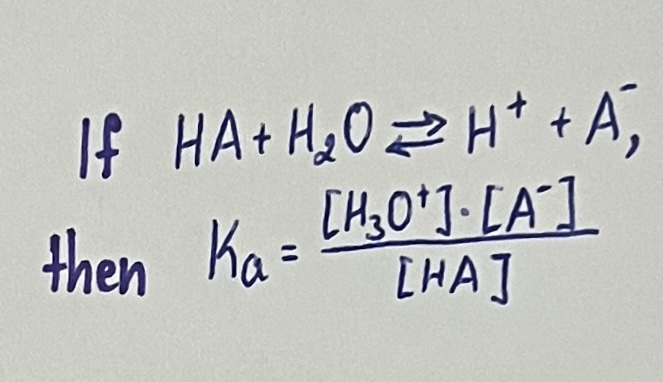
What is an acid dissociation constant?
It is a measure of the strength of an acid in solution, represented as Ka , indicating the extent to which an acid donates protons to water
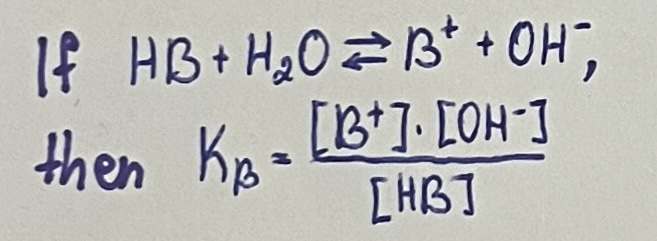
What is a base dissociation constant?
It is a measure of the strength of a base in solution, represented as Kb, indicating the extent to which a base accepts protons from water.
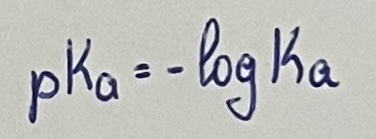
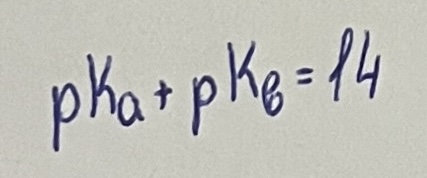
How is pKa defined?
Negative logarithmus of Ka
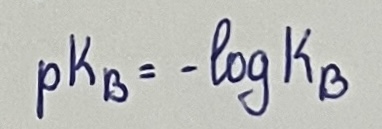
How is pKb defined?
Negative logarithmus of Kb
The ________ the Ka and ________ the pKa, the stronger is the acid.
higher; lower
The ________ the Kb and ________ the pKb, the stronger is the base.
higher; lower
What happens, when Ka (Kb) is high and pKa (pKb) is low?
The equlibrium lies to the left and the acid (base) dissociates extensively
What happens, when Ka (Kb) is low and pKa (pKb) is high?
The equilibrium lies to the right, and the acid (base) does not dissociate significantly
What applies to conjugated acid/base pairs?
The stronger the acid, the weaker its conjugated base and vice versa
What is a buffer solution?
Type of solution that resists changes in pH when small amounts of acid or base are added. It typically consists of a weak acid and its conjugate base, or a weak base and its conjugate acid.
Which equation describes the pH in a buffer solution?
Henderson-Hasselbach equation

What is a titrant?
A solution of known concentration used in titration
What is an analyte?
The substance whose concentration is being measured in a titration
In titration, the ________ is slowly added to the ________ until the reaction neutralizes
titrant; analyte
What is acidimetry?
Testing an unknown acid, using a known base
What is alkalimetry?
Testing an unknown base, using a known acid
What is a half-equivalence point?
A point in titration, where exactly half of the original analyte has been neutralized
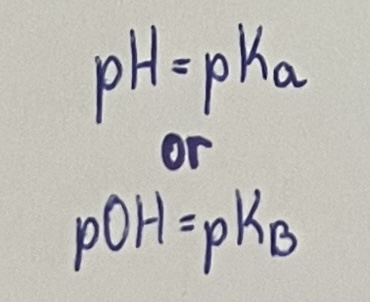
What is true for pH and pOh at the half-equivalence point?
pH=pKa and pOH=pKb
What is an equivalence point in titration?
A point, when enough titrant has been added to consume all of the original analyte

pH at equivalence point for strong base/strong acid titration
pH=7
pH at equivalence point for strong base/weak acid titration
pH is more than 7
pH at equivalence point for weak base/strong acid titration
pH is less than 7
In which range does phenol phtalein change its color?
In the pH range of approximately 8.2 to 10.
For which titration reactions is phenol phtalein particularly useful?
For weak acid+strong base reactions
In which range does methyl orange change its color?
In the pH range of approximately 3.1 to 4.4
For which titration reactions is methyl orange particularly useful?
For strong acid+weak base reactions
In which range does bromothyol blue change its color?
In the pH range of approximately 6.0 to 7.6.
For which titration reactions is bromothyol blue particularly useful?
For strong acid + strong base reactions
For which titration reactions is a pH electrode particularly useful?
For weak acid + weak base reactions
What does a pH electrode do?
It measures the hydrogen ion concentration in a solution, providing an accurate pH reading
What is a chemical basis of the acid/base titration?
Proton transfer between reactants