Lab #1: The Language of Anatomy
 Call Kai
 Learn
Learn Practice Test
 Spaced Repetition
 Match
Match Flashcards
 Knowt Play
1/85

Earn XP
Description and Tags
Name | Mastery | Learn | Test | Matching | Spaced | Call with Kai | Chat |
|---|
No analytics yet
Send a link to your students to track their progress
86 Terms
cephalic region
head
nasal region
nose
oral region
mouth
cervical region
neck
acromial region
shoulder
axillary region
armpit
mammary region
breast
brachial region
upper arm
antecubital region
the front of the elbow (pit)
abdominal region
the area of the abdomen between the thorax and pelvis.
antebrachial region
forearm
carpal region
wrist
palmar region
the area of the palm of the hand.
digital region
fingers
upper limb region
the part of the body that includes the arm, forearm, and hand.
genital region
the area of the body related to the reproductive organs.
crural region
shin
tarsal region
ankle
pedal region
foot
frontal region
forehead
orbital region
eyes
buccal region
cheeks
mental region
chin
sternal region
the area of the chest located in the center, often relating to the sternum or breastbone.
pectoral region
the area of the chest related to the breasts and underlying muscles.
umbilical region
the area around the navel or belly button.
inguinal region
the area of the lower abdomen near the groin
coxal region
the area of the hip or hip joint.
femoral region
thigh
patellar region
knee
dorsum of the foot
the upper surface of the foot.
lower limb region
the part of the body that includes the thigh, leg, and foot.
otic region
the area of the ear.
occipital region
the area located at the back of the head.
vertebral region
the area of the spine.
scapular region
the area of the shoulder blades.
olecranal region
the area of the elbow. (back)
lumbar region
the area of the lower back.
sacral region
the area at the base of the spine.
gluteal region
the area of the buttocks.
perineal region
the area between the thighs, surrounding reproductive organs and butt
popliteal region
the area behind the knee.
sural region
the area of the calf.
calcaneal region
the area of the heel.
plantar region
the area of the sole of the foot.
ventral/anterior
relating to the front or belly side of the body.
dorsal/posterior
relating to the back side of the body.
superior
referring to a position toward the head or upper part of the body. only for head and trunk
inferior
referring to a position toward the feet or lower part of the body. only for head and trunk
medial
referring to a position closer to the midline of the body.
lateral
referring to a position farther from the midline of the body.
proximal
referring to a position closer to the point of attachment or origin of a structure.
distal
referring to a position farther from the point of attachment or origin of a structure.
superficial
referring to a position closer to the surface of the body.
deep
referring to a position farther from the surface of the body.
ipsilateral
referring to structures on the same side of the body.
contralateral
referring to structures on opposite sides of the body.
supine
referring to a position lying on the back.
prone
referring to a position lying on the stomach.
sagittal plane
a vertical plane that divides the body into right and left halves.
transverse plane
a horizontal plane that divides the body into upper and lower parts.
coronal plane
a vertical plane that divides the body into anterior and posterior sections.
oblique plane
a plane that runs at an angle to the sagittal, coronal, and transverse planes.
cranial cavity
the space within the skull that houses the brain.
vertebral cavity
the space that contains the spinal cord.
thoracic cavity
the space within the chest that contains the lungs and heart.
mediastinum
pericardial
2 pleural
mediastinum
the central compartment of the thoracic cavity, between the two pleural sacs, containing the heart, great vessels, trachea, and esophagus.
pericardial
the space surrounding the heart, containing pericardial fluid that reduces friction.
pleural cavities
the two spaces on either side of the mediastinum that contain the lungs.
abdominopelvic cavity
the large cavity that houses the abdominal and pelvic organs, including the digestive, reproductive, and urinary systems.
parietal serous membrane
A membrane that lines the walls of body cavities, providing a smooth surface to reduce friction. (outside)
Lungs, heart, peritoneum
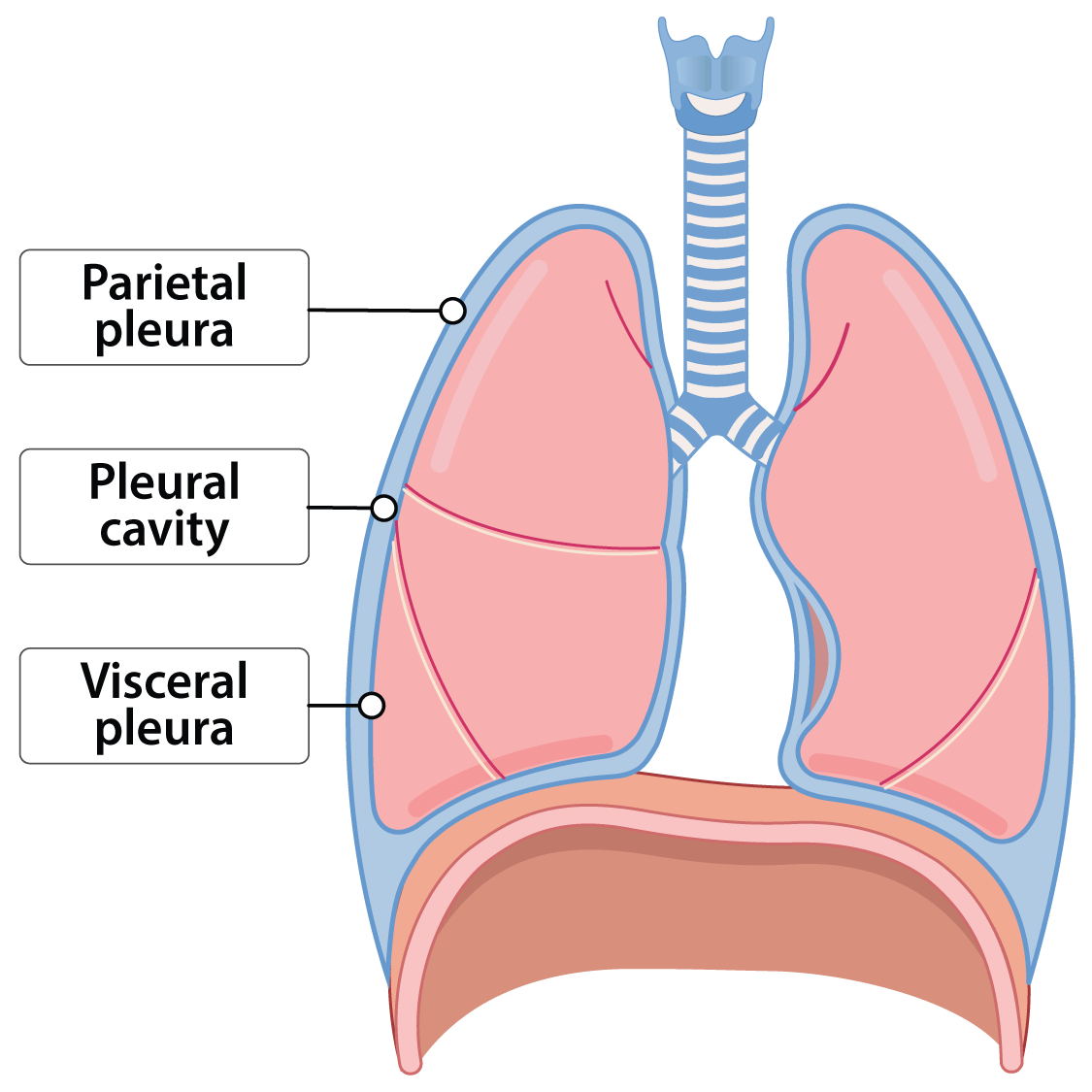
visceral serous membrane
A membrane that covers the organs within body cavities, providing protection and reducing friction with surrounding structures. (inside)
Lungs, heart, peritoneum
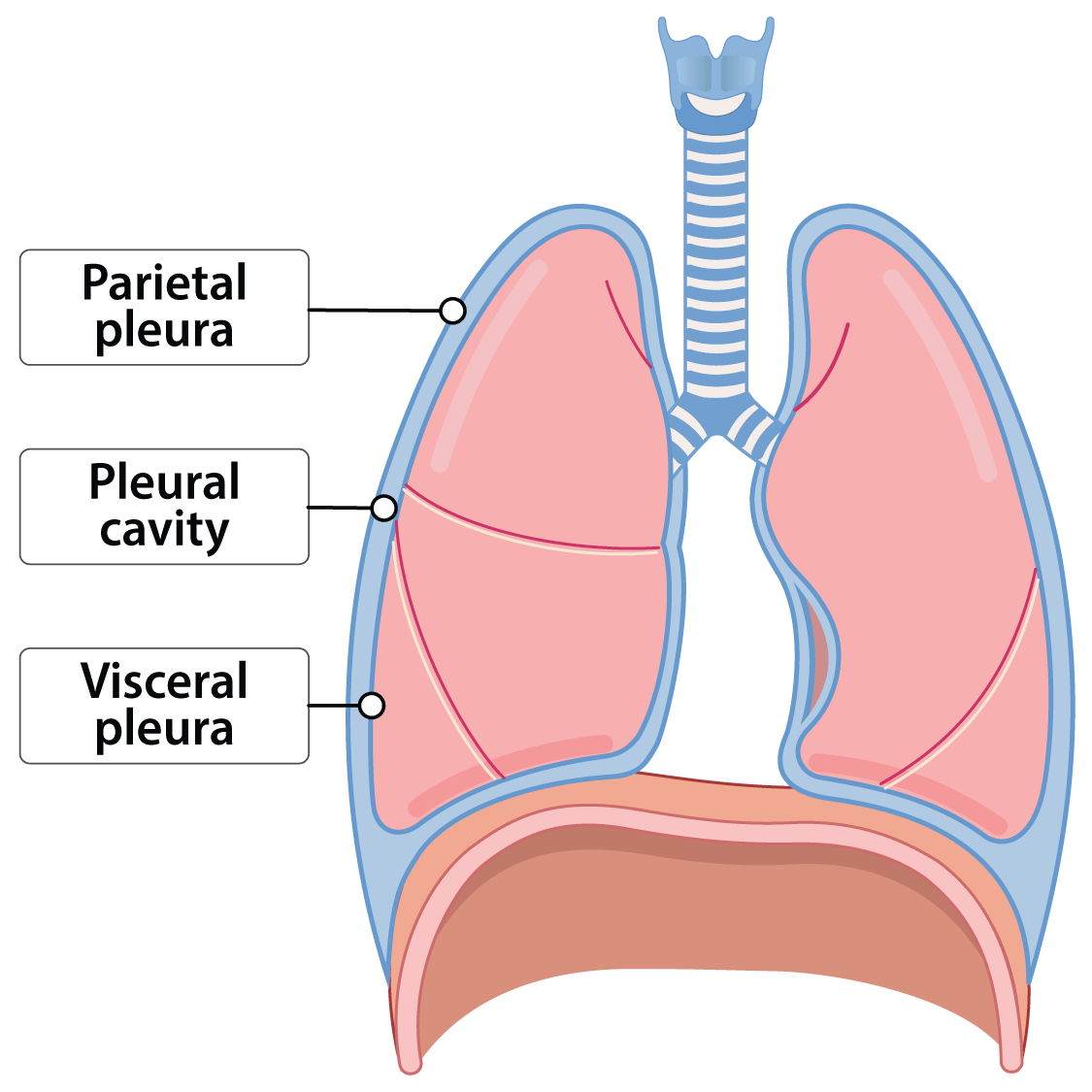
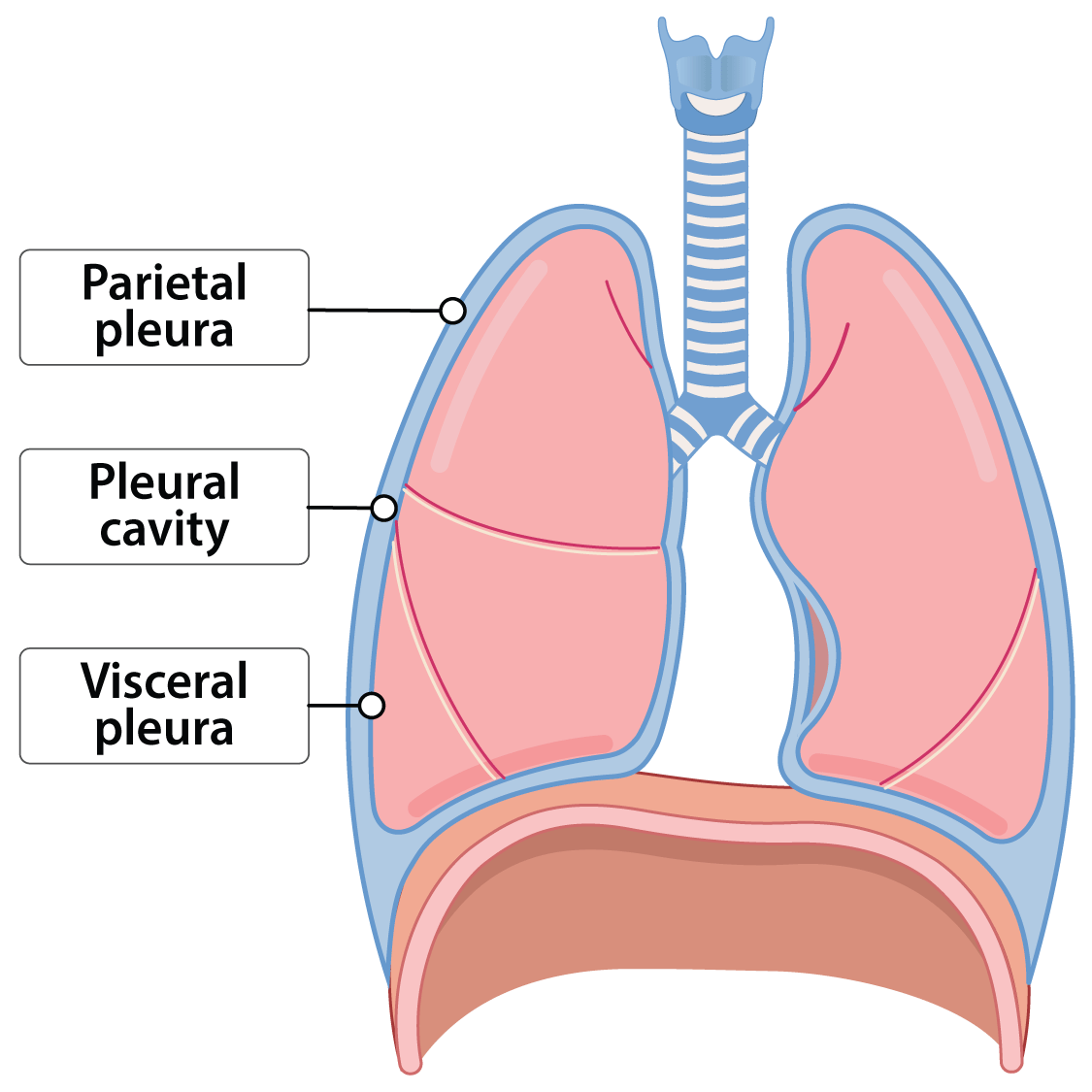
pleural cavity
The space between the pleura surrounding each lung, containing pleural fluid to reduce friction during breathing. (middle)
pericardial in heart, peritoneal in abdominal
right upper quadrant
The area of the abdomen that contains organs such as the liver, gallbladder, and part of the pancreas. It is one of the four quadrants used in abdominal mapping.
left upper quadrant
The area of the abdomen that contains organs such as the stomach, spleen, and part of the pancreas. It is one of the four quadrants used in abdominal mapping.
right lower quadrant
The area of the abdomen that contains organs such as the appendix, right ovary, and part of the large intestine. It is one of the four quadrants used in abdominal mapping.
left lower quadrant
The area of the abdomen that contains organs such as the left ovary, sigmoid colon, and part of the large intestine. It is one of the four quadrants used in abdominal mapping.
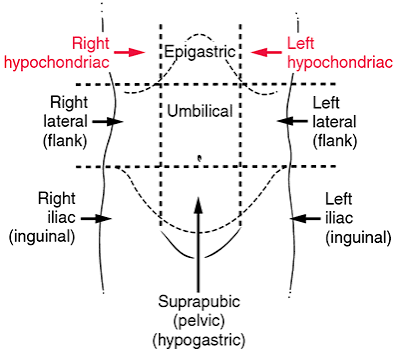
right hypochondriac
The area of the abdomen located below the ribs on the right side, containing organs such as the liver and gallbladder. It is one of the nine regions used in abdominal mapping.
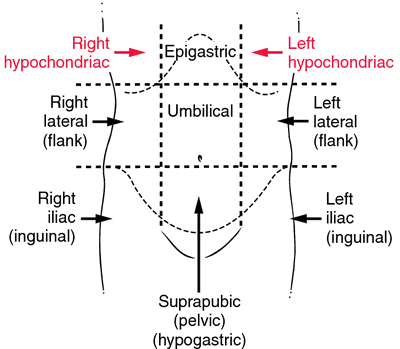
epigastric
The area of the abdomen located above the stomach, containing organs such as the stomach, liver, and pancreas. It is one of the nine regions used in abdominal mapping.
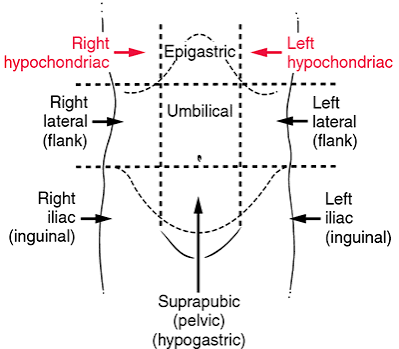
left hypochondriac
The area of the abdomen located below the ribs on the left side, containing organs such as the spleen and parts of the stomach. It is one of the nine regions used in abdominal mapping.

right lumbar
The area of the abdomen located on the right side at the level of the lumbar vertebrae, containing organs such as the ascending colon and part of the small intestine. It is one of the nine regions used in abdominal mapping.

umbilical
The area of the abdomen surrounding the belly button, containing parts of the small intestine and the transverse colon. It is one of the nine regions used in abdominal mapping.
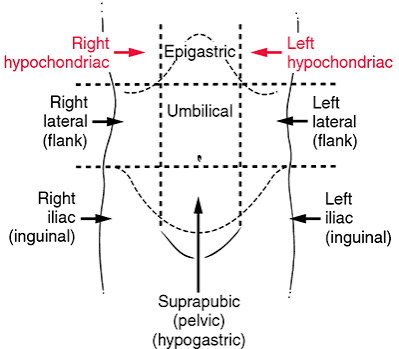
left lumbar
The area of the abdomen located on the left side at the level of the lumbar vertebrae, containing organs such as the descending colon and part of the small intestine. It is one of the nine regions used in abdominal mapping.
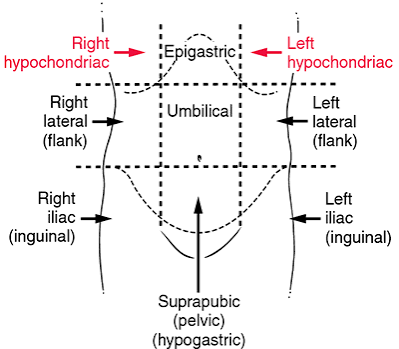
right iliac
The area of the abdomen located on the right side, just below the right lumbar region. It contains the appendix and part of the cecum, and is one of the nine regions used in abdominal mapping.
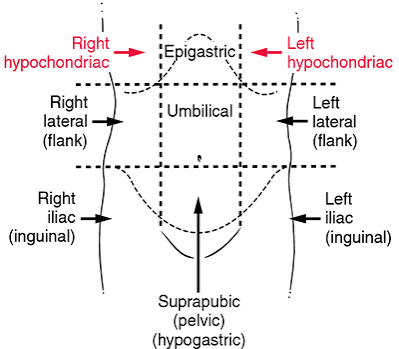
hypogastric
The area of the abdomen located below the umbilical region and above the pubic area, containing parts of the bladder and reproductive organs. It is one of the nine regions used in abdominal mapping.
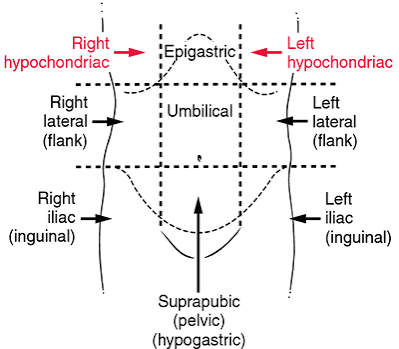
left iliac
The area of the abdomen located on the left side, just below the left lumbar region. It contains parts of the sigmoid colon and is one of the nine regions used in abdominal mapping.