Section 7: Laws and Rules of the Road (Continued)
 Call Kai
 Learn
Learn Practice Test
 Spaced Repetition
 Match
Match Flashcards
 Knowt Play
1/37

There's no tags or description
Looks like no tags are added yet.
Name | Mastery | Learn | Test | Matching | Spaced | Call with Kai | Chat |
|---|
No analytics yet
Send a link to your students to track their progress
38 Terms
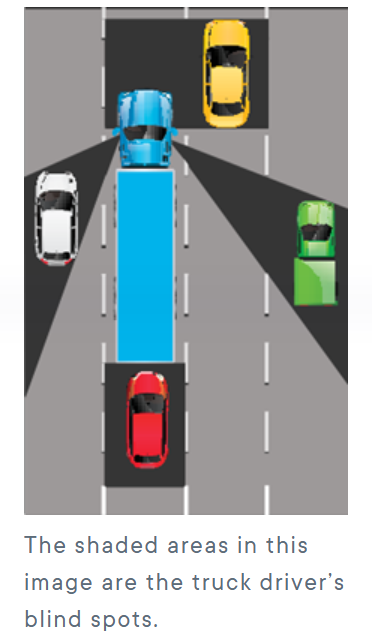
No Zones
In these areas, your vehicle can disappear from a large vehicle or truck driver’s view.
If you cannot see the truck’s side mirrors, the truck driver cannot see you.
Large vehicles and commercial trucks take longer to stop than passenger vehicles traveling at the same speed. Do not move in front of a large vehicle and suddenly slow down or stop. The large vehicle will not be able to stop fast enough to avoid crashing into you.
The average passenger vehicle traveling at 55 mph can stop within 300 feet.
A large vehicle traveling at the same speed can take up to 400 feet to stop.
When driving near large vehicles and trucks, do not:
Change lanes directly in front of them to reach an exit or turn.
Drive next to them longer than you need to. Always pass a large vehicle on the left side then move ahead of it
Follow too closely. Tailgating decreases a vehicle’s safety distance.
Underestimate their size and speed as they often appear to be traveling slower.

Safety zones
are spaces set aside for pedestrians waiting for buses, streetcars, and trolleys. Safety zones are marked by raised buttons or markers on a road.
Do not drive through a safety zone under any condition.

When a bus, streetcar, or trolley is stopped at a safety zone or traffic light,
you may pass at no more than 10 mph.

Do not turn in front of light rail vehicles.
To safely share the road with motorcyclists:
Allow a safe three-second following distance. This space will help you avoid hitting a motorcyclist if they brake suddenly or fall.
Whenever possible, give a motorcycle the full lane. It is legal to share lanes with motorcycles, this is known as lane splitting.
Never try to pass a motorcycle in the same lane as you.
When possible, move to one side of your lane to give motorcyclists more room to pass.
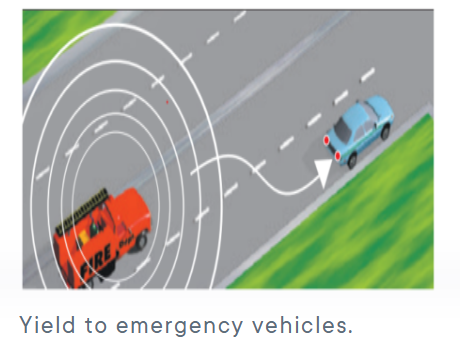
Yield to emergency vehicles.
If you are in an intersection when you see an emergency vehicle, continue through the intersection. Drive to the right as soon as it is safe and stop.
Obey any direction, order, or signal given by a law enforcement officer, or firefighter even if they conflict with existing signs, signals, or laws.
It is against the law to follow within 300 feet of any fire engine, law enforcement vehicle, ambulance, or other emergency vehicle when their siren or flashing lights are on.

Slow-moving Vehicles
Scooters
Neighborhood electric vehicles
Golf carts
Road maintenance vehicles
Some slow-moving vehicles have an orange and red triangle on their back, such as road maintenance vehicles, which usually travel at 25 mph or less.
When a railroad crossing is not controlled, what is the speed limit when you are within 100 feet and cannot see for 400 feet in both directions?
15 mph.
Which of the following is a requirement of California’s Basic Speed Law?
Never drive faster than is safe for current conditions.
In addition to setting your parking brake, what should you do when parking on a hill?
Make sure your vehicle is in the “park” position or in gear.
You are under 18 years of age and have had your license for eight months. You may drive:
Between 5 a.m. and 11 p.m.
You are required to notify DMV by filing a Report of Traffic Accident Occuring in California (SR-1) form if:
You were involved in a collision with more than $1,000 in damages
At what point during a rainfall are roads slippery on a hot day?
For the first several minutes.
A highway has a posted speed limit of 65 mph. What does this mean?
You must drive 65 mph only if driving conditions are ideal.
If a traffic signal is green, but traffic is blocking the intersection, what should you do?
Wait and do not enter the intersection until your vehicle can get completely across.
What should you do when traffic is slow and heavy, and you must cross railroad tracks before reaching the upcoming intersection?
Wait until you can completely cross the tracks before proceeding.
Which of the following should you do if you are being followed by a tailgater?
Change lanes and allow the tailgater to pass.
Which lights should be used if a driver is having trouble seeing other vehicles because of dust or smoke blowing across the roadway?
Headlights.
When is it legal for a person to drive with an alcoholic beverage container that has been opened?
If the container is in the trunk of the vehicle.
When you cannot change lanes to pass a bicyclist, allow at least three feet between your vehicle and the bicyclist. If you cannot give three feet of space, do not pass the cyclist until three feet of clearance can be given.
Fines for traffic violations in a work zone can be $1,000 or more.
Anyone convicted of assaulting a highway worker faces fines of up to $2,000 and imprisonment for up to one year.

Vehicles with Hazardous Loads
The speed limit is 25 mph within 500 feet of a school while children are outside or crossing the street. Some school zones may have speed limits as low as 15 mph
Some school buses flash yellow lights when preparing to stop to let children off the bus.
The yellow flashing lights warn you to slow down and prepare to stop.

When the bus flashes red lights you must stop from either direction until the children are safely across the street and the lights stop flashing.
If you fail to stop, you may be fined up to $1,000 and your driving privilege could be suspended for one year.

Blind Intersections
An intersection is considered blind if it has no stop signs at any corner
The speed limit for a blind intersection is 15 mph.
Alleys: any road no wider than 25 feet that is used to access the rear or side entrances of buildings or properties.
The speed limit in an alley is 15 mph.
The speed limit is 15 mph within 100 feet of a railroad crossing and you cannot see the tracks for 400 feet in both directions.
When the crossing devices or a person warns you a train is coming, stop at least 15 feet from the nearest track.
Business or Residential Districts
The speed limit is 25 mph
It is a misdemeanor to use a motor vehicle to flee or attempt to evade law enforcement performing their duties. This is punishable by imprisonment in a county jail for one year or less.
A person convicted of causing serious bodily injury during a law enforcement pursuit is subject to imprisonment in a state prison for up to seven years, or a county jail for one year or less.
A person convicted of manslaughter resulting from evading law enforcement during a pursuit is subject to imprisonment in a state prison for a minimum of 4 to 10 years.
If an unlicensed person is caught driving your vehicle, it may be impounded for 30 days.
an adult, your license may be suspended if your driver’s record shows one of the following point totals:
4 points in 12 months.
6 points in 24 months.
8 points in 36 months.