Econ Final Exam Review
 Call Kai
 Learn
Learn Practice Test
 Spaced Repetition
 Match
Match Flashcards
 Knowt Play
1/110

There's no tags or description
Looks like no tags are added yet.
Name | Mastery | Learn | Test | Matching | Spaced | Call with Kai | Chat |
|---|
No analytics yet
Send a link to your students to track their progress
111 Terms
Law of diminishing marginal returns
reflects people’s preferences
each additional unit provides less marginal utility than the previous one
Demand
the relationship between the price of a good and the amount the buyer is willing to purchase
The Law of Demand
holding all else equal, the quantity demanded for a good falls as the price rises and vice versa
Ceteris Peribus
(all else equal)
The Law of Supply
Holding all else equal, the quantity of a good supplied rises if the price rises and vice versa
The decision to sell something is based on what
the marginal principle
cost-benefit principle
only sell if marginal benefit > marginal cost
Assumptions about firms
Only objective is to maximize profit
Firms operate in a competitive marketplace
Buyers and sellers are price takers —→ cannot influence price they sell at, they just choose how much to sell
The rational rule for sellers
continue making product until marginal cost = price
Why don’t firms sell infinite things?
diminishing marginal returns —→ the cost to produce more rises and it is not worth it to produce one extra thing
Demand Schedule
Supply Schedule
What is Quantity demanded if the demand/supply function gives you a negative answer?
0
Market Demand
sum of all individual quantities demanded by each buyer in the market
find each person’s individual quantity demanded at each price
at each price, add up the quantity demanded by everyone
Plot total quantity demanded at each price for market demand curve
Demand vs Quantity demanded
Demand: relationship between price and quantity
Quantity demanded: the exact amount people will buy at a SPECIFIC price
Supply vs Quantity supplied
Supply: relationship between price and quantity supplied
Quantity supplied: the exact amount that firms would sell at a SPECIFIC
6 Factors that shift demand
The number of buyers
more buyers = more demand
The price of other things
higher price of complements —→ lower demand
higher price of substitutes —→ higher demand
Income
normals good: higher income —→ higher demand
inferior good: higher income —→ lower demand
Preferences
Expectations
Expect prices to go up —→ higher demand today
expect lower prices —→ lower demand today
Network effects and congestions
Network (insta/snap): more people = more demand
Congestion (beaches/restaurants): more people = less demand
5 Shifters of Supply
Number of sellers
more sellers = higher demand
The price of other things
Complements: higher price —→ decrease supply
Substitutes: higher price —→ higher supply
Price of inputs
higher input price —→ decreased supply
Productivity & Technology
Higher productivity/technology —→ higher supply
Expectations
higher price in the future —→ lower supply now
ONLY IF GOOD IS STORABLE
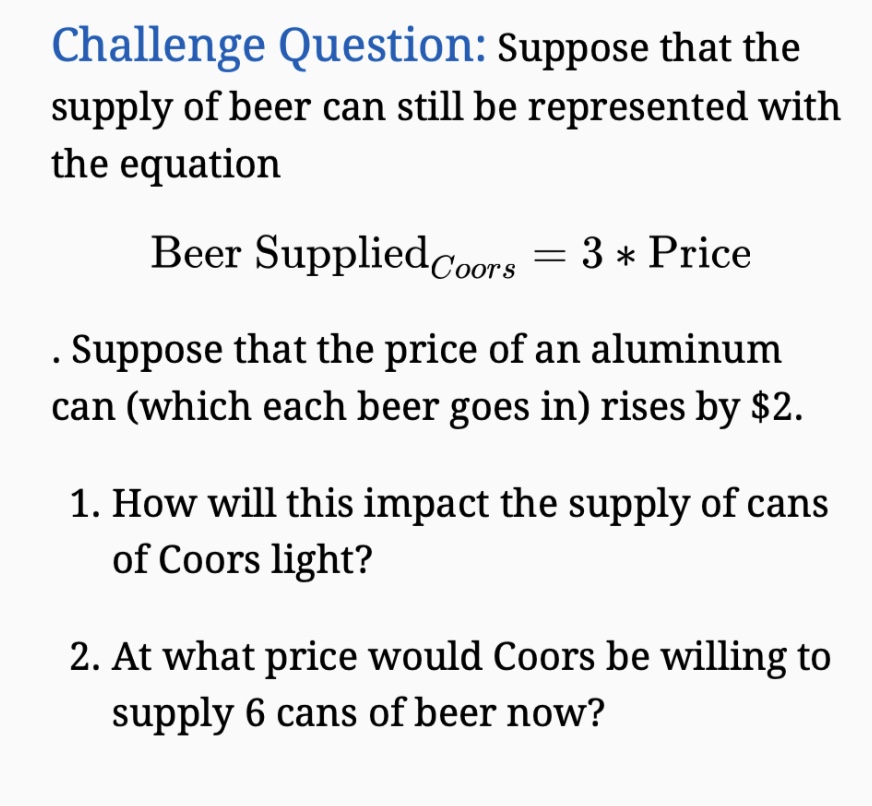
if price increases by $2 then plug in P-2 in Qs equation
Is voluntary trade common?
Yes
Production Possibilities Frontier (PPF)
shows what combination of things a person/business/nation can produce
Below the frontier —→ inefficient use of resources
Outside the frontier —→ unattainable productivity
PPF always slopes down
What is opportunity Cost
what you give up/what you get
Why is PPF bulging outwards instead of linear?
law of diminishing marginal returns
For people to engage in trade both need to benefit
Absolute advantage
ability to do a task using fewer resources
tells us who can produce more using the same inputs
Will someone always have a comparative advantage?
yes, as long as opportunity costs are different
What is the price of trade?
Between the opportunity cost of that thing
If you are trying to find the terms of trade for 1 collected data set it is in-between the opportunity cost for the collected data set of each person
What is economics?
study of people “in the business of ordinary life”
study of decision making under scarcity
how people use resources and respond to incentives
social science that studies the production, consumption, and distribution of goods
Scarcity
condition where demand for something exceeds the supply
Economic Surplus
Total benefit - total cost
Does every market have a price for transactions?
yes
Why is price an incentive?
sellers produce more
buyers consume less
Equilibrium
no tendency for change
Qs = Qd
occurs when buyers and sellers are in agreement
What happens if buyers and sellers disagree?
shortage Qd > Qs
surplus Qs > Qd
What happens if a market is out of equilibrium
prices and economic fundamentals push it back to equilibrium
How do businesses maximize profit
marginal principle —→ keep inching up the price to see until when buyers will buy
What happens at equilibrium?
Everyone who wants to buy at the equilibrium price gets to buy as much as they want
Symptoms of market at disequilibrium
Queuing (lines for things)
Secondary markets (unofficial channels to buy something at higher prices)
Positive analysis
objective statements
true/false
Normative analysis
prescribing what should happen
involves a value judgement
who is going to bear the consequences or reap the benefits
Economic Efficiency
more economic surplus = more economic efficiency
surplus is size of economic pie while efficiency is how to make the pie bigger
efficiency does not mean more equity
even if a policy hurts some people it might still be worth it
all policy has winners and losers
Consumer surplus = MB - P
Producer Surplus = P - MC
Market
brings together buyers and sellers or trading partners
Price
communicates value, scarcity, and cost
incentive for buyers and sellers
Equilibrium
point at which there is no tendency for change in a market
Quantity supplied = quantity demanded
buyers n sellers are in equilibrium
what happens when market goes out of equilibrium?
prices and economic fundamentals push back up to equilibrium
Economic Disequilibrium
Queuing (people lining up to buy something) —shortage
Secondary markets (unofficial channels to buy something at higher price) —shortage
What is DWL
Efficient outcome - Actual economic surplus
Competitive Equilibrium
maximizes total surplus — ASSUMING perfectly competitive markets
Ways markets fail
Market power undermines competition
Externalities create side effects
Government can impede market forces
Information problems undermine trust
Irrationality leads to bad decision making
Maximizing efficiency is just one way to conduct normative analysis
Increasing efficiency (economic pie) does not mean:
increasing equity
The budget problem
our demand for something is influenced by our budget not just MB
Price Elasticity of demand
Shows how much Qd changes with a 1% change in price
Negative PED
price up, demand down
COMPARING elasticities
ignore the negative sign; higher number is more elastic
Better way to think about it
|PED| < 1 = inelastic
|PED| = 1 = unit elastic
|PED| > 1 = elastic
PED = 0 Perfectly inelastic
PED = infinity Perfectly elastic
Price elasticity of supply
Es < 1: inelastic
Es > 1: elastic
Determinants of Price elasticity of Supply
More inventory: more elastic
More availability of inputs: more elastic
Extra capacity: more elastic
More barriers to entry/exit: less elastic
Time horizon: over time, supply becomes more elastic
Determinants of Price elasticity of Demand
More competing products = more elastic
Narrow market = more elastic; broad market = less elastic
Budget: larger share of budget = more elastic
More necessary = less elastic
More willing to search = more elastic
More time = more elastic
Why do we use the midpoint method
the direction of price changing doesn’t matter
Cross price elasticity of demand
how does price change of another good change demand for this good
+ sub
- comp
Income elasticity of demand
percent change in Q demanded from a 1% change in income
+ normal goods
- inferior goods
Price Ceiling
max price that sellers can legally charge
rent control
anti- gouging laws
laws limiting medical costs
Price Floor
min price that sellers can legally charge
minimum wage
Quota
max amount of good that can be bought or sold
Mandate
minimum amount of good that can be bought/sold
Unexpected consequences of price ceilings
rent controlled. properties are lower quality
discrimination
black markets
long run, suppliers will pivot into different industries
gov. buys surplus from price floor
What is a businesses ultimate objective?
to maximize profit
Accounting profit
total revenue - explicit financial costs
Economic Profit
Total revenue - explicit costs - implicit costs (opportunity costs)
Production function for individual firms
land
labor (workers)
entrepreneurship (puts all three together)
capital (machines)
Marginal product
change in output associated with the next unit of input
Diminishing marginal returns
if firm increases use of one input the resulting output will become smaller and smaller
Long run
firms can enter or exit the market
economic agent has total flexibility to change their decisions
Short Run
business can only choose weather to operate and how much to make
Story of Firm
Increasing marginal returns: business hires more workers and adding new workers increases output at a growing rate
Decreasing marginal returns: as the business grows, new workers increases output, but at a decreasing rate
Decreasing total returns: adding more people (input) hurts output
Marginal product
shows how costly increasing production is
Total fixed cost
cost that firms pay once to begin operations (overhead like rent)
Total Variable Cost
sum of costs that occur because of a firms output
variable costs always rise
Average total cost
total cost/ total output
always a U shape
Average fixed cost
fixed cost / quantity
decreases with more production
Average variable costs
total variable costs / time
increases eventually with more production
diminishing marginal returns
Average Revenue
AR = total revenue / total output = price
Profit Margin
P - ATC
AR - ATC
Marginal Cost
change in total cost/ change in total output
down and then up because of diminishing returns
Marginal costs and avg costs
when marginal costs are below avg costs, avg costs go down
when marginal costs are above avg costs, avg costs go up
Marginal Revenue
tells us what kind of market the firm is operating in
Marginal Revenue
MR = P for perfectly competitive marketplaces
Firm demand line for perfectly competitive
Horizontal
Profit maximizing rule
produce until MR = MC
Perfectly competitive firms
produce until MR = P
MRDARP
profit margin is economic profit margin (P-ATC) x Q
Shutdown point
AVC = MC
Free Entry
absence of obstacles that would make it costly to enter or exit an industry
Firm story (low profits)
negative profits
firms exit
supply shifts left
prices improve
profit margin tends make to 0
Firm Story (high profits)
positive profits
firms enter
supply shifts right
prices decrease
profit margin tends towards 0
Long run:
P = ATC
profit margin = 0
economic profit = 0
firms could still have positive accounting profit
Free trade is not disagreed upon