Potentiometric and Amperometric Titrations
 Call Kai
 Learn
Learn Practice Test
 Spaced Repetition
 Match
Match Flashcards
 Knowt Play
1/35

There's no tags or description
Looks like no tags are added yet.
Name | Mastery | Learn | Test | Matching | Spaced | Call with Kai | Chat |
|---|
No analytics yet
Send a link to your students to track their progress
36 Terms
What is an electrochemical cell made up of?
An electrochemical cell is made up of two half cells.
What does the half cells do?
Each of the two half cells develop a particular potential or electromotive force
What happens when two half cells are connected together?
When two half cells are connected together (internally and externally), the electromotive force developed causes a current to flow in the external circuit
Daniel cell
• One half cell consists of a copper electrode immersed in a solution of copper sulphate.
• Another half cell consists of a zinc electrode immersed in a solution of zinc sulphate.
• The two solutions are separated by a porous material which permits the passage of ions but prevents the mixing of ions ie. connected electrically internally.
• If the two metal electrodes are connected by an external wire, current will flow in the wire.
• If the two metal electrodes are connected to a meter, we can measure the potential developed across the two half cells.
Factors affecting electrical potential
The electrical potential depends on two factors: (a) the particular metal and cation involved (b) the activity or effective concentration of the cation in the solution
Standard electrode potential
If the activity of the cation is 1 gram ion/liter, the electrode potential developed is the ‘standard electrode potential’ for that metal.
Hows does reduction potential effect the metal?
In an electrochemical cell, the metal with the higher reduction potential will get reduced and the metal with the lower reduction potential will get oxidized.
Nernst equation
A positively charged ion of the metal M can be reduced by taking on a number of electrons n to produce one atom of the metal.
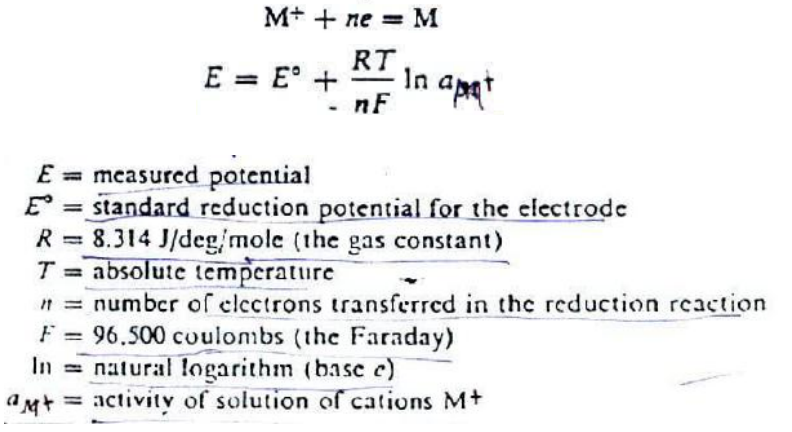
Nernst equation at room temperature
At room temperature ie. 25℃ (298°K), Nernst equation becomes simplified.
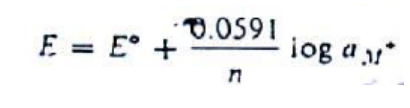
Classification of half cells
A metal in equilibrium with its ions
A metal in equilibrium with a saturated solution of a slightly soluble salt
Two soluble species in equilibrium at an intert electrode
A metal in equilibrium with a saturated solution of a slightly soluble salt example
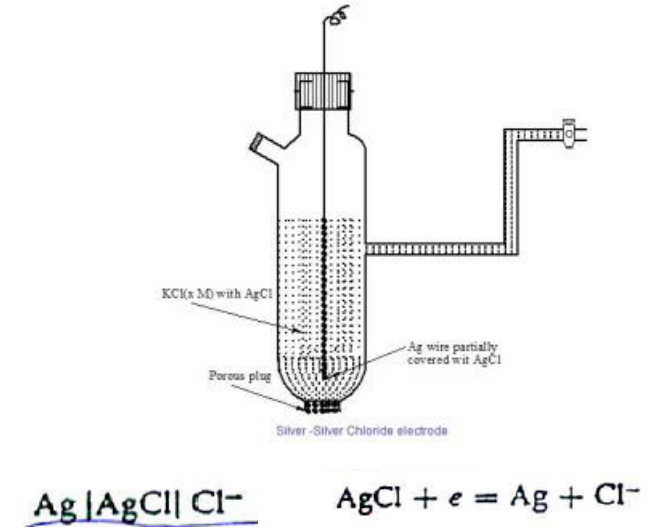
Silver - silver chloride electrode
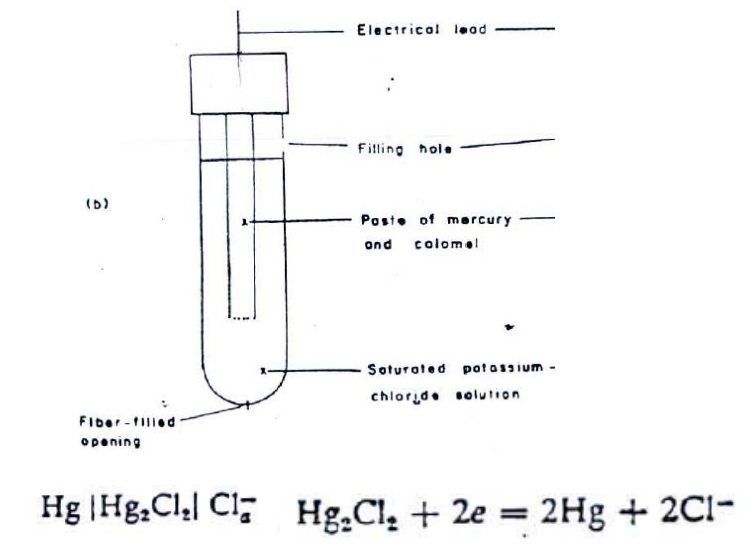
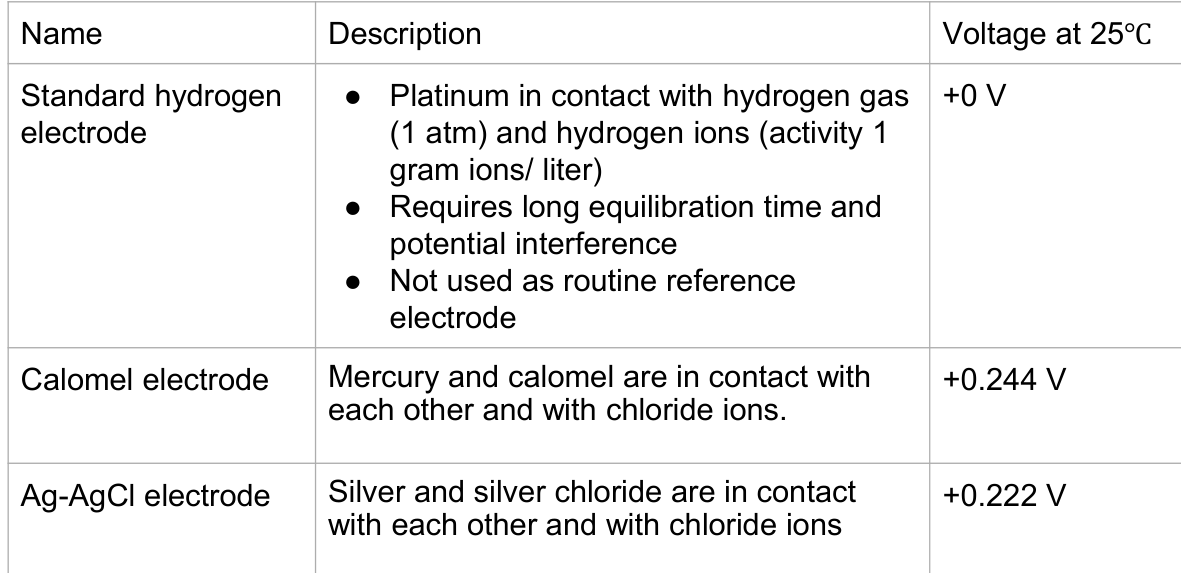
Calomel electrode
Silver - silver chloride electrode
Silver and silver chloride are in contact with each other and with chloride ions
Calomel electrode
Mercury and calomel are in contact with each other and with chloride ions
Two soluble species in equilibrium at an inert electrode
• In this type of half cell, a solution contains two soluble species which can convert to each other by an oxidation-reduction reaction.
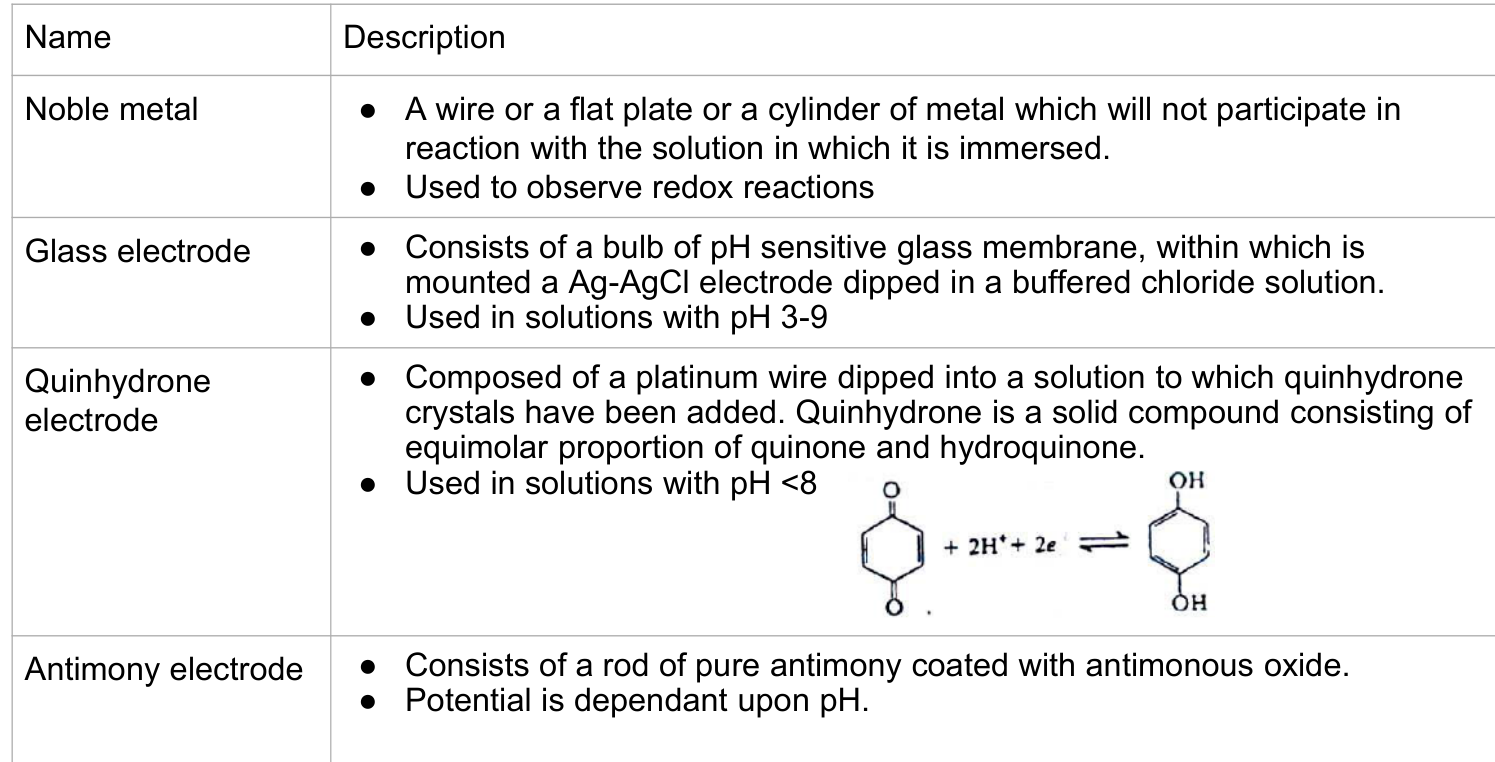
• An inert metallic electrode is inserted into the solution to lead the potential developed to a potentiometer.
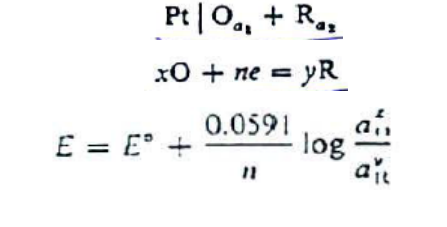
The overall potential of the cell can be expressed as
Ecell= Ereference + Eindicator + Ejunction

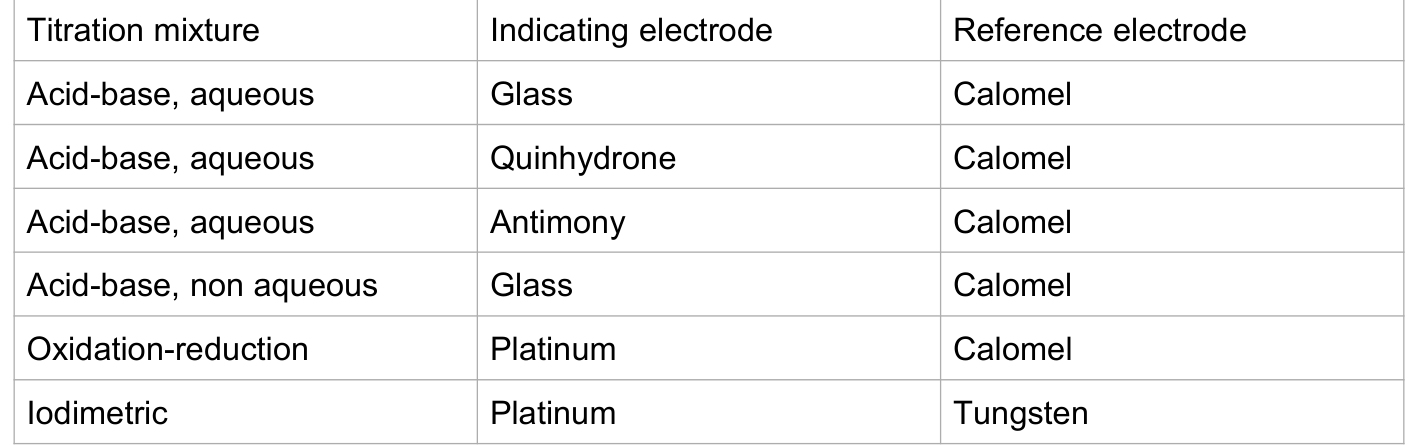
Common reference electrodes
Common indicating electrodes
Potentiometric titration definition
A potentiometric titration is a quantitative determination where the end point is derived from the change in the potential
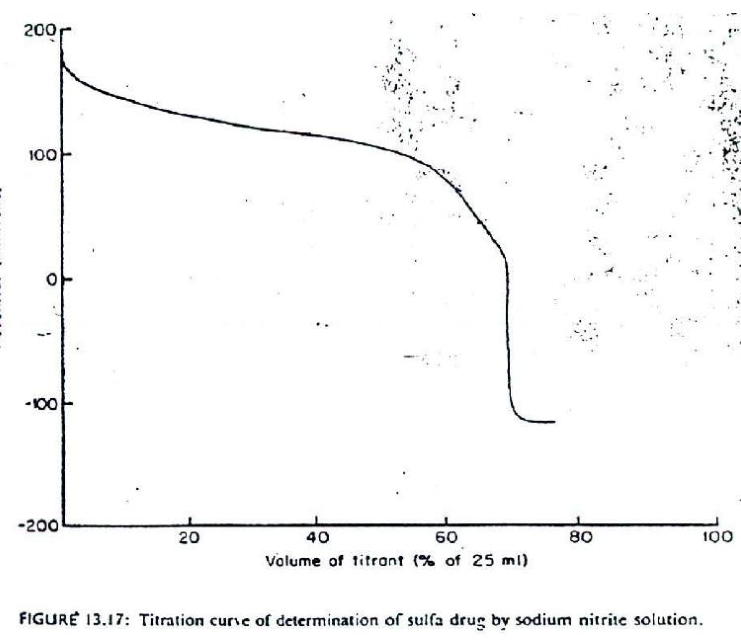
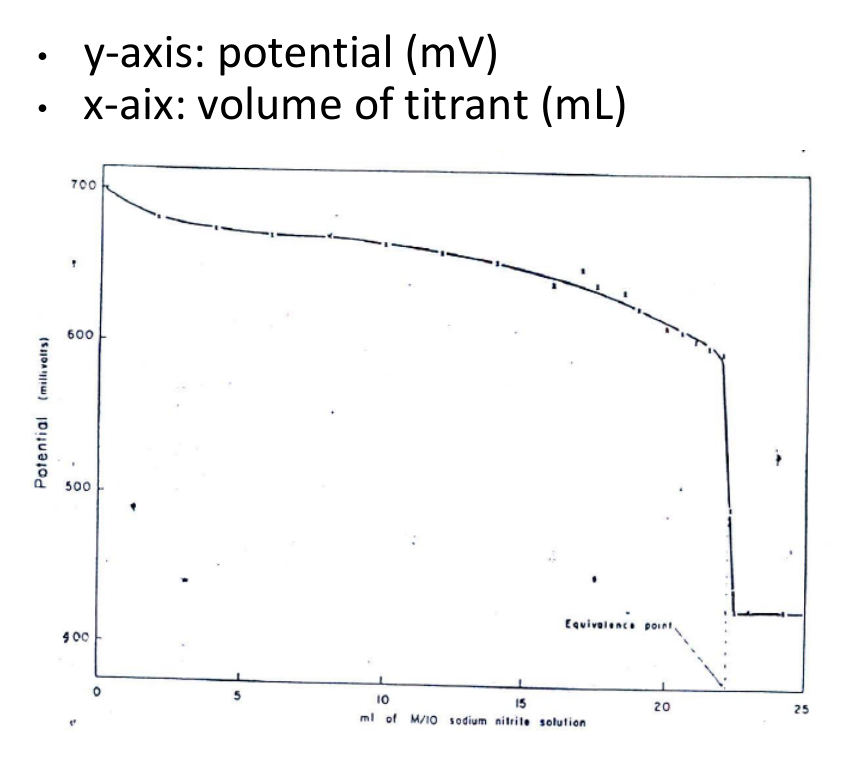
Titration curve of determination of sulfa drug by sodium nitrite solution
Potentiometric titration pH formula

In potentiometric titration involving acids and bases, what is more common?
In titrations involving acids and bases, it is more common to plot pH against volume of titrant added
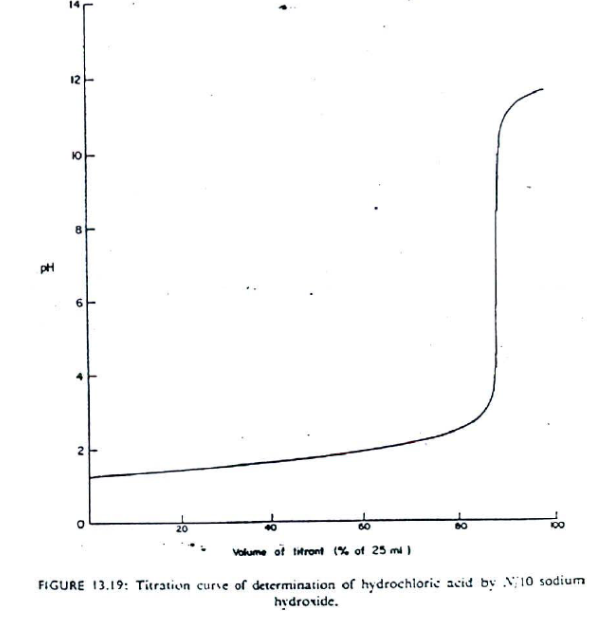
Titration curve of determination of hydrochloric acid by N/10 sodium hydroxide
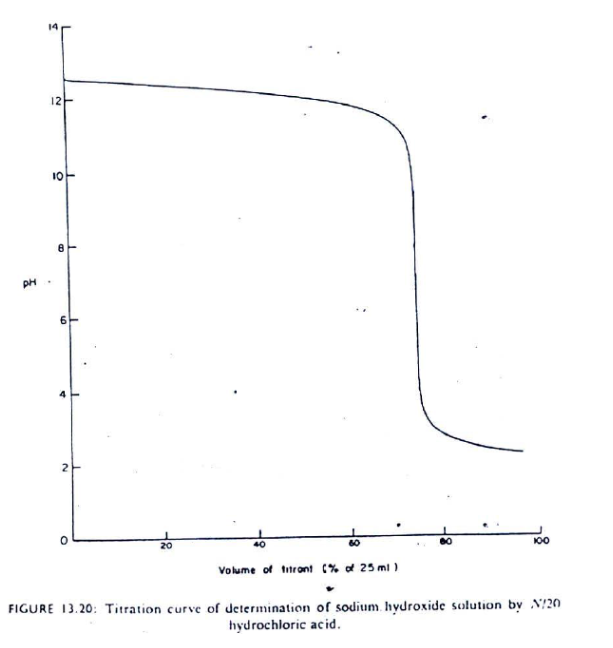
Titration curve of determination of sodium hydroxide solution by N/20 hydrochloric acid
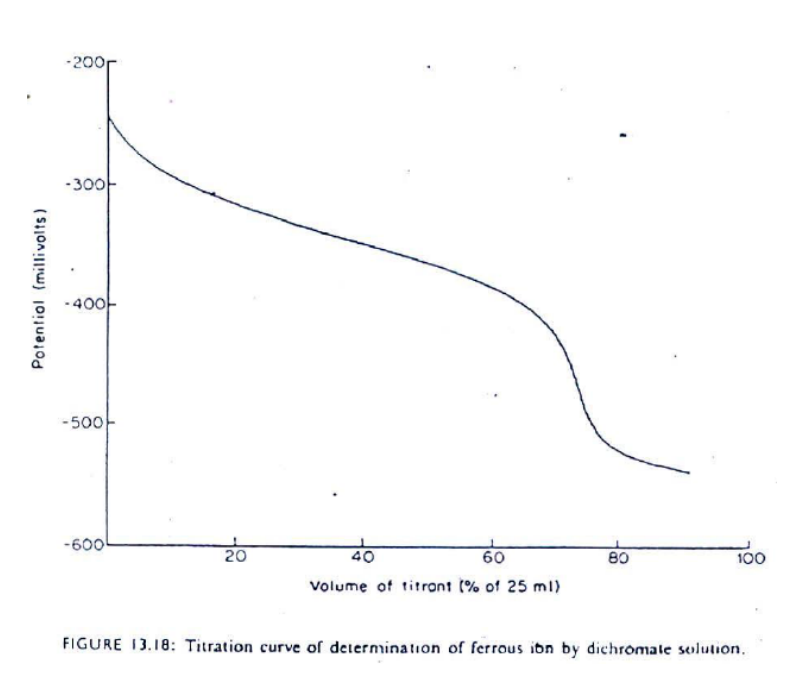
Titration curve of determination of ferrous ion by dichromate solution
End point detection
• The end point in a potentiometric titration is the sharp rise or fall which occurs in the potential produced at an indicating electrode immersed in the titration vessel.
• If the rise or fall is sufficiently steep, end point can be selected from the midpoint in the steep part of the titration curve.
• When the rise or fall in potential is more gradual, it is difficult to select the end point.
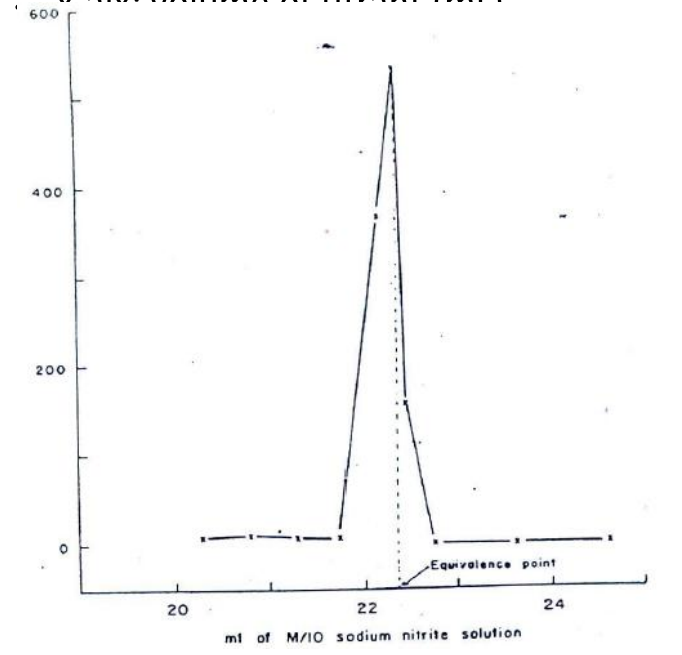
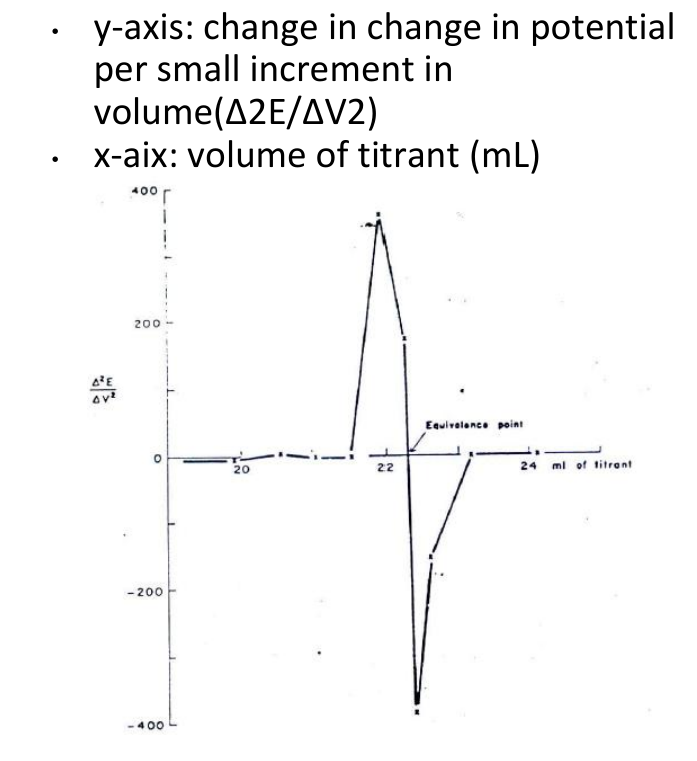
• In such case it is more useful to resort to the first or second derivative titration curve.
• To obtain a first derivative curve, change in potential per small increment of titrant added is plotted against volume of titrant added.
Zero derivative titration curve
First derivative titration curve
Second derivative titration curve
Instrumentation of potentiometric titration
• Any commercial pH meter allowing readings to be estimated at the 0.01 unit level is satisfactory for acid-base potentiometric titration.
• Plotting of the first derivative curves can be done manually or it can be traced out manually on automatic titrators eg. Metrohm potentiograph, Sargent- Malmstadt titrator.
Selection of electrodes
Any titration can be performed by potentiometric means provided that the change in potential can be followed by a suitable indicating electrode when used in conjunction with a reference electrode.
Advantage of potentiometric titration over indicators
• Can be used in coloured or turbid solutions where the use of colour indictors would be useless.
• Can be used where colour indicators can not be used due to restrictions in effective ranges or potentials.
• It permits automatic titrations to be performed.
• Can be used readily with recorders to record the titration curve.
• Derivative curves can be computed by the instrument to detect end point accurately.
What is amperometry
Amperometry is a method in which analyte, dissolved in a suitable medium, is placed in an electrochemical cell where the reaction is controlled by a variable known potential applied to the working electrode
Explain amperometry
• Amperometry is a method in which the analyte, dissolved in a suitable medium, is placed in an electrochemical cell where the reaction is controlled by a variable known potential applied to the working electrode.
• The change in concentration of an electroactive analyte, titrant or product can be followed by observing the change in current, at a constant applied potential.
• The working electrode is usually the dropping mercury electrode or the rotating platinum electrode.
• The reference electrode is usually the saturated calomel electrode.
• Most of these titrations are based upon precipitate formation.
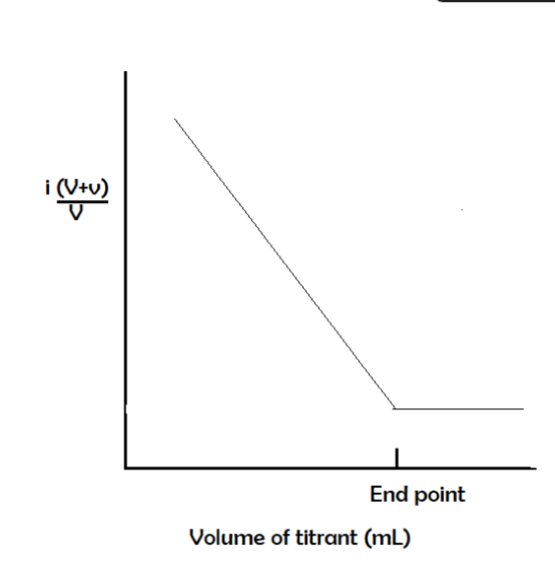
Titration of lead iron with sulphate
• Type 1: Only analyte is reduced but titrant is not.
• Initially, there is only analyte in the solution.
• During titration, the analyte reacts with the titrant every time titrant is added to the solution. The concentration of the analyte decreases until the end point.
• Therefore, the current also decreases.
• At end point, analyte no longer accepts electrons.
• Example: Titration of lead ion with sulphate
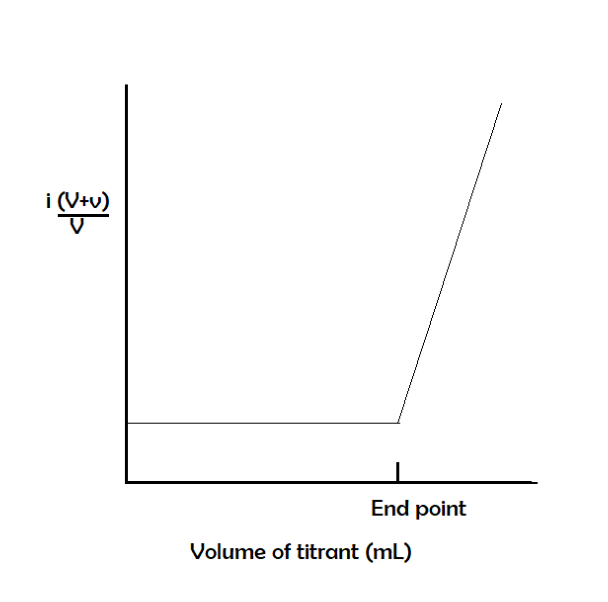
Titation of halides with silver ion
• Type 2: Only titrant is reducible but analyte is not.
• Initially, there is only analyte in the solution.
• During titration, the analyte reacts with the titrant every time titrant is added to the solution.
• Current will remain zero until the end point.
• After the end point, if more titrant is still added, the concentration of the titrant gradually increases.
• Therefore, the current also increases.
• Example: titration of halides with silver ion.
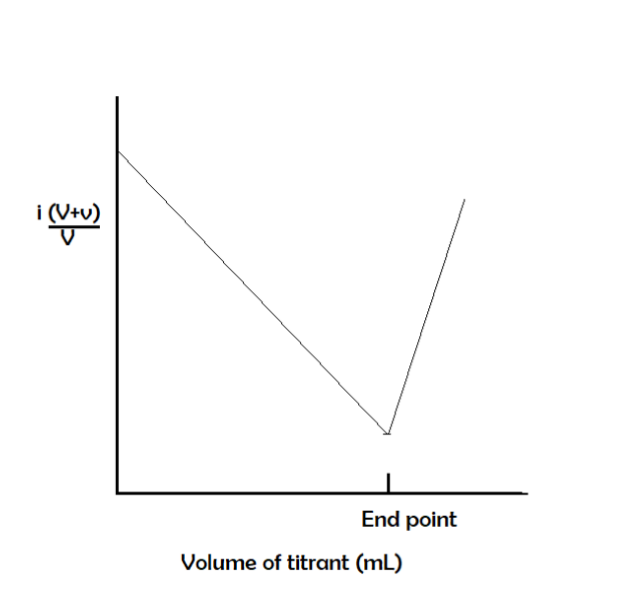
Titration curve type 3
• Type 3: Both analyte and titrant are reducible.
• Before the end point, the current decreases because the concentration of the analyte decreases since it reacts with the titrant.
• At the end point, there is no analyte left unreacted.
• After the end point, the concentration of the titrant increases and so the current increases.