PSYCH 230 NVCC- EXAM 3
 Studied by 1 person
 Call with Kai
 Learn
Learn Practice Test
 Spaced Repetition
 Match
Match Flashcards
 Knowt Play
1/78

There's no tags or description
Looks like no tags are added yet.
Name | Mastery | Learn | Test | Matching | Spaced | Call with Kai |
|---|
No study sessions yet.
79 Terms
puberty
Hormonal and physical changes by which children become sexually mature and reach adult height and weight
What age does adrenal androgens released from glands at top of kidneys?
about age 6-8
What age does HPG axis: hypothalamus -> pituitary -> gonads (ovaries & testes)?
-Gonads release estrogens & testosterone
about age 10
sexual maturity
Development of primary and secondary sexual
characteristics.
Growth Milestones
Achievement of adult height and weight.
Puberty Transition
Marks the shift from childhood to adulthood physiologically,
though psychological, emotional, and social developments may lag.
Around what age do kids in the United States typically experience puberty?
Average onset below 13 years.
During the 1860s what age did kids hit puberty in the United States?
Between 17-18
Causes of Declining Puberty Age: Nutrition
-Improved nutrition leads to better energy storage and earlier physical development.
-Malnutrition in developing countries correlates with delayed puberty.
Causes of Declining Puberty Age: Genetics
Parental pubertal timing influences children's pubertal onset.
Causes of Declining Puberty Age: Climate
Warmer climates contribute to earlier puberty.
Causes of Declining Puberty Age: Life stress
Increased stress levels can trigger earlier puberty.
Causes of Declining Puberty Age: Body weight
Higher body mass index (BMI) and fat reserves signal readiness for puberty.
What are are possible influences on puberty timing?
nutrition, genetics, climates, life stress, body weight
Adrenal Androgens (Ages 6-8)
Produced by adrenal glands.
Stimulate sexual desire and the onset of secondary sexual
characteristics (e.g., pubic hair).
Hypothalamus-Pituitary-Gonads Axis (Ages 9-10)
Hypothalamus signals pituitary gland, which in turn signals gonads.
Release of sex hormones: estrogens in girls and testosterone in boys.
Primary sexual characteristics
Directly involved with reproduction (e.g., penis, menstruation)
Secondary sexual characteristics
Not directly involved with reproduction (e.g., female breasts, male facial hair)
growth spurt
dramatic increase in height and weight during puberty
What are the changes girls will go through during puberty?
Highly variable rate of change
Growth spurt- Occurs first and earlier than in boys.
Breast and pubic hair development
Menarche- Onset of menstruation.
Uterus and vagina growth
Vocal cords, red blood cells, and heart development
Increased strength
What are the changes boys will go through during puberty?
Growth spurt in height and muscle mass
Penis, testicles, and pubic hair growth
Changes in hands, feet, and legs
Increase in sweat gland activity
Development of body hair and vocal cords
What brain development occurs during puberty?
Fully matures in early to mid-twenties.
Adolescents exhibit high impulsivity and sensation seeking due to on going brain maturation.
Variety of forces predict why children mature earlier or later than their peers
Genetics
Ethnicity differences (within and between)
BMI (body mass index) during elementary school (girls)
Rapid weight gain during first nine months of life (girls)
Intense family stress
What are some reactions to the changing body that are influenced by social environment?
-Breast development often causes positive emotions.
-Feelings about menstruation may be more positive among middle-class girls.
-A boy's first ejaculation is rarely discussed or celebrated.
-Changing bodies tend to cause more embarrassment around opposite-sex parent.
How may social media impact an adolescenes view on their body image?
-High societal expectations for female thinness and male muscularity.
-Social media exacerbates body dissatisfaction among adolescents.
anorexia nervosa
Characterized by severe dieting and distorted body image.
High mortality rate.
bulimia nervosa
Involves binge eating followed by purging.
Less deadly but still dangerous.
binge eating disorder
Recurrent binge eating without purging.
what are risk factors to developing an eating disorder?
Heredity: Genetic predisposition to eating disorders
Parental Influence: Negative messaging about body weight and appearance.
Child Temperament: Anxiety, depression, and low self-efficacy.
3 multiple choice options
what are some presentations and treatments for eating disorders?
Meditation and Self-Efficacy Building.
Innovative Treatments: Training adolescents to recognize and
accept their actual body size through repeated exposure to their own
images.
sexual biological basis
Onset is tied to output of adrenal androgens and testosterone production (around age 10).
sex: influencing factors
Early Onset: Linked to African American ethnicity and lower-income
males.
Personality Traits: Impulsiveness, risk-taking, low self-worth.
Peer Influence: Friends' sexual experiences encourage earlier
intercourse.
Media Exposure: Sexualized media increases interest in sexual
activity.
what is the average age for first intercourse for women?
17.8 years
what is the average age for first intercourse for men?
18 years
early maturation in boys may result in?
-Greater success at sports boosts popularity and self-esteem
-More prone to abuse substances, especially if low impulse control exists
-Higher risk for depression when personality problems or unhappy family life presents
early maturation in girls may result in?
-Higher risk of developing externalizing problems when in stressful environment
-Tendency for earlier involvement in smoking, drinking, and drugs
-Less likely to use contraception
-Lower self-worth leading to poor body image, depression
how to minimize puberty distress: Parents
-Parental discussion about puberty with same-sex parent before changes begin
-Encouraging child involvement in positive activities with same-age friends, especially for early-maturing girls
how to minimize puberty distress: society
-Schools matter!
-Adequate puberty education is important.
Body image issues: girls
-Body self-image is closely tied to overall self-esteem
-Tend to feel worse about their looks than boys do, partly because of social expectations of a female thin ideal.
-The impulse to be thin may have prebirth epigenetic roots (i.e., intense stress during pregnancy)
-The female impulse to be thin may have prebirth epigenetic roots (i.e., intense stress during pregnancy)
Body image issues: boys
-Body self-image is closely tied to overall self-esteem
-Boys feel pressured to build up their muscles.
-The female impulse to be thin may have prebirth epigenetic roots (i.e., intense stress during pregnancy)
sexual interest: teenagers
-Threshold androgen level primes initial feelings.
-Environmental feedback heightens interest in sex.
Who are teens having intercourse with?
Most U.S. teens have first intercourse with a steady partner
Noncommitted sex
-1 in 5 outside committed relationship
-3 in 4 with well-known person (e.g., "friends with benefits")
2 multiple choice options
trends in Teen sexuality
-Most sexual encounters are in committed love relationships
-Sexual activity rates among adolescents are similar in the US and western Europe
-Pregnancy rates and the prevalence of gonorrhea and chlamydia in U.S adolescents are very high compared to those in western Europe
-Rates of pregnancies, births, and abortions in U.S. adolescents have been declining in recent years
importance of sex education?
Comprehensive sex education reduces pregnancy rates and delays sexual initiation.
challenges of sex education
Pushback from parents against sex education, fearing it promotes sexual activity.
Sex education: recommendations
Improve Curriculum: Focus on relationships, empathy, and pleasure alongside prevention.
Safe Learning Environments: Create spaces where adolescents can discuss and learn about sexuality without stigma.
What are the three classic theories of teenage thinking?
Piaget – cognitive development
Kohlberg – moral reasoning
Elkind – adolescent egocentrism
Piaget's Formal Operational Stage
-Ability to think logically about concepts, abstracts, and hypothetical possibilities
-Ability to think scientifically
-Ability to plan for the future and engage in complex problem-solving.
Examples of Piaget's Formal Operational Stage in Real Life
-Considering and debating controversial issues
-Planning for future life
-Developing identity
-Behaving like adults
Piaget's Formal Operational Stage: criticism
Not universally observed across all cultures.
Overestimates cognitive maturity at certain ages.
Kohlberg's Stages of Moral Reasoning
preconventional, conventional, postconventional
Kohlberg's Stages of Moral Reasoning: preconventional
Stage 1: Obedience and punishment orientation.
Stage 2: Self-interest or instrumental relativist orientation.
Kohlberg's Stages of Moral Reasoning: convential
Stage 3: Good interpersonal relationships.
Stage 4: Maintaining social order.
Kohlberg's Stages of Moral Reasoning: postconventional
Stage 5: Social contract and individual rights.
Stage 6: Universal ethical principles.
Kohlberg's Stages of Moral Reasoning: criticism
Gender Bias: Carol Gilligan argued that Kohlberg's model undervalues an ethic of care typically associated with females.
Behavioral Prediction: High moral reasoning does not necessarily translate to moral actions.
Kohlberg's Stages of Moral Reasoning: Application to real life
-Changes in moral reasoning occur during adolescence
-Kohlberg's categories provide insight into moral priorities
Categories are more attuned to social injustice
-Transition from conventional to post-conventional thinking allows for activism and questioning of societal norms.
Elkind's Theory of Adolescent Egocentrism
Theorizes this part of life is about the immaturity of the thinking process (Studied tendency of teens to feel invincible and invulnerable). Increased awareness of difference between what adults say and do emerges. Increased sensitivity to what others think leads to adolescent egocentrism.
Elkind's Theory of Adolescent Egocentrism: components
Imaginary Audience: Belief that others are constantly watching and judging.
Personal Fable: Belief in one's uniqueness and invincibility.
Elkind's Theory of Adolescent Egocentrism: criticism
Increased sensitivity to peer opinions.
Heightened risk-taking behaviors due to perceived invincibility.
Are adolescents exceptionally socially sensitive?
Yes, especially during puberty (one of three aspects of "storm and stress")
Are adolescents risk takers?
yes for both sexes (two of three aspects of "storm and stress")
Are adolescents more emotional, more emotionally disturbed, or both?
-Yes, more emotionally intense
-No, not more emotionally disturbed. Suicide rates are higher in old age than adolescence (two of three aspects of "storm and stress")
Adolescents' Outlook on Life
Teenagers are generally upbeat and confident about their future.
•Four in 10 flourish (most do well in adolescence)
•Only 6 percent are totally demoralized.
•However, risk-taking tendencies in late teens encourage crime, nonsuicidal self-injury, and depression.
Social Sensitivity
Heightened awareness and sensitivity to others' opinions.
risk taking
Increased propensity for taking risks, especially in peer
settings.
emotional intensity
Greater emotional fluctuations without being
necessarily emotionally disturbed.
Brain Development
Impulsivity and sensation seeking peak in early adolescence.
Cognitive control continues to mature into mid-twenties.
Risk-taking behavior in adolescence
peer influences: Presence of peers significantly increases risky behaviors in adolescents compared to adults.
Pubertal popularity
•Risks related to drive for popularity
ØReduced academic motivation
ØRelational aggression
ØUnethical behavior; manipulation and deception
•Fear of peer rejection greater than fear of poor family relationships
At-risk teens tend to have
-prior emotional regulation difficulties
-poor family relationships
-non-nurturing environments
-risk taking environment
flourishing teens tend to have
- Superior executive functions
- A mentor
- Close family relationships
- Prosocial friends
- Academic success
- Strong schools and communities rich in nurturing activities
- A passion or a special talent
how to make the world fit the teenage mind
•Avoid punishing adolescents as if they were cognitively like adults
•Pass laws that accurately consider teenage mental processes
•Provide group activities that capitalize on adolescent strengths
üYouth development programs
•Tailor high schools to provide better adolescent–environment fit
--Nurturing schools
--Sleep requirements
--Rethink zero-tolerance policies and school-to-prison pipeline (unconditional positive regard?)
Family closeness across childhood
-Puberty brings intense teenager-parent struggles for independence in many families around the world.
-Pubertal hormonal surges may underlie this struggle.
-Parents gradually grant more freedom, and adolescents begin to think of and plan for future.
-Eventually a more friend like parent-teen relationship emerges
Immigrant teens
-Expectations for behavior differ in teens from societies when parental obedience is stressed.
-Family separation attempts related to acculturation may cause intense stress.
-The immigrant paradox suggests that caring for parents can have a variety of positive outcomes
Steps from unisex elementary cliques to adult romantic relationships
-Crowds – large mixed-sex groups of adolescents that share similar values
-Cliques – groups of about 6 teenagers with similar attitudes and shared activities
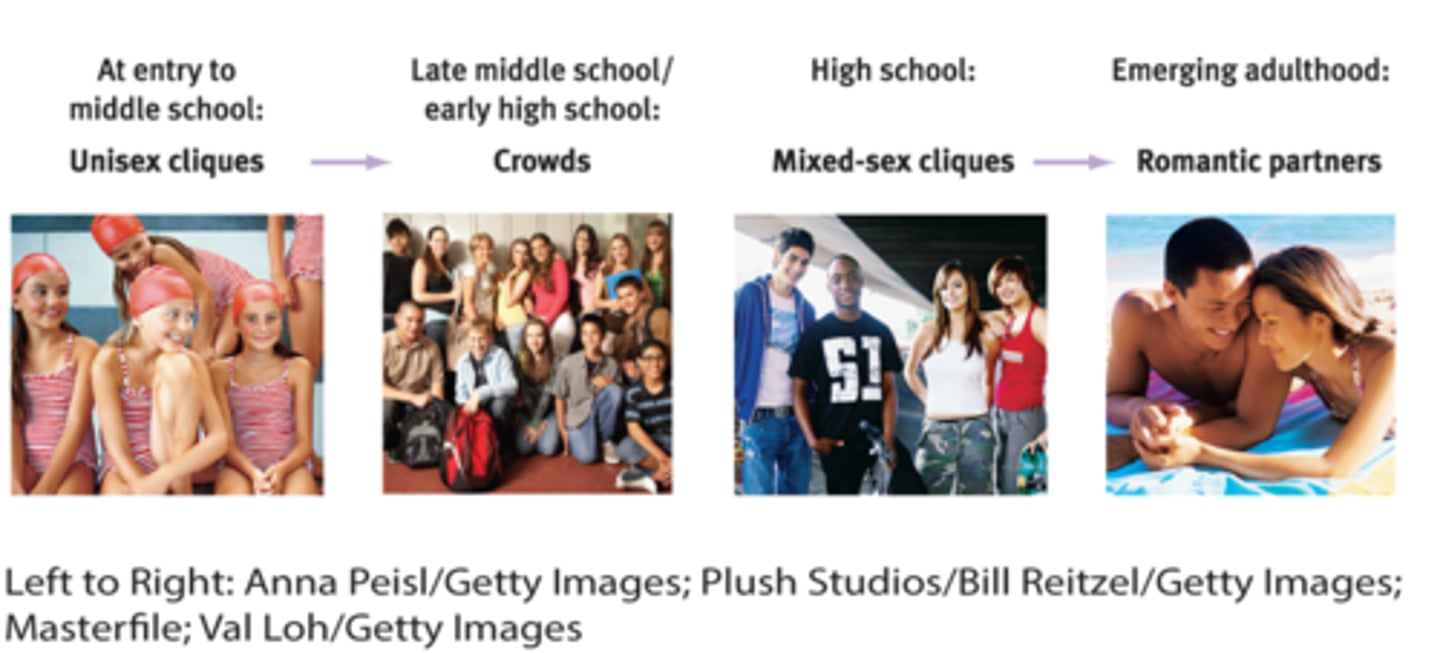
crowds
•Bridge gap between sexes
•Connect adolescents with peers who share their values (+/-)
•Facilitated by social media
•Influenced by school size - more common in larger schools
•Crowd categories:
--Intellectuals (liability in high school?)
--Populars (jocks in high school)
--Deviants
--Residual type (e.g., goths, hip-hop)
"Bad" crowds
-May attract at-risk kids
-Promote antisocial behavior
-Reinforce hostile attributional bias
-Provide "deviancy training"
teenage gangs
- entail close-knit delinquent peer group
-share collective identity
-influenced by socioeconomic context
-provide status and may provide protection
Adolescence Worldwide
adolescence does not exist for nearly 50 million displaced children