Development of the Limbs
 Call Kai
 Learn
Learn Practice Test
 Spaced Repetition
 Match
Match Flashcards
 Knowt Play
1/31

There's no tags or description
Looks like no tags are added yet.
Name | Mastery | Learn | Test | Matching | Spaced | Call with Kai | Chat |
|---|
No analytics yet
Send a link to your students to track their progress
32 Terms
formation of the limb bud
proliferation of the somatic lateral plate mesoderm gives rise to the limb buds (wk.4)
levels of the limbs along the body axis are determined by which genes
hox genes
what does the lateral plate mesoderm form
skeletal elements
connective tissues
vasculature of the limbs
upper limb bud
appear around wk.4
small bulges on lateral body wall→ C5 to T1
end of wk 4, lower limb buds appear→ L1 to S1
formation of somites
paraxial mesoderm forms somites
around 42-44 pairs by the end of 4th week
what do somites give rise to
sclerotome→ axial skeleton
dermomyotome→ dermis and skeletal muscle
pre-myogenic cells→ migrate from dermatomyotome to limb bud

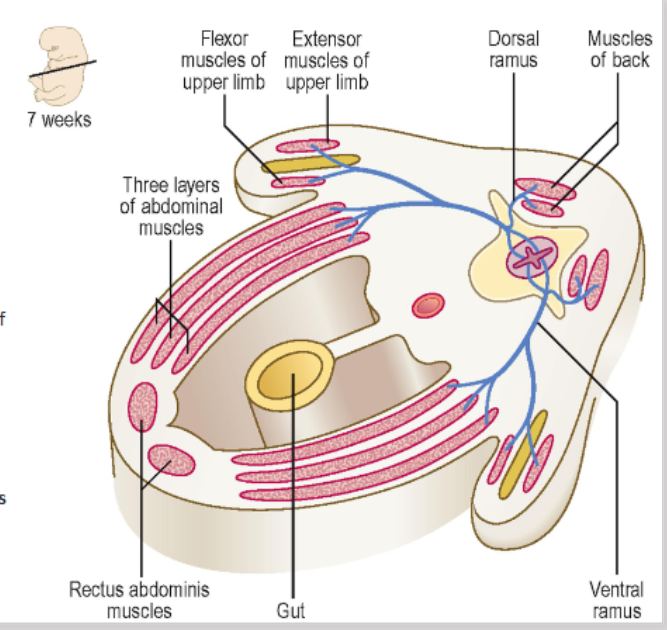
muscle masses
muscle precursor cells originating from somites migrate into limb
cells divide into 2 groups:
dorsal muscle mass
ventral muscle mass
what does dorsal muscle mass give rise to
extensors
supinators
abductor
what does ventral muscle mass give rise to
flexors
pronators
adductors
innervation of the limbs
spinal nerves divide into dorsal and ventral rami
dorsal rami→ muscles of the back
ventral rami→ muscles of thoracic and abdo. wall and limbs
in limbs, nerves divide again into ventral and dorsal divisions
ventral→ ventral mass (flexors)
dorsal→ dorsal mass (extensors)
proximodistal growth
upper and lower limb buds protrude laterally from the trunk
proximodistal growth
limb bud is encased in ectoderm→ skin
mesenchymal core of limb bud secretes fibroblast growth factor 10 (FGF10)
FGF10 induces thickening of overlying ectoderm along the tip of the limb bud→ apical ectodermal ridge (AER) ((pictures))

what is the AER
signalling centre
controls growth and elongation of the limb
progress zone
region below AER
contains rapidly dividing undifferentiated mesenchymal cells providing material for growing limb
AER releases FGF signals→ stimulate cells in the progress zone to keep dividing and prevent them from differentiating too early
new cells added to growing limb from progress zone→ limbs lengthen
Amelia
complete absence of limb
very early failure of FGF signalling/AER function
PZ doesn’t develop
meromelia
partial absence of limb
later or partial loss of FGF signalling/ AER function
arrest of outgrowth
vascular abnormalities may also be responsible
failure of segments of AER
induction and maintenance of AER essential for limb outgrowth
mutation can result in failure of middle of AER to form properly
can result in split (cleft) hand/foot
differential growth
dorsal aspect of limb grows faster than ventral which causes limb bud to curve around body wall
limb rotation
Upper limb undergoes lateral rotation
lower limb undergoes medial rotation

dermatomes
area of skin supplied by a single spinal nerve
regions organised in segmental pattern along body
limb rotation alters segmental arrangement of dermatomes in trunk
digits
distal limb bud flattens to form hand and foot plates in wk. 6
apoptosis in AER splits into 5 segments (A)
continued PD outgrowth in 5 segments under AER to form and lengthen digit (B)
apoptosis between digits separates them (C)

syndactyly
fused digits
failure of normal apoptosis between developing digits
craniocaudal patterning
explains why thumb is lateral and finger is medial
determined by region of mesenchyme in caudal part of limb bud→ zone of polarising activity (ZPA)
ZPA
ZPA in caudal part of bud secretes SHH (sonic hedgehog)
high conc. SHH in caudal= caudal structures e.g. little finger
SHH diffuses in cranial direction
ring, middle and index develop under progressively lower levels of SHH
low conc. cranially induces cranial structures e.g. thumb
sonic the hedgehog
SHH signalling from ZPA signals formation of caudal elements
loss of ZPA therefore results in loss of caudal elements
upregulation of ZPA signals results in additional caudal elements
duplication of ZPA results in duplication of caudal elements
dorso-ventral patterning
determine which side of the limb will be the back and the front
dorsal side in dorso-ventral patterning
signalled by Wnt7a proteins from skin over limb
Wnt7a activates LMX1B gene in underlying tissue which specifies dorsal indentity
ventral side e.g. palm or sole
involves BMP signals
prevent dorsal signals from working
nail patella syndrome
defect in LMX1B gene
rare condition affecting nails, bones, kidneys, eyes
causes of limb abnormalities
genetics
drugs
environmental toxins/poisons
maternal illness
idiopathic
phocomelia
digits develop prematurely
proximal elements of limb absent
can be due to genetic factors or teratogens
associated with thalidomide use
amniotic band syndrome
constriction of limbs by fibrous amniotic bands
leads to congenital amputations or other malformations