B3 RESPONSE TO INTERNAL STIMULI
 Call Kai
 Learn
Learn Practice Test
 Spaced Repetition
 Match
Match Flashcards
 Knowt Play
1/33

There's no tags or description
Looks like no tags are added yet.
Name | Mastery | Learn | Test | Matching | Spaced | Call with Kai | Chat |
|---|
No analytics yet
Send a link to your students to track their progress
34 Terms
What’re receptors?
cells which detect a specific stimulus and covert some sort of energy into a generator potential, which can cause an action potential in the sensory neurone
What is the generator potential?
the change in electrical potential in a receptor when it is stimulated
What is a pacinian corpuscle?
a receptor which is specific to pressure
What does a pacinian corpuscle look like?
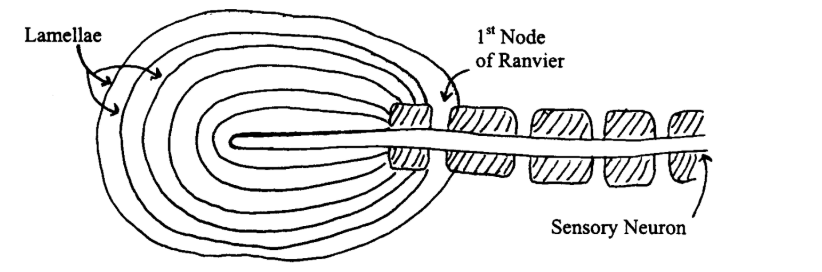
How do pacinian corpuscles work?
pressure distorts the layers on the pacinian corpuscle
the stretch mediated sodium channels open
sodium ions diffusee in
causes a potential difference across the membrane, leading to depolarisation
this is the generator potential
the greater the pressure, the larger the generator poteential
if the generator potential reaches the threshold value an action potential is created
What is the eye?
a sense organ
has receptor cells found in the retina
What’re the 2 types of receptor cells found on the retina?
rod cells
cone cells
What’re characteristics of rod cells?
distributed evenly throughout the retina
do not allow colour vision
very sensitive to light
low visual acuity (image is poorly resolved)
What’re characteristics of cone cells?
found mostly in the fovea
allow colour vision
contain pigments sensitive to red, green and blue light
not as sensitive to light
high visual acuity giving a sharp image
What’re the light sensitive pigments found in rod cells?
rhodopsin
What’re the light sensitive pigments found in cone cells?
iodopsin
What does light do to the pigment?
causes it to break down, altering its chemical structure leading to the production of a generator potential
How’re rods and cones connected to nerves?
have synapses which connect them to bipolar neurones
have synapses with neurones in the optic nerve
Why do rods have a poor visual acuity?
several rods are connected to one bipolar neurone, meaning that the light which falls on several rod cells will only generate one impulse to the brain and the brain cannot distinguish between the separate light sources that generated them
How are rods sensitive to low light intensitities?
the stimulation of several rods results in enough neurotransmitters released to reach the threshold value in the bipolar neurone in low light intensities (retinal convergence)
Why do cones have a high visual acuity?
each cone synapses with its own bipolar neurone, meaning that light falling on 2 cone cells generates 2 impulses to the brain and the brain can therefore distinguish between the light sources that generated them, so the brain can see them as separate
Why are the cone cells not very sensitive to light?
each cone cell has to produce enough neurotransmitter to reach the threshold in the bipolar neurone, and this is only likely in bright light, as in low light intensities there is not enough neurotransmitter to create an action potential in the bipolar neurone
What type of muscle is the heart muscle?
myogenic as it will beat without any nervous stimulation
What acts as the hearts natural pacemaker?
sinoatrial node
What is the sinoatrial node controlled by?
the medulla oblongata in the autonomic nervous system which controls the rate at which it sends out waves of electrical activity
What does the heart muscle look like?
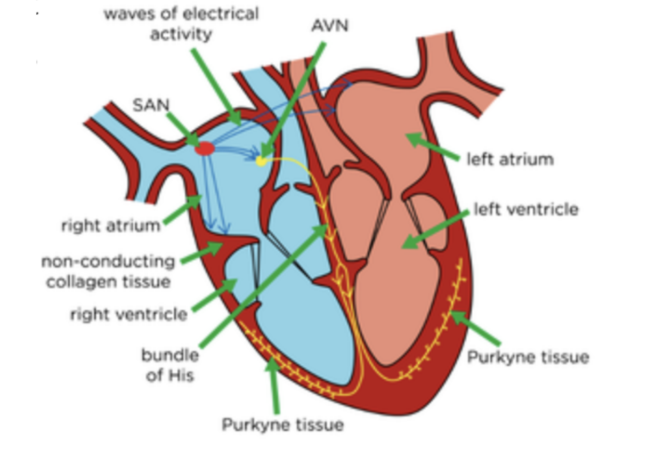
How does ventricular systole occur?
sinoatrial node generates a wave of electrical activity which spreads across both atria causing atrial systole
a layer of non-conductive tissue stops the wave of electrical activity from spreading into the ventricles
the wave of electrical activity spreads to the atrioventricular node
after a short delay the atrioventricular node conveys a wave of electrical activity down the septum through the bundle of His
the bundle of His splits in 2 which carry the electrical activity down the apex into the pukinje fibres which extend up the outer walls of the ventricles
this causes the ventricles to contract simultaneously
What nervous system is heart rate controlled by?
the autonomic
What’re the two antagonistic branches in the autonomic nervous system?
sympathetic
parasympathetic
What is the sympathetic nervous system?
stimulates effectors
speeds up
fight or flight
neurotransmitter is noradrenaline
What is the parasympathetic nervous system?
inhibits effectors
controls activity at rest
neurotransmitter is acetylecholine
What’re the 2 parts of the medulla oblongata’s cardioregulatory centre?
acceleratory centre (linked to the sinoatrial node by the sympathetic nervous system)
inhibitory centre (linked to the sinoatrial node by the parasympathetic nervous system)
What’re the 2 types of receptors important in the control of heart rate?
baroreceptors (respond to changes in blood pressure)
chemoreceptors (respond to changes in pH)
Where are baroreceptors and chemoreceptors found?
in the aorta and the carotid artery
What happens if blood pressure rises above normal?
baroreceptors detect this and send impulses to the medulla
more impulses are sent to the sino atrial node via parasympathetic nerves
this decreases the frequency of impulses from the sino atrial node across the atria, decreasing the rate at which the artia contract
this means the atriaventricular node fires less frequently so the ventricles contract less frequently and heart rate decreases
What happens if blood pressure falls below normal?
baroreceptors detect this and send impulses to the medulla
more impulses are sent to the sino atrial node via sympathetic nerves
this increases the frequency of impulses from the sino atrial node across the atria, increasing the rate at which the atria contract
this means the atrioventricular node fires more frequently so the ventricles contract more frequently and the heart rate increases
How does changes in carbon dioxide levels affect the pH of blood?
the carbon dioxide forms carbonic acid which dissolves in blood plasma to lower the blood pH (increase in pH leads to an increase in respiration)
What happens if carbon dioxide levels rise so the pH falls?
chemoreceptors detect this and send impulses to the medulla
more impulses are sent to the sino atrial node via sympathetic nerves
this increases the frequency of impulses from the sino atrial node across the atria, increasing the rate at which the atria contract
this means the atrioventricular node fires more frequently so ventricles contract more frequently and the heart rate increases
What happens if carbon dioxide levels decrease and the pH rises?
chemoreceptors detect this and send impulses to the medulla
more impulses are sent to the sino atrial node via parasympathetic nerves
this decreases the frequency of impulses from sino atrial node across the atria, decreasing the rate at which the atria contract
this means the atriaventricular node fires less frequently so the ventricles contract less frequently and the heart rate decreases