AWS Certified AI Practitioner
 Call Kai
 Learn
Learn Practice Test
 Spaced Repetition
 Match
Match Flashcards
 Knowt Play
1/129

There's no tags or description
Looks like no tags are added yet.
Name | Mastery | Learn | Test | Matching | Spaced | Call with Kai | Chat |
|---|
No analytics yet
Send a link to your students to track their progress
130 Terms
AI
Artificial Intelligence is the general development of intelligent systems capable of performing tasks that typically require human intelligence,
ML
Machine Learning is a type of AI for understanding and building methods that make it possible for machines to learn
DL
Deep Learning uses the concept of neurons and synapses similar to how our brain is wired. E.g. Amazon Rekognition
Generative AI
A subset of deep learning because it can adapt models built using deep learning, but without retraining or fine tuning
Machine Learning Process
Training data -> ML Algorithm -> Model
Types of ML data used in training an ML model
Labeled, unlabeled, structured, and unstructured data
Labeled vs Unlabeled data
Each instance is accompained by a label or target variable representing, vs no associated label
Structured vs Unstructured data
Data is organised in a predefined manner (csv, database, time, readings) vs lacking any format (text, images, audio, and video)
Supervised learning
Algorithms trained on labeled data, to learn a mapping function to predict the output for a new data input
Unsupervised learning
Algorithms learn from unlabeled data, to discover inherent patterns, structures, or relationships within the input data
Reinforcement learning
The machine is given a score as guidance. Semi supervised learning. Learns from feedback to in form of reward or penalty
Batch inferencing
Computer takes a large amount of data and analyses it all at once to provide a set of results. For data analsis or accuracy is not crucial
Real-time inferencing
Computer must make decisions as they come in, decision making is critical and instantaneous (E.g. Self driving cars or chatbots)
Neural Networks
Contains nodes in layers, Identifies patterns from examples, make predictions on new data
NLP
Branch of AI dealing with computer and human language interactions
Computer Vision
Computers can interpret and understand unstructured data
FMs
Foundation Models, pretrained on internet-scale data, powers gen ai
FM Lifecycle
Data selection -> Pre-training -> Optimization -> Evaluation -> Deployment -> Feedback and Continuous Improvement
How to optimize FMs
Prompt engineering, fine-tuning, or RAG
LLMs
Large Language Models,
Powerful models that can understand and generate human-like text. Trained on internet, books and more
Tokens
Basic units of text that the model processes. Standardize input data, making easy processing
Embeddings
Numerical reps of tokens, assigning to a vector (list), capturing meaning and relationship with other tokens
Diffusion models
DL architecture system starting with pure noise or random data then gradually adding more meaningful information
Forward vs Reverse Diffusion
Adding small amount of noise until only noise vs noisy image is denoised until a image is introduced
Multimodal models
Process and general multiple modes of data simultaneously (e.g. image + text = new image + caption, auto video captioning)
GAN
Generative Adversarial Networks
Gen model involving 2 neural networks competing (generator (synthetic) and discriminator (real))
VAE
Variational Autoencoders
Combines autoencoders and Variational inference. Contains encoder (input) and decoder (reconstruct)
Prompt engineering
Prompts act as instructions for foundation model. Focuses on developing, designing, and optimizing prompts to enhance the output
Prompt forms
Instructions, Context, Input data, Output indicator
Fine-tuning
Supervised learning process, adding specific, smaller datasets. Instruction or RLHF
Changes the model weights
Instruction vs RLHF fine-tuning
Using examples (prompt tuning) compared to reinforcement learning from human feedback (data)
RAG
retrieval-augmented generation
Supplies domain-relevant data as context to product responses based on that data.
Does not change the weights of the FM
Amazon Sagemaker
Fully managed ML to build, train, and deploy custom models
Amazon Comprehend
Natural Language Processing (NLP)
Amazon Translate
Language translation
Amazon Textract
Extracting data from scanned documents
Amazon Lex
Build conversational interfaces (Same DL as Alexa)
Amazon Polly
Text to speech
Amazon Transcribe
Automatic speech recognition
Amazon Rekognition
DL based analysing images and videos
Amazon Kendra
Enterprise search for websites and applications to readily find content
Amazon Personalize
Real time personalization and recommendations
AWS DeepRacer
Fully autonomous 1/18th scale race car for hands on experience with reinforcement learning
Amazon SageMaker JumpStart
Provides a set of solutions for the most common use cases
Amazon Bedrock
Fully managed service that makes FMs from Amazon and leading AI startups through an API
PartyRock
Hands-on experience experiementing with building AI applications
Amazon Q
A gen AI powered assistant designed for work that can be tailored for a business's data
Amazon Q Developer
Provides ML powered code recommendations to accelerate development in a variety of programming languages and applications
4 Benefits of AWS AI solutions
1. Accelerated development and deployment
2. Scalability and cost optimization
3. Flexibility and access to models
4. Integration with AWS tools and services
Cost considerations
1. Responsiveness and availability
2. Redundancy and regional coverage
3. Performance
4. Token-based pricing
5. Provisioned throughput
6. Custom models
Media and entertainment use cases
Content generation, VR, new generation (articles or summaries)
Retail use cases
Product review summaries, pricing optimization, virtual try-ons, store layout
Healthcare use cases
Personalize medicine, improve medical imaging
AWS HealthScribe
Empowers healthcare software vendors to build clinical applications
Life sciences use cases
Drug discovery, protein folding prediction, synthetic biology
Financial services use cases
Fraud detection mechanisms, portfolio management, debt collection
Manufacturing use cases
Predictive maintenance, process optimization, product design, material science
Computer Vision applications
Autonomous driving, healthcare or medical imaging, and public safety and home security
NLP applications
Insurance (e.g. extract policy no.s, expiration date), telecommunication (e.g. customer messages) , and education (Q&A chatbots)
IDP
Intelligent Document Processing
Extracts and classifies information from unstructured data, generating summaries, and providing actionable insights
IDP applications
Financial services, lending, legal, and healthcare
Fraud detection applications
Used by financial services, retail, and telecommunication
Types of supervised learning
Classification (Assign labels and categories to new data) and regression (Predicting continuous or numerical values)
Types of unsupervised learning
Clustering (Groups data based on similar features or distances) and Dimensionality reduction (reduce the amount of features or dimensions in a dataset)
Capabilities of Gen AI
Adaptability, responsiveness, simplicity, creativity and exploration, data efficiency, personalization, and scalability
Challenges of Gen AI
Regulatory violations, social risks, data security and privacy concerns, toxicity, hallucinations, interpretability, non determinism
Factors to Consider When Selecting a Generative AI Model
Performance requirements, constraints, capabilities, compliance, cost
Gen AI models
Jurassic-2, Amazon Titan, Claude, Stable Diffusion, Command, Llama
Responsible AI
An AI system practicing trustworthiness and transparency
AI bias
the model is missing important features of the datasets
AI variance
the model's sensitivity to fluctuations or noise in the training data
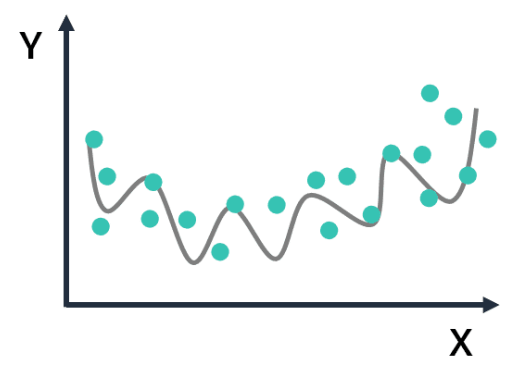
Overfitted
model performs well on the training data but does not perform well on the evaluation data
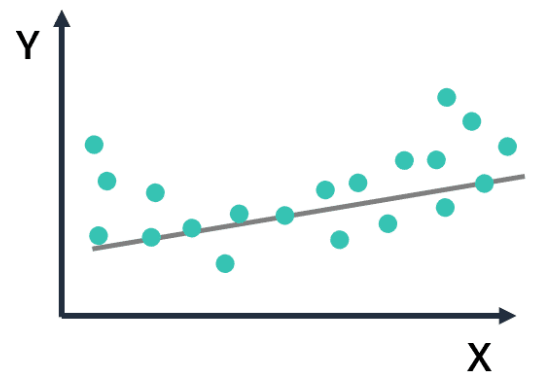
Underfitted
High bias, the model is not capturing enough difference in the features of the data
How to overcome bias and variance errors
Cross validation, increase data, regularization, simpler models, dimension reduction, stop training early
Responsible AI dimensions
1. Fairness
2. Explainability
3. Privacy and security
4. Veracity and robustness
5. Transparency
6. Governance
7. Safety
8. Controllability
Model Evaluation on Amazon Bedrock
Evaluate, compare, and select the best foundation model for your use case
Amazon SageMaker AI Clarify
Auto evaluate FMs for gen ai use cases with accuracy, robustness, and toxicity
Identifies potential bias in ML
Guardrails for Amazon Bedrock
Help control the interaction between users and FMs by filtering undesirable and harmful content, redacting PII
Amazon SageMaker Data Wrangler
Prepares and more data using web interface. Balances data through random undersampling, random oversampling, and synthetic minority oversampling Technique (SMOTE)
Amazon SageMaker Model Monitor
Monitors the quality of SageMaker ML models in production
Amazon A2I
Amazon Augmented AI
Builds the workflows required for human review of ML predictions and help ensure accurate predictions
Data curation
Curating datasets and ensuring it is relevant, high quality, and reliable data
Data Processing -> Data Augmentation -> Regular Auditing
AWS AI Service Cards
A resource to increase transparency and help customers better understand AWS AI services
SageMaker Model Cards
Document critical details about ML models for streamlined governance and reporting
SageMaker Autopilot
Uses tools provided by SageMaker AI Clarify to help provide insights into how ML models make predictions
Model Trade-Offs
Interpretability, Explainability, Safety, Controllability,
Principles of human-centered design for explainable AI
Design for amplified and unbiased decision-making, human and AI learning, reinforcement learning from human feedback
Amazon SageMaker Ground Truth
Incorporating human feedback across the ML lifecycle to improve model accuracy and relevancy
ML Development Lifecycle
Business Problem → ML Problem Framing → Data Processing → Model Development → Model Deployment → Model Monitoring → Model Retraining
Machine Learning Advanced Development Lifecycle
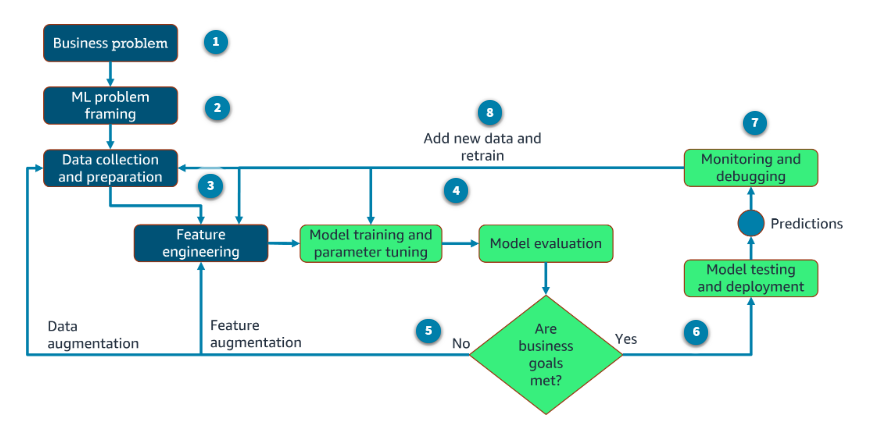
What happens during the Data Processing stage
Data collection, data pre-processing, and feature engineering
Amazon SageMaker Studio Classic
Built-in integration of Amazon EMR and AWS Glue sessions to handle data prep and ml workflows
Amazon SageMaker Processing API
Customers can run scripts and notebooks to process, transform, and analyse datasets
Amazon SageMaker Feature Store
Helps to create, share, and manage features for ML development. Features can be retrieved and enriched
Amazon SageMaker Canvas
Use machine learning to generate predictions without needing to write any code
Amazon SageMaker Experiments
Experiment with multiple combinations of data, algorithms, and parameters, all while observing the impact of incremental changes on model accuracy.
Amazon SageMaker Automatic Model Tuning
Uses hyperparameter tuning by running many jobs with different combinations and measuring each of them
Hyperparameter
A way to find the best version of your models
Confusion Matrix
Help classify why and how a model gets something wrong
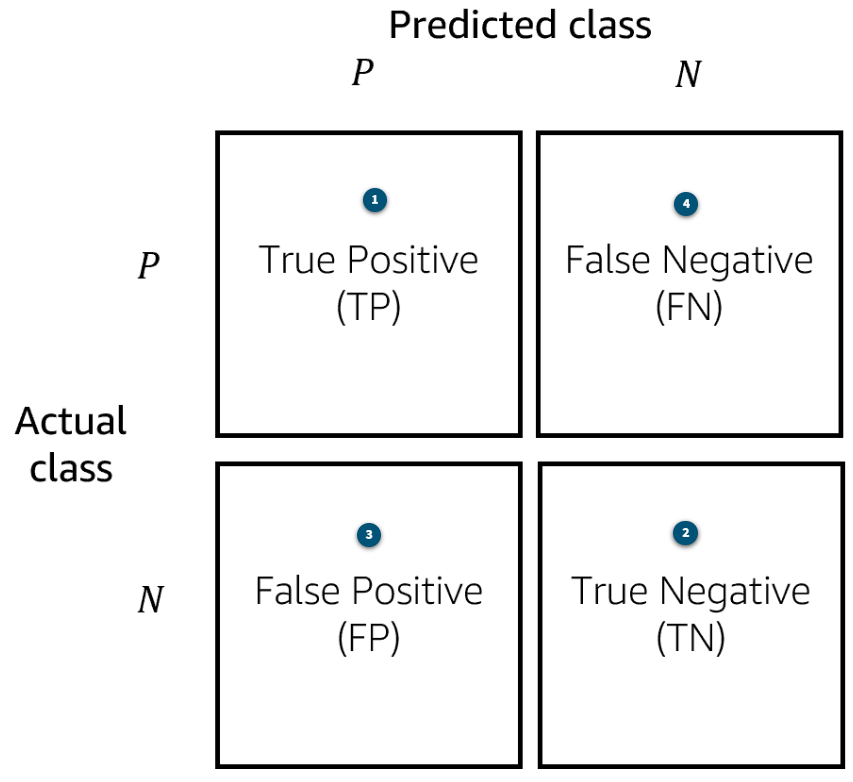
Model Accuracy Calculation
( TP + TN ) / (TP + TN + FP + FN )