Study Guide - Bio 101 Exam 1
 Note
Note Call Kai
 Learn
Learn Practice Test
 Spaced Repetition
 Match
Match Flashcards
 Knowt Play
1/56

There's no tags or description
Looks like no tags are added yet.
Name | Mastery | Learn | Test | Matching | Spaced | Call with Kai | Chat |
|---|
No analytics yet
Send a link to your students to track their progress
57 Terms
Life
The condition distinguishing living organisms from inorganic matter, characterized by growth, reproduction, and response to stimuli
Common Characteristics of Living Things
Traits shared by all living organisms, including cellular organization, metabolism, homeostasis, growth, reproduction, and adaptation
Genetic Relatedness
All living things share a common genetic heritage, indicating evolutionary connections among species
Atomic Number
The number of protons in an atom's nucleus, which determines the element's identity and electron configuration
Isotopes
Variants of a chemical element that have the same number of protons but different numbers of neutrons; radioisotopes are unstable isotopes that emit radiation
Polar Covalent Bonds
Bonds formed when electrons are shared unequally between atoms, resulting in partial charges; non-polar covalent bonds involve equal sharing of electrons
Ionic Bonds
Formed when one atom donates an electron to another, creating charged ions that attract each other
Ion
An atom or molecule with a net electric charge due to the loss or gain of one or more electrons; cation:positively charged ion; anion:negatively charged ion
How ionic bonds are formed
When one atom transfers one or more of its electrons to another atom, this typically happens between metals and non-metals
How an ion is formed from a neutral
atom
A neutral atom either loses or gains electrons, leading to an imbalance between the number of protons (positive charges) and electrons (negative charges)
Cation
Positively-charged ions (atoms or groups of atoms that have more protons than electrons due to having lost one or more electrons)
Anion
Negatively-charged ions (meaning they have more electrons than protons due to having gained one or more electrons)
Salt Dissolution
Salt dissolves in water due to the attraction between water molecules and the charged ions of the salt
Hydrogen Bonds
Weak attractions between a hydrogen atom covalently bonded to an electronegative atom and another electronegative atom
Strength of Bonds
Covalent bonds > ionic attractions > hydrogen bonds > van der Waals forces
Hydrophilic
Molecules that are attracted to water; hydrophobic:molecules that repel water
Hydrophilic
water-loving
Hydrophobic
water-fearing
Examples of hydrophilic and hydrophobic molecules:
Hydrophylic
glucose
sodium chloride
ethanol
amino acids
proteins
Hydrophobic
lipids
cholesterol
methane
benzene
fatty acids
Hydrophobic Interactions
Nonpolar molecules clustering together in an aqueous environment to minimize contact with water
Properties of Water
High specific heat, cohesion, adhesion, and solvent capabilities due to hydrogen bonding
Ice Floats
Ice is less dense than liquid water due to the formation of a crystalline structure in freezing
High Heat Capacity
Water's ability to absorb and retain heat helps regulate temperature in living organisms
How water’s high heat capacity (related to high specific heat) and heat of vaporization is beneficial to living organisms
High heat capacity
temperature regulation
climate moderation
protection of aquatic life
Heat of vaporization
cooling mechanism (evaporative cooling)
sweating
panting
water cycle and climate
Acids
Substances that donate hydrogen ions (H+) or protons in solution, pH less than 7
Bases
Substances that accept hydrogen ions (H+) or protons in solution, pH greater than 7
pH Scale
Measures the acidity or basicity of a solution, ranging from 0 (acidic) to 14 (basic).
Macromolecules
Four types found in cells:proteins, carbohydrates, lipids, and nucleic acids, constructed from specific monomers.
Functional Groups
Specific groups of atoms that confer particular chemical properties to organic molecules.
Structural Isomers
Molecules with the same molecular formula but different structural arrangements; optical isomers are non-superimposable mirror images.
Condensation Reactions
Chemical reactions that link monomers together, releasing water as a byproduct
Hydrolysis Reaction
A reaction that breaks down polymers into monomers by adding water
Functions of Macromolecules
Proteins (catalysis, structure), carbohydrates (energy storage, structure), lipids (membranes, energy), nucleic acids (genetic information)
Amino Acid Structure
Composed of an amino group, carboxyl group, and R group (side chain)
Amino Acid Properties
Determined by the characteristics of their side chains, affecting polarity and charge
Disulfide Bonds
Covalent bonds formed between the sulfur atoms of cysteine residues, stabilizing protein structure
Peptide Linkages
Bonds formed between amino acids, linking the N terminus to the C terminus of a polypeptide
Protein Shape
The three-dimensional structure of a protein is crucial for its biological function
Protein Structures
Primary (sequence), secondary (α-helix, β-sheet), tertiary (3D folding), and quaternary (multiple polypeptides)
Denaturation
The process where a protein loses its functional shape due to environmental changes, affecting its activity
Environmental Factors
Temperature, pH, and ionic strength can influence protein structure and function
Quaternary Structure
The arrangement of multiple polypeptide chains in a protein, stabilized by various interactions
Chaperone Proteins
Assist in the proper folding of proteins and prevent aggregation
Carbohydrate Structure
Composed of carbon, hydrogen, and oxygen, typically in a 1:2:1 ratio
Monosaccharide
The simplest form of carbohydrates, consisting of single sugar units
Glucose Forms
Exists in both chain and ring forms, with α and β configurations
Glycosidic Linkages
Bonds between monosaccharides; α-glycosidic linkages are found in maltose, while β-glycosidic linkages are in cellobiose
Important functional groups…
…
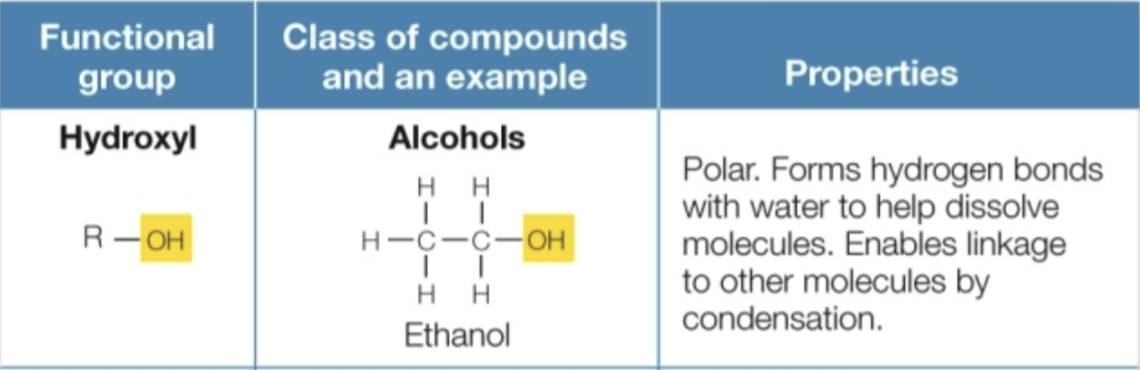
Functional group: hydroxyl R-OH
Class of compounds: alcohols (ethanol) OH
Properties: polar, forms hydrogen bonds with water to help dissolve molecules, enables linkage to other molecules by condensation
Functional group aldehyde H-C=O
Class of comnpounds: aldehydes (acetaldehyde) H-C=O
Properties: polar, C=O group is very reactive, important in building molecules and in energy-releasing reactions
Functional group: keto C=O
Class of compounds: ketones (acetone) C=O
Properties: Polar, C=O group is important in carbohydrates and energy reactions
Functional Group: carboxyl OH-C=O
Class of compounds: carboxylic acids (acetic acid) OH-C=O
Properties: charged; acidic, ionizes in living tissues to form
-COO- and H+, enters into condensation reactions by giving up
-OH, some carboxylic acids important in energy-releasing reactions
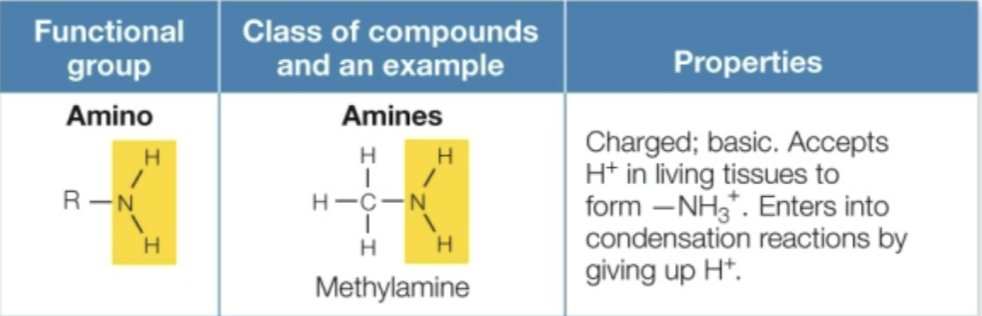
Functional group: amino R-H-N-H
Class of compounds: amines (methylamine) H-N-H
Properties: charged; basic, accepts H+ in living tissues to form -NH3+, enters into condensation reactions by giving up H+
Functional Group: phosphate R-O-P=O-O-O
Class of compounds: organic phosphate (3-phosphogylcerate) O-P=O-O-O
Properties: charged; acidic, enters into condensation reactions by giving up -OH
Functional Group: sulfhydryl R-SH
Class of compounds: thiols (mercaptoethenal) SH
Properties: by giving up H, 2 -SH groups can react to form a disulfide bridge, stabilizing protein structure
Functional Group: methyl CH3
Class of compounds: alkyl (alkaline) CH3
Properties: nonpolar, important in interacting with other nonpolar molecules and in energy transfer