Speciation (Macroevolution)
 Call Kai
 Learn
Learn Practice Test
 Spaced Repetition
 Match
Match Flashcards
 Knowt Play
1/16

There's no tags or description
Looks like no tags are added yet.
Name | Mastery | Learn | Test | Matching | Spaced | Call with Kai | Chat |
|---|
No analytics yet
Send a link to your students to track their progress
17 Terms
Species
A group of populations in nature whose members can interbreed to produce viable fertile offspring (meaning their offspring can also interbreed)
Macroevolution
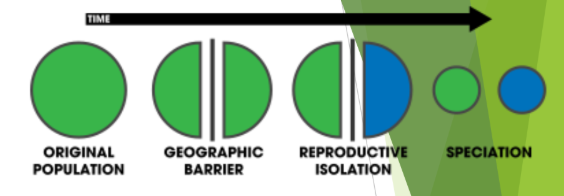
When a species changes so much that it becomes a new species
Speciation
The formation of a new species from existing species. This is also called macroevolution.
Speciation is a process where species become more defined over time.
Differences accumulate over time (often very long periods of time), yet some similarities remain.
At a certain point, differences become great enough that scientists will define a new species has been formed.
Reproductive isolation
Occurs when there is little to no gene flow within populations over a period of time. The factors of microevolution will cause allele frequencies to change in both populations until they are separate species.
Thus, one species becomes too different to interbreed with its original population.
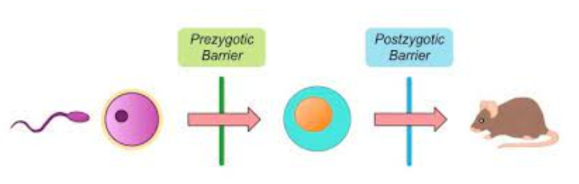
Reproductive isolating mechanisms can be:
pre-zygotic (before mating), or
post-zygotic (after mating)
Prezygotic Isolating Mechanisms
Pre-zygotic isolating mechanisms either:
Prevent mating between species, or
Prevent fertilization of the eggs if individuals from different species attempt to mate
There are 5 types:
Behavioural
Temporal
Ecological/Habitat
Mechanical
Gametic
Behavioural Isolating Mechanisms
Many species use different behaviours to attract mates. If this behaviour changes, species can become behaviourally isolated.
Ex. Songs of birds, Courship rituals of elk, Chemical signals of insects
Ex. The Eastern and Western meadowlark look nearly identical and have overlapping habitat ranges. Because of their differences in songs, they don’t mate and are different species.
Habitat Isolating Mechanisms
Two species may live in the same region but different habitats – in case, they may not be in contact. This is called habitat isolation.
Ex. The common garter snake and the northwest garter snake live in the same area. The northwest garter snake prefers open areas and rarely enters water, while the common garter snake stays by the water. These two did not mate and developed into two different species.
Temporal Isolating Mechanisms
Many species are kept apart by timing barriers
Two species may be in the same habitat but mate at different times of day, seasons, or years
Ex. Tropical orchids bloom for a single day, with the flowers opening at dawn and withering in the evening. Three species bloom on 3 different days, leaving them reproductively isolated due to timing.
Mechanical Isolating Mechanisms
Fertilization cannot occur due to anatomical incompatibility between species.
Ex. Pollination: Some plant species are pollinated by a species of bee that carries pollen on their backs while other bees carry pollen on their wings. The differences in plant structure do not allow pollination by some bee species.
Ex. Genital Incompatibility: An easy example would be the idea of a lock-and-key system for genitals. If two organisms have incompatible hardware, they are unable to mate.
Gametic Isolating Mechanisms
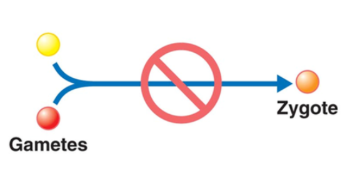
If gametes (egg and sperm) from two species do meet, gametic isolation will ensure they do not fuse to form a zygote (beginnings of offspring)
These methods vary depending on the species
Ex. Female fertilization: The sperm of one species may not be able to survive in environment of the female reproductive tract.
Ex. Plants: Pollen grains of one species will fail to germinate on the stigma of another species.
Post-zygotic isolating mechanisms
Sometimes, a sperm from one species can successfully fertilize an egg from another species to produce a zygote.
Post-zygotic isolating mechanisms are barriers that prevent hybrid zygotes from developing into viable, fertile individuals.
Hybrid Inviability
Hybrid Sterility
Hybrid Breakdown
Hybrid Inviability
the early development of the hybrid zygote is stopped and zygote dies.
Hybrid Sterility
fully grown hybrid offspring is sterile (cannot reproduce).
Hybrid Breakdown
first hybrid generation is viable and fertile, but second generation is sterile.
Types of Speciation
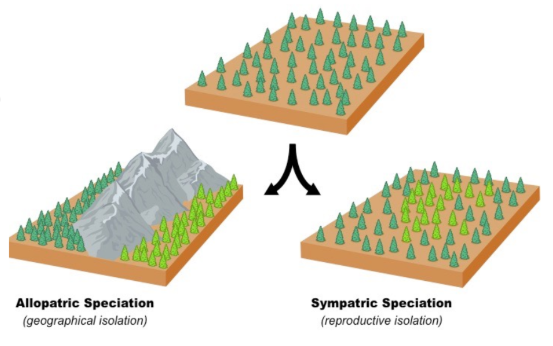
Sympatric Speciation: When populations within the same geographical areas diverge and become reproductively isolated
Allopatric Speciation: When a population is split into two or more isolated groups by a geographical barrier
Sympatric Speciation
Factors such as mutations and non-random mating alter gene flow
Far more common in plants than in animals
Can sometimes happen quickly due to mutations or interbreeding
Ex. Plants
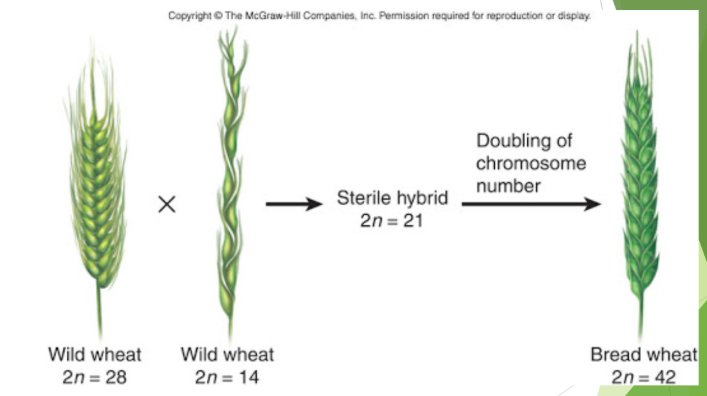
Two species interbreed to produce a sterile offspring
This offspring is infertile but can reproduce asexually – creating a new population
A mutation in meiosis may cause one of the offspring to become a new, fertile polyploid species!
This situation occurred during the evolution of wheat
Allopatric Speciation
Also called geographical speciation Eventually, gene pool of both populations become different from one another due to microevolution/adaptation to one’s environment
Examples:
Lava flow
Glacier
Avalanche
Fluctuations in ocean levels that turn a peninsula into an island
A few colonizers being moved to a different habitat
Geographical isolation must occur for long enough that the species become reproductively incompatible