lec 4 - cell-cell interactions: TGF-β and FGF signaling
 Call Kai
 Learn
Learn Practice Test
 Spaced Repetition
 Match
Match Flashcards
 Knowt Play
1/67

There's no tags or description
Looks like no tags are added yet.
Name | Mastery | Learn | Test | Matching | Spaced | Call with Kai | Chat |
|---|
No analytics yet
Send a link to your students to track their progress
68 Terms
cells recieve info from their environment to make ____ decisions
cell fate decisions
information from environment → cell behaviors + progressive specialization/restriction of cell potential towards specific differentiated cell types
what is the most common type of signaling during development
paracrine
paracrine signaling
a cell produces a signal → acts on nearby cells to produce a response
signal transduction
the conversion of a signal from one form to another
the process by which a signal is recieved and initates a series of intracellular molecular events that lead to a response
3 stages of signal transduction
reception, transduction, response
TGF-β ligands are ___meric
dimeric
two subfamilies of the TGF-β super family
TGF-β-like family
BMP-like family
types of ligands in the TGF-β-like family
TGF-βs
Activins
Nodal
types of ligands in the BMP-like family
BMPs
GDFs
AMH
role of TGF-βs
important roles in ECM + cell division
implicated in tumors
role of activins + nodal
differentiation of mesoderm
left-right asymmetry in the early embryo
what does BMP stand for
bone morphogenic protein
role of BMPs
bone formation + embryonic development
what does canonical mean
the main pathway
the ____ subfamily uses Smad 2/3
the ____ subfamily uses Smad 1/5/8
TGF-β-like
BMP-like
describe the TGF-B signaling pathway
dimeric TGF-β ligand binds to a type 2 TGF-βR to form the ligand-receptor complex
type 2 receptor recruits/activates type 1 receptor via phosphorylation of serines/threonines in the GS domain
type 1 receptors phosphorylate Smad proteins, which act as secondary messengers
pSmad 2/3 (or 1/5/8) link to Smad 4 to create the phosphorylated Smad complex
the Smad complex translocates from the cytoplasm to the nucleus
the Smad complex binds upstream TGF-β target genes → activates transcription of the genes → cell response
what are the components of the ligand-receptor complex formed during TGF-β signaling
dimeric TGF-β ligand
2 type two receptors
2 type one receptors
receptor oligomerization
describes the process of assembling the ligand-receptor complex
TGF-β signaling - what kind of receptors are type 2 and type 1 receptors
2 - serine/threonine kinases (STKs)
1 - receptor tyrosine kinases (RTKs)
how do type 2 receptors activate type 1 receptors
bind to serines/threonines in GS domains
BMP signaling is controlled via
inhibition
notable BMP inhibitors
chordin, noggin, follistatin
what type of inhibitors are BMP inhibitors
ligand traps
ligand trap
inhibitor binds to ligand to inhibit it
why is BMP signaling controlled via inhibition
crucial to making sure pathway activation only occurs in the correct time and place
how can we image BMP pathway activation
use an antibody against pSmad 1/5/8 - specifically phosphorylated Smad
design an experiment to analye TGF-β receptor ffunction
use genetic engineering to create DNA that encodes a mutated receptor (LOF or GOF) and then express it in cells to interfere with signaling
how to create a LOF mutated receptor
change an amino acid in the kinase domain
what does a GOF mutation do to a receptor
makes it constitutively active
design an experiment to understand the role of Nodal signaling
Nodal is a TGF-β ligand
squint/cyclops are zebrafish Nodal ligands
oep (one-eyed pea) is a mutant for Cripto. Cripto is an essential Nodal co-receptor.
WT zebrafish
squint/cyclops KO
Cripto → oep
what happens if you KO squint and cyclops in a zebrafish
mesoderm? gone
(Nodal helps pattern the mesoderm)
what happens if you change Cripto → oep?
mesoderm? gone
just like squint/cyclops, bc Cripto is a Nodal co-receptor (if Cripto doesn’t work, then Nodal can’t bind)
Nodal helps pattern the mesoderm
how to rescue oep mutants
inject constitutively activated type receptor RNA into the oep embryo → allows for Smad phosphorylation/mesoderm production without ligand binding
RTKs play essential roles in
RTK defects can cause
fundamental cell processes
diseases, cancer
RTKs mediate signals from ___, which are [diffusable/non-diffusable] because they are ____. These ligands use ____ signaling.
growth factors
non-diffusable
associated with the ECM
mostly paracrine (except for hormones)
are RTKs specific or can they interact with many ligands
both
most RTKs exist as ____ when unbound, except for ___
monomers
insulin receptor
RTK domains
extracellular, transmembrane, intracellular
RTK extracellular domain
variable or conserved?
role
variable
determines ligand binding specificity
RTK intracellular domain
variable or conserved
role
highly conserved
tyrosine kinase
canonical RTK receptor signaling pathway
ligand usually dimerises - binds simultaneously to two receptors
sometimes ligand remains a monomer - two ligands bind simultaneously to two receptors
ligand binding facilitates receptor dimerization
receptor dimerization brings together intracellular tyrosine kinase domains
cross-phosphorylation of Y sites to activate
post-phosphorylation of Y sites → sites are sticky to other proteins → act as docking sites for downstream signaling proteins
how does phosphorylation of Y sites make the receptor sticky?
all RTK-binding proteins have an SH2 domain, which recognizes the phosphopeptide pY-E-E-I, found inside phosphorylated Y sites
proteins that bind to RTKs contain an ___ domain and ____ domain.
the first domain allows it to:
the second domain allows it to:
SH2; SH3
SH2 binds to pY-E-E-I domains, letting it stick to phosphorylated tyrosine sites
SH3 facilitates protein-protein interaction
RTKs are regulated by
Ras
Ras is an
intracellular switch
explain the Ras activation/inactivation cycle
GDP-Ras = inactive
GEF proteins exchange GDP for GTP
GTP-Ras = active
GAP proteins hydrolyze GTP → GDP
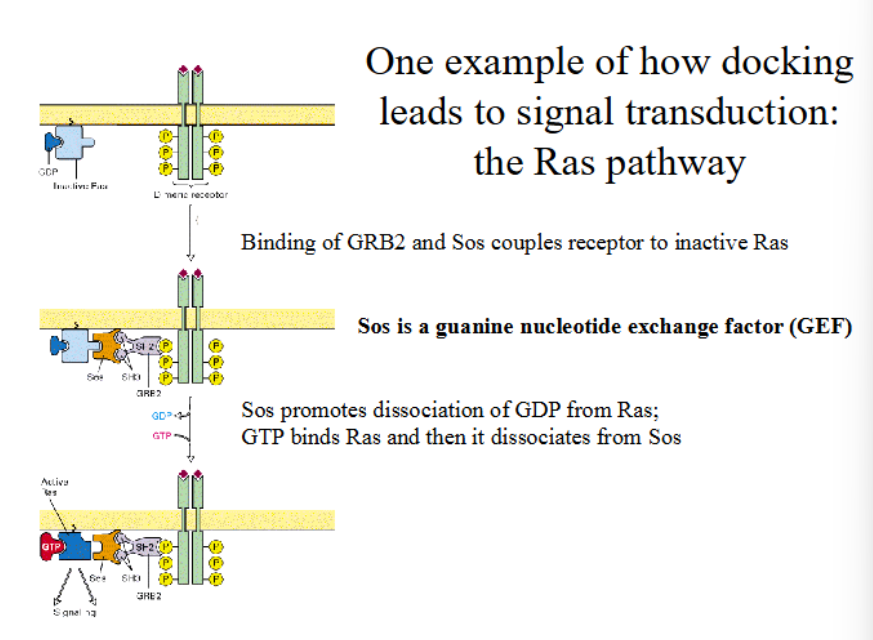
Ras pathway - how does docking lead to signal transduction
GRB2 contains both SH2 domains and SH3 domains
GRB2 binds to tyrosine kinase domains of the RTK (SH2)
GRB2 binds to Sos, a GEF protein (SH3)
Sos binds to nearby Ras, and promotes dissociation of GDP from Ras
Ras binds to GTP, is activated, and then it dissociates from Sos
Ras is now free to phosphorylate secondary messengers
Ras can get inactivated by GAP proteins easily. how does it create a more lasting signal?
binds to MapK signaling pathway
explain the MapK signaling pathway
Ras → MapKKK/Map3K (usually Raf)
MapKKK/Map3K/Raf → MapKK/Map2K/MeK
via dual phosphorylation on a serine and threonine separated by one amino acid (pS-R-pT)
MapKK/Map2K/MeK → MapK
via dual phosphorylation on a serine and threonine separated by one amino acid (pS-R-pT)
MapK → downstream proteins/TFs
why does the MapK pathway involve dual phosphorylation
safety mechanism - activation of the MapK pathway will only occur when Ras activates it
how many FGF receptors are there
4
what are the 3 FGF subfamilies
paracrine, intracrine, endocrine
describe the FGF receptor
extracellular domains
Ig (immunoglobulin)-like domains - D1, D2, and D3
D2 and D3 are responsible for ligand binding
D3 determines ligand specificity
between D1 and D2
acid box
within D2
heparin binding site
FGFR activation requires binding with heparing sulfate proteoglycans
transmembrane domain
intracellular domain - split into 2 kinase domains
HSPG
heparan sulfate proteoglycan
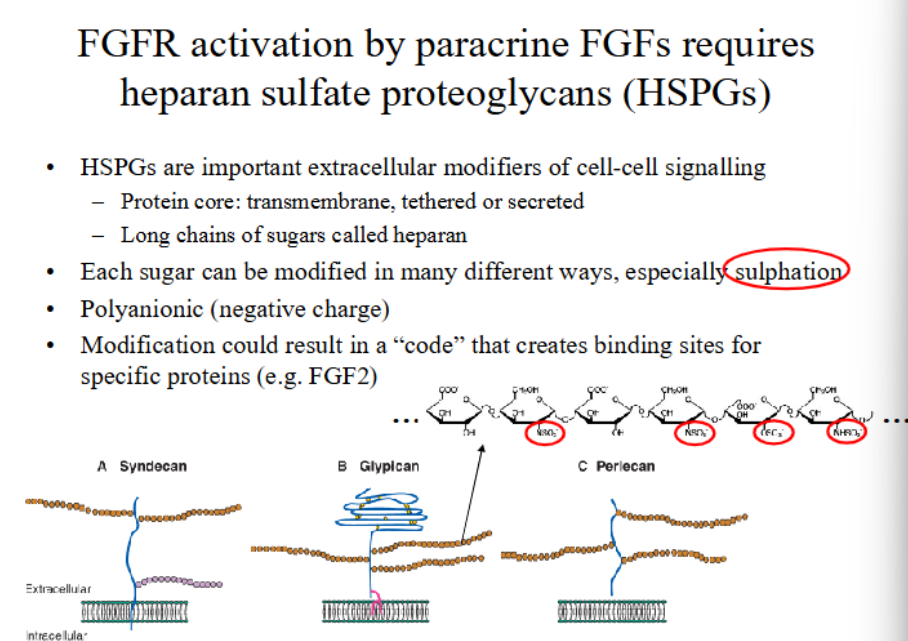
what are heparan sulfate proteoglycans (HSPGs)
important extracellular modifiers of cell-cell signaling
3 main types of heparan sulfate proteoglycans (HSPGs)
A - transmembrane syndecans
B - membrane-tethered glypicans
C - secreted perlicans
what are HSPGs made of
protein core + long chain of sugars called heparan
how do HSPGs help FGF receptors
each heparan sugar can be modified by sulfation
modification results in a code that creates binding sites for specific FGF ligands
there are a LOT of FGF ligands - this helps the receptor react specifically to each one
FGF ligand can only bind/activate the RTK with HSPGs
_____ FGFs have a high affinity for HSPGs.
_____ FGFs have a low affinity for HSPGs.
Paracrine; Endocrine
Paracrine FGFs - high affinity for HSPGs → retained at cell surface, act locally
Endocrine FGFs - low affinity for HSPGs → diffuse into bloodstream
FGF signaling may trigger different cell behaviors through distinct pathway.
what are the pathways it triggers, what gene does it activate, and what is that gene’s function?
canonical
Mapk - FOS (for cell proliferation)
noncanonical
Akt - FOXO (for cell survival)
Calcineurin - NFAT (for cell motility)
name three diseases caused by FGFR mutations
Apert syndrome, Pfeiffer syndrome, Achondroplasia
craniofacial, skeletal, and limb abnormalities
achondroplasia is caused by
mutations in FGFR3
a cell produces a signal → acts on nearby cells to produce a response
paracrine signaling
the conversion of a signal from one form to another
the process by which a signal is recieved and initates a series of intracellular molecular events that lead to a response
signal transduction
name the subfamily
TGF-βs
GDFs
AMH
Nodal
BMPs
Activins
TGF-β-like
BMP-like
BMP-like
TGF-β-like
BMP-like
TGF-β-like
TGF-β-like family uses Smad ____
BMP-like family uses Smad ____
2/3
1/5/8
chordin, noggin, and follistatin fxn
inhibit BMP
Apert syndrome, Pfeiffer syndrome, and Achondroplasia are caused by
FGFR mutations