AQA A level Bio 2.4 Immune system Part II
 Call Kai
 Learn
Learn Practice Test
 Spaced Repetition
 Match
Match Flashcards
 Knowt Play
1/47

Earn XP
Description and Tags
Name | Mastery | Learn | Test | Matching | Spaced | Call with Kai | Chat |
|---|
No analytics yet
Send a link to your students to track their progress
48 Terms
When a vaccine is given to a person, it leads to the production of antibodies against a disease-causing organism. Describe how. (5)
Vaccine contains antigen from pathogen (1)
Macrophage presents antigen on its surface (1)
T cell with complementary receptor protein binds to antigen (1)
T cell stimulates B cell (1)
B cell divides to form clone all secreting / producing same antibody. (1)
What is vaccination? (2)
Injection of antigens (1)
stimulates formation of memory cells (1)
Describe how antibodies are produced in the body following a viral infection. (6)
Virus contains antigen (1)
Virus engulfed by phagocyte/ macrophage (1)
Presents antigen to B cell (1)
Memory cells/ B-cell becomes activated (1)
(divides to) form clones (1)
plasma cells produce antibodies (1)
which are specific to antigen (1)
Explain one advantage of using antibodies from plants to treat a disease, rather than antibodies produced in an experimental animal (1)
fewer ethical difficulties/ less risk of infection (1)
Vaccines protect people against disease. Explain how. (5)
Vaccines contain antigens (1)
memory cells made (1)
on second exposure memory cells produce antibodies (1)
rapidly (1)
antibodies destroy pathogens (1)
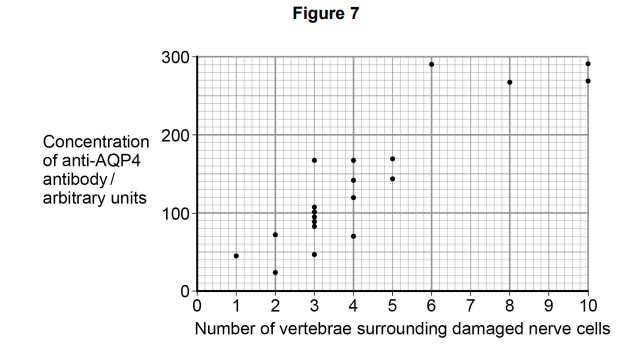
Scientists measured the concentration of anti-AQP4 antibody in the blood of people with NMO.
The spinal cord is surrounded by small bones called vertebrae. For each person, the scientists also determined the number of vertebrae surrounding damaged nerve cells.
Their results are shown in Figure 7
A scientist suggested that the concentration of anti-AQP4 antibody in a person’s blood could be used to predict the number of vertebrae surrounding damaged nerve cells they are likely to have.
Use Figure 7 to suggest reasons why this suggestion might not be valid (3)
Only one study (1)
No statistical test is used (1)
Correlation is weak (1)
A new treatment for NMO involves using a monoclonal antibody. The structure of the variable region of this monoclonal antibody is identical to the variable region of an anti-AQP4 antibody, but the rest of its structure is different.
Use this information and your knowledge of antigen-antibody complexes to suggest how this monoclonal antibody prevents anti-AQP4 damaging nerve cells. (2)
The monoclonal antibody binds to nerve cell antigen so less / no anti-AQP4 can bind (1)
When monoclonal antibody binds it doesn’t cause damage to nerve cell (1)
HIV attaches to a specific protein receptor on helper T cells. A low percentage of people have a mutation of the CCR5 gene which codes for this protein receptor. This mutation results in a non-functional protein receptor. Explain how this mutation can result in the production of a non-functional protein receptor. (4)
Chnage in DNA base (sequence) (1)
Change in amino acid sequence (1)
Alters (position of) hydrogen/ionic/disulfide bonds (1)
Change in tertiary structure of receptor (1)
The frequency of the CCR5 mutation is highest in Europe. Scientists have collected data on the history and number of HIV infections in Europe. Using these data, scientists have concluded that the high frequency of the CCR5 mutation is not due to natural selection in response to HIV.
Suggest two reasons why scientists reached this conclusion (2)
Low/lower number of HIV/AIDS (infections/cases) (1)
Mutation/CCR5 has been around for many years (1)
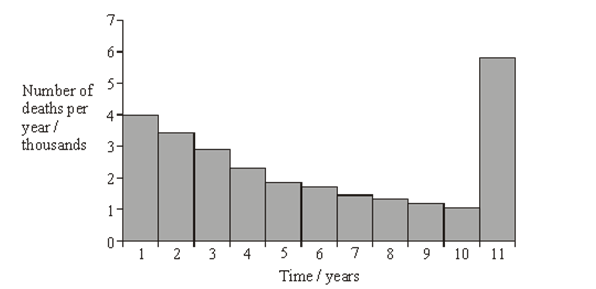
The graph shows the number of deaths from influenza per year in a developed country. Suggest an explanation for the change in the number of deaths from influenza during the first 10 years (1)
fall in deaths due to rise in number of people with immunity / better care (1)
Some strains of the bacterium that causes gonorrhoea are resistant to antibiotics. This makes the disease difficult to treat. One way of testing the effectiveness of antibiotics is to use discs of paper soaked in antibiotic. These are placed in the centre of an agar plate covered by bacteria. A clear zone forms around the disc if the antibiotic is effective.
The table shows some results of an investigation into the effect of four different antibiotics on gonorrhoea bacteria.
Antibiotic | Diameter of clear zone / mm | Minimum diameter of clear zone if antibiotic is effective / mm |
A | 47 | 52 |
B | 30 | 28 |
C | 22 | 40 |
D | 33 | 34 |
The antibiotic reached the bacteria by diffusion. Suggest why an effective antibiotic may produce only a small clear zone.(1)
It diffuses slowly (1)
Some strains of the bacterium that causes gonorrhoea are resistant to antibiotics. This makes the disease difficult to treat. One way of testing the effectiveness of antibiotics is to use discs of paper soaked in antibiotic. These are placed in the centre of an agar plate covered by bacteria. A clear zone forms around the disc if the antibiotic is effective.
The table shows some results of an investigation into the effect of four different antibiotics on gonorrhoea bacteria.
Antibiotic | Diameter of clear zone / mm | Minimum diameter of clear zone if antibiotic is effective / mm |
A | 47 | 52 |
B | 30 | 28 |
C | 22 | 40 |
D | 33 | 34 |
Which antibiotic used in the investigation would be most useful for treating gonorrhoea? Explain your answer. (2)
B (1)
Produces inhibition zone greater than minimum diameter (1)
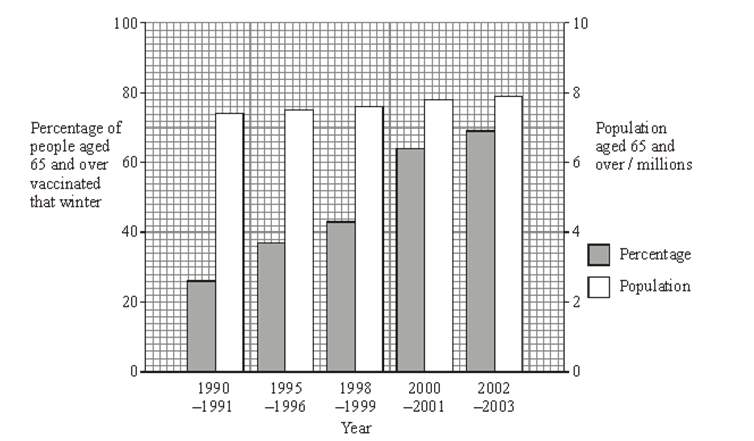
People considered ‘at risk’ are offered a vaccination against influenza each year. The bar chart shows the number of people in the UK population aged 65 and over and the percentage of those who were vaccinated against influenza each winter.
A student suggested that some people aged 65 and over were being vaccinated every year. Explain how the information in the bar chart supports this suggestion (2)
Over 50% of population are being vaccinated (1)
But only from 2000 onwards (1)
An influenza virus consists of a protein coat surrounding nucleic acid. The influenza vaccine consists only of the protein coat of the virus. Explain how the influenza vaccine produces immunity in the body. (2)
(Protein coat) carries antigens which stimulates B-cells / production of antibodies (1)
Production of memory cells (1)
Describe and explain the role of antibodies in stimulating phagocytosis.
Do not include details about the process of phagocytosis. (2)
Bind to antigen (1)
Antibodies cause clumping/agglutination (1)
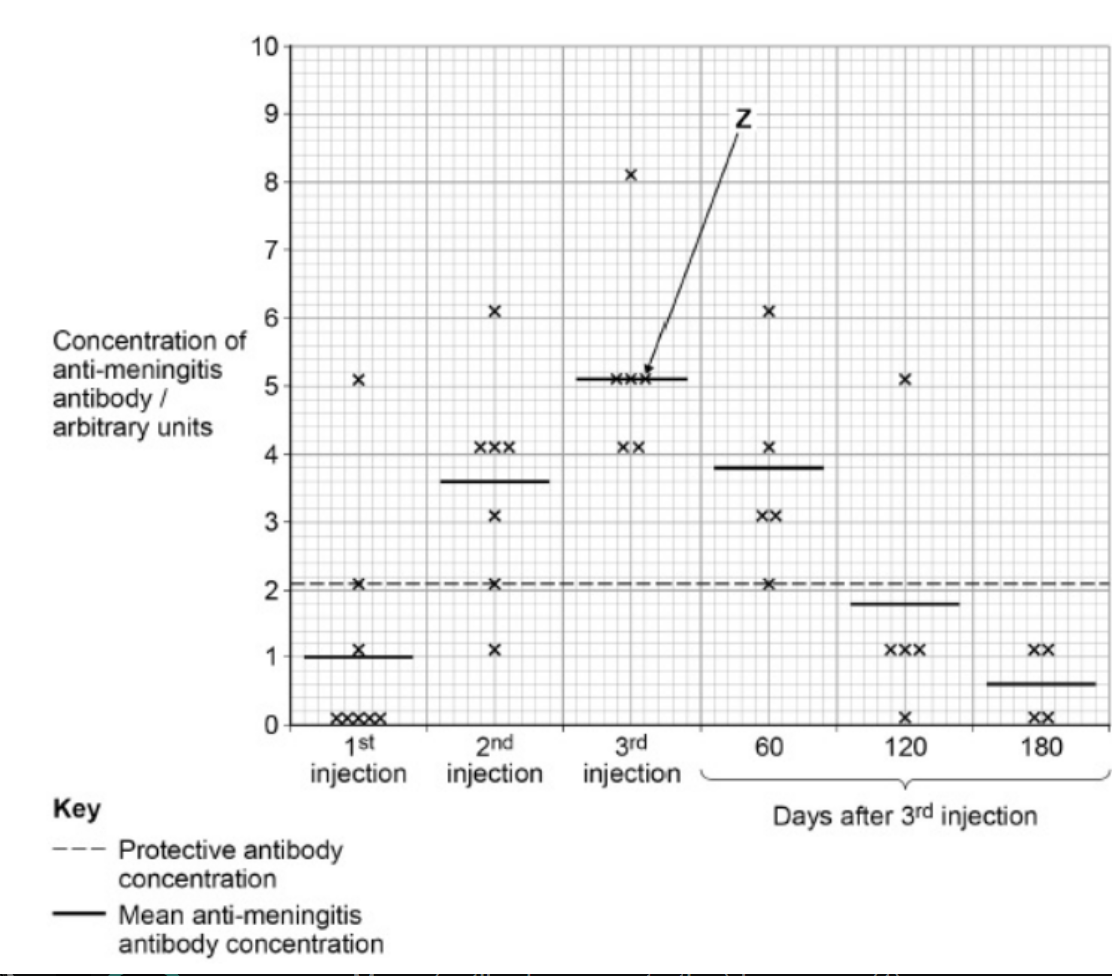
Meningococcus bacteria cause a disease called meningitis. Scientists investigated a new meningitis vaccine (MenG) by measuring changes in blood anti-meningitis antibody concentration in mice.
Each mouse was given three separate MenG injections. The concentration of anti-meningitis antibody was measured in a sample of blood taken soon after each injection.
After the 3rd injection, the concentration of anti-meningitis antibody in the blood was also measured after 60 days, after 120 days and then after 180 days. The graph shows the scientists’ results. Each plotted point on the graph is the result for a different mouse.
Using the graph above, what can you conclude about the effectiveness of each injection on the immune response of these mice? (4)
Mean antibody concentration increases (1)
1st injection protects some mice/1 mouse/2 mice (1)
2nd/3rd injection protects most/all mice (1)
Because antibody at/above protective level/2.1 (1)
Meningococcus bacteria cause a disease called meningitis. Scientists investigated a new meningitis vaccine (MenG) by measuring changes in blood anti-meningitis antibody concentration in mice.
The scientists hypothesised that memory B cells had formed in the mice 180 days after the 3rd injection. Suggest and explain a practical method the scientists could use to test this hypothesis. (2)
Inject vaccine (again)/meningitis antigen/ inactive antigen/dead/living bacteria/ pathogen/use a booster (1)
(Memory cells present if) faster/more rapid production/higher concentration antibody (than 1st injection) (1)
Bacterial meningitis is a potentially fatal disease affecting the membranes around the brain. Neisseria meningitidis (Nm) is a leading cause of bacterial meningitis.
In the UK, children are vaccinated against this disease. Describe how vaccination can lead to protection against bacterial meningitis. (6)
Antigen binds to surface receptor on a (specific/single) T cell (1)
(Activated) T cell releases cytokine (1)
(Cytokine) stimulates production of plasma cells (1)
B cells / plasma cells release antibodies (1)
(Some) B cells become memory cells (1)
Memory cells produce plasma / antibodies faster (1)
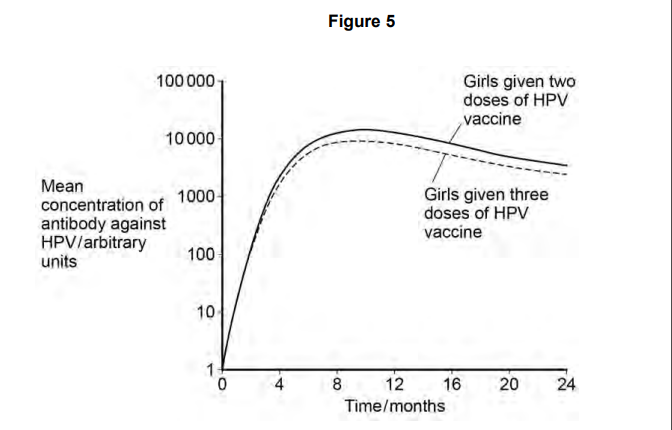
Doctors investigated whether it was better to give two or three doses of the HPV vaccine. They determined the mean concentration of antibody against HPV in blood samples from girls who were given either two or three doses of the vaccine.
• Girls given two doses received an initial vaccination, followed by a second at 6 months.
• Girls given three doses received an initial vaccination, followed by a second at 1 month and a third at 6 months.
The doctors measured the concentration of antibody each month. The results are shown in Figure 5.
What do these results suggest about whether it is better to give two or three doses of the vaccine? Give reasons for your answer. (2)
Two (doses) because got more antibody (1)
Three doses would be more expensive/less popular with parents/girls (1)
The box jellyfish produces a poison which enters the blood when a person is stung. A person who has been stung can be treated with an injection of antivenom. This antivenom is produced by injecting small amounts of venom from box jellyfish into sheep, then extracting antibodies from the sheep's’ blood. These antibodies are then injected into the person who has been stung.
Injecting antivenom does not give a person lasting protection against the venom of box jellyfish. Explain why (2)
Passive immunity, so no memory cells produced (1)
Antivenom breaks down / destroyed (1)
The box jellyfish produces a poison which enters the blood when a person is stung. A person who has been stung can be treated with an injection of antivenom. This antivenom is produced by injecting small amounts of venom from box jellyfish into sheep, then extracting antibodies from the sheep's’ blood. These antibodies are then injected into the person who has been stung.
Suggest one possible problem in injecting people with antivenom made in this year (1)
Could transfer disease / Allergy / Immune response to antibodies from animal (1)
When a person is bitten by a venomous snake, the snake injects a toxin into the person. Antivenom is injected as a treatment. Antivenom contains antibodies against the snake toxin. This treatment is an example of passive immunity. Explain how the treatment with antivenom works and why it is essential to use passive immunity rather than active immunity. (2)
(Antivenom/Passive immunity) antibodies bind to the toxin/venom/antigen and (causes) its destruction(1)
Active immunity would be too slow/slower (1)
To produce antivenom a mixture of venoms from several snakes of the same species is used. Suggest why (2)
May be different forms of antigen/toxin within one species (1)
Different antibodies needed in the antivenom (1)
Explain the role of APCs(Antigen Presenting cells) in cell-mediated immunity (3)
APCs are phagocytic cells that perform phagocytosis (1)
They present specific antigens on their surface (1)
Stimulate T-helper cells which stimulate cytotoxic T-cells to destroy infected cells (1)
What features of the T helper cell allows it to identify specific foreign antigens(2)
Specific receptors that are complementary (1)
to antigen on APC surface (1)
An antigen in a vaccine leads to the production of antibodies. Describe the part played by B lymphocytes in this process (4)
Macrophages present antigens to B lymphocytes (1)
Antigen is complementary to receptors on lymphocyte (1)
B lymphocytes reproduce by mitosis (1)
plasma cells secrete antibodies (1)

The drawing show the changes in a B lymphocyte after stimulation by specific antigens
Explain how the changes shown in the drawings are related to the function of B lymphocytes (4)
Mitochondria provides energy (1)
more ribosomes synthesise proteins (1)
More golgi body modifies proteins (1)
B lymphocytes produces antibodies (1)
Describe how presentation of a virus antigen leads to the secretion of an antibody against the virus antigen (3)
Helper T cell bind to the antigen (on the antigen-presenting cell) (1)
B cell divides by mitosis (1)
Forms plasma cells that release antibodies (1)
What is an antibody (2)
Protein (1)
Specific to antigen (1)
Describe how antibodies are produced in the body following a viral infection (6)
Virus contains antigen (1)
Virus engulfed by phagocyte/macrophage (1)
Presents antigen to B-cell (1)
B-cells/ memory cell becomes activated (1)
divide by mitosis to form clones (1)
plasma cells secrete antibodies (1)
NMO is a disease that leads to damage to nerve cells in the spinal cord. A person with NMO produces anti-AQP4 antibody that attacks only these nerve cells
Explain why the anti-AQP4 antibody only damages these cell(4)
(Anti-AQP4) antibody has a (specific) tertiary structure (1)
Has binding site / variable region that only binds to / complementary to one antigen (1)
Antigen to this antibody (only) found on these nerve cells (1)
So, antibody (only) binds to / forms antigen-antibody complex with these nerve cells (causing damage (1)
Describe how HIV is replicated (4)
Attachment proteins attach to receptors on helper T cell/lymphocyte (1)
Nucleic acid/RNA enters cell /inserted into cell(1)
Reverse transcriptase converts RNA to DNA (1)
Viral protein/capsid/enzymes produced (1)
Virus (particles) assembled and released (from cell) (1) 4 max
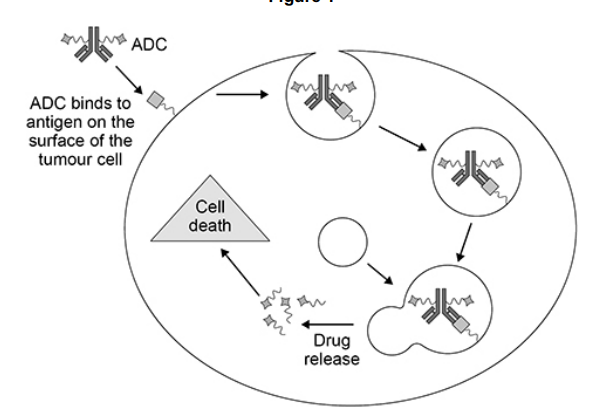
ADCs are molecules made of a monoclonal antibody linked to a cancer drug.
Figure 1 shows how an ADC enters and kills a tumour cell. The process of entering the cell and the breakdown of the antibody to release the drug is very similar to phagocytosis.
Use your knowledge of phagocytosis to describe how an ADC enters and kills the tumour cell.(3)
Cell ingests/engulfs the antibody/ADC (1)
Lysosomes fuse with vesicle/phagosome (containing ADC) (1)
Lysozymes breakdown/digest the antibody/ADC to release the drug (1)
Scientists investigated whether one type of ADC could be used to treat human breast cancer.
This ADC is a monoclonal antibody combined with a drug to inhibit mitosis. The monoclonal antibody binds to a protein found on human breast cancer cells.
The scientists placed small pieces of human breast cancer tissue under the skin of mice.
Suggest and explain two further investigations that should be done before this ADC is tested on human breast cancer patients.(2)
Tested on other mammals to check for safety/side effects (1)
Investigate different concentrations of ADC to find suitable/safe dosage (1)
HIV-1 is the most common type of HIV. HIV-1 binds to a receptor on TH cells called CCR5.
Current treatment for HIV-1 involves the use of daily antiretroviral therapy (ART)
to stop the virus being replicated. Only 59% of HIV-positive individuals have
access to ART.
Scientists have found that two HIV-1-positive patients (P and Q) have gone into
remission (have no detectable HIV-1). This happened after a blood stem cell
transplant (BSCT).
• Patient P was given two BSCTs, and patient Q was given one BSCT.
• All BSCTs came from a donor with TH cells without the CCR5 receptor.
• In addition, patient P had radiotherapy, and patient Q had chemotherapy.
Both of these treatments are toxic.
• Both patients (P and Q) stopped receiving ART 16 months after BSCT.
18 months after stopping ART, both patients had no HIV-1 RNA in their plasma,
no HIV-1 DNA in their TH cells and no CCR5 on their TH cells
Use the information given to evaluate the use of BSCT to treat HIV infections. (5)
For
(There appears to be) no virus/ HIV(-1)/RNA/DNA, so could be a cure/effective (1)
No CCR5/receptor, so nothing for HIV(-1) to bind to (1)
Against
Don’t know if chemotherapy/radiotherapy is needed (1)
Only worked/tried in 2 cases (1)
HIV-1 may mutate and be able to bind to a different receptor (on TH cells) (1)
What is the role of the disulfide bridge in forming the quaternary structure of an antibody? (1)
Joins two (different) polypeptides (1)
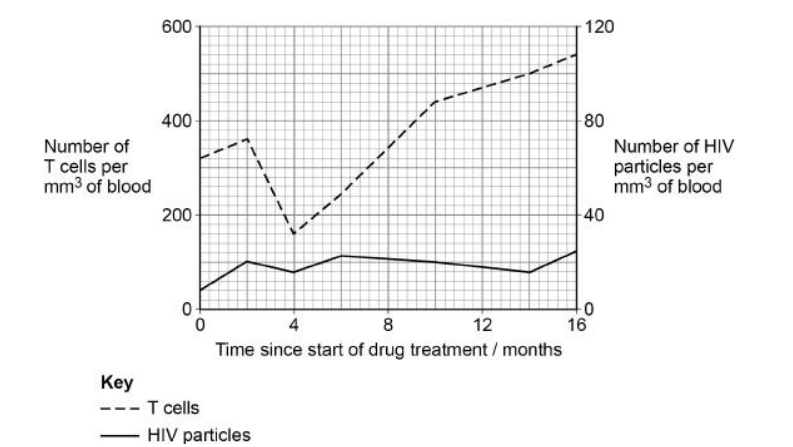
A scientist measured the effect of a drug on the number of T cells and the number of HIV particles in blood taken from a person with AIDS. The results are shown on the graph below
Symptoms of AIDS occur when the number of T cells is below 200 cells mm-3
Use all of this information to evaluate the effectiveness of the drug in treating AIDS. (5)
Not effective in treating AIDS because
Number of T cells < 200 at 4 months (1)
(So) drug is not effective (1)
Does not remove (all) HIV (particles) (1)
No stats test (1)
No control group (1)
Unknown side effects (1)
In Europe, viruses have infected a large number of frogs of different species. The viruses are closely related and all belong to the Ranavirus group. Previously, the viruses infected only one species of frog.
Suggest and explain how the viruses became able to infect other species of frog. (2)
Mutation in the viral DNA/RNA/genome/genetic material (1)
Altered (tertiary structure of the) viral attachment protein (1)
Determining the genome of the viruses could allow scientists to develop a vaccine.
Explain how.(2)
(The scientists) could identify proteins (that derive from the genetic code) (1)
(They) could (then) identify potential antigens (to use in the vaccine)(1)
What is a monoclonal antibody? (1)
(antibody produced from) identical/cloned plasma cells/ B cells/ B lymphocytes (1)
After a disease is diagnosed, monoclonal antibodies are used in some medical treatments. Give one example of using monoclonal antibodies in a medical treatment. (1)
Targets/binds/carries drug/medicine to specific cells/antigens/receptor (1)
Describe the role of antibodies in producing a positive result in an ELISA test. (4)
(First) antibody binds/attaches /complementary (in shape) to antigen (1)
(Second) antibody with enzyme attached is added (1)
(Second) antibody attaches to antigen (1)
(Substrate/solution added) and colour changes (1)
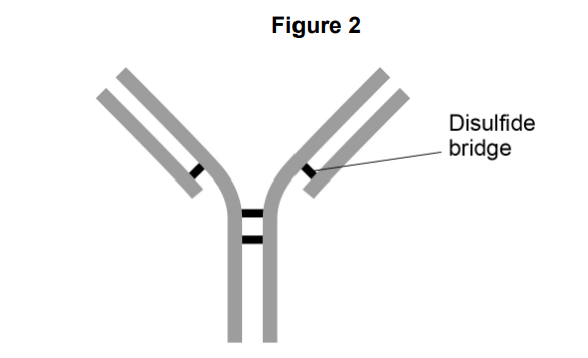
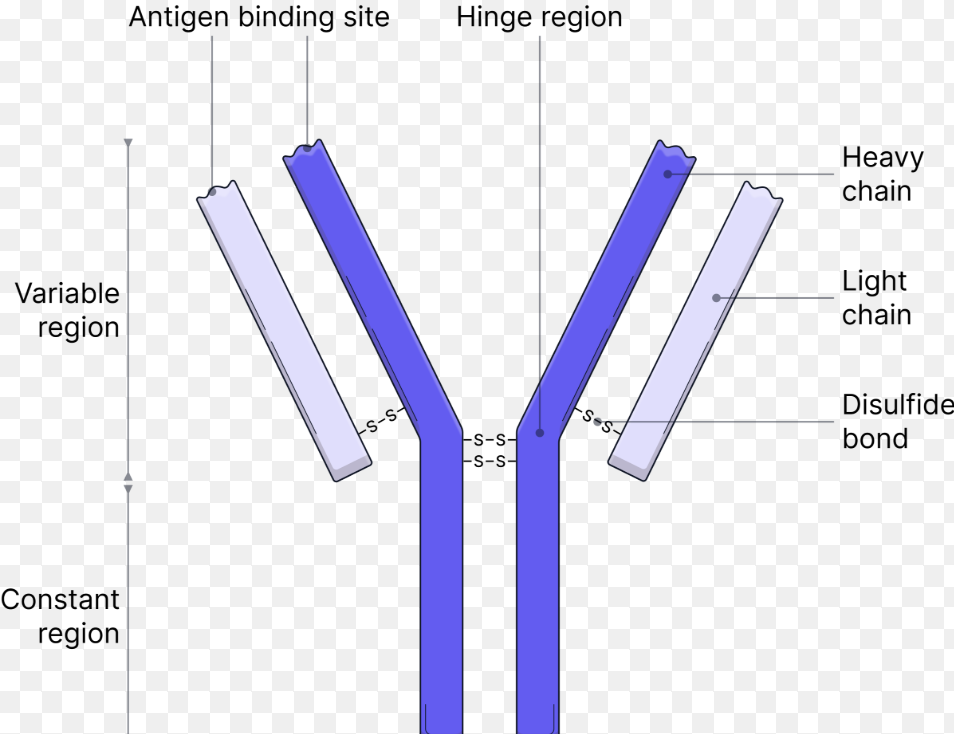
Figure 2 shows the structure of an antibody
Label Figure 2 with an X where the antigen binding site is (1)
X written at either or both ends of Y shape (1)
Penicillin-resistant Staphylococcus aureus (PRSA) bacteria have evolved by natural selection. From 1941, penicillin was used extensively to treat S. aureus infections. The first case of PRSA was reported in 1942. By the late 1960s, more than 80% of S. aureus bacteria were resistant to penicillin. Many antibiotics have a beta-lactam ring in their chemical structure, which inhibits the synthesis of bacterial cell walls. PRSA have an allele of a gene blaZ that codes for an enzyme called beta lactamase. This enzyme hydrolyses beta-lactam rings in antibiotics such as penicillin. The evolution of PRSA resulted in the development of new antibiotics, such as methicillin in 1960. However, by 1961, methicillin-resistant S. aureus (MRSA) were identified. In 2022, 675 cases of MRSA were reported in England. However, in 2023, the number of cases of MRSA rose to 787. Patients in hospitals are at greater risk of MRSA infections than the general population. Use the information in the passage and your own knowledge to answer the following questions.
Many antibiotics have a beta-lactam ring in their chemical structure, which inhibits synthesis of bacterial cell walls (lines 5–6). Suggest two reasons why this makes infections caused by PRSA difficult to treat. (2)
(PRSA) can be resistant to many antibiotics (1)
No new antibiotics in recent years (1)
Penicillin-resistant Staphylococcus aureus (PRSA) bacteria have evolved by natural selection. From 1941, penicillin was used extensively to treat S. aureus infections. The first case of PRSA was reported in 1942. By the late 1960s, more than 80% of S. aureus bacteria were resistant to penicillin. Many antibiotics have a beta-lactam ring in their chemical structure, which inhibits the synthesis of bacterial cell walls. PRSA have an allele of a gene blaZ that codes for an enzyme called beta lactamase. This enzyme hydrolyses beta-lactam rings in antibiotics such as penicillin. The evolution of PRSA resulted in the development of new antibiotics, such as methicillin in 1960. However, by 1961, methicillin-resistant S. aureus (MRSA) were identified. In 2022, 675 cases of MRSA were reported in England. However, in 2023, the number of cases of MRSA rose to 787. Patients in hospitals are at greater risk of MRSA infections than the general population. Use the information in the passage and your own knowledge to answer the following questions.
Patients in hospitals are at greater risk from MRSA infections than the general population (lines 12–13). Suggest and explain two reasons why. (2)
Weaker immune system so more susceptible (1)
More MRSA sufferers so more likely to come into contact with it (1)
Read the following passage.
Herpes simplex virus (HSV) infects nerve cells in the face, including some near the lips. Like many other viruses, HSV can remain inactive inside the body for years. When HSV becomes active, it causes cold sores around the mouth. Human cells infected with a virus may undergo programmed cell death. While HSV is inactive inside the body, only one of its genes is transcribed. This gene is the latency-associated transcript (LAT) gene that prevents programmed cell death of an infected nerve cell. Scientists have found that transcription of the LAT gene produces a microRNA. This microRNA binds to some of the nerve cell’s own mRNA molecules. These mRNA molecules are involved in programmed cell death of nerve cells. The scientists concluded that production of this microRNA allows HSV to remain in the body for years.
HSV can remain inactive inside the body for years (lines 2–3). Explain why this virus can be described as inactive. (2)
Virus is not replicated (1)
No more (nerve) cells injected (1)
Read the following passage.
Herpes simplex virus (HSV) infects nerve cells in the face, including some near the lips. Like many other viruses, HSV can remain inactive inside the body for years. When HSV becomes active, it causes cold sores around the mouth. Human cells infected with a virus may undergo programmed cell death. While HSV is inactive inside the body, only one of its genes is transcribed. This gene is the latency-associated transcript (LAT) gene that prevents programmed cell death of an infected nerve cell. Scientists have found that transcription of the LAT gene produces a microRNA. This microRNA binds to some of the nerve cell’s own mRNA molecules. These mRNA molecules are involved in programmed cell death of nerve cells. The scientists concluded that production of this microRNA allows HSV to remain in the body for years.
Suggest one advantage of programmed cell death (1)
Prevents replication of virus (1)
Read the following passage.
Herpes simplex virus (HSV) infects nerve cells in the face, including some near the lips. Like many other viruses, HSV can remain inactive inside the body for years. When HSV becomes active, it causes cold sores around the mouth. Human cells infected with a virus may undergo programmed cell death. While HSV is inactive inside the body, only one of its genes is transcribed. This gene is the latency-associated transcript (LAT) gene that prevents programmed cell death of an infected nerve cell. Scientists have found that transcription of the LAT gene produces a microRNA. This microRNA binds to some of the nerve cell’s own mRNA molecules. These mRNA molecules are involved in programmed cell death of nerve cells. The scientists concluded that production of this microRNA allows HSV to remain in the body for years.
The scientists concluded that production of this microRNA allows HSV to remain in the body for years.
Explain how this microRNA allows HSV to remain in the body for years (4)
MicroRNA binds to cell’s mRNA
Binds by specific base pairing (1)
prevents mRNA being read by ribosomes(1)
so prevents translation/production of proteins (1)
that cause cell death (1)