CHEM001C_Chemical Bonding
 Call Kai
 Learn
Learn Practice Test
 Spaced Repetition
 Match
Match Flashcards
 Knowt Play
1/16

There's no tags or description
Looks like no tags are added yet.
Name | Mastery | Learn | Test | Matching | Spaced | Call with Kai | Chat |
|---|
No analytics yet
Send a link to your students to track their progress
17 Terms
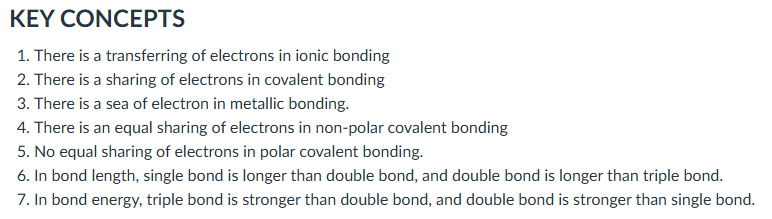
Chemical Bond
Attractive force between two atoms holding them together to form a molecule or a chemical compound.
Forces that link together atoms to form different kinds of matter.
Valence Electrons
Electrons located in the outermost energy level.
Plays a crucial role in formation of chemical bonds.
Duet Rule
states that hydrogen and helium may have no more than two electrons in their valence shells.
Octet Rule
In forming chemical bonds, main group elements gain, lose , or share electrons to achieve configuration in which they are surrounded by eight valence electrons.
Ionic Bond
there is an electron transfer between two atoms
metal with non-metal
the positively charged ion (cation) is attracted to negatively charged ion (anion).
(Na-Cl, Ba-Cl, Na-O)
Covalent Bond
formed by a shared pair of electrons between two atoms.
chemical bond formed when valence electrons are shared by nonmetal elements
(CO, CO2, CH4)
Polar Covalent Bond
Type of chemical bond where a pair of electrons is unequally shared between two atoms.
Non-polar Covalent Bond
A bond that has an even distribution of charge due to an equal sharing of bonding electrons.
Types of Covalent Bonds
due to difference in electronegativity of atoms
if the electronegativity difference is zero, the bond is classified as nonpolar covalent
the greater the electronegativity difference, the more polar the bond
when the electronegativity difference greater than or equal to 2.0, the bond is classified as ionic
Metallic Bond
"sea of electrons"
Positively charged metal nuclei arranged in a lattice.
Electrons move, more or less, freely throughout the whole lattice.
Free movement allows metals to conduct electricity
Single Bond
[TYPES OF BONDS] Two atoms share exactly one pair of electrons.
![<p><span>[</span><strong>TYPES OF BONDS] </strong><span>Two atoms share exactly one pair of electrons.</span></p>](https://assets.knowt.com/user-attachments/9eebedb8-69fd-4dae-ba5c-51877841808c.png)
Double Bond
[TYPES OF BONDS] Consists of two pairs of shared electrons.
![<p>[<strong>TYPES OF BONDS] </strong><span>Consists of two pairs of shared electrons.</span></p>](https://assets.knowt.com/user-attachments/0b673fb9-a122-47bb-88a3-efd6efc81aff.png)
Triple Bond
[TYPES OF BONDS] Consists of three pairs of shared electrons.
![<p>[<strong>TYPES OF BONDS] </strong>Consists of three pairs of shared electrons.</p>](https://assets.knowt.com/user-attachments/9ec69d08-3047-401f-beef-a15dfddd643f.png)
Bond Length
The distance between the nuclei of the bonded atoms.
Single bond is longer than double bond, and double bond is longer than triple bond.
Bond Order
The number of electron pairs shared between two atoms in the formation of the bond.
Single Bond: Bond order = 1
Double Bond: Bond order = 2
Triple Bond: Bond order = 3
Bond Energy
The energy released when isolated atoms form a covalent bond.
The amount of energy required to break a bond (Bond dissociation energy).
The larger the bond energy, the stronger the bond.
Triple bond is stronger than double bond, and double bond is stronger than single bond.

Ok