DNA Ligation Protocol
 Call Kai
 Learn
Learn Practice Test
 Spaced Repetition
 Match
Match Flashcards
 Knowt Play
1/9

There's no tags or description
Looks like no tags are added yet.
Name | Mastery | Learn | Test | Matching | Spaced | Call with Kai |
|---|
No analytics yet
Send a link to your students to track their progress
10 Terms
Material Provided
0.5 U/µl T4 DNA igase
10x T4 DNA ligase buffer
restriction digested vector DNA
restriction digested PCR/insert DNA
Step 1
thaw T4 DNA ligase buffer at room temp
assure that all precipitates are re-dissolved prior to use
Step 2
calculate DNA concentrations and molar ratios for optimal reaction
we pre reactions of 1:0, 1:1 and 1:3 ratios of plasmid:insert
Step 3
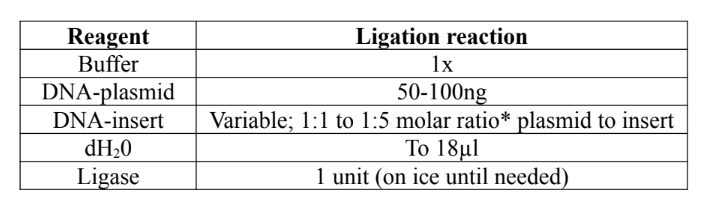
at room temp, assemble 20µl ligation reactions by adding reagents in the order of the figure
include a no-insert negative control reaction, substituting dH2O for insert DNA
Step 4
Incubate the reaction at room temp for 15 mins
Theory
Molar Ratio
the ratio of the number of one type of molecule to another
in this case, the ratio of number of plasmid molecules to insert molecuels
the ratio of plasmid:insert can affect ligation success, but the optimal ratio can’t be determined ahead of time, so a number of ligation reactions w/ variable ratios are set up
since both molecules are DNA, are are relatively long, the molecular mass of each molecule is directly related to their length
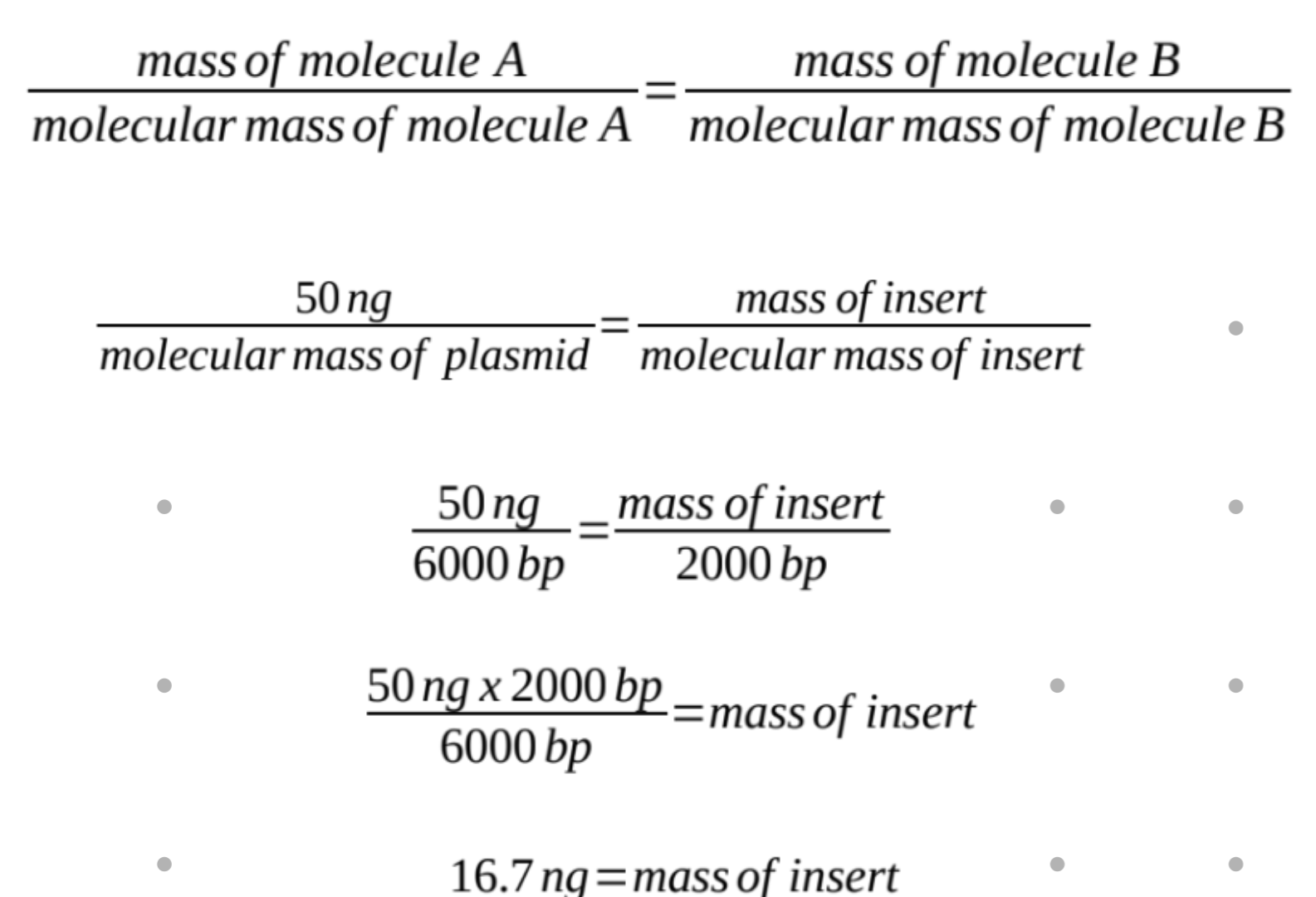
in the formula, we can substitute molecular mass for bp
Molar Ratio Example Calculation
here we’re setting up a 1:1 molar ratio, using 50 ng of cut plasmid
Ligase Enzyme
natural function is to repair double-strand breaks in genomic DNA
formation of two covalent bonds: phosphodiester bonds between 3’ OH of one nucleotide, with the 5’ phosphate end of another nucleotide
reaction is ATP-dependent
Sticky Ends
sticky ends can be more efficiently ligated than blunt ends
where complementary overhangs are generated, the nucleotide polymers are held in place by H-bonds, which allows DNA ligase to function more efficiently in joining the strands
most commonly used ligase is T4 ligase, derived from a bacteriophage. Works best at 25ºC but will function at lower which may promote the complementation of sticky DNA ends