L12 - The Electron Transport Chain
 Call Kai
 Learn
Learn Practice Test
 Spaced Repetition
 Match
Match Flashcards
 Knowt Play
1/27

There's no tags or description
Looks like no tags are added yet.
Name | Mastery | Learn | Test | Matching | Spaced | Call with Kai | Chat |
|---|
No analytics yet
Send a link to your students to track their progress
28 Terms
Outer membrane of mitochondria allows
small molecules and ions to pass and is freely permeable
Inner membrane of mitochondria is impermeable to
most small molecules and ions
Inner membrane space is between
inner membrane and outer membrane
Inside inner membrane is the
matrix
Inner membrane have integral membrane proteins for
ETC and transport proteins
Energy is transduced and captured through
electron transport
More negative reducing potential (greater tendency to donate electrons) drives the electron transport to
more positive reducing potential (greater tendency to accept electrons)
ΔE =
acceptor - donor
ΔG =
-nFΔE
Hydrolysis of ATP has a high negative ΔG and is ___________ than the synthesis of ATP
7x more energy
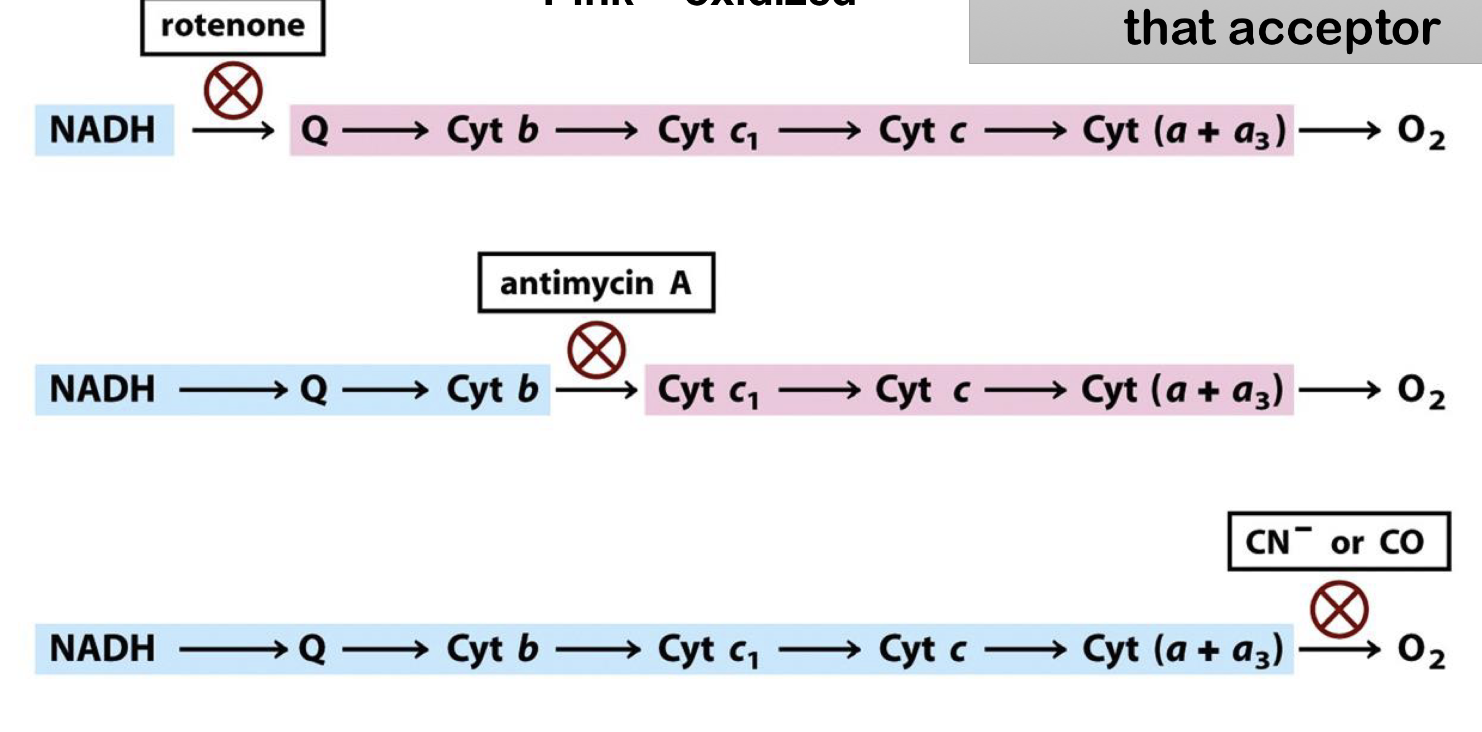
Inhibitors are used to determine sequence events of
electron transfer
NADH is reduced form of
NAD+
FADH2 is fully reduced from of
FAD
FAD and FMN accept electrons
one at a time
Heme are
iron containing porphyrin ring
Hemes are part of
cytochrome
Cytochrome is an
electron carrier and has three classes a, b, and c; Fe3+ or Fe2+ depending on whether it’s being oxidized or reduced
Ubiquinone (CoQ/Q) is a
lipid-soluble benzoquinone that has a long hydrocarbon change and freely diffuses in the inner mitochondrial membrane. Can accept one or two electrons (semiquinone).
Q is fully
oxidized
QH is
semiquinone
QH2 is fully
reduced - ubiquinol
Iron sulfur centers participates in
one electron transfer
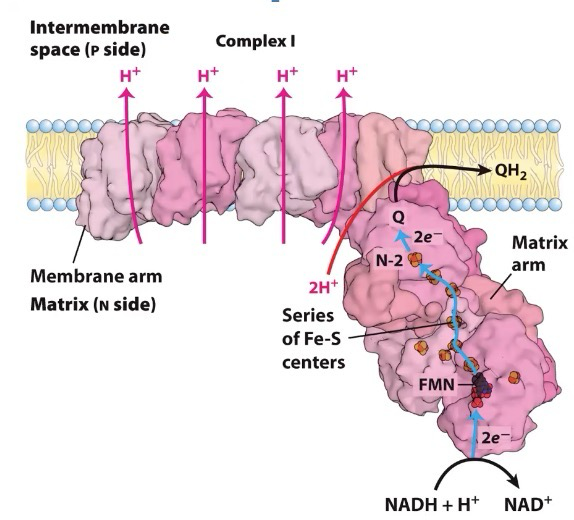
Complex 1 (ubiquinone oxidyl reductase/NADH dehydrogenase)
Large L shape enzyme
Firmly embedded in the inner membrane (integral)
Catalyzes NADH + H+ + Q → NAD+ and QH2
FMN accepts 2e- from NADH + H+
Pumps protons from matrix (n) to intermembrane space (p)
Creating a proton gradient which creates potential energy
Series of Fe-S centers accepts electrons
Complex 2
Succinate dehydrogenase converts FAD to FADH2 (Recall TCA)
Not pumping protons
CoQ accepts electrons from complex two and is reduced to QH2
Series of Fe-S centers accepts electrons
FAD has less energy than NADH

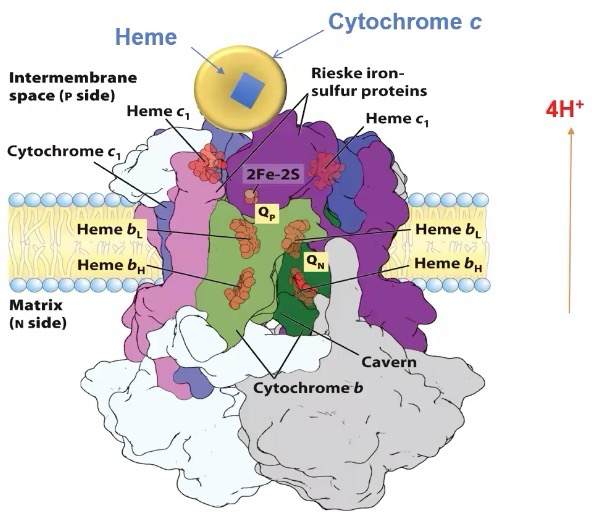
Complex 3
QH2 oxidized
Proton pumping
Iron sulfur centers and cytochromes pass around electrons to cytochrome c where QH2 → Q
Cytochrome C is mobile and is an electron acceptor/carrier
Cytochromes present b and c
Cytochrome C - soluble peripheral protein of intermembrane space
Complex 4
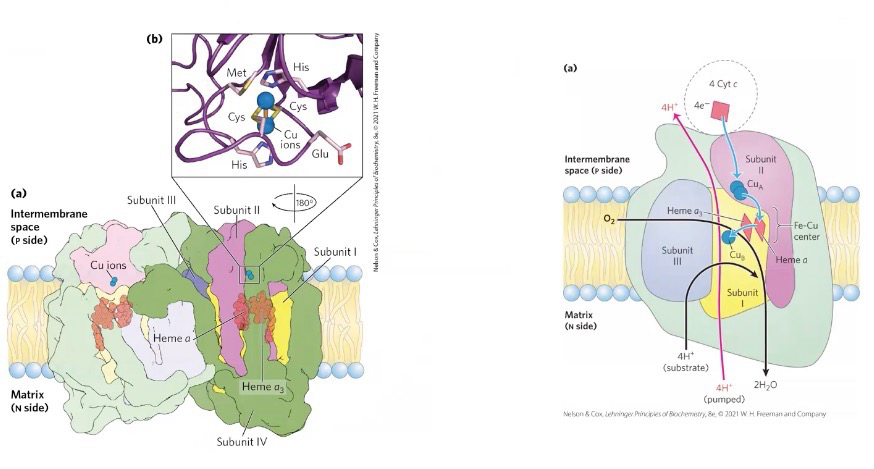
Cytochrome C in reduced form transfers electrons into complex four
Large dimeric
3 subunits
Contains Heme a and Heme a3
Passes electrons from a series of Hemes, O2 accepts electrons, makes water
Pumps protons
Cyanide (CN-) inhibits
ETC Net Equation and summary
Electrons from NADH pass Complex I to CoQ, Succinate dehydrogenase on Complex II also pass electrons to CoQ. This is all passed through Complex III, then CytC, and lastly through Complex IV, where O2 accepts and turns into water. Complex I, III, and IV facilitate H+ pumping to P side.
Net eq: 2 NADH + 22H+N + O2 → 2 NAD+ + 20H+P + 2H2O
22H on mitochondrial (N/negative) side is either pumped to intermembrane space (P/positive) or converted to water

Inhibitors of ETC Complexes
Rotenone: Complex I
Antimycin A: Complex III
CN- or CO: Complex IV