Skeletal muscle vs smooth muscle contraction
 Call Kai
 Learn
Learn Practice Test
 Spaced Repetition
 Match
Match Flashcards
 Knowt Play
1/18

There's no tags or description
Looks like no tags are added yet.
Name | Mastery | Learn | Test | Matching | Spaced | Call with Kai |
|---|
No analytics yet
Send a link to your students to track their progress
19 Terms
Where is smooth muscle found?
along the walls of hollow organs (blood vessels, bronchioles, digestive tract, etc)
Which system controls smooth muscle?
autonomic nervous system (not somatic motor)
Smooth muscle cell contraction is “graded” or has a range of lengths
Not “all or nothing” like the contraction of skeletal muscle cells
The more calcium that influxes, the more forceful the smooth muscle contraction
A twitch is smooth muscle is much (faster/slower) than skeletal muscles and requires less ATP
slower!
so smooth muscle cells are largely fatigue resistant
Contractile proteins are not arranged into sarcomeres in smooth muscle, and these proteins are cued into action by electrical or chemical signals or both
Contraction is cues by a more complicated cascade of reactions (similar to a G-protein coupled receptor cascade)
Smooth muscle lacks specialized receptor regions like the motor endplates on skeletal muscle cells
Receptors are scattered all over smooth muscle cell membranes and receive neurotransmitter from nearby varicosities
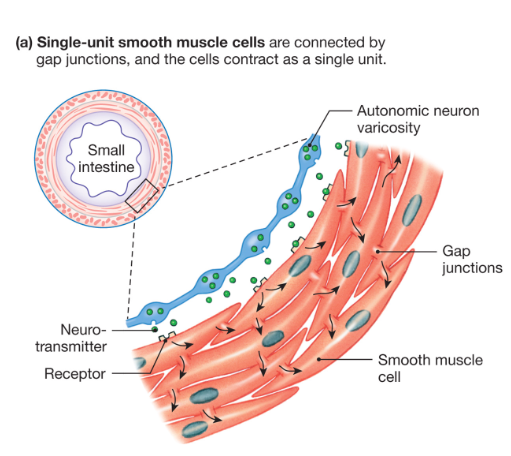
Notice shape of smooth muscle cells, where on hollow organs they are positioned, receptors, all over surface, control by autonomic varicosities, etc
smooth muscle cells can also be connected via gap junctions
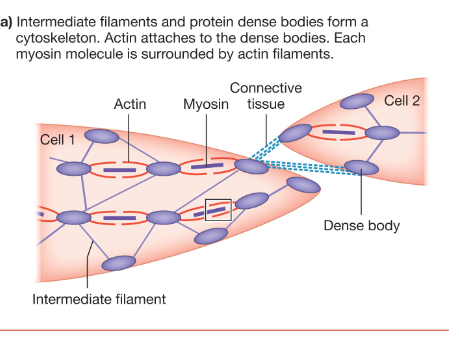
Notice that myosin and actin are present, but there are no repeating sarcomeres
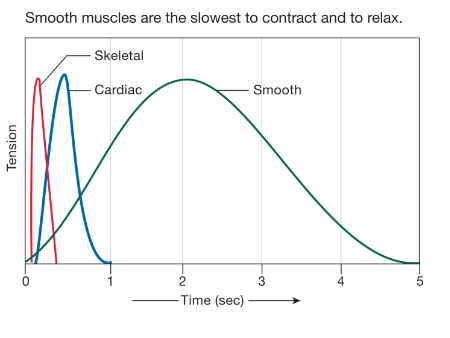
A muscle “twitch” is one contraction and relaxation cycle
notice the difference in twitch speed for a skeletal and smooth muscle cell
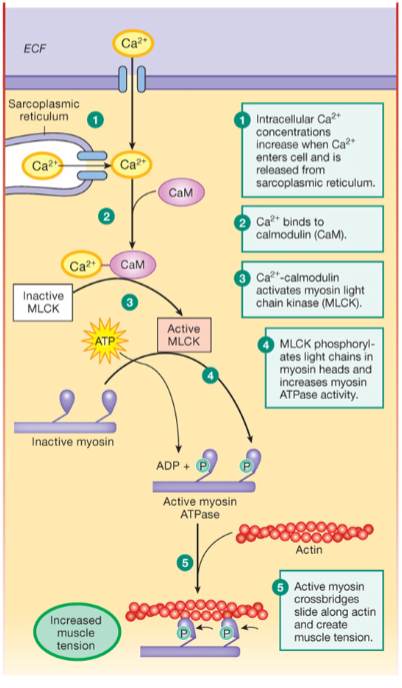
The events that lead to contraction!
Electrical and/or chemical signal allows Ca++ to enter from ECF, which stimulates Ca++ release from the SR
→ this is called “calcium-induced calcium release”
Ca++ activates calmodulin
Calmodulin activates myosin light chain kinase (MLCK)
MLCK phosphorylates myosin, myosin ATPase activity then increases, and tension is produced via power stroking in much the same way as in skeletal muscle
→ the lumen of a hollow organ will now constrict (decrease in diameter)
Events that lead to contraction pt 2
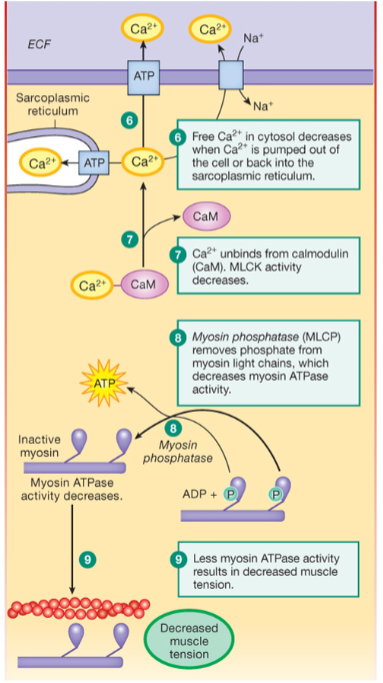
When stimulation of smooth muscle ceases, Ca++ is pumped back into ECF and also into the sarcoplasmic reticulum
Activated calmodulin and MLCK levels fall
Activity of myosin light chain phosphatase (MLCP) INCREASES
→ it will dephosphorylate myosin…
→ Myosin ATPase activity then decreases
Smooth muscle relaxes due to less power stroking
→ the lumen of the hollow organ will now dilate (increase in diameter)
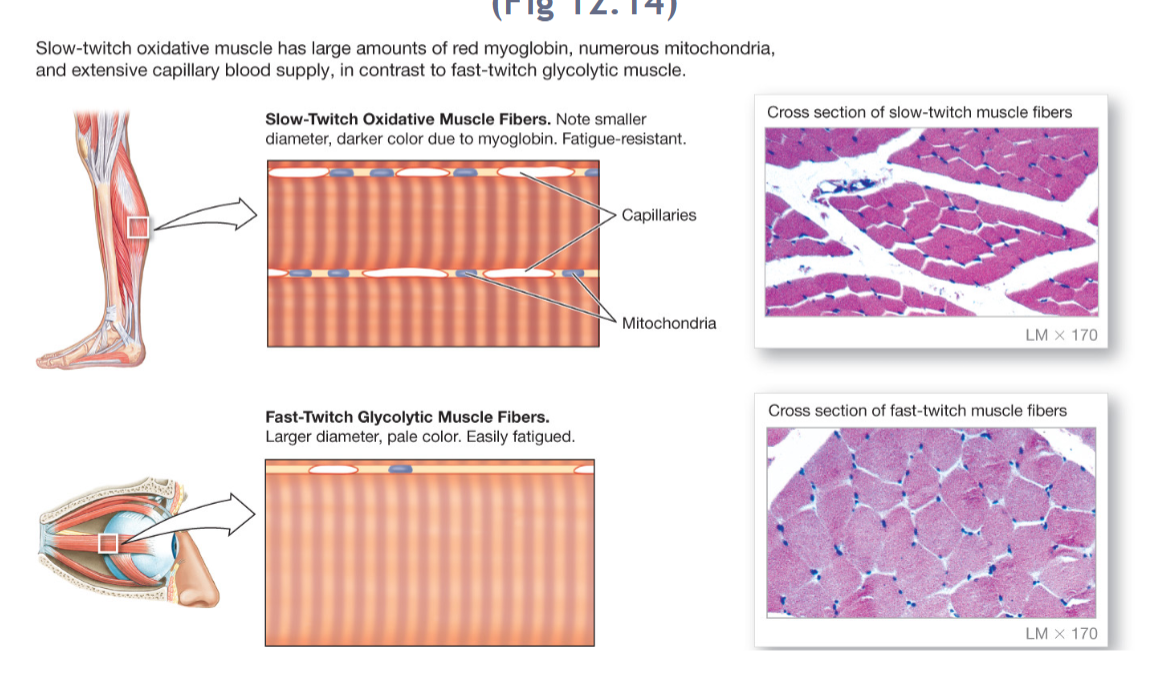
Skeletal muscle fiber types: they’re not all created equal
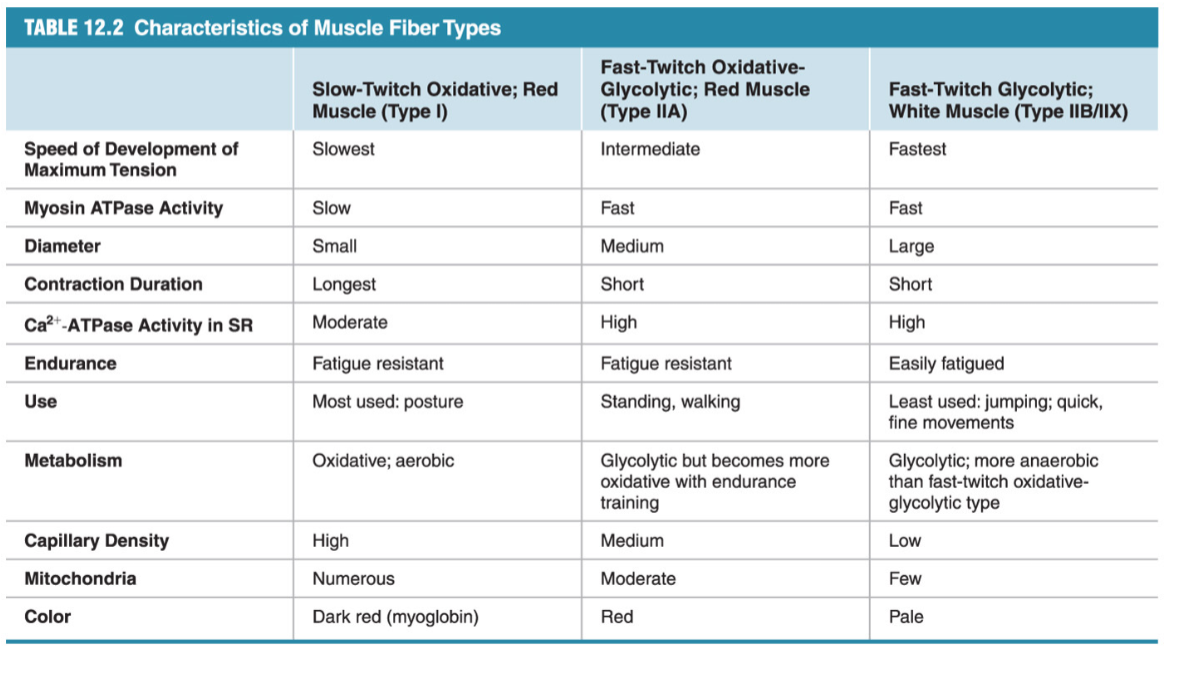
Which one contracts the slowest?
Slow-twitch oxidative
Fast-twitch oxidative-glycolytic
Fast-twitch glycolytic
Which has the most glycogen stored in it?
HINT: what IS glycogen? A long chain of what monomers?
HINT: which energy apthways would be used to break that monomer down for ATP production?
Slow-twitch oxidative
Fast-twitch oxidative-glycolytic
Fast-twitch glycolytic
Which one would be considered the most “aerobic”
HINT: what intracellular organelle must be plentiful to support that?
Slow-twitch oxidative
Fast-twitch oxidative-glycolytic
Fast-twitch glycolytic
Which one produces the most lactic acid
HINT: do you remember the energy pathway associated with that molecule?
Slow-twitch oxidative
Fast-twitch oxidative-glycolytic
Fast-twitch glycolytic
Which one has the most myoglobin?
Slow-twitch oxidative
Fast-twitch oxidative-glycolytic
Fast-twitch glycolytic
Which one has the most capillaries around it?
Slow-twitch oxidative
Fast-twitch oxidative-glycolytic
Fast-twitch glycolytic

