Intro to learning & training
 Studied by 0 people
 Call Kai
 Learn
Learn Practice Test
 Spaced Repetition
 Match
Match Flashcards
 Knowt Play
1/28

There's no tags or description
Looks like no tags are added yet.
Name | Mastery | Learn | Test | Matching | Spaced |
|---|
No study sessions yet.
29 Terms
what is dominance
= relationship between individual animals, established by force/aggression and submission
what does dominane determine
determine the access to resources
issues with dominance based training techniques
can lead to
increased fear
escalated aggression
breakdown of human-animal bond
poor welfare
(T/F) Most behavioral problems are due to dominance.
False. NOT an explanation for most behaviour problems, most relate to anxiety, fear or inadvertent reinforcement
define learning
the process of acquiring new knowledge through experience
how does learning occur?
learn by association (i.e. pairing/predicting) and consequences (good outcome - repeat vs. bad outcome - avoid)
what are the 3 main types of learning
associative learning
non-associative learning
innate behavior
what are innate behaivors
Behaviors that are inherited and performed correctly the first time without prior experience or practice.
what are the 2 types of associative learning
classical conditioning
operant conditional (instrumental learning)
what are the 2 types of non-associative learnig
habituation
densensitization/sensitization
what is associative learning
= animal learns that different properties of the environment, or different stimuli, are associated. then the next time the same stimuli appears, the animal modifies its behavioral responses accordingly.
(i.e. when ‘x’ happens, ‘y’ also happens)
classical conditioning vs operant conditioning
classical = Learning new associations between a stimulus & an innate response (e.g. salivating when smelling food) - also called Pavlovian conditioning)
operant = Learning associations between learned behaviors and outcomes.
what do the following abbreviations refer to regarding classical conditioning? - CS US CR UR
CS = conditioned stimulus
US = unconditioned stimulus
CR = conditioned response
UR = unconditioned response
explains how classicial condition works using these terms: CS US CR UR
natural behavior: US produces UR (food → salivation)
animal associates CS with US (bell+food → salivation)
end when CS produces CR (bell → salivation)
in this case US = food, UR = salivation with food, CS = bell, CR = salivation with bell
Using training puppy to defecate in a specific location as an example to explain how classicial conditioning works
US = full stomach
UR/CR = gastrocolic reflex/increased motility = defecate
CS = location
what is operant conditioning also called?
instrumental learning
trial and error
what does operant conditioning depend on?
consequences affects future behavior - likelihood of repeating behavior is affected by outcome of current behavior
(e.g. hand on stovetop = hot pain/burn = less likely to do again)
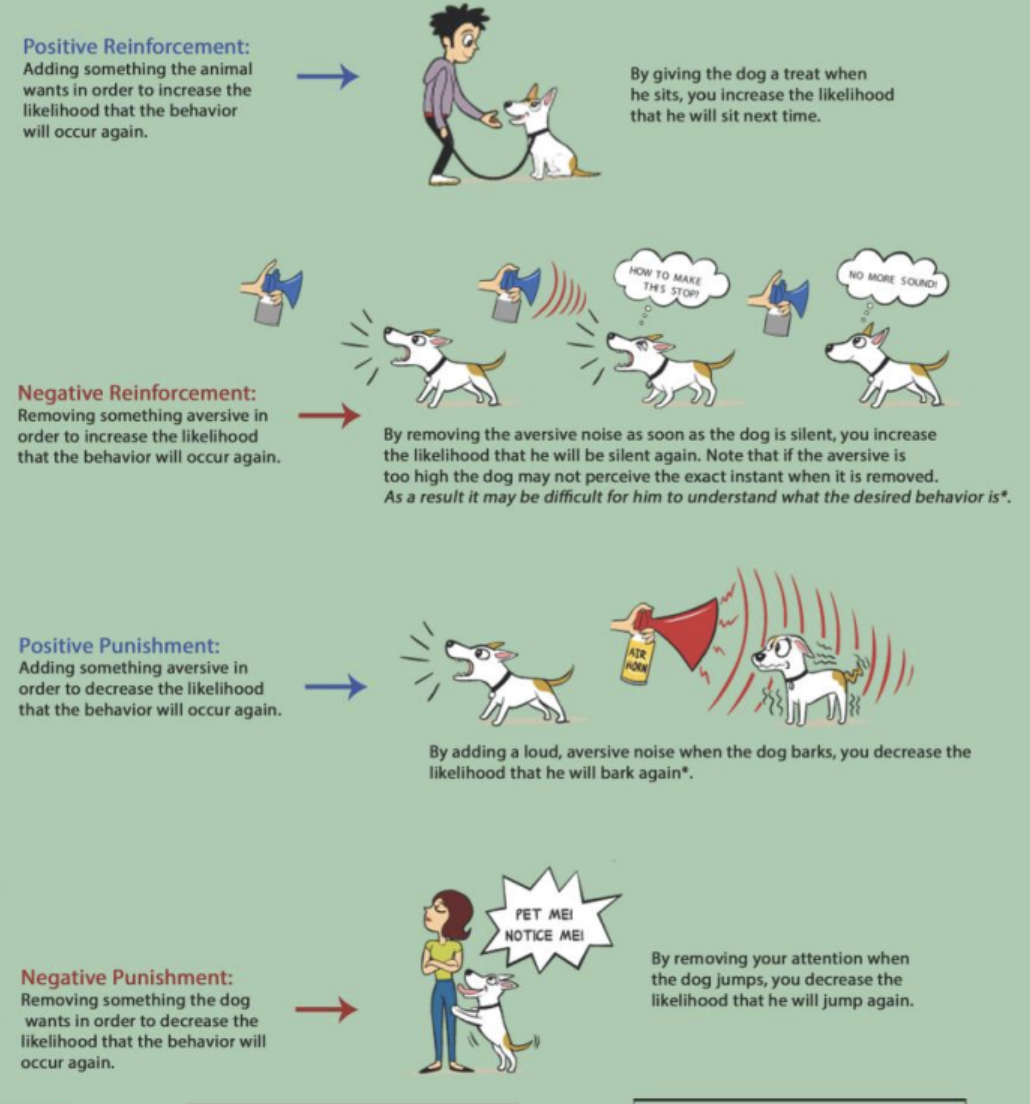
reinforcement vs punishment in operant conditioning
reinforcement: more likely to repeat behavior
punishment: less likely to repeat behavior
what are the 4 types of operant conditioning methods
Pos. reinforcement = present stimulus, more behavior
Negative reinforcement = removal stimulus, more behavior
Positive punishment = present stimulus, less behavior
Neg punishment = remove stimulus, less behavior
what are 4 things that make a reinforcement effective
delivered immediately
appropriate
of value to the animal (desirable by the animal)
contingent on behavior
what should a reinforcement schedule be like?
Continuous (1:1) when teaching new behaviour
Intermittent variable (not fixed ratio or time interval) to maintain behaviour and resist extinction
Bonus rewards for great responses
what are some possible issues with aversive techniques (Negative Reinforcement, Positive Punishment)
Difficult to get timing right
Difficult to get appropriate level of aversiveness
Can intensify anxiety/fear
Can lead to or escalate aggression
May mask aggression warning signs
Associated context (person, animals)
May not teach alternate, desired behaviour
how does sensitisation work?
increase in sensitivity to a stimulus
more reactive to lower level stimulus as sensitivity increases
how does habituation work?
waning of a response as a result of repeated stimulation (not followed by any kind of reinforcement specific to the stimulus)
simply drop responses rather than changing or adding them
what are the 2 types of habituation levels?
desensitization = exposed to stimulus from distance, or weakened stimulus. gradually increase strength as animal gets used to the low-level stimulus (cannot use unless can control stimulus)
flooding = exposed to full force stimulus. (if animal fearful, flooding can be sensitive)
what is the goal of counter-conditioning
to change the emotional/physiological response to a stimulus or to train an alternate incompatible behavio
how is counter-conditioning different from habituation
positive response as its goal
vs. desensitisation achieves a neutral response to the stimuli
classical counter-conditioning vs. operant counter-conditioning
classical: condition a new association. usually combined with desensitization (associate blowing in face w/ treats to reduce aggression, or teaching dog to associate treat with loud noise)
operant: train an alternate, incompatible behaivor (trainining dog to go thru obedience exercise when seeing other dogs so that it is distracted and doesn’t bark back at other dogs)
Give 5 examples of general principles that we should follow when training an animal
clear goals & steps
timing & consistency
1:1 reward to cue initially to learn, then variable intermittent to maintain
short, frequent lessons - to enhance learning & memory response
clarity of cues/signals
value of reinforcer to animal
finish session on reward