JOINTS
 Note
Note Call Kai
 Learn
Learn Practice Test
 Spaced Repetition
 Match
Match Flashcards
 Knowt Play
1/48

There's no tags or description
Looks like no tags are added yet.
Name | Mastery | Learn | Test | Matching | Spaced | Call with Kai | Chat |
|---|
No analytics yet
Send a link to your students to track their progress
49 Terms
2 points
all skeletal muscles connect to at least ________
muscle origin
connects to less moveable of two bones
muscle insertion
connects to more movable bone
movement
when the muscle insertion is brought to the muscle origin
synarthrotic
joints don’t move
amphiarthrotic
joints have slight movement
diarthrotic
joints have full movement
fibrous joints
dense connective tissue, these joints lie between bones that closely contact one another
a thin layer of dense CT joins the bones
examples are sutures, where there is little movement (synarthrotic)
some joints have limited movement like the joint beteen distal ends of the tibia and fibula
fibrous joints
generally synarthrotic/maybe amphiarthrotic
fibrous joints
sutures, joints between tibia and fibula
cartilaginous joints
made up of hyaline cartilage or fibrocartilage tissue
joints of this type separate the vertebrae, known as intervertebral disc
allow limited movement (amphiarthrotic) due to the slight flexibility of the tissue
cartilaginous joints
examples are intervertebral discs
cartilaginous joints
allow amphiarthrotic movement
synovial joints
most common kind
made up of __________ fluid
generally diarthrotic
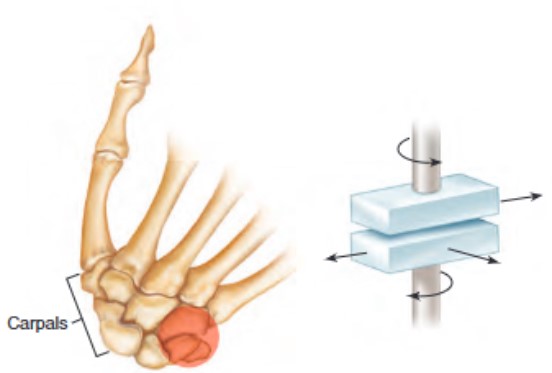
plane joints
sliding and twisting movements
articulating surfaces are flat/slightly curved
found in the wrist/ankle + in the articular processes of adjacent vertebrae
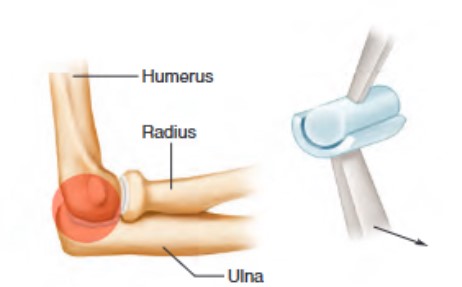
hinge joints
flexion + extension movements
convex surface of bone bone fits into the concave surface of another
found in elbow and joints of phalanges
uniaxial
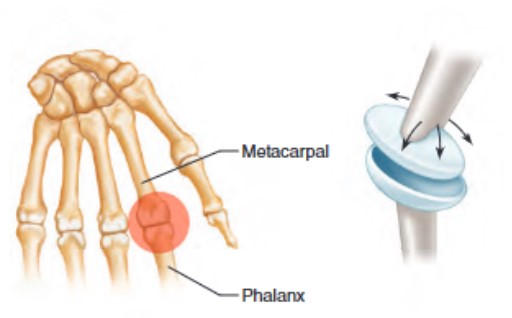
condylar joints
movement in 2 planes only + no rotation
also known as ellipsoidal joint, the ovoid condyle of one bone fits into the elliptical cavity of another bone
example is the joint between metacarpals and phalanges
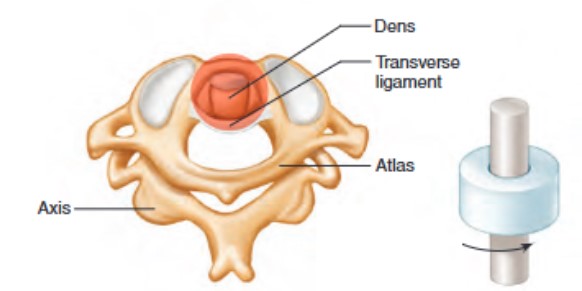
pivot joint
rotation around central axis
also known as trochoid joint, the cylindrical surface of one bone rotates within a ring formed of bone/ligament
only rotation around central axis
helps you twist your body
joints between the atlas and the dens of the axis is of this type
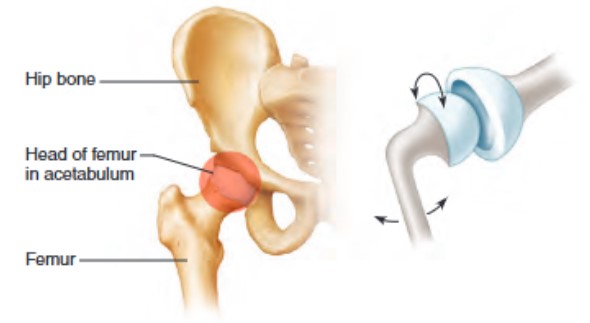
ball/socket joint
movement in all planes + rotation
also known as spheroidal joint, consists of a bone with a egg-shaped end that articulates with cup-shaped cavity of another bone
movement in all planes — multiaxial + rotational movement around a central axis
shoulder and hips are examples of these joints
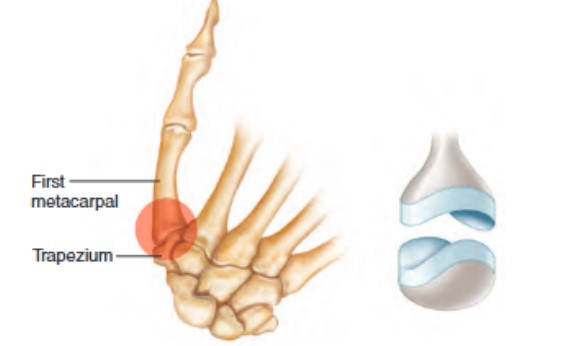
saddle joint
2 planes + some variable movement
also known as sellar joint, this joint forms between bones whos articulating surfaces have both concave and convex regions
the surface of one bone fits the complementary surface of the other
joints between a carpal (trapezium) and metacarpal of the thumb
fibrous capsule
outside fluid of joint, near ligaments
synovial membrane
membrane of fluid cushioning the joint
synovial fluid
fluid cushioning the joint
joint cavity
filled with synovial fluid
articular cartilage
structure found at epiphysis of bone
joint (also known as articular) capsule
made up of fibrous capsule and synovial membrane, mostly made up of dense connective tissue + filled with an inner lining at synovial membrane —> the synovial membrane secretes synovial fluid
ligaments
strengthen and hold joints together
meniscus
C-shaped piece of tough, rubbery cartilage, acts as a shock absorber between femur and tibia
usually between articulating surfaces of the bone
suprapatellar bursa
bursa above your knee joint, provide cushioning and reduce friction
prepatellar bursa
bursa in front of your knee joint, reduces friction between patella and skin
infrapatellar bursa
bursa below your knee joint, reduce friction between patellar ligament and overlying skin
bursa
fluid-filled sacs, line with synovial membranes, commonly located between tendons and underlying bony prominences
aid movement of tendons that glide over bony parts
flexion
bending parts at a joint so that the angle between them decreases
extension
moving parts at a joint so that the angle between them increases
dorsiflexion
movement at the ankle that brings the foot closer to the shin, flex
plantar flexion
movement at the ankle that brings the foot farther from the shin, pointing your toe
hyperextension
abnormal extension beyond the normal range of motion
abduction
moving away from the midline
adduction
moving towards the midline
rotation
moving a part around an axis
circumduction
moving a part so that its end follows a circular path
pronation
rotation of the forearm so that the palm is facing downward in anatomical position
supination
rotation of the forearm so that the palm is facing upward
inversion
turning the foot so that it sickles
eversion
turning the foot so that its winged, turned out laterally
retraction
moving a part backward
protraction
moving a part forward
elevation
raising a part like shrugging the shoulders
depression
lowering a part, like drooping or sagging the shoulders